
飞天茅台(53度/500ml)

Search documents
春节临近 白酒市场再现价格异动
Nan Fang Du Shi Bao· 2026-02-05 23:15
Core Viewpoint - The white liquor market is experiencing price fluctuations as the Spring Festival approaches, with Moutai's prices rising and various brands engaging in aggressive promotional activities, leading to a complex interplay of supply control and demand stimulation in the industry [4][5][9]. Price Movements - Moutai's wholesale price has increased, with some distributors predicting it could reach 2000 yuan per bottle before the festival. The average retail price for Moutai (500ml/53 degrees) was reported at 1843.38 yuan per bottle as of January 30, up from 1600 yuan in December, marking a 15.6% increase [5][9]. - The price of Wuliangye (500ml/52 degrees) has seen a slight decline, with an average retail price of 874.75 yuan per bottle as of January 30, indicating a downward trend [7]. Promotional Activities - Major liquor brands are launching extensive promotional campaigns, including cash rewards and limited edition gifts, to boost sales during the festive season. For instance, Wuliangye's promotional activities include a gift card worth up to 5000 yuan and a limited edition gift box priced at 1599 yuan [7][8]. - Other brands like Fenjiu and Guojiao 1573 are also offering similar incentives, such as cash prizes and gold jewelry, to attract consumers [8]. Market Dynamics - There is a divergence in market expectations regarding sales performance during the Spring Festival. Some distributors are optimistic about sales, while others report a decline in year-on-year sales, indicating a cautious approach to inventory management [9][11]. - Analysts suggest that the overall market is characterized by a "strong at both ends, weak in the middle" dynamic, where high-end brands like Moutai and Wuliangye maintain stable inventory levels, while mid-tier and regional brands face inventory pressures [11].



贵州茅台罕见暴涨!白酒股大面积涨停!“拐点”真的来了?
Nan Fang Du Shi Bao· 2026-01-29 08:57
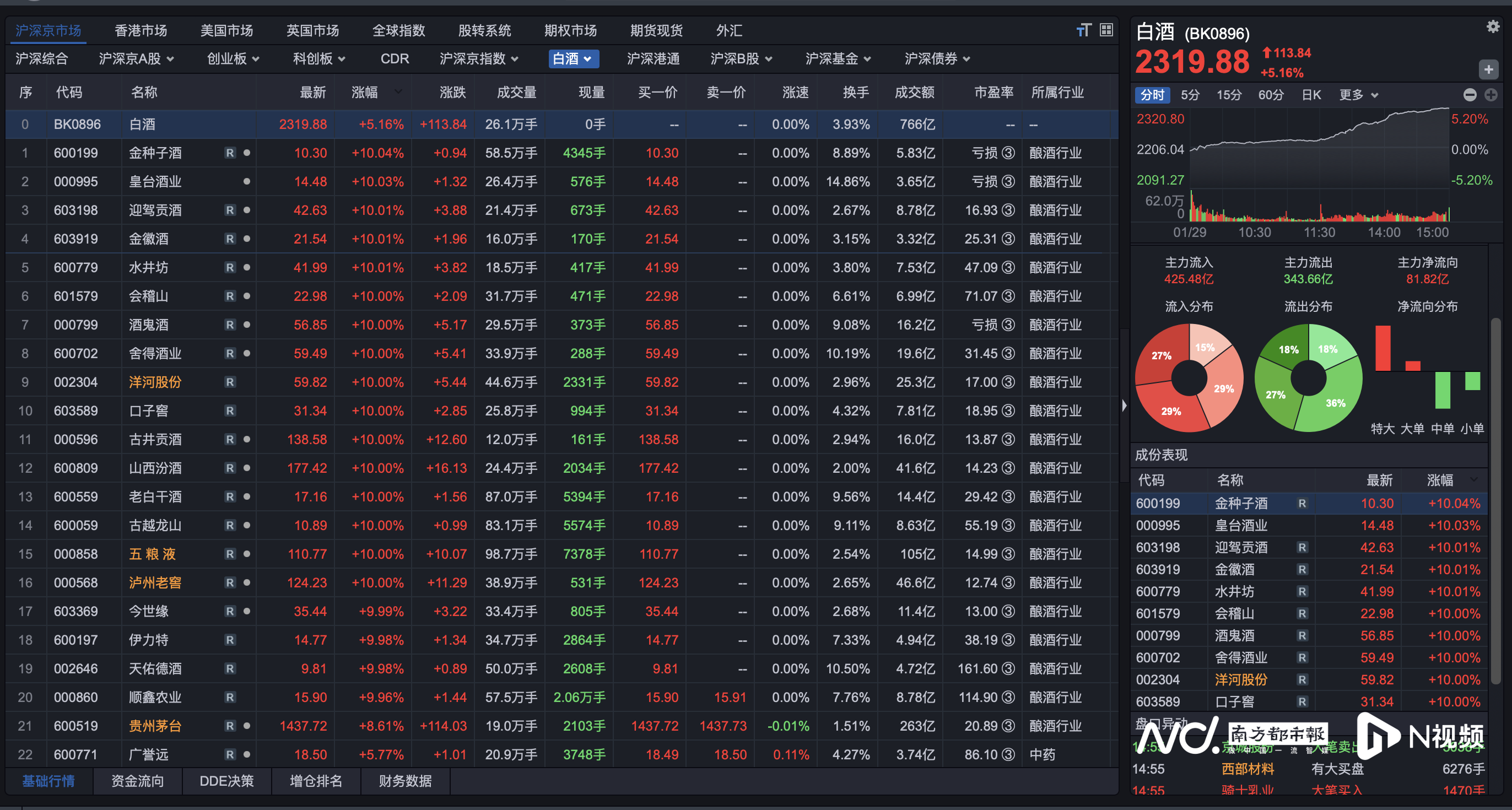
Core Viewpoint - The surge in the A-share liquor sector, particularly in major brands like Kweichow Moutai and Wuliangye, is attributed to a combination of market sentiment release and macroeconomic "expectation repair," indicating a potential recovery in consumer demand, especially ahead of the Spring Festival [1][11]. Group 1: Market Performance - On January 29, the liquor sector saw a significant increase, with Kweichow Moutai closing at 1437.72 CNY per share, up 8.61% [1]. - Over ten liquor companies, including Wuliangye and Luzhou Laojiao, reached their daily price limits, reflecting a broad market rally in the sector [1][2]. - The liquor index rose by 5.16%, indicating strong investor interest and confidence in the sector [2]. Group 2: Macroeconomic Factors - Analysts highlight that macroeconomic measures, such as relaxed real estate policies and local government consumption vouchers, are expected to boost social consumption and business banquets, which are crucial for liquor sales [3]. - Local governments are prioritizing consumption enhancement as a key annual task, with various initiatives aimed at increasing consumer capacity and optimizing supply [3]. Group 3: Seasonal Demand and Pricing - The demand for Kweichow Moutai is reportedly strong ahead of the Spring Festival, with some distributors indicating that their quotas for January and February have already sold out [6]. - Analysts suggest that the price increase for Moutai is driven by both seasonal demand and the company's market control measures, aimed at stabilizing prices [8]. Group 4: Industry Outlook - Despite the recent surge, the actual recovery in liquor sales during the Spring Festival remains uncertain, with analysts noting a mixed inventory situation among different brands [9][10]. - The current valuation of leading liquor companies, such as Kweichow Moutai and Wuliangye, is considered low compared to the broader market, suggesting potential investment opportunities [10]. - However, there are concerns about the performance of some liquor companies, with significant profit declines expected for several firms, indicating that the sector may still face challenges [11].


飞天茅台等高端名酒下挫,“价格焦虑”仍在,白酒如何“鏖战”中秋
Nan Fang Du Shi Bao· 2025-09-05 02:23
Core Insights - The latest monitoring report indicates a downward trend in the prices of high-end liquor, with 9 out of 14 mainstream products experiencing price declines, leading to a collective "price anxiety" in the industry [1][2] - The second quarter of 2025 saw a slowdown in growth or even a decline in net profits for major liquor companies, marking the first drop in nearly a decade for some leading brands [1][2] - The price fluctuations are attributed to a combination of "inventory reduction" and "promotional wars," as companies increase promotional efforts to capture market share ahead of the Mid-Autumn Festival [1][2] Price Trends - Major brands such as Moutai, Wuliangye, and Guojiao 1573 have reported price declines compared to previous periods, reflecting a broader trend of insufficient demand [2][11] - The average retail prices for various liquor brands as of September 4 include: Moutai at 2223, Wuliangye at 964.92, and Guojiao at 320.34 [11] Supply and Demand Dynamics - The industry is currently in a deep adjustment phase, with weak demand in key consumption scenarios such as banquets and business gatherings exacerbating inventory issues [2][4] - High inventory levels have led to a reduction in the number of distributors for major brands like Wuliangye and Luzhou Laojiao, indicating a contraction in the distribution network [4] Inventory Management Strategies - To alleviate channel pressure, many companies are shifting from traditional inventory pressure tactics to "controlled supply" methods, aiming to stabilize terminal prices [5] - However, this strategy has resulted in increased inventory levels at the production end, with the average inventory turnover days rising to 900 days, a 10% year-on-year increase [5] Upcoming Market Events - As the traditional peak season of Mid-Autumn Festival approaches, companies are preparing marketing campaigns, although this year's promotional activities appear less aggressive compared to previous years [6][8] - The subdued marketing efforts may be linked to last year's disappointing sales performance during the same period, where demand for business banquets and gifting declined [8] Policy Environment - Recent local policies, such as those in Shaoxing, are aimed at boosting consumption by providing subsidies for banquet expenditures, which may positively impact the liquor market [10]
茅台又出手了!已回购超53亿元
2 1 Shi Ji Jing Ji Bao Dao· 2025-08-04 14:47
Group 1 - Guizhou Moutai announced a share buyback of 69,600 shares in July, totaling a payment of 99.93 million yuan, with a cumulative buyback of 3.4517 million shares and a total payment of 5.301 billion yuan by the end of July [1][2] - The buyback program was initiated to protect the interests of shareholders and enhance investor confidence, with a planned buyback amount between 3 billion and 6 billion yuan [2] - The company emphasized a shift from "channel-oriented" to "consumer-oriented" strategies to improve service quality and meet consumer demand for high-quality products [3] Group 2 - The price of Moutai products has seen significant declines, with the price of the 25-year Flying Moutai dropping to 1,860 yuan per bottle, a decrease of 16.22% from its peak [4] - The wholesale price of the Moutai Zodiac Snake wine fell to 1,995 yuan per bottle, marking a 47.5% drop from its initial high [3][4] - The overall market for Moutai products is experiencing a downturn, with various products seeing price reductions, indicating a broader trend affecting the brand [4] Group 3 - The A-share market showed a reversal with all three major indices rising, indicating a high level of market activity despite short-term fluctuations [5] - The market's liquidity remains robust, with an increase in financing balance and participation from public and private funds, suggesting a positive outlook for future investments [6] - The focus on "anti-involution" policies and the growth potential in the consumer services sector are highlighted as key themes for future market trends [6]