香港大盘30ETF(520560)

Search documents
财报靴子落地,美团绩后上涨!百亿港股互联网ETF华宝(513770)盘中走强,内卷落幕,拐点已现?
Xin Lang Cai Jing· 2026-03-27 05:51AI Processing
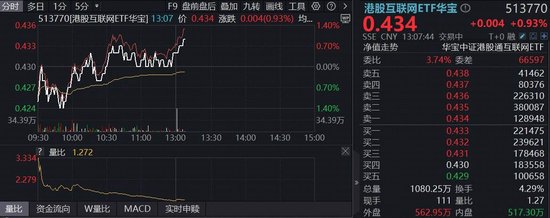
3月27日,港股盘中走强,港股AI核心工具——港股互联网ETF华宝(513770)场内价格现涨0.93%, 互联网龙头集体上行,小米集团-W涨近3%,美团-W绩后涨超1%,阿里巴巴-W、腾讯控股跟涨。 继腾讯、阿里、小米,昨日美团-W发布最新财报,外卖大战对业绩的压制靴子落地。美团表示,坚决 反对内卷,预计今年一季度的外卖业务亏损环比将明显改善;此外美团透露坚定投入AI与国际化,将 美团升级为行业领先的AI驱动应用。 近日外卖市场迎来重大转折,国家市场监管总局转发官媒题为《外卖大战该结束了》的评论,市场普遍 解读成——监管层对"内卷式"价格战发出明确叫停信号,带来互联网龙头业绩修复预期。 港股互联网ETF华宝(513770)基金经理丰晨成指出,近期大模型厂商与云服务厂商集体涨价,互联网 龙头算力及云服务价格在潜在需求变化中存在显著的上涨弹性;叠加反内卷竞争的式微,多个积极因素 共振,港股互联网的基本面有望从2季度开始迎来逐步上修,估值和位置是其之后弹性的保障。 展望后市,银河证券表示,若美伊发生泥潭式长期冲突,港股市场将经历"短期情绪冲击→中期基本面 传导→长期结构性分化"的三阶段演进。但港股的估值洼地优势、 ...


盈利不及预期,阿里巴巴低开6%,AI相关收入连续10季三位数增长!关注低位互联网龙头AI商业化兑现
Xin Lang Cai Jing· 2026-03-20 02:23
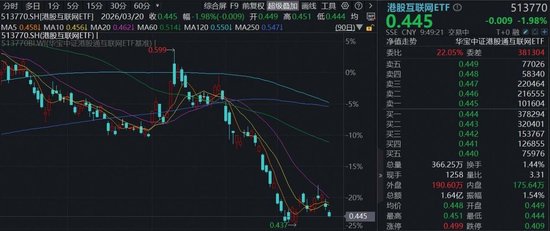
Core Viewpoint - The Hong Kong stock market opened lower on March 20, with technology stocks struggling due to disappointing third-quarter earnings from Alibaba, which saw a significant drop in both revenue and profit [1][8]. Group 1: Company Performance - Alibaba's third-quarter revenue for the fiscal year 2026 reached 284.84 billion yuan, a year-on-year increase of 2%, while adjusted net profit fell by 67% to 16.71 billion yuan [10]. - Adjusted EBITA for Alibaba was 23.397 billion yuan, reflecting a 57% year-on-year decline [10]. - Despite overall profit pressure from strategic investments, AI and cloud computing emerged as key growth areas, with the cloud intelligence group revenue increasing by 36% year-on-year [10]. Group 2: Market Trends - The AI-related product revenue for Alibaba has achieved triple-digit growth for ten consecutive quarters, indicating that AI is becoming a core growth engine for the company [10]. - Recent price increases announced by Tencent Cloud and Alibaba Cloud, along with a surge in token usage, are expected to drive up cloud product prices, enhancing the commercial viability of leading internet companies during the AI cycle [10]. - As of March 18, the price-to-earnings ratio (TTM) for the Hong Kong Internet Index was 22.03, significantly lower than that of the NASDAQ 100 and A-share technology sectors, suggesting a favorable margin of safety for investors [10]. Group 3: Investment Opportunities - The Hong Kong Internet ETF (513770) tracks the CSI Hong Kong Internet Index and includes major tech companies like Alibaba, Tencent, and Xiaomi, providing significant liquidity and T+0 trading [11]. - For investors looking to reduce volatility while still gaining exposure to technology, the Hong Kong Large Cap 30 ETF (520560) offers a balanced strategy by including both high-growth tech stocks and stable dividend-paying companies [13][14].

ETF盘中资讯 港股回血!阿里、腾讯、小米、美团涨超3%,拐点已现?
Jin Rong Jie· 2026-03-06 05:41
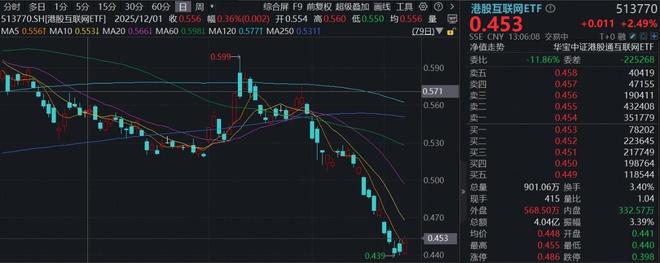
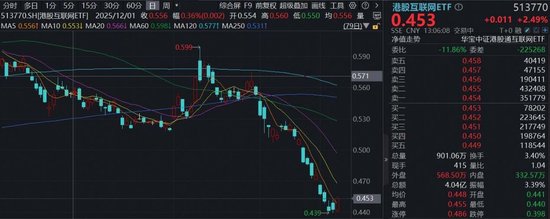
Core Viewpoint - The Hong Kong stock market has experienced a strong rebound, particularly in the internet sector, with major companies like Alibaba, Xiaomi, Meituan, and Tencent all seeing gains of over 3% [1] Group 1: Market Performance - The Hong Kong internet ETF (513770) has shown a recovery, rising by 2.49% and reclaiming the 5-day moving average [1] - The current price-to-earnings (PE) ratio for the internet sector is 20.74, significantly lower than the NASDAQ 100's 32.85 and the ChiNext Index's 41.52 [3] - The market has seen substantial buying activity, boosting confidence after a five-month adjustment period [3] Group 2: Company Earnings - Recent earnings reports from internet companies have alleviated concerns about increasing losses, confirming the positive impact of AI as a "second growth curve" [3] - Bilibili is projected to achieve its first annual profit in 2025, with an adjusted net profit of 2.59 billion [3] - JD Health is expected to see revenue and net profit growth of 26.3% and 29.16% year-on-year, respectively, by 2025 [3] Group 3: Investment Outlook - The technology sector is identified as a long-term investment focus for Hong Kong stocks, with the recent pullback creating buying opportunities [3] - The rise of AI capabilities in China is anticipated to enhance market confidence [3] - Investors are encouraged to monitor developments in large model applications and trends in overseas liquidity [3] Group 4: ETF Information - The Hong Kong internet ETF (513770) and its linked funds (Class A 017125; Class C 017126) passively track the CSI Hong Kong Internet Index, with top holdings including Alibaba, Tencent, Xiaomi, Kuaishou, and Bilibili, collectively accounting for over 76% [3] - For those looking to reduce volatility while investing in technology, the Hong Kong Large Cap 30 ETF (520560) is recommended, featuring a mix of high-growth tech stocks and stable dividend-paying companies [5]
港股回血!阿里、腾讯、小米、美团涨超3%,拐点已现?
Xin Lang Cai Jing· 2026-03-06 05:18
Core Viewpoint - The Hong Kong stock market has experienced a strong rebound, particularly in the internet sector, with major companies like Alibaba, Xiaomi, Meituan, and Tencent all seeing gains of over 3% [1][8]. Market Performance - The Hong Kong internet sector's current price-to-earnings ratio (PE) is 20.74, which is significantly lower than the NASDAQ 100's 32.85 and the ChiNext Index's 41.52, indicating a strong valuation margin [3][10]. - The Hong Kong internet ETF (513770) has risen by 2.49%, recovering above the 5-day moving average [1][8]. Financial Results - Recent earnings reports from internet companies have alleviated concerns about increasing losses, confirming the positive impact of AI as a "second growth curve" [3][10]. - Bilibili is projected to achieve its first annual profit in 2025, with an adjusted net profit of 2.59 billion yuan, while JD Health expects revenue and net profit growth of 26.3% and 29.16% respectively in 2025 [3][10]. Investment Outlook - Analysts suggest that the technology sector remains a long-term investment focus for Hong Kong stocks, with the recent market correction creating buying opportunities [3][10]. - The rise of AI capabilities in China is expected to bolster market confidence, with attention on the progress of large model applications and overseas liquidity trends [3][10]. ETF and Fund Information - The Hong Kong internet ETF (513770) and its linked funds (Class A 017125; Class C 017126) passively track the CSI Hong Kong Internet Index, with top holdings including Alibaba, Tencent, Xiaomi, Kuaishou, and Bilibili, collectively accounting for over 76% of the fund [3][11]. - For investors looking to reduce volatility, the Hong Kong Large Cap 30 ETF (520560) offers a "technology + dividend" strategy, featuring both high-growth tech stocks and stable dividend-paying companies [5][11].
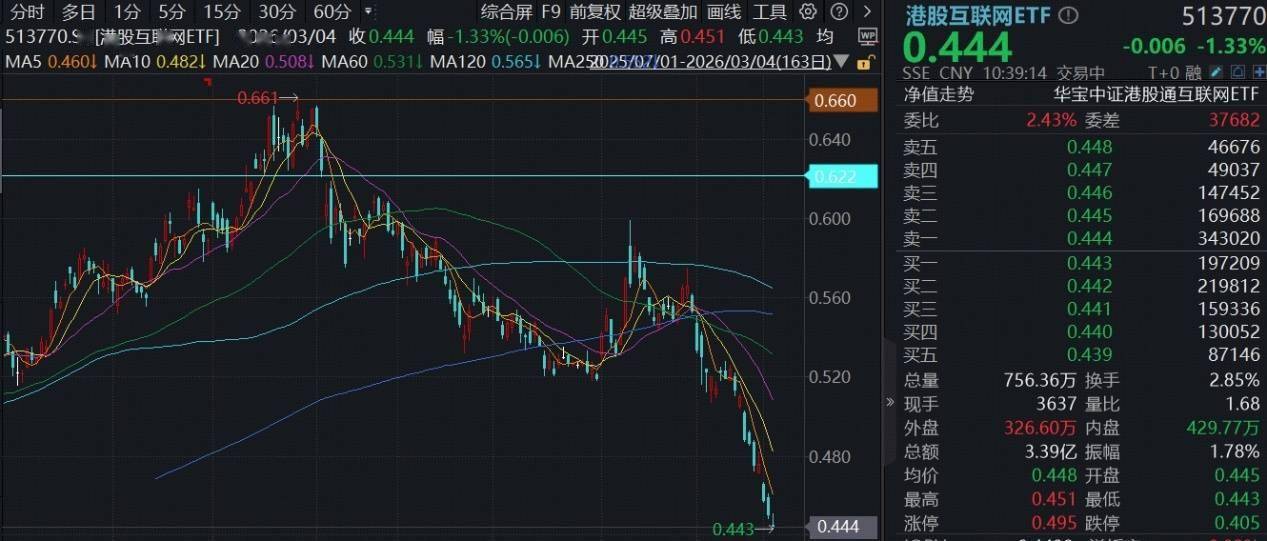
ETF盘中资讯|三重压力,恒生科技继续回调,南向资金逆势“抄底”,机构:互联网龙头静待修复
Sou Hu Cai Jing· 2026-03-04 03:21
Core Viewpoint - The Hong Kong stock market is experiencing a downturn, particularly in the technology sector, with significant declines in major internet stocks, while southbound capital continues to increase its holdings in these companies [1][2]. Group 1: Market Performance - The Hang Seng Index and the Hang Seng Tech Index both fell over 1% in early trading on March 4, with the Hong Kong Internet ETF (513770) reaching a new low since July 2025 [1]. - Major internet companies like Alibaba-W and Meituan-W saw declines of over 3% and nearly 2%, respectively, while Tencent Holdings fell by 0.88% [1]. Group 2: Investment Trends - Despite the market downturn, southbound capital has shown a net inflow in 27 out of 36 trading days this year, totaling a net inflow of 181.8 billion HKD [2]. - Southbound capital has significantly increased its holdings in major internet companies, with Tencent's market value exceeding 540 billion HKD and Alibaba's exceeding 320 billion HKD [2]. Group 3: Sector Analysis - Concerns about high expenditures on delivery subsidies and AI initiatives are causing competitive pressures among companies [2]. - The emergence of new AI players like Zhipu and MiniMax is raising doubts about the technological advantages of established internet giants [2]. - Analysts suggest that the current market correction presents a buying opportunity in the Hong Kong internet sector, supported by favorable policies and liquidity conditions [2][3]. Group 4: Future Outlook - Analysts from various firms, including Industrial Securities, believe that the downturn in the Hong Kong tech sector may present investment opportunities, particularly as AI support from the government continues to strengthen [2][3]. - The Hong Kong Internet ETF (513770) and its associated funds are positioned to benefit from the growth of AI and the unique advantages of Hong Kong internet companies [3].
三重压力,恒生科技继续回调,南向资金逆势“抄底”,机构:互联网龙头静待修复
Xin Lang Cai Jing· 2026-03-04 03:00
Core Viewpoint - The Hong Kong stock market is experiencing a significant adjustment, particularly in the technology sector, driven by concerns over high expenditures, competition from new AI players, and liquidity pressures due to changing Federal Reserve interest rate expectations [3][11]. Market Performance - On March 4, the Hong Kong stock market opened lower, with the Hang Seng Index and Hang Seng Tech Index both dropping over 1%. The Hong Kong Internet ETF (513770) fell by 1.33%, reaching a new low since July 2025. Major internet companies like Alibaba-W, Meituan-W, and Tencent Holdings saw declines of over 3%, nearly 2%, and 0.88%, respectively [1][9]. Investment Trends - Despite the market downturn, southbound capital has been consistently increasing. As of March 3, there were 27 net inflow trading days out of 36 this year, totaling a net inflow of 181.8 billion HKD. Major internet companies have seen significant increases in holdings, with Tencent's market value exceeding 540 billion HKD and Alibaba's over 320 billion HKD [3][11]. Sector Analysis - Analysts suggest that the current deep adjustment in the Hong Kong tech sector is due to three main pressures: concerns over high spending on delivery subsidies and AI initiatives, competition from emerging AI companies, and liquidity pressures from revised Federal Reserve interest rate expectations [3][11]. - Investment opportunities are emerging in the Hong Kong Internet sector as policies supporting AI development are expected to enhance the growth of internet companies [3][11]. ETF Insights - The Hong Kong Internet ETF (513770) and its linked funds are designed to track the CSI Hong Kong Internet Index, with the top ten holdings including major players like Alibaba-W, Tencent Holdings, and Xiaomi Group, collectively accounting for over 76% of the index [4][12]. - For investors looking to reduce volatility while still gaining exposure to technology, the Hong Kong Large Cap 30 ETF (520560) is recommended, combining high-growth tech stocks with stable dividend-paying companies [14].
地缘冲突+英伟达绩后连跌,港股互联网ETF(513770)重挫4%,机构:3月中下旬是重要观察窗口
Xin Lang Cai Jing· 2026-03-02 05:36
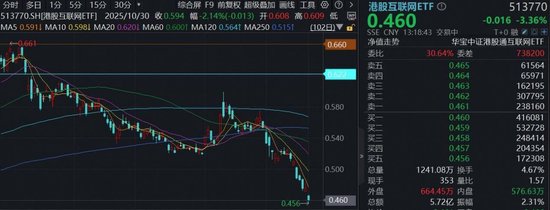
Market Overview - The Hong Kong stock market indices collectively declined on March 2, with the Hang Seng Index falling by 1.68% and the Hang Seng Tech Index dropping over 2% [1][3] - Major internet companies experienced a pullback, with Xiaomi Group-W down over 4%, Alibaba-W and Meituan-W down more than 3%, and Tencent Holdings down 0.58% [1][3] - The Hong Kong Internet ETF (513770) saw its price drop over 4%, reaching an 11-month low, and is currently down 3.36% [1][3] Market Sentiment and Analysis - The market pullback is attributed to heightened risk aversion due to geopolitical conflicts and concerns over an AI bubble following Nvidia's stock decline over two consecutive trading days [3][11] - Despite exceeding market expectations in recent earnings reports, significant increases in capital expenditures by tech leaders have raised concerns about Nvidia's financial sustainability and the actual profitability of AI investments [3][11] Valuation Insights - The current price-to-earnings (P/E) ratio of the Hong Kong internet sector has returned to the 11th percentile of the past five years, indicating that companies like Tencent are at historically low absolute valuation levels [3][12] - Leading internet companies maintain advantages in technology, market access, ecosystem, and infrastructure, with increasing demand for cloud computing services driven by the exponential growth in computing power consumption from open-source large models [3][12] Future Outlook - According to Guangfa Securities, the significant pressure factors on the Hong Kong market, such as the peak of lock-up expirations and earnings disclosures, may dissipate by mid to late March, potentially improving market sentiment [3][12] - The focus on AI large models needing scenario monetization and advancements in consumer applications could catalyze fundamental improvements [3][12] - Citic Securities suggests that the Hong Kong market remains supported by the Federal Reserve's interest rate cut cycle and continuous inflow of southbound funds, indicating that sectors with strong industrial logic are worth ongoing attention [3][12] Investment Opportunities - The Hong Kong Internet ETF (513770) and its linked funds are designed to passively track the CSI Hong Kong Internet Index, with the top ten weighted stocks including Alibaba-W, Tencent Holdings, and Xiaomi Group-W, collectively accounting for over 76% [4][12] - For investors looking to reduce volatility while maintaining exposure to technology, the Hong Kong Large Cap 30 ETF (520560) offers a "technology + dividend" strategy, including both high-growth tech stocks and stable dividend-paying companies [6][14]

港股互联网ETF(513770)再探阶段新低,是否调整到位?南向资金爆买!
Xin Lang Cai Jing· 2026-02-26 02:43
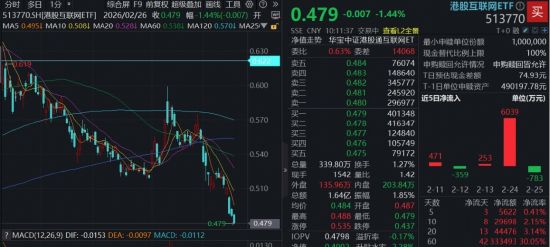
Core Viewpoint - The Hong Kong stock market, particularly the AI sector, is experiencing a correction, with the Hong Kong Internet ETF (513770) dropping 1.44% to a near 10-month low [1][9]. Group 1: Market Performance - The technology sector in Hong Kong has seen significant adjustments, with the CSI Hong Kong Internet Index recording a cumulative decline of over 10% since February [3][11]. - Notable individual stock performances include Xiaomi Group-W rising over 1%, while Alibaba-W, Kuaishou-W, Meituan-W, and Tencent Holdings all experienced declines [1][9]. Group 2: Capital Inflows - Southbound capital has increased its buying intensity, with a cumulative net purchase exceeding 80 billion HKD since February 2026, surpassing the total for January 2026 [3][11]. - Major Hong Kong internet leaders have been heavily accumulated, with Tencent Holdings and Alibaba-W each seeing over 30 million shares added [3][11]. - The Hong Kong Internet ETF (513770) has attracted a net inflow of 445 million CNY over the past 20 days, with fund shares surpassing a historical high of 26.6 billion [3][11]. Group 3: Future Outlook - CICC believes that the future of the market depends on three dimensions: credit cycles affecting index space, industry trends influencing structural strength, and liquidity amplifying volatility [3][11]. - GF Securities suggests that if positive catalysts emerge, the Hong Kong market could see a recovery in sentiment and capital inflows, particularly in technology stocks benefiting from AI trends [4][12]. Group 4: Investment Strategies - The Hong Kong Internet ETF (513770) and its linked funds are recommended for passive tracking of the CSI Hong Kong Internet Index, with top holdings including Alibaba-W, Tencent Holdings, and Xiaomi Group-W, collectively accounting for over 76% [4][12]. - For investors seeking to reduce volatility while maintaining exposure to technology, the Hong Kong Large Cap 30 ETF (520560) is highlighted as a suitable long-term investment tool [4][14].
ETF盘中资讯|港股AI全线走低,513770下探近10个月新低,阿里、腾讯齐跌逾2%!机构提示港股科技“三重底”
Sou Hu Cai Jing· 2026-02-24 02:22
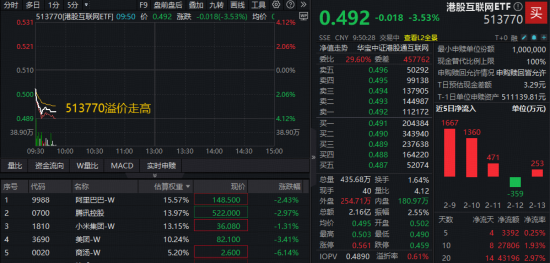
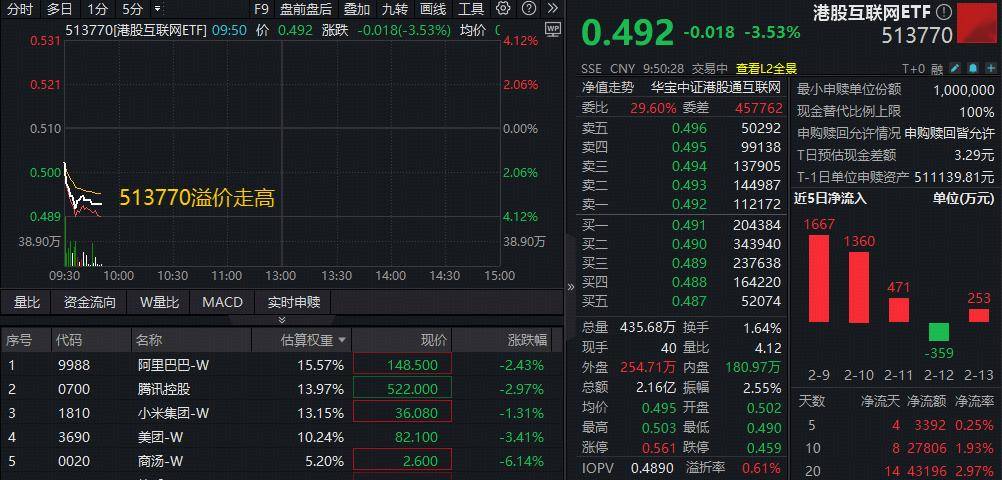
Core Viewpoint - The Hong Kong Internet ETF (513770) has experienced a significant decline, dropping over 3.5% to reach a nearly 10-month low, indicating potential buying opportunities as it continues to trade at a premium [1] Group 1: Market Performance - The Hong Kong Internet ETF (513770) opened lower and has seen a decline of 3.53%, with a current price of 0.492 [2] - The ETF is currently trading at a premium, suggesting that some investors may be looking to buy on dips [1] - The market has shown increased volatility, particularly in the technology and cyclical sectors, despite positive consumer data [1][3] Group 2: Investment Strategy - According to Everbright Securities, the Hong Kong technology sector is entering a strategic configuration zone characterized by high win rates and high odds, with three key bottom features becoming increasingly clear [3] - The ETF tracks the CSI Hong Kong Internet Index, which includes major tech companies like Alibaba, Tencent, and Xiaomi, collectively accounting for over 76% of the index [3][4] - The focus is on the potential of AI commercialization by 2026, highlighting the importance of investing in core AI tools within the Hong Kong market [3] Group 3: ETF Composition - The top ten holdings of the Hong Kong Internet ETF include Alibaba (15.57%), Tencent (13.97%), and Xiaomi (13.15%), among others, indicating a strong concentration in leading tech firms [4] - The ETF is designed to provide exposure to both high-growth tech stocks and stable dividend-paying companies, making it a suitable long-term investment vehicle [4]
港股AI全线走低,513770下探近10个月新低,阿里、腾讯齐跌逾2%!机构提示港股科技“三重底”
Xin Lang Cai Jing· 2026-02-24 02:13
Group 1 - The Hong Kong stock market saw a decline in AI-related stocks, with major players Alibaba and Tencent both dropping over 2%, and Xiaomi falling more than 1% [1][8] - The Hong Kong Internet ETF (513770) opened lower and fell over 3.5%, reaching a nearly 10-month low, while maintaining a premium in trading, indicating potential buying interest [1][8] - The market is experiencing a divergence between AI newcomers and established internet giants, with consumer data showing positive trends but not significantly boosting sector performance [8][10] Group 2 - According to Everbright Securities, the Hong Kong tech sector is entering a strategic configuration zone characterized by high win rates and high odds, with signs of oversold valuations and upward trends in fundamentals [3][10] - The Hong Kong Internet ETF (513770) tracks the CSI Hong Kong Internet Index, with its top ten holdings including major tech companies like Alibaba, Tencent, and Xiaomi, collectively accounting for over 76% of the ETF [3][10] - The Hong Kong 30 ETF (520560) is recommended for those looking to reduce volatility while investing in tech, as it includes both high-growth tech stocks and stable dividend-paying companies [11]