高端医疗

Search documents
培育旅游消费超级品牌,推动三张“金字招牌”能级跃升
Xin Lang Cai Jing· 2026-01-28 16:48
Core Insights - In 2025, Hainan's tourism economy is expected to enter a new development phase, with a projected 106 million domestic and international visitors, representing a 9.1% year-on-year increase, and total visitor spending reaching 225.43 billion yuan, up 10.5% [1] - The province aims to enhance its international tourism appeal, with inbound visitors expected to reach 1.5005 million, a 35.2% increase, and overnight international tourists at 5.9429 million nights, up 59.0% [1] - The provincial government plans to implement consumption expansion measures, attracting 270 conferences, 44 exhibitions, 279 sports events, and 27 large-scale performances, which are estimated to boost consumption by 16.7 billion yuan [1] Group 1: Tourism Development Strategies - The provincial tourism department will focus on cultivating super brands in tourism consumption, promoting "duty-free shopping," "high-end medical services," and "studying in Hainan" as key attractions [1] - New emerging brands in marine tourism, health and wellness tourism, and aerospace tourism will be developed to enhance the tourism landscape [2] Group 2: Enhancing Tourism Supply - The government will implement five key projects to enrich international tourism supply, including revitalizing marine tourism attractions, improving coastal resorts, and developing marine-themed districts [2] - There will be a focus on multi-dimensional development of aerospace tourism, including space travel, health services, and educational initiatives [2] Group 3: Building Tourism Consumption Hubs - Haikou and Sanya will be further developed as high-level tourism consumption centers, with plans to establish Danzhou as a "Cultural and Entertainment Capital," Wenchang as an "Aerospace Tourism Capital," and Qionghai as a "Medical Tourism Capital" [2] - The construction of high-quality consumption clusters will be promoted, including duty-free shopping areas in Haikou and Sanya, and wellness tourism zones in Wuzhishan and Baoting [2] Group 4: Improving Tourism Environment - Efforts will be made to enhance global accessibility and service quality in tourism, including the introduction of travel insurance and the promotion of a "Safe Consumption in Hainan" brand [2]
董事长发朋友圈宣布离职? 横琴人寿回应称“在核实中”
Zhong Guo Jing Ying Bao· 2026-01-28 09:37
Core Viewpoint - Hengqin Life Insurance has completed a capital increase of over 1.8 billion yuan, with Chairman Qian Zhonghua indicating that the company's tasks are largely accomplished and preparations for the 2026 business year are underway [1]. Group 1: Company Leadership and Strategy - Qian Zhonghua, born in 1962, is the second chairman of Hengqin Life Insurance and has extensive experience in the insurance industry, having previously worked at China Pacific Life Insurance [1][2]. - Since taking office in April 2024, Qian has implemented a dual strategy focusing on individual insurance development and stable bank insurance operations, emphasizing the "Golden Lotus" model in personal marketing channels [2]. Group 2: Business Performance - Despite the implementation of the "Golden Lotus" model, Hengqin Life Insurance has faced significant challenges, with insurance business revenue for the first three quarters of 2025 reported at 5.673 billion yuan, a year-on-year decline of 22.83% [3]. - The company recorded a net loss of 326 million yuan and a negative net cash flow of 747 million yuan, with the dividend account business showing a net cash flow of -3.672 billion yuan [3].
平安人寿广西分公司获区级养老金融示范项目
Xin Lang Cai Jing· 2026-01-22 23:17
Core Insights - The core viewpoint of the article highlights that China Ping An Life Insurance Co., Ltd. Guangxi Branch has been recognized as a provincial-level demonstration project in pension finance due to its innovative "insurance product + rights" pension financial service system [2][3] Group 1: Pension Financial Service System - The company has developed a comprehensive pension solution that covers the entire life cycle, creating a closed-loop process of "payment - service - risk control" [2] - The product supply strategy includes a precise customer adaptation approach, forming a product matrix that covers different life stages [2] - For middle-aged clients, the company recommends a combination of "medical insurance + long-term insurance" to strengthen pension security [2] Group 2: Value-Added Services - The company has established a dual-driven rights system of "home-based elderly care + family doctor" [3] - The home-based elderly care service utilizes a "three-in-one steward" platform, integrating AI, life stewards, and doctor stewards to provide 24/7 service [3] - The family doctor service offers a one-stop health management solution, including a dedicated family doctor, three health services, a proactive process, and numerous medical resources [3] Group 3: Future Development - The recognition as a district-level demonstration project injects strong momentum into the development of the company's pension financial services [3] - The company plans to continue deepening product innovation and service optimization in the pension finance sector to provide secure and comfortable pension guarantees for more families [3]



海南2025年接待游客突破1亿人次
Zhong Guo Xin Wen Wang· 2026-01-21 07:53
Core Insights - Hainan is projected to receive over 106 million domestic and international tourists in 2025, marking a 9.1% year-on-year increase, with total tourist spending expected to reach 225.43 billion yuan, a 10.5% increase [1][2] Group 1: Tourism Growth - In 2025, Hainan aims to host 1.15 billion tourists, with a target of 200 million international visitors, reflecting a 33.3% increase [2] - The province recorded 1.5 million inbound tourists in the previous year, a 35.2% increase, with overnight visitors reaching 5.94 million, up 59.0% [1][2] Group 2: Cultural and Historical Preservation - Hainan made significant advancements in cultural heritage protection, discovering 761 new cultural relics and adding 19 new provincial-level protection units [2] - The province initiated nine historical cultural protection projects and conducted the first archaeological excavation of deep-sea shipwreck sites [2] Group 3: Tourism Development Strategies - Hainan plans to enhance tourism consumption through three key brands: duty-free shopping, high-end medical services, and studying in Hainan, while also developing marine tourism, wellness tourism, and aerospace tourism [3] - The province will implement five major projects to improve marine tourism, including the renovation of marine tourism attractions and the development of integrated marine tourism complexes [3] Group 4: International Cooperation - Hainan aims to expand its domestic and international tourism cooperation through a "one journey, multiple stops" mechanism and will implement nine measures to support inbound tourism development [4] - The province seeks to attract leading inbound travel agencies to establish operations in Hainan and promote cultural exchange through performances [4]
海南省政府召开专题会议 研究“十五五”海南国际旅游消费中心规划编制工作
Zheng Quan Shi Bao Wang· 2025-12-31 15:36
Core Insights - The Hainan provincial government is focusing on the development of an international tourism consumption center by 2025, emphasizing the need for strategic planning and execution to enhance tourism appeal and consumer experience [1][2]. Group 1: Strategic Planning - The government aims to analyze and adapt to new trends in domestic and international tourism consumption, focusing on diversification and precision marketing [2]. - There is a strong emphasis on upgrading existing tourist attractions and introducing leading cultural and tourism enterprises to create world-class tourist attractions [2]. Group 2: Brand Development - The strategy includes leveraging Hainan's free trade port policies to build a brand matrix centered around "duty-free shopping," "high-end medical services," and "studying in Hainan" [2]. - New tourism products and experiences, such as "marine tourism" and "aerospace tourism," are to be developed to enhance the uniqueness of Hainan's offerings [2]. Group 3: Consumer Experience - The focus is on converting tourist traffic into actual spending by improving the convenience for inbound tourists and enriching the variety of consumption scenarios [2]. - There is a commitment to deepening reform and innovation, promoting the integration of culture and tourism, and utilizing new technologies to enhance the tourism experience [2]. Group 4: Infrastructure Development - The development of Hainan's tourism infrastructure will be driven by the integration of the island's tourism highway and the tropical rainforest national park tourism highway [2]. - The goal is to enhance both tourism and transportation functions, creating a cohesive network of attractions across the region [2]. Group 5: Regulatory Framework - The government is advocating for standardized, honest, and civilized tourism practices to create a favorable business and consumer environment [2]. - This regulatory framework aims to ensure that both business operators and tourists feel comfortable and secure in Hainan, laying a solid foundation for the construction of the international tourism consumption center [2].
创新药商保目录专家电话会议
2025-12-08 15:36
Summary of Conference Call on Commercial Health Insurance and Innovative Drugs Industry Overview - The conference focused on the commercial health insurance (CHI) sector in China, particularly its integration with the national medical insurance system and the implications for innovative drug companies [1][2]. Key Points and Arguments Integration of Commercial Health Insurance and National Medical Insurance - The National Healthcare Security Administration (NHSA) has led the establishment of a commercial insurance directory, addressing fragmentation in the commercial insurance industry and enhancing the importance of pharmaceutical companies and their products [1][3]. - The commercial health insurance directory aims to provide a platform for innovative drugs, similar to centralized procurement but with a greater emphasis on clinical and economic evaluations rather than just fund calculations [2][4]. Innovative Drug Coverage and Payment Models - Commercial health insurance is adapting to high treatment costs, such as CAR-T therapy, by implementing partial reimbursement and pay-for-performance models to alleviate patient financial burdens [1][5]. - The NHSA's increasing payment for innovative drugs is projected to reach approximately CNY 200 billion by 2024, yet the share of commercial insurance remains low, around CNY 12.5 billion [7][10]. Market Dynamics and Challenges - The high-end medical insurance market in China is currently underdeveloped, with a total market size of less than CNY 10 billion, primarily due to economic factors and the limited purchasing power of potential customers [8][9]. - The commercial health insurance sector is expected to see significant growth, with projections indicating that by 2030, health insurance investments could reach CNY 25 trillion, with CNY 500 billion allocated for innovative drugs, increasing the reimbursement share from 1/16 to 1/4 [10][11]. Future Trends and Opportunities - The future growth of commercial health insurance is anticipated to focus on mid-tier medical insurance, particularly for patients with pre-existing conditions, which can fill gaps in the current healthcare system [13][19]. - The integration of commercial insurance with national healthcare is expected to facilitate a one-stop settlement model, enhancing patient access to innovative treatments and improving overall healthcare service quality [11][27]. Characteristics of Newly Added Drugs - The drugs included in the commercial insurance directory this year are characterized by small market sizes, high costs, and uncertain efficacy, which allows for real-world studies to support future inclusion in the national insurance system [20][21]. Operational Changes in Insurance Companies - Future operational changes in commercial insurance companies may include direct settlement models, where patients do not need to pay upfront, and a focus on different customer segments through business separation [25][27]. Additional Important Insights - The average reimbursement rate for million medical insurance is around 40%, indicating a significant portion of funds is allocated to operational costs rather than patient payouts [18]. - The commercial health insurance market in China has substantial growth potential, with current insurance density and depth significantly lower than OECD averages, suggesting room for expansion [16][17]. This summary encapsulates the critical insights from the conference call, highlighting the evolving landscape of commercial health insurance in China and its implications for innovative drug companies.
好看又好用!新时代家庭保险配置指南助您“心安为家”
Sou Hu Cai Jing· 2025-09-19 08:51
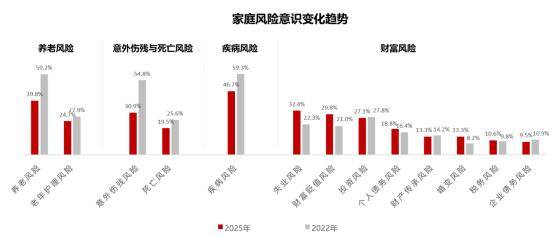
Core Insights - The white paper titled "White Paper on the Risk Protection System for Chinese Families under the Background of High-Quality Development of the Insurance Industry" was officially released, providing guidance for the scientific allocation of insurance for Chinese families in the new era [1][2] - The research emphasizes the evolving risk perceptions of families, highlighting a significant increase in awareness of wealth-related risks compared to traditional survival risks [3][4] Group 1: Family Risk Perception and Management - Chinese families are facing multiple challenges such as slowing income growth, increasing employment and debt risks, currency depreciation, and declining investment returns [3] - The study indicates a shift in focus from traditional risks like health and accidents to wealth management and security, with a notable rise in concern over unemployment and wealth depreciation risks [4][6] - The white paper identifies six major impacts of macroeconomic changes on family risks, including income and debt risks, purchasing power risks, and the effects of an aging population [3][4] Group 2: Consumer Preferences and Risk Management Solutions - Modern families are increasingly seeking comprehensive risk management solutions that combine products and services, moving beyond traditional insurance compensation [10][11] - The primary concerns of families include health issues, retirement planning, children's education, wealth security, and wealth inheritance, reflecting a strong demand for certainty and sustainability [10][11] - High-net-worth families show a growing interest in specialized services such as tax consultation and wealth inheritance planning, indicating a shift towards personalized insurance solutions [12][13] Group 3: Recommendations for Insurance Allocation - The white paper proposes a framework for analyzing income, assets, and liabilities to guide insurance allocation based on family lifecycle stages and wealth levels [17] - It suggests that families should adjust their insurance products according to their lifecycle stage, with specific recommendations for different income levels [17][18] - The introduction of the "Family Risk Defense Index Model" aims to assist families in optimizing their insurance strategies and improving financial security [14][15] Group 4: Strategic Opportunities for the Insurance Industry - The insurance industry is positioned at a critical strategic opportunity, with companies like Great Wall Life Insurance aiming to transition from serving individuals to serving families [18] - The company emphasizes the importance of understanding changing family needs and has developed various intelligent tools to help consumers identify risks and allocate insurance effectively [18][19] - Great Wall Life Insurance is committed to providing comprehensive risk protection services, enhancing customer trust through a focus on both product and service quality [18][19]