1个月期国库现金定存

Search documents
1个月期国库现金定存利率降至1.73%
Bei Jing Shang Bao· 2025-11-24 15:52
Group 1 - The Ministry of Finance and the People's Bank of China conducted a tender for the 2025 Central Treasury Cash Management Commercial Bank Time Deposits, with a total bid amount of 120 billion and a bid rate of 1.73%, down 3 basis points from the previous rate of 1.76%, indicating a reasonable liquidity level in the banking system [1] - The Central Treasury Cash Deposits have been conducted 12 times this year, covering 1-month, 2-month, and 3-month terms, with the recent 6 operations showing a gradual decline in bid rates from 1.78% to 1.73% [1] - The decline in treasury deposit rates suggests a weakening demand from commercial banks for these funds, reflecting an overall reasonable liquidity in the banking system [1] Group 2 - While the treasury deposit rates are declining, the interbank funding market rates have shown a slight increase, with the 7-day SHIBOR rising by 3 basis points to 1.447% and the 1-month SHIBOR increasing by 0.1 basis points to 1.52% [2] - The divergence in rates is attributed to different pricing logic, with treasury deposit rates determined through a bidding process and SHIBOR reflecting short-term funding needs, influenced by month-end liquidity pressures [2] Group 3 - The People's Bank of China has been injecting liquidity through various monetary tools, including a net injection of 557 billion via 7-day reverse repos on November 24, following previous net injections on November 19, 20, and 21 [3] - The recent decline in the 1-month treasury cash deposit rate is expected to lower short-term funding costs for commercial banks, improving their interest margin and signaling a degree of monetary easing [3] - Future expectations suggest that the 1-month treasury cash deposit rate may remain stable, as the People's Bank of China is likely to maintain its accommodative policy stance despite seasonal tightening pressures at year-end [3]
利率“锚”定1.40%!央行2125亿逆回购释放稳健信号
Huan Qiu Wang· 2025-10-23 03:45
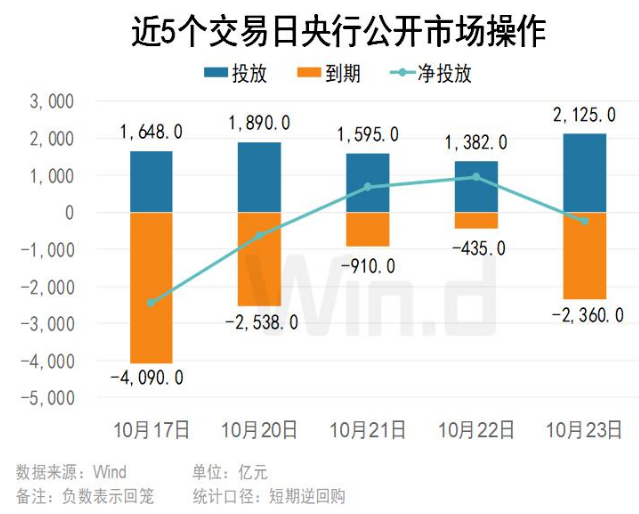
Core Viewpoint - China's macroeconomic policy is entering a critical period for stable growth in the fourth quarter, with coordinated monetary and fiscal measures aimed at creating a favorable financial environment for economic recovery [1]. Group 1: Monetary Policy - The People's Bank of China (PBOC) announced a 7-day reverse repurchase operation of 212.5 billion yuan, maintaining the operation rate at 1.40%, while net draining 23.5 billion yuan on the same day due to 236 billion yuan of reverse repos maturing [1]. - Despite a slight tightening in market liquidity due to tax periods and month-end factors, the overall liquidity remains stable under the PBOC's management, with expectations for the upcoming 700 billion yuan Medium-term Lending Facility (MLF) to be rolled over or slightly increased to stabilize market expectations [1]. Group 2: Credit Expansion Measures - The three major policy banks have disclosed that nearly 300 billion yuan of a new 500 billion yuan policy financial tool has been deployed, which is expected to drive total project investments exceeding 4 trillion yuan, with full deployment anticipated by the end of the year [3]. - Compared to 2022, the current round of tools has a broader scope, including sectors like service consumption, digital economy, artificial intelligence, and technological innovation, aiming to leverage project capital to support economic structural transformation [3]. Group 3: Fiscal and Banking Coordination - The Ministry of Finance and the PBOC conducted a 120 billion yuan one-month treasury cash deposit auction, enhancing the coordination between fiscal and monetary policies [4]. - Regional small and medium-sized banks have initiated a new round of deposit rate cuts to alleviate pressure on net interest margins, creating conditions to support the real economy [4]. Group 4: Future Outlook - Professionals generally anticipate that monetary policy will continue to strengthen in the fourth quarter, with the PBOC expected to utilize various tools and potentially implement reserve requirement ratio (RRR) cuts and interest rate reductions to enhance support for the real economy [5]. - The synergistic effect of monetary and fiscal policies is expected to provide strong support for achieving the annual economic and social development goals [5].