流动性调节

Search documents
央行开展万亿逆回购操作,国产大模型节前集体上新 | 财经日日评
吴晓波频道· 2026-02-14 00:39
Monetary Policy - The People's Bank of China conducted a 1 trillion yuan buyout reverse repurchase operation with a 6-month term, marking a net liquidity injection of 600 billion yuan for February, which is an increase of 300 billion yuan compared to the previous month [2][3] - The central bank's continued use of quantity-based tools indicates a reduced likelihood of interest rate cuts or reserve requirement ratio reductions in the short term [2][3] Real Estate Market - In January, new home prices in first-tier cities fell by 0.3% month-on-month, while second-tier cities saw a smaller decline of 0.2%, indicating a narrowing of price drops in these areas [4][5] - The overall trend shows an increase in cities with declining new home prices compared to late 2022, with the year-on-year decline in first-tier cities expanding to 2.1% [4][5] Automotive Industry - The State Administration for Market Regulation released guidelines to clarify legal risks in the automotive industry, aiming to promote healthy competition and compliance among manufacturers [6][7] - The guidelines address various pricing behaviors that could lead to legal issues, emphasizing the need for a clear competitive framework in the automotive sector [6][7] AI Industry - Anthropic raised $30 billion in its latest funding round, achieving a valuation of $380 billion, which is double its previous valuation [10][11] - The competition in the AI sector is intensifying, with major players like OpenAI and Anthropic attracting significant investments, indicating a growing interest in AI commercialization [10][11] Commodity Funds - Recent fluctuations in international oil prices have led to strict purchase limits on commodity funds, with some funds allowing purchases as low as 1 yuan [12] - The volatility in commodity markets has prompted fund companies to implement tighter risk control measures, reflecting a heightened speculative atmosphere [12] Stock Market - The A-share market experienced a decline, with the Shanghai Composite Index falling by 1.26% and trading volume decreasing by 161.8 billion yuan compared to the previous day [13][14] - The market is transitioning from an overheated phase to a more rational state, with the index seeking a new consolidation platform above 4000 points [14]



央行去年净买入国债1200亿元,国债买卖操作成流动性调节新工具
Sou Hu Cai Jing· 2026-01-15 12:55
Group 1 - The People's Bank of China (PBOC) reported a net injection of 6 trillion yuan through open market operations in 2025, including a net buy of government bonds amounting to 120 billion yuan [1][3] - The issuance of government bonds reached 16 trillion yuan in 2025, with a net increase of 6.6 trillion yuan, resulting in a year-end balance of approximately 40 trillion yuan [3] - Major holders of government bonds include banks (27 trillion yuan), non-bank financial institutions (5 trillion yuan), and foreign institutions (2 trillion yuan) [3] Group 2 - The PBOC aims to maintain liquidity and create a favorable monetary environment for the smooth issuance of government bonds by flexibly conducting bond buy-sell operations [3][4] - The bond buy-sell operations are part of the central bank's efforts to enhance coordination between monetary and fiscal policies, especially in light of increased government bond issuance [3][4] - The PBOC's operations also aim to prevent market volatility and ensure a balanced supply-demand situation in the bond market [4]

2026年货币政策延续“适度宽松”:短中长期多层次流动性调节更趋精准 政策利率或有1-2次降息空间
Xin Hua Cai Jing· 2026-01-04 07:14
Core Viewpoint - In 2025, China's monetary policy returned to a stance of "moderate easing," focusing on guiding expectations and improving transmission channels, with a more precise and prudent approach to operations [1][6]. Group 1: Monetary Policy Overview - The liquidity management system in 2025 was characterized by a multi-layered approach, utilizing tools such as reverse repos, medium-term lending facilities (MLF), and government bond transactions [2]. - The People's Bank of China (PBOC) adjusted the MLF bidding model to a "fixed quantity, interest rate bidding, multiple price bidding" format, which further diminished the policy interest rate's anchoring role [2]. - The net MLF issuance in 2025 reached 1.161 trillion yuan, with a total net liquidity injection of 4.961 trillion yuan [2]. Group 2: Interest Rate Adjustments - The PBOC implemented a downward adjustment of 0.25 percentage points on structural monetary policy tool rates and a comprehensive reserve requirement ratio cut of 0.5 percentage points, effectively reducing the overall financing costs [3]. - The average interest rate for newly issued corporate loans was approximately 3.1% in November, down about 30 basis points year-on-year, while the rate for personal housing loans was also around 3.1%, down 3 basis points year-on-year [3]. - The frequency and magnitude of interest rate cuts in 2025 were lower than in 2024, with only one reduction of 10 basis points for the 7-day reverse repo rate [3]. Group 3: Structural Support and Focus Areas - The monetary policy continued to emphasize support for key sectors, including technology innovation and small enterprises, with increased quotas for re-lending aimed at these areas [3][8]. - The third quarter report indicated that loans for technology, green projects, and inclusive finance grew faster than the overall loan growth rate [3]. - The focus on structural monetary policy tools is expected to persist, with significant investments anticipated in technology and consumer sectors [8]. Group 4: Future Outlook for 2026 - The monetary policy for 2026 is expected to maintain a "moderate easing" stance, with an emphasis on precise support and collaboration with fiscal policies [5][6]. - Analysts predict that the social financing scale in 2026 may exceed that of 2025, driven by increased government debt financing [7]. - There is potential for 1-2 rate cuts in 2026, with a possible reduction of 10-20 basis points, while the focus will remain on maintaining a reasonable interest rate relationship [7][8].
人民银行加量续作6000亿元买断式逆回购
Bei Jing Shang Bao· 2025-12-15 15:51
Core Viewpoint - The People's Bank of China (PBOC) is actively injecting medium-term liquidity into the banking system through a series of buyout reverse repurchase operations to maintain ample liquidity levels, particularly in response to potential tightening at the end of the year [1][4]. Group 1: Buyout Reverse Repo Operations - On December 15, 2025, the PBOC conducted a buyout reverse repo operation of 600 billion yuan with a six-month term, marking the fourth consecutive month of increased buyout reverse repo operations [1][3]. - The buyout reverse repo tool, introduced in October 2024, allows the PBOC to purchase bonds from primary dealers and sell them back at a later date, effectively transferring ownership during the period [3]. - In December, the PBOC has already conducted two buyout reverse repo operations, including a 1 trillion yuan operation on December 5, resulting in a total increase of 200 billion yuan for the month [3]. Group 2: Liquidity Management and Market Conditions - The PBOC's actions are aimed at stabilizing the funding environment, especially as the maturity of interbank certificates of deposit reaches 3.7 trillion yuan in December, the highest level of the year [4]. - Current liquidity in the market is generally loose, with the PBOC's operations aimed at smoothing out fluctuations while maintaining a broadly accommodative stance [4]. - The PBOC is expected to continue its buyout reverse repo operations, along with Medium-term Lending Facility (MLF) operations, to ensure liquidity remains ample [4][6]. Group 3: Future Outlook - The PBOC's liquidity management strategies align with macroeconomic policies that emphasize maintaining a moderately loose monetary policy to support economic stability and reasonable price recovery [6]. - Looking ahead to the first quarter of the next year, it is anticipated that funding rates will remain low, with potential room for further interest rate cuts and reserve requirement ratio reductions depending on credit conditions and bank liabilities [6].

1个月期国库现金定存利率降至1.73%
Bei Jing Shang Bao· 2025-11-24 15:52
Group 1 - The Ministry of Finance and the People's Bank of China conducted a tender for the 2025 Central Treasury Cash Management Commercial Bank Time Deposits, with a total bid amount of 120 billion and a bid rate of 1.73%, down 3 basis points from the previous rate of 1.76%, indicating a reasonable liquidity level in the banking system [1] - The Central Treasury Cash Deposits have been conducted 12 times this year, covering 1-month, 2-month, and 3-month terms, with the recent 6 operations showing a gradual decline in bid rates from 1.78% to 1.73% [1] - The decline in treasury deposit rates suggests a weakening demand from commercial banks for these funds, reflecting an overall reasonable liquidity in the banking system [1] Group 2 - While the treasury deposit rates are declining, the interbank funding market rates have shown a slight increase, with the 7-day SHIBOR rising by 3 basis points to 1.447% and the 1-month SHIBOR increasing by 0.1 basis points to 1.52% [2] - The divergence in rates is attributed to different pricing logic, with treasury deposit rates determined through a bidding process and SHIBOR reflecting short-term funding needs, influenced by month-end liquidity pressures [2] Group 3 - The People's Bank of China has been injecting liquidity through various monetary tools, including a net injection of 557 billion via 7-day reverse repos on November 24, following previous net injections on November 19, 20, and 21 [3] - The recent decline in the 1-month treasury cash deposit rate is expected to lower short-term funding costs for commercial banks, improving their interest margin and signaling a degree of monetary easing [3] - Future expectations suggest that the 1-month treasury cash deposit rate may remain stable, as the People's Bank of China is likely to maintain its accommodative policy stance despite seasonal tightening pressures at year-end [3]
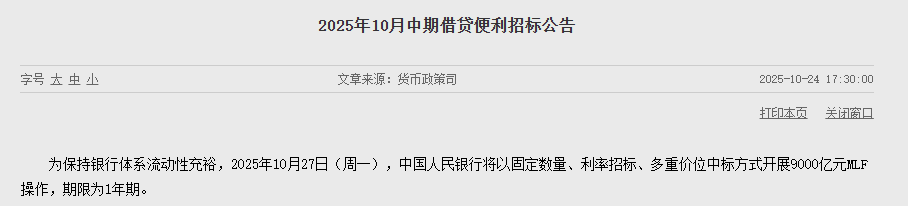
央行预告,下周一,9000亿元
Zhong Guo Zheng Quan Bao· 2025-10-25 00:21
Core Viewpoint - The People's Bank of China (PBOC) is set to conduct a 900 billion yuan MLF operation on October 27 to maintain ample liquidity in the banking system, with a one-year term [1][2]. Group 1: MLF Operations - The PBOC will implement a fixed quantity, interest rate bidding, and multiple price bidding method for the 900 billion yuan MLF operation [1]. - With 700 billion yuan of MLF maturing in October, the net injection of MLF for the month will reach 200 billion yuan, aligning with market expectations [2]. - The continuous net injection of MLF indicates policy consistency and aims to stabilize market expectations while ensuring sufficient liquidity [2]. Group 2: Market Liquidity - In October, the PBOC also conducted a net injection of 400 billion yuan through reverse repos, bringing the total net liquidity injection to 600 billion yuan, consistent with the previous month [2]. - The net injection of medium-term liquidity has been ongoing for five months, with a significant increase in the last three months, primarily due to expected government bond net financing reaching one trillion yuan [2]. - The regulatory authorities are guiding financial institutions to increase credit issuance, while the PBOC's actions signal a sustained commitment to quantitative monetary policy tools [2]. Group 3: Future Monetary Policy - In the near future, the PBOC is expected to utilize various monetary policy tools, including reverse repos and MLF operations, to enhance short- and medium-term market liquidity [3]. - The PBOC aims to optimize the liquidity term structure to meet the demands of government bond issuance and increased credit supply [3]. - The central bank will adapt its monetary policy tools based on macroeconomic conditions to ensure liquidity, support consumption, and stabilize the financial market [3].
1.1万亿元 央行10月9日开展买断式逆回购操作
Sou Hu Cai Jing· 2025-10-09 02:05
Core Points - The People's Bank of China (PBOC) will conduct a 1.1 trillion yuan reverse repurchase operation on October 9, 2025, to maintain ample liquidity in the banking system [1] - The reverse repurchase operation will be conducted with a fixed amount, interest rate bidding, and multiple price bids, with a term of 3 months (91 days) [1] - The PBOC has introduced the reverse repurchase tool in the open market operations since October 28, 2024, targeting primary dealers [1] Summary by Sections Monetary Policy Actions - The PBOC's reverse repurchase operations are aimed at injecting medium-term liquidity into the banking system, helping to stabilize the funding environment [2] - The operations are expected to support government bond issuance and encourage financial institutions to increase credit supply [2] - The PBOC plans to continue conducting reverse repurchase operations, with an expectation of a 6-month term operation later in October [1][2] Market Impact - The announcement of the reverse repurchase operation before the holiday is intended to stabilize market expectations and ensure smooth liquidity post-holiday [2] - The PBOC's actions are part of a broader strategy to enhance liquidity management and support key strategic areas and sectors [2][3] Future Outlook - The PBOC's monetary policy committee has emphasized the need for proactive and targeted monetary policy adjustments based on domestic and international economic conditions [2] - The goal is to align the growth of social financing and money supply with economic growth and inflation expectations [2]
人民银行操作组合式逆回购,持续净投放维稳流动性
Bei Jing Shang Bao· 2025-09-17 12:22
Core Viewpoint - The People's Bank of China (PBOC) is actively managing liquidity through various market operations, including reverse repos, to ensure stable financial conditions and support economic recovery [1][3][5]. Group 1: Liquidity Operations - On September 17, the PBOC conducted a 7-day reverse repo operation of 418.5 billion yuan at a fixed rate of 1.40%, resulting in a net injection of 114.5 billion yuan after accounting for 304 billion yuan maturing that day [1][4]. - On September 15, the PBOC executed a 6-month buyout reverse repo operation of 600 billion yuan, which is designed to provide stable medium-term funding while minimizing disruptions in the bond market [3][5]. - The PBOC's reverse repo operations have shown a pattern of "scale fluctuation adjustment" while maintaining high net injections, with various operations throughout September resulting in significant net liquidity additions [4][5]. Group 2: Interest Rates and Market Conditions - As the end of the quarter approaches and with a recovery in real financing demand, interbank market rates have shown a slight upward trend, with the weighted average rate of the DR007 rising to 1.5404% [4][5]. - Overnight rates have stabilized between 1.40% and 1.45%, while 7-day rates are around 1.50%, indicating a stable liquidity environment [5][6]. Group 3: Future Monetary Policy Outlook - The PBOC is expected to increase liquidity injections to counter tightening pressures as local government bond issuance rises, maintaining an overall accommodative monetary policy stance [5][6]. - The PBOC's monetary policy committee emphasized the need for a moderately loose monetary policy and effective implementation of structural monetary tools to support key sectors such as technology innovation and consumption [5][6].

呵护意图明显 8月以来央行加码投放中长期流动性
Zhong Guo Zheng Quan Bao· 2025-08-24 23:18
Core Viewpoint - The People's Bank of China (PBOC) is actively implementing various monetary policy tools to maintain liquidity in the banking system, with a focus on medium-term liquidity support through operations like MLF and reverse repos [1][2][3]. Group 1: Monetary Policy Operations - A total of 20,770 billion yuan in reverse repos will mature this week, along with 3,000 billion yuan in Medium-term Lending Facility (MLF) and 9,000 billion yuan in buyout reverse repos [1]. - The PBOC has conducted multiple reverse repo operations and MLF operations in August to ensure ample liquidity in the banking system, indicating a commitment to using various monetary policy tools for liquidity adjustment [1][2]. - The PBOC's recent MLF operation on August 25 involved a net injection of 3,000 billion yuan, marking the sixth consecutive month of increased MLF operations [2]. Group 2: Market Liquidity and Interest Rates - The net injection of medium-term liquidity in August reached 6,000 billion yuan, double that of the previous month and the largest since February 2025, signaling a supportive monetary policy stance despite stable economic performance [3]. - Experts predict that the PBOC will continue to use various monetary policy tools to maintain liquidity, with limited upward pressure on market interest rates [4]. - The PBOC aims to create a conducive monetary environment for economic recovery while enhancing communication and transparency regarding liquidity operations [4].
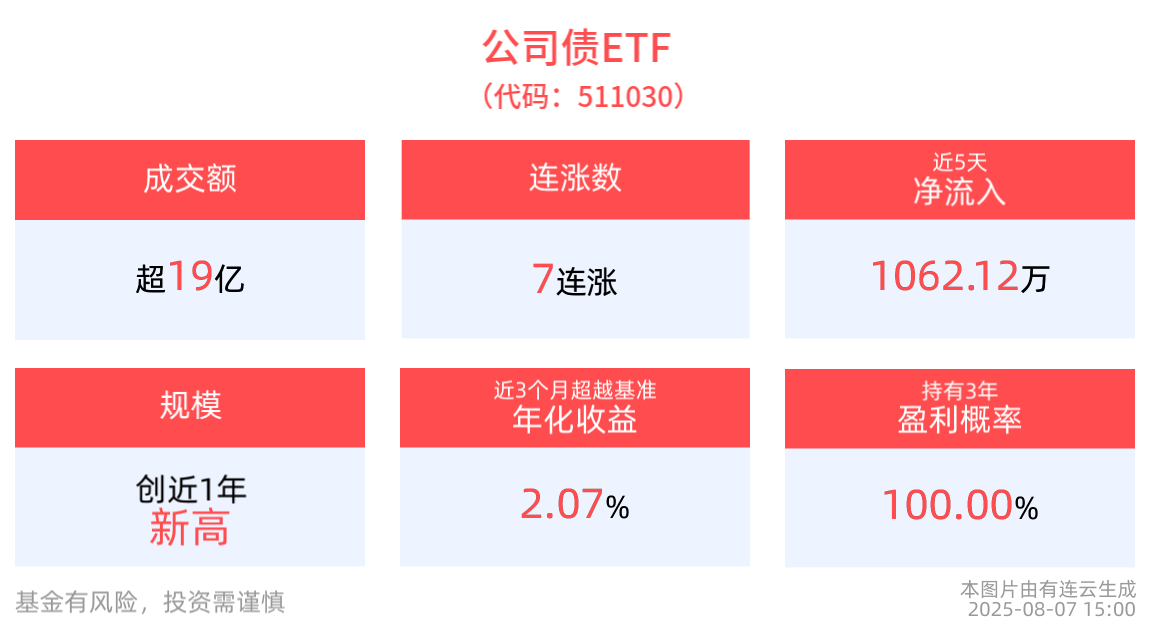
央行将开展7000亿元买断式逆回购操作,公司债ETF(511030)实现7连涨
Sou Hu Cai Jing· 2025-08-08 01:48
Group 1: Bond Issuance by China Development Bank - China Development Bank issued a 1-year bond with a scale of 6 billion yuan and an issuance rate of 1.3618%, with a bid-to-cover ratio of 3.19 times and a marginal ratio of 3.92 times [1] - A 5-year bond was issued with a scale of 11 billion yuan and an issuance rate of 1.6253%, with a bid-to-cover ratio of 3.76 times and a marginal ratio of 1.63 times [1] - A 10-year bond was issued with a scale of 18 billion yuan and an issuance rate of 1.7467%, with a bid-to-cover ratio of 3.28 times and a marginal ratio of 1.53 times [1] Group 2: Central Bank Operations - The People's Bank of China announced a 700 billion yuan 3-month reverse repurchase operation scheduled for August 8 [1] - Industry insiders believe this operation aims to smooth out the peak of fiscal tax payments and preemptively hedge against liquidity pressure at the end of the quarter [1] - The central bank is expected to continue using various monetary policy tools to maintain liquidity and implement a moderately loose monetary policy [1] Group 3: Company Bond ETF Performance - As of August 7, 2025, the company bond ETF (511030) rose by 0.03%, marking a 7-day consecutive increase, with the latest price at 106.3 yuan [4] - The ETF has accumulated a year-to-date increase of 1.14% and has a recent trading volume of 19.94 billion yuan with a turnover rate of 8.92% [4] - The latest scale of the company bond ETF reached 22.363 billion yuan, a new high in nearly a year [4] Group 4: Fund Flows and Leverage - The fund inflow and outflow for the company bond ETF are balanced, with a total inflow of 10.6212 million yuan over the last five trading days [4] - The latest financing buy-in amount for the ETF is 2.477 million yuan, with a financing balance of 16.6183 million yuan [4] Group 5: Historical Performance and Returns - Over the past five years, the net value of the company bond ETF has increased by 13.68% [4] - The ETF's highest single-month return since inception was 1.22%, with the longest consecutive increase lasting 9 months and a maximum increase of 3.80% [4] - The annual profit percentage stands at 83.33%, with a monthly profit probability of 79.91% and a 100% probability of profit over a 3-year holding period [4] Group 6: Risk and Fee Structure - The maximum drawdown for the company bond ETF this year is 0.50%, with a relative benchmark drawdown of 0.08% [5] - The management fee rate for the ETF is 0.15%, and the custody fee rate is 0.05% [5] - The tracking error for the ETF this year is 0.013% [5]