
资金市场利率

Search documents
利率呈“短涨长稳”态势
Qi Huo Ri Bao· 2026-02-25 07:37
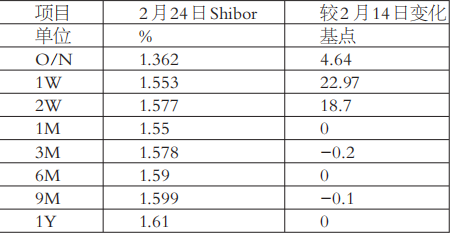
Group 1 - The core viewpoint of the article indicates that the money market interest rates are experiencing a "short-term rise and long-term stability" trend following the holiday period, driven by increased funding demand as businesses resume normal operations and the expiration of a large amount of reverse repos [1][3]. Group 2 - As of February 24, the Shanghai Interbank Offered Rate (Shibor) for overnight, 1-week, and 2-week periods reported at 1.362%, 1.553%, and 1.577% respectively, showing increases of 4.64, 22.97, and 18.7 basis points compared to February 14 [2]. - The 1-month, 6-month, and 1-year Shibor rates remained unchanged at 1.55%, 1.59%, and 1.61% respectively, while the 3-month and 9-month rates decreased slightly by 0.2 and 0.1 basis points [2]. Group 3 - A total of 852.4 billion yuan in reverse repos expired during the Spring Festival holiday, with an additional 800 billion yuan in 14-day reverse repos set to expire this week, indicating significant pressure for capital recovery in the market [3]. - The central bank conducted a reverse repo operation of 526 billion yuan on the first trading day after the holiday, and with 300 billion yuan in Medium-term Lending Facility (MLF) maturing this week, it is expected that the central bank will likely conduct an excess rollover to alleviate short-term funding tightness [3].

短端利率上行
Qi Huo Ri Bao· 2026-02-12 09:15
Group 1 - The core viewpoint of the articles indicates that the short-term interest rates in the money market have shown a pattern of short-term increases and long-term decreases, driven by strong demand for funds ahead of the Spring Festival and expectations of continued accommodative monetary policy from the central bank until 2026 [1][2] - As of February 11, the Shanghai Interbank Offered Rate (Shibor) for overnight, 1-week, 2-week, and 1-month periods were reported at 1.366%, 1.523%, 1.6%, and 1.5511% respectively, reflecting increases of 4.8, 5, 1.7, and 0.11 basis points compared to February 4 [1] - The central bank has increased its reverse repurchase operations to counteract the strong demand for funds before the holiday, conducting 9029 billion yuan in reverse repos in the first three working days of the week, including 5029 billion yuan for 7-day and 4000 billion yuan for 14-day reverse repos [1] Group 2 - Post-holiday, the domestic money market interest rates are expected to be weak in the short term but stable in the long term, as the demand for funds is anticipated to decrease significantly despite a large amount of reverse repos maturing [2] - The central bank's recent commitment to continue implementing a moderately accommodative policy is likely to lead to a re-pricing of interest rates in the market, with expectations that medium- to long-term rates will stabilize after adjustments [2]
近期利率全面回落
Qi Huo Ri Bao· 2026-02-04 03:14
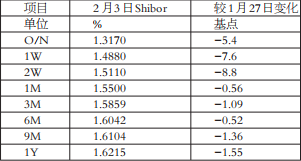
Group 1 - The domestic funding market interest rates have shown a comprehensive downward trend recently, with short-term rates slightly decreasing as of early February after the demand release at the end of January [1] - The People's Bank of China (PBOC) has increased the Medium-term Lending Facility (MLF) injection, leading to ample market liquidity and suppressing the trend of medium to long-term interest rates [1] - The Shibor rates have decreased across various tenors, with the Overnight (O/N) rate at 1.3170%, down by 5.4 basis points, and the 1-Year (1Y) rate at 1.6215%, down by 1.55 basis points compared to January 27 [2] Group 2 - To meet the funding demand at the end of January, the PBOC increased the reverse repurchase operations, resulting in a maturity of 1.7615 trillion yuan in 7-day reverse repos this week [3] - The PBOC is expected to withdraw significant liquidity through reverse repos, and the domestic funding market rates are anticipated to exhibit a "short-term rise and long-term decline" pattern, especially as the Spring Festival approaches [3] - The recent significant decline in commodity prices has led to a decrease in market risk appetite and a subsequent drop in investment demand, contributing to the weakening of medium to long-term interest rates [3]
1个月期国库现金定存利率降至1.73%
Bei Jing Shang Bao· 2025-11-24 15:52
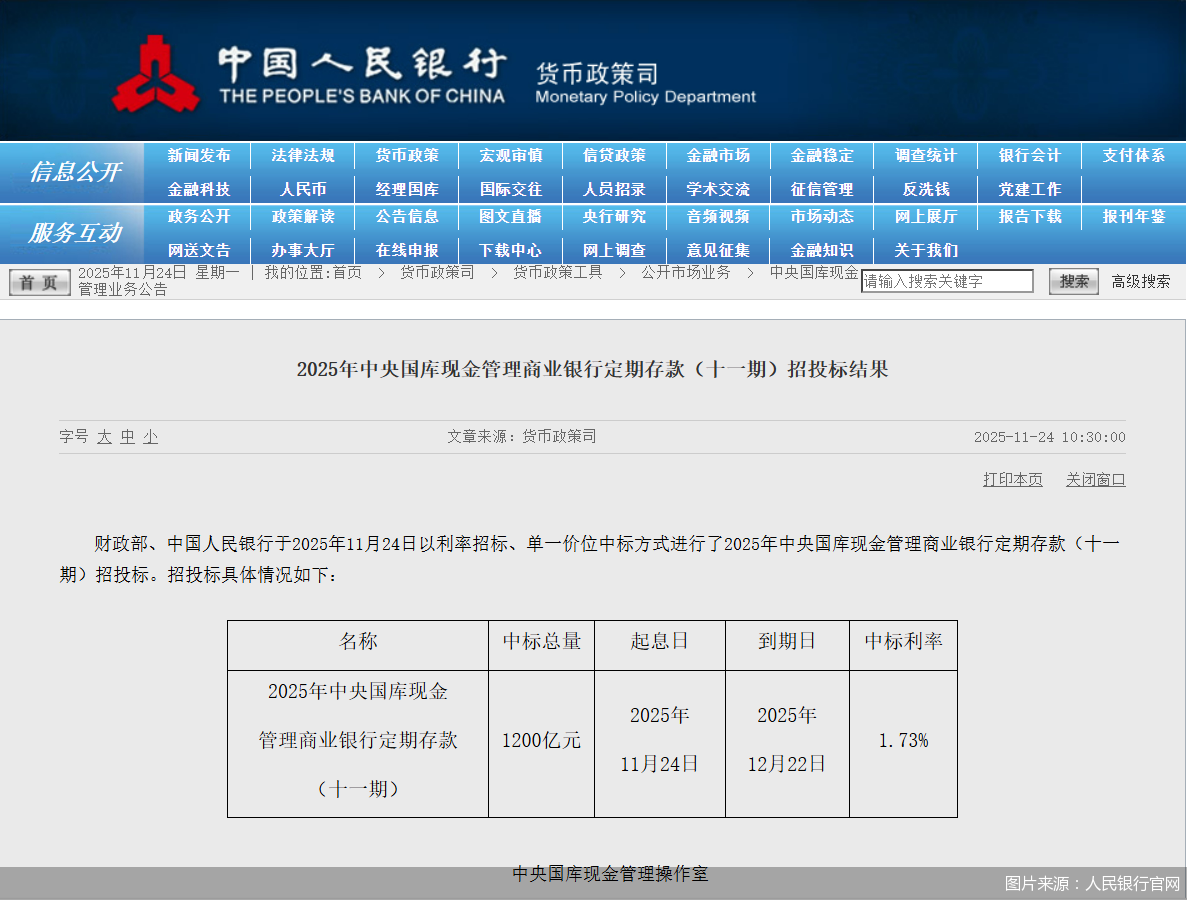
Group 1 - The Ministry of Finance and the People's Bank of China conducted a tender for the 2025 Central Treasury Cash Management Commercial Bank Time Deposits, with a total bid amount of 120 billion and a bid rate of 1.73%, down 3 basis points from the previous rate of 1.76%, indicating a reasonable liquidity level in the banking system [1] - The Central Treasury Cash Deposits have been conducted 12 times this year, covering 1-month, 2-month, and 3-month terms, with the recent 6 operations showing a gradual decline in bid rates from 1.78% to 1.73% [1] - The decline in treasury deposit rates suggests a weakening demand from commercial banks for these funds, reflecting an overall reasonable liquidity in the banking system [1] Group 2 - While the treasury deposit rates are declining, the interbank funding market rates have shown a slight increase, with the 7-day SHIBOR rising by 3 basis points to 1.447% and the 1-month SHIBOR increasing by 0.1 basis points to 1.52% [2] - The divergence in rates is attributed to different pricing logic, with treasury deposit rates determined through a bidding process and SHIBOR reflecting short-term funding needs, influenced by month-end liquidity pressures [2] Group 3 - The People's Bank of China has been injecting liquidity through various monetary tools, including a net injection of 557 billion via 7-day reverse repos on November 24, following previous net injections on November 19, 20, and 21 [3] - The recent decline in the 1-month treasury cash deposit rate is expected to lower short-term funding costs for commercial banks, improving their interest margin and signaling a degree of monetary easing [3] - Future expectations suggest that the 1-month treasury cash deposit rate may remain stable, as the People's Bank of China is likely to maintain its accommodative policy stance despite seasonal tightening pressures at year-end [3]
1个月期国库现金定存利率下降至1.73%,资金面宽松信号持续释放
Bei Jing Shang Bao· 2025-11-24 13:08
Core Viewpoint - The recent auction of the 2025 Central Treasury Cash Management time deposits indicates a slight decrease in the bidding interest rate, reflecting a reasonable liquidity level in the banking system [1][6]. Group 1: Auction Details - The auction held on November 24 resulted in a total bid amount of 120 billion yuan with a bidding interest rate of 1.73%, down from 1.76% in the previous auction, marking a decrease of 3 basis points [1][4]. - The term for this deposit is set at one month, with the interest rate showing a downward trend over the last six auctions [6]. Group 2: Market Implications - The decline in the treasury cash deposit interest rate suggests a reduced demand for these funds by commercial banks, indicating that the banking system is not facing significant liquidity shortages [6][8]. - In contrast, the interbank market rates, such as the Shanghai Interbank Offered Rate (SHIBOR), have shown a slight increase, indicating differing pricing logic between treasury deposits and interbank borrowing [7]. Group 3: Central Bank Actions - The People's Bank of China has been actively injecting liquidity into the market, conducting a net injection of 55.7 billion yuan through a 7-day reverse repurchase operation on November 24, following several days of similar operations [7]. - The central bank plans to conduct a 10 billion yuan Medium-term Lending Facility (MLF) operation on November 25, aiming to maintain a multi-layered liquidity adjustment system [7]. Group 4: Future Outlook - The downward trend in the one-month treasury cash deposit interest rate is expected to help lower short-term funding costs for commercial banks, although the scale of this operation is limited and primarily serves as a signal [8]. - The overall monetary policy stance of the People's Bank of China is expected to remain stable, with a clear intention to counter seasonal liquidity pressures as the year-end approaches [8].
近来资金利率短涨长跌
Qi Huo Ri Bao· 2025-11-12 01:21
Core Viewpoint - The domestic funding market interest rates are experiencing a short-term rise and long-term decline trend, influenced by tax payments and liquidity injections from the central bank [1][3]. Interest Rate Summary - As of November 11, the Shanghai Interbank Offered Rate (Shibor) for overnight, 1-week, and 2-week rates are reported at 1.508%, 1.501%, and 1.518%, showing increases of 19.3, 8.6, and 4 basis points respectively compared to November 4 [2]. - The 1-month, 3-month, 6-month, 9-month, and 1-year rates are reported at 1.525%, 1.58%, 1.618%, 1.639%, and 1.65%, reflecting decreases of 2.1, 1.4, 0.85, 1.3, and 0.8 basis points respectively compared to November 4 [2]. Central Bank Operations - The central bank has a total of 495.8 billion yuan in reverse repos maturing this week and has conducted 523.7 billion yuan in reverse repo operations in the first two working days to stabilize short-term funding demand [3]. - The central bank is expected to release significant liquidity into the market through reverse repos during the week [3]. Economic Outlook - In October, the Consumer Price Index (CPI) rose from a year-on-year decline of 0.4% to an increase of 0.2%, enhancing market confidence and supporting long-term interest rates [3]. - Future expectations indicate a reversal in domestic funding market interest rates, likely transitioning to a short-term decline and long-term increase pattern as short-term funding demand subsides post-tax payments [3].

资金利率全面回升
Qi Huo Ri Bao Wang· 2025-09-11 00:19
Core Viewpoint - The domestic funding market interest rates are experiencing a comprehensive rebound due to government bond issuance, concentrated tax payments, and increased funding demand at the end of the month [1] Group 1: Interest Rate Trends - As of September 10, the Shanghai Interbank Offered Rate (Shibor) for various terms has increased, with overnight, 1-week, 2-week, 1-month, 3-month, 6-month, 9-month, and 1-year rates reported at 1.425%, 1.449%, 1.501%, 1.528%, 1.553%, 1.621%, 1.653%, and 1.663% respectively, showing increases of 10.9, 1.6, 1.5, 1.1, 0.3, 1.1, 0.8, and 0.7 basis points compared to September 3 [1] Group 2: Central Bank Operations - The central bank has 10,684 billion yuan in reverse repos maturing this week and has conducted 7,425 billion yuan in reverse repo operations in the first three working days of the week, indicating a likely increase in reverse repo injections to stabilize funding rates [1] Group 3: Future Expectations - In the short term, funding market interest rates are expected to maintain a strong trend due to the convergence of seasonal funding demands from the end of the quarter and upcoming holidays, with short-term rates likely to continue rising [1] - Overall financing demand is recovering, and mid-to-long-term rates are expected to remain stable with a slight upward trend [1]
近期利率全面上升
Qi Huo Ri Bao Wang· 2025-07-30 01:19
Core Viewpoint - The domestic funding market interest rates have risen across the board due to increased demand for funds and expectations of future funding needs driven by government infrastructure projects [1] Group 1: Interest Rate Movements - As of July 29, the Shanghai Interbank Offered Rate (Shibor) for various terms has increased, with overnight, 1-week, 2-week, 1-month, 3-month, 6-month, 9-month, and 1-year rates reported at 1.366%, 1.545%, 1.631%, 1.55%, 1.56%, 1.613%, 1.632%, and 1.644% respectively, showing increases of 4.9, 8.3, 8, 2.1, 1.1, 2.2, 2, and 2.3 basis points compared to July 22 [1] Group 2: Central Bank Operations - The central bank has 16,563 billion yuan in reverse repos maturing this week and has conducted 9,450 billion yuan in reverse repo operations in the first two working days to inject liquidity into the market [1] - On July 25, the central bank had 2,000 billion yuan in Medium-term Lending Facility (MLF) maturing and rolled over 4,000 billion yuan, injecting 2,000 billion yuan into the market [1] Group 3: Future Outlook - The funding market interest rates are expected to exhibit a "short-term decline and long-term rise" trend, with short-term rates under pressure due to a decrease in demand at the beginning of the month [1] - The frequent introduction of proactive fiscal policies may lead to a continued slight increase in long-term rates [1]