
20年期日本国债

Search documents
20年期日本国债收益率上涨6.5个基点,至2.945%
Mei Ri Jing Ji Xin Wen· 2026-02-25 05:51
Group 1 - The 20-year Japanese government bond yield increased by 6.5 basis points to 2.945% [1]
拍卖需求持续稳健 日本国债市场企稳
智通财经网· 2026-02-19 06:47
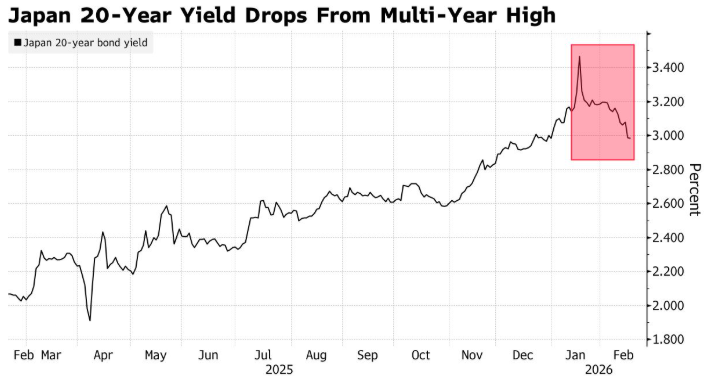
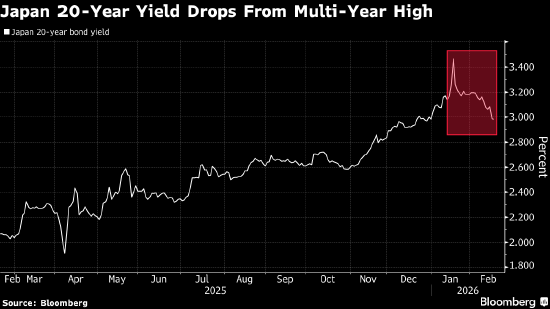
Core Viewpoint - Despite a decline in demand for the 20-year Japanese government bond auction, the Japanese bond market remains stable, indicating strong investor confidence [1] Group 1: Auction Results - The subscription ratio for the 30-year Japanese government bond fell to 3.08, below the previous issuance level and the average of the past 12 months [1][4] - The yield on the 20-year Japanese government bond is currently around 2.97%, significantly down from the peak of 3.46% last month, which was the highest level since 1997 [1] - The auction coverage ratio was lower than the last auction at 3.19 and below the average of 3.29 over the past 12 months, marking the lowest level since May [4] Group 2: Market Reactions - The yield on the benchmark 10-year Japanese government bond rose by 1 basis point, while bond futures prices slightly declined [1] - The bond market is under pressure globally, influenced by cautious comments from Federal Reserve officials regarding interest rate cuts and robust U.S. economic data [4] - Japanese bond traders can refocus on the theme of yield curve flattening after the completion of the 20-year bond issuance, with all indicators falling within recent expectations [4] Group 3: Investor Sentiment - Strong short-covering demand supported the auction, with expectations that pension funds will sell stocks and buy bonds for portfolio rebalancing amid rising stock prices [1] - The proposed accounting standard changes for insurance companies regarding fixed-income securities holdings may provide additional support for Japanese government bond prices [6] - The sentiment in the market improved following a successful auction of 5-year Japanese government bonds, as expectations for early interest rate hikes by the Bank of Japan have diminished [6] Group 4: Risks and Challenges - The four major life insurance companies in Japan have seen unrealized losses on their holdings of Japanese government bonds, highlighting the risks associated with investing in a volatile bond market [5] - Investors are awaiting further clarification from the Japanese Prime Minister on how to balance tax cuts with increased defense and strategic industry spending [4]

日本迎来大选后首次超长期国债拍卖考验 交易员严阵以待
Xin Lang Cai Jing· 2026-02-18 22:39
Core Viewpoint - The issuance of 20-year Japanese government bonds will be the first test of demand for ultra-long-term bonds since the Prime Minister's election victory triggered a surge in buying interest [1][4]. Group 1: Market Reaction and Bond Yields - In January, concerns over fiscal policy due to Prime Minister Kishi's plan to cut the food consumption tax for two years led to significant volatility in the Japanese bond market, with yields rising to multi-year highs [1][4]. - The current yield on 20-year Japanese government bonds is around 2.97%, a notable decrease from last month's peak of 3.46%, which was the highest level since 1997 [5]. - The rapid decline in ultra-long-term rates post-election may deter domestic institutional investors, such as life insurance companies, from actively participating in the 20-year bond auction [5]. Group 2: Foreign Investment and Demand Dynamics - As domestic life insurance companies remain cautious and the Bank of Japan reduces its bond purchases, the proportion of foreign investors in the subscription is increasing, amplifying volatility in the Japanese bond market [5]. - Recent declines in ultra-long-term yields appear to be primarily driven by foreign investors, indicating that the upcoming auction will test whether this trend continues after significant yield reductions [5][7]. Group 3: Strategic Insights from Investment Firms - PIMCO favors 30-year Japanese government bonds, while Mark Nash from Jupiter Asset Management is making a long-term strategic bet on rising Japanese bond prices [7]. - The fundamental issue of supply-demand imbalance remains unresolved, with demand for ultra-long-term bonds continuing to rely on foreign investors and pension fund rebalancing [7]. - Investors are awaiting clearer signals on how Prime Minister Kishi will balance the food consumption tax cut with increased defense and strategic industry spending [7].
20年期日债收益率涨1.5bp
Jin Rong Jie· 2026-02-16 01:25
Core Viewpoint - The yield on Japan's 20-year government bonds has increased by 1.5 basis points, reaching 3.060% [1] Group 1 - The rise in yield indicates a potential shift in investor sentiment towards long-term government debt in Japan [1] - The increase in yield may reflect broader economic conditions and expectations regarding inflation and interest rates in Japan [1]
20年期日本国债收益率上涨1.5个基点,至3.060%
Mei Ri Jing Ji Xin Wen· 2026-02-16 01:08
Core Viewpoint - The 20-year Japanese government bond yield has increased by 1.5 basis points, reaching 3.060% [1] Group 1 - The rise in the 20-year Japanese government bond yield indicates a potential shift in investor sentiment towards long-term debt instruments [1]
5年期、20年期日债收益率走高
Jin Rong Jie· 2026-02-09 04:48
Group 1 - The 5-year Japanese government bond yield increased by 4.0 basis points to 1.725% [1] - The 20-year Japanese government bond yield rose by 1.5 basis points to 3.145% [1]
20年期日本国债收益率下跌3.0个基点,至3.150%
Xin Lang Cai Jing· 2026-02-05 06:58
Group 1 - The 20-year Japanese government bond yield decreased by 3.0 basis points to 3.150% on February 5 [1]
每日机构分析:1月20日
Xin Hua Cai Jing· 2026-01-20 08:54
Group 1 - The recent strengthening of the RMB is attributed to seasonal factors, with increased demand for currency exchange expected in December, leading to a typical appreciation of 0.5% and 0.8% against the USD in December and January respectively, with probabilities of 75% and 67% [1] - A survey by Bank of America indicates that global investor sentiment is at its highest since July 2021, with cash holdings dropping to a historical low of 3.2%, and 38% of respondents expecting economic growth, while concerns about recession are at a two-year low [2] - Lombard Odier strategists suggest that geopolitical risks, particularly related to US tariffs on European countries, may increase risk premiums, with gold expected to lead the market [3] Group 2 - Citigroup's Japan market head indicates that if the yen remains weak, the Bank of Japan may raise interest rates three times in 2026, potentially doubling the current rate, with a first increase expected if the USD/JPY rate exceeds 160 [3] - The Bank of Japan is anticipated to raise its economic growth forecast and signal readiness for further rate hikes due to yen depreciation and inflation risks, although specific timing for rate increases remains uncertain [3] - A weak 20-year Japanese government bond auction has led to further selling of Japanese bonds, with concerns over government fiscal conditions and potential increases in government spending regardless of the election outcome [4]
20年期日本国债收益率上升3.0个基点至3.015%
Mei Ri Jing Ji Xin Wen· 2026-01-05 00:56
Group 1 - The 20-year Japanese government bond yield increased by 3.0 basis points to 3.015% [1]
20年期日本国债收益率创纪录新高
Jing Ji Guan Cha Wang· 2025-12-19 05:11
Core Insights - The yield on 10-year Japanese government bonds has risen by 4.5 basis points to 2.010%, marking the highest level since 1999 [1] - The yield on 20-year Japanese government bonds has increased by 3 basis points to 2.965%, setting a new record high [1]