
10年期日本国债

Search documents
拍卖需求持续稳健 日本国债市场企稳
智通财经网· 2026-02-19 06:47
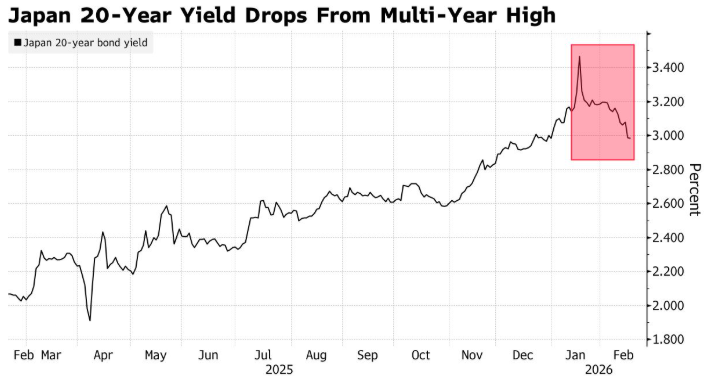
Core Viewpoint - Despite a decline in demand for the 20-year Japanese government bond auction, the Japanese bond market remains stable, indicating strong investor confidence [1] Group 1: Auction Results - The subscription ratio for the 30-year Japanese government bond fell to 3.08, below the previous issuance level and the average of the past 12 months [1][4] - The yield on the 20-year Japanese government bond is currently around 2.97%, significantly down from the peak of 3.46% last month, which was the highest level since 1997 [1] - The auction coverage ratio was lower than the last auction at 3.19 and below the average of 3.29 over the past 12 months, marking the lowest level since May [4] Group 2: Market Reactions - The yield on the benchmark 10-year Japanese government bond rose by 1 basis point, while bond futures prices slightly declined [1] - The bond market is under pressure globally, influenced by cautious comments from Federal Reserve officials regarding interest rate cuts and robust U.S. economic data [4] - Japanese bond traders can refocus on the theme of yield curve flattening after the completion of the 20-year bond issuance, with all indicators falling within recent expectations [4] Group 3: Investor Sentiment - Strong short-covering demand supported the auction, with expectations that pension funds will sell stocks and buy bonds for portfolio rebalancing amid rising stock prices [1] - The proposed accounting standard changes for insurance companies regarding fixed-income securities holdings may provide additional support for Japanese government bond prices [6] - The sentiment in the market improved following a successful auction of 5-year Japanese government bonds, as expectations for early interest rate hikes by the Bank of Japan have diminished [6] Group 4: Risks and Challenges - The four major life insurance companies in Japan have seen unrealized losses on their holdings of Japanese government bonds, highlighting the risks associated with investing in a volatile bond market [5] - Investors are awaiting further clarification from the Japanese Prime Minister on how to balance tax cuts with increased defense and strategic industry spending [4]

别等7月了!瑞穗高管放狠话:日本或在3月加息,全年加息3次
Xin Lang Cai Jing· 2026-02-12 08:07
Core Viewpoint - The Bank of Japan is expected to raise its benchmark interest rate as early as March, with potential for up to three rate hikes by 2026 due to persistent inflation and a weak yen [1][3]. Group 1: Interest Rate Predictions - Kenya Koshimizu from Mizuho Financial Group indicates that the next interest rate hike could occur in March or April, driven by a weak yen and inflation rates exceeding the Bank of Japan's target [1][3]. - Koshimizu forecasts up to three rate hikes this year, reflecting a more aggressive stance compared to other economists who predict action may not occur until July [1][3]. Group 2: Economic Factors - Current positive economic indicators include a nominal GDP growth rate of 3% to 4% and clearer policy strategies from Prime Minister Fumio Kishida [1][3]. - The Bank of Japan raised its policy rate to 0.75%, the highest in 30 years, in December, signaling readiness for further increases [1][3]. Group 3: Bond Market Insights - Koshimizu believes that the current bond yields are reasonable, with the 10-year Japanese government bond yield in the 2% range being expected in a 3% to 4% nominal growth environment [2][4]. - The 10-year yield reached a 27-year high of 2.38% in late January due to concerns over Japan's fiscal health but has since retreated to around 2.2% [2][4].
10年期日本国债收益率上涨4.5个基点,至2.275%
Xin Lang Cai Jing· 2026-02-09 04:46
Core Viewpoint - The 10-year Japanese government bond yield increased by 4.5 basis points to 2.275% on February 9 [1] Group 1 - The rise in the 10-year Japanese government bond yield indicates a shift in market sentiment towards interest rates [1]
大选前夕的“及时雨”!日本30年期国债拍卖需求强劲 缓解市场抛售压力
智通财经网· 2026-02-05 07:07
Group 1 - Strong demand for Japan's 30-year government bonds led to a price increase, alleviating concerns over the upcoming Senate election [1] - The bid-to-cover ratio for the recent bond auction rose to 3.64, above the previous auction's 3.14 and the 12-month average of 3.35 [1] - Long-term bonds, including the 40-year bonds, saw significant buying support, with the 40-year yield dropping by 9.5 basis points to 3.845% [1] Group 2 - Investors are expected to return to the long-term Japanese bond market after the upcoming early election, with a 10-year yield of 2.5% seen as a buying trigger [2] - The recent auction tested investor demand for long-term bonds amid concerns over fiscal spending, with the 10-year yield currently around 2.25% [2] Group 3 - Prime Minister Suga's proposal to lower food consumption tax caused a spike in bond yields to historical highs, impacting global bond markets [3] - Public support for Suga remains strong, and the ruling party is expected to secure an absolute majority in the election, which may stabilize market conditions [3] - The strong demand for the 30-year bond auction exceeded the average level for 1-year bonds, boosting market confidence [3] Group 4 - Concerns over yen depreciation persist, with hedge funds preparing to short the yen ahead of the election [5] - Investors are closely monitoring how the election results will influence the Bank of Japan's interest rate path, as Suga is known for his loose monetary policy [5]
瑞穗:日债“买方罢工”行情将在周末大选后终结,机构正待收益率触及“买入点”
Zhi Tong Cai Jing· 2026-02-05 02:25
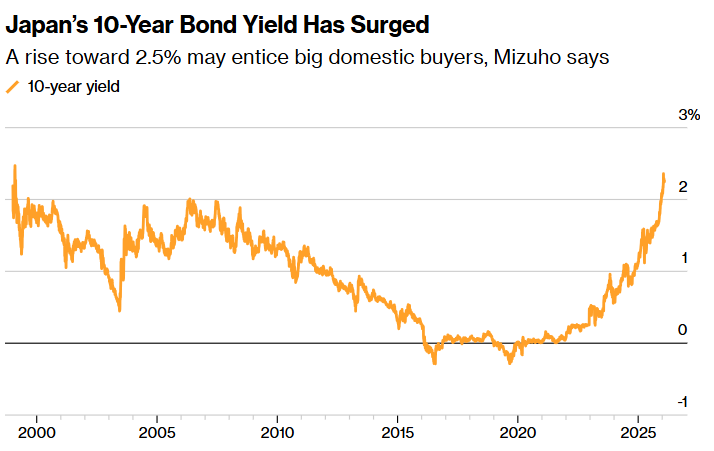
Group 1 - Investors are expected to return to the long-term Japanese government bond market following the upcoming snap elections, with large asset management firms viewing a 2.5% yield on 10-year Japanese government bonds as a buying trigger [1] - Jordan Rochester, the macro strategy head at Mizuho Bank, noted that the uncertainty surrounding the elections is likely to dissipate, potentially ending the current strike by long-term buyers [1] - Major Japanese investors, including life insurance companies and asset management firms, are waiting for yields to rise slightly before making purchases, with current yields hovering around 2.25% [1] Group 2 - Ahead of Prime Minister Kishida's announcement of early elections, the yield on 10-year Japanese government bonds rose to 2.38%, the highest level since 1999 [4] - Domestic investors have been avoiding the long-term bond market due to concerns over increasing fiscal worries and market volatility, which has weakened demand despite some foreign investors filling the gap [4] - The Japanese government plans to issue approximately 700 billion yen (about 4.5 billion USD) in 30-year bonds next Thursday, which will test the demand for long-term Japanese government bonds [4] Group 3 - Rochester anticipates that the 10-year Japanese government bond yield could rise to 3% by the end of the year, driven by higher demand for longer-term government bond premiums and Japan's economic recovery from years of deflation [4]
10年期日本国债收益率上涨1个基点,至2.255%
Mei Ri Jing Ji Xin Wen· 2026-02-05 00:33
Group 1 - The 10-year Japanese government bond yield has increased by 1 basis point to 2.255% [1]
日央行放宽收益率控制引升值
Jin Tou Wang· 2026-02-03 03:20
Core Viewpoint - The Japanese yen has experienced significant fluctuations due to changes in the Bank of Japan's monetary policy, particularly the adjustment of the yield curve control policy, which has led to a short-term appreciation of the yen while long-term trends remain influenced by various factors [1][2]. Group 1: Monetary Policy Adjustments - On February 2, the Bank of Japan announced an adjustment to its core monetary policy, expanding the 10-year Japanese government bond yield fluctuation range from ±0.25% to ±0.5%, marking the first change in three years [1]. - This policy adjustment is aimed at addressing domestic inflation changes and enhancing monetary policy flexibility, with Japan's core CPI expected to rise by 2.3% in 2025, exceeding the central bank's 2% inflation target for four consecutive years [1][2]. Group 2: Inflation and Economic Indicators - The January Tokyo core CPI increased by 2.0% year-on-year, the lowest since March 2022, but still close to the central bank's target, indicating persistent inflationary pressures [2]. - The unemployment rate remains stable at 2.6%, providing a foundation for potential policy tightening, while December's industrial output growth rate exceeded expectations at 2.6%, suggesting some momentum in Japan's economic recovery [2]. Group 3: Currency Market Dynamics - Despite the Bank of Japan signaling a tightening stance, the divergence in monetary policies between the U.S. and Japan continues to support the yen in the long term, with the 10-year U.S.-Japan government bond yield spread at 198.8 basis points as of February 2 [3]. - The market anticipates that if inflation remains above 2%, the Bank of Japan will gradually raise interest rates in 2026, although the pace will be cautious [2][3]. Group 4: Political and Market Implications - The upcoming Japanese general election on February 8 is expected to influence currency policies, with the weak yen and rising living costs being key issues in the election [3][4]. - Concerns about potential official intervention in the currency market have increased, particularly if there are no substantial actions following the election, which could lead to the dollar-yen exchange rate entering a new range of fluctuations [4][5].
日本首相高市早苗需先说服债券投资者 再争取选民支持
Xin Lang Cai Jing· 2026-02-02 09:19
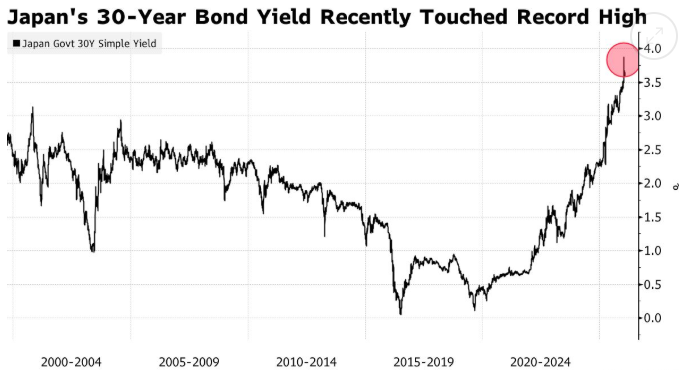
Core Viewpoint - Japanese Prime Minister Sanna Takashi is facing a critical market test ahead of the upcoming snap election, aiming for a decisive victory to gain authorization for expansionary fiscal policies [1][6]. Group 1: Bond Auction and Market Reactions - The Japanese Ministry of Finance plans to auction approximately 700 billion yen (about 4.5 billion USD) of 30-year government bonds three days before the election [1][7]. - Concerns over fiscal loosening have made these bonds particularly sensitive, as evidenced by a significant drop in their value last month due to investor resistance to Takashi's commitment to suspend the food consumption tax [1][7]. - In the past five auctions of 30-year bonds, four saw yields spike to historical highs immediately after the auction preparation or results were announced [2][8]. Group 2: Investor Sentiment and Yield Trends - The yield on 30-year Japanese government bonds was around 3.63% on Monday, having increased by approximately 0.5 percentage points since early October, despite a slight retreat from a historical high of 3.46% on January 20 [3][9]. - The term premium for 30-year bonds is calculated at 2.8 percentage points, significantly steeper than the 1.6 percentage points for 10-year bonds, indicating heightened investor caution [3][9]. Group 3: Market Composition and Foreign Investment - The Japanese sovereign bond market is primarily funded by domestic investors, with no actual risk of capital outflow; however, the share of foreign accounts, particularly hedge funds, in ultra-long-term bond trading has been increasing [4][10]. - As of December last year, foreign investors accounted for approximately 46% of ultra-long-term bond trading, a substantial increase from 13% a year prior [4][10]. - The current market dynamics are characterized by speculative funds rather than long-term investment, leading to increased volatility as traditional buyers like life insurance companies and pension funds withdraw [4][10].
40年期日本国债拍卖周三来袭,分析师警惕“崩盘”重演
Zhi Tong Cai Jing· 2026-01-27 09:01
Core Viewpoint - The Japanese bond market is facing significant volatility risks ahead of the upcoming 40-year government bond auction, with analysts warning of potential "collapse" similar to previous events due to rising yields and political uncertainties [1][2]. Group 1: Auction Risks - Traders are cautious about the upcoming auction of 40-year Japanese government bonds, which follows a recent spike in yields to historical highs [1]. - Barclays Securities strategists highlighted that risks related to fiscal policy could exacerbate yield pressures, potentially leading to disappointing auction results [1]. - Weak auction outcomes could trigger a sell-off in long-term bonds, putting additional pressure on the yen and increasing speculation about government intervention in the foreign exchange market [1]. Group 2: Political Uncertainty - The current market environment is unfavorable for bond auctions due to uncertainties surrounding election outcomes and food tax reductions, prompting a more cautious investor stance [2]. - The Japanese government is reportedly prepared to take action to prevent further depreciation of the yen and rising bond yields, as indicated by recent comments from Prime Minister Fumio Kishida [2]. - Polls show a slight decline in Kishida's approval ratings, indicating potential risks associated with the decision to hold early elections [2]. Group 3: Future Bond Auctions - Upcoming auctions for 10-year and 30-year Japanese government bonds will serve as critical tests for investor demand for long-term bonds [3]. - Concerns over food tax reductions are heightening cautious sentiment regarding all government bond auctions during the election period [3].
10年期日本国债收益率上升3.5个基点,至2.270%
Mei Ri Jing Ji Xin Wen· 2026-01-27 01:09
Group 1 - The 10-year Japanese government bond yield increased by 3.5 basis points to 2.270% [1]