结汇需求

Search documents
人民币升至6.8,年内有望冲6.5,老百姓留学、出游更划算
Sou Hu Cai Jing· 2026-02-27 23:18
Group 1 - The offshore and onshore RMB exchange rates against the US dollar have both surpassed the 6.84 mark, marking the entry of the RMB into the "6.8 era" with a midpoint rate of 6.9228, the highest in 34 months since April 2023 [1] - The strong appreciation of the RMB is influenced by a dramatic factor involving the investigation of Federal Reserve Chairman Jerome Powell, which has raised doubts about the independence of the Fed and subsequently affected investor confidence in the US dollar [3][4] - In 2025, China's trade surplus reached $1.189 trillion, making it the first economy to exceed a $1 trillion trade surplus in a single year, contributing approximately 5.5% to China's GDP [8] Group 2 - The appreciation of the RMB has direct effects on ordinary Chinese citizens, with significant savings on expenses for studying abroad and traveling, as the cost of education and travel has decreased due to the stronger currency [7] - The strong RMB has led to increased demand for currency exchange as export companies accumulate substantial dollar positions, with a notable surplus in currency exchange transactions in January 2026 [10] - Different industries are experiencing varied impacts from the RMB appreciation; for instance, airlines benefit from reduced costs in dollar-denominated fuel purchases, while textile manufacturers face squeezed profit margins due to lower returns from exports [10][11] Group 3 - The People's Bank of China is focusing on counter-cyclical adjustments in its exchange rate mechanism, aiming to manage market expectations and prevent excessive fluctuations, rather than pursuing a significant appreciation of the RMB [13] - The strengthening of the RMB indicates a reset in the attractiveness of Chinese assets in global asset allocation, with the stability and potential appreciation of the RMB becoming a key factor in attracting international capital [14]



人民币对美元汇率创近三年新高,后续走势如何?
Xin Hua Cai Jing· 2026-02-26 15:05
Core Viewpoint - The recent appreciation of the Renminbi (RMB) is attributed to multiple factors, including a weaker US dollar, improved external conditions, and accelerated release of settlement demand from previous high export growth [1][2][3]. Group 1: RMB Exchange Rate Trends - As of February 26, the onshore RMB reached a high of 6.8310, while the offshore RMB peaked at 6.8267, both marking the highest levels since April 2023 [1]. - The RMB has appreciated over 2% against the US dollar since the beginning of 2026, with the central parity rate increasing by 93 basis points to 6.9228 on the same day [1]. - In February, the cumulative appreciation of the RMB against the US dollar is approximately 450 basis points [1]. Group 2: Factors Influencing RMB Strength - Analysts attribute the RMB's strength to a weaker US dollar, the anticipated release of settlement demand post-September 2025, and the resilience of the domestic economy [1][2]. - The CFETS RMB exchange rate index has shown a stable pattern, indicating that the RMB's strength is primarily driven by the overall weakness of the US dollar [1]. - The ongoing strong signals from the central parity rate and the release of settlement demand are key factors supporting the RMB's appreciation [2]. Group 3: Future Outlook - Analysts expect the RMB to continue its strong performance in the short term, with a likelihood of maintaining a dual-directional fluctuation and moderate appreciation [3][4]. - The People's Bank of China has emphasized the role of the exchange rate as an automatic stabilizer for the macroeconomy and international balance of payments [3]. - The RMB's potential for significant unilateral appreciation is constrained in the short term, but a "slow bull" appreciation trend remains feasible in the medium term due to expected further interest rate cuts by the Federal Reserve and gradual domestic economic recovery [3][4].
人民币持续创新高,什么原因?
Xin Lang Cai Jing· 2026-02-26 05:38
Core Viewpoint - The Chinese yuan (RMB) has shown a strong upward trend against the US dollar following the Spring Festival holiday, with significant appreciation observed in both onshore and offshore markets [3][10]. Group 1: Exchange Rate Movements - On February 26, the offshore RMB reached a peak of 6.83605 against the US dollar, appreciating over 0.25% from the previous trading day [3][10]. - The onshore and offshore RMB both broke the 6.87 mark, marking the highest level since April 2023, with the onshore midpoint rate reported at 6.9231, an increase of 93 basis points [5][12]. - Since the end of December 2025, the RMB has remained below the 7.0 threshold against the dollar [13]. Group 2: Factors Influencing RMB Strength - The recovery of China-US trade relations since November 2025 and an overall improvement in the external environment are key factors contributing to the RMB's strength [5][12]. - A weaker US dollar has led to a general appreciation of non-USD currencies, including the RMB [5][12]. - Recent data shows significant foreign exchange settlement surpluses, with bank customer settlement surpluses reaching $99.93 billion and $88.76 billion in December 2025 and January 2026, respectively, ranking first and third historically [5][12]. Group 3: Future Outlook - Analysts predict that the RMB will continue to appreciate in the short term, supported by a stable external environment and strong export growth in the first quarter [6][13]. - The RMB's exchange rate will be influenced by three main factors: the US dollar's performance, changes in China's external trade environment, and the effectiveness of domestic growth policies [6][13]. - Despite recent strong performance, there are stabilizing factors for the RMB, including a potential return to a more balanced exchange rate and seasonal fluctuations in settlement demand [14].
人民币汇率突破6.87创近三年新高 或可提振股市
2 1 Shi Ji Jing Ji Bao Dao· 2026-02-25 13:18
Core Viewpoint - The recent appreciation of the Renminbi (RMB) against the US dollar is attributed to multiple factors, including improved external economic conditions and a weaker US dollar, with expectations for continued strength in the RMB in the near term [1][9][10]. Group 1: RMB Exchange Rate Trends - On February 25, the offshore RMB reached 6.8619 and the onshore RMB hit 6.8654, both marking new highs since April 2023, with increases exceeding 130 basis points [1][3]. - Since the beginning of February, the RMB has appreciated nearly 300 basis points against the US dollar, with both onshore and offshore rates rising over 1% [5]. - The RMB's middle rate was adjusted up by 93 basis points to 6.9321 on February 25, continuing the upward trend [3]. Group 2: Factors Influencing RMB Strength - The stabilization of China-US trade relations since November 2025 has significantly contributed to the RMB's strength [9]. - The ongoing investigation into the Federal Reserve Chairman has put pressure on the US dollar, contributing to the appreciation of non-USD currencies, including the RMB [9]. - High demand for currency settlement from previous export growth has accelerated the release of settlement needs, further supporting the RMB's appreciation [10]. Group 3: Future Outlook - Analysts predict that the RMB will maintain a strong position in the short term, with expectations of continued robust export growth in the first quarter [10]. - The RMB's appreciation is seen as a passive response to a weaker US dollar rather than a direct strength of the RMB itself [11]. - The RMB exchange rate is expected to fluctuate around the 7.0 to 7.2 range, influenced by external economic conditions and domestic growth policies [12][17].
今年人民币汇率料延续双向波动走势 结汇需求加速释放
Zhong Guo Zheng Quan Bao· 2026-02-24 00:01
Core Viewpoint - The offshore RMB to USD exchange rate has shown an overall increase during the Spring Festival holiday, driven by favorable external conditions and increased corporate demand for currency settlement [1][2]. Group 1: Exchange Rate Trends - As of February 23, the offshore RMB to USD exchange rate rose by 0.26%, closing at 6.8835, with a notable increase of 137 basis points from the previous closing price [2]. - The RMB has maintained a trend of continuous appreciation since breaking the 7.0 mark at the end of 2025, with the onshore RMB briefly surpassing 6.90 before the holiday [2]. - Experts predict that the RMB will likely exhibit a dual-directional fluctuation and moderate appreciation throughout the year, rather than a one-sided trend [3]. Group 2: Factors Influencing Exchange Rate - Increased corporate demand for currency settlement before the Spring Festival has been a significant factor in the recent appreciation of the RMB [2]. - External factors, such as the U.S. Department of Justice's investigation into the Federal Reserve Chairman, have impacted the dollar's strength, allowing non-USD currencies, including the RMB, to appreciate [2]. - The RMB's exchange rate will be influenced by the dollar's performance, changes in the external environment, and the effectiveness of domestic growth policies [3]. Group 3: Corporate Risk Management - The People's Bank of China is encouraging financial institutions to enhance their currency risk hedging services, providing companies with effective tools for managing exchange rate risks [4][5]. - The importance of hedging against exchange rate fluctuations has increased for companies, as these fluctuations directly affect profit margins, cash flow, and competitive positioning [4]. - The National Foreign Exchange Administration plans to strengthen support for enterprises in managing exchange rate risks, promoting a neutral risk management philosophy and simplifying foreign exchange derivative transactions [5].
今年人民币汇率料延续双向波动走势
Zhong Guo Zheng Quan Bao· 2026-02-23 20:17
Core Viewpoint - The offshore RMB to USD exchange rate has shown an overall increase during the Spring Festival holiday, influenced by favorable external conditions and increased corporate demand for currency settlement [1][2]. Group 1: Exchange Rate Trends - As of February 23, the offshore RMB to USD exchange rate rose by 0.26%, closing at 6.8835, with a notable increase of 137 basis points from the previous closing price [1]. - The onshore RMB briefly surpassed the 6.90 mark against the USD prior to the holiday, indicating a trend of appreciation since breaking the 7.0 mark at the end of 2025 [1]. - Experts predict that the RMB will likely continue to exhibit a dual-directional fluctuation pattern throughout the year, supported by fundamental factors and stable policy expectations [2]. Group 2: Factors Influencing Exchange Rate - Increased corporate demand for currency settlement has been a significant driver of the recent RMB appreciation, particularly as companies sought to settle their foreign exchange needs before the holiday [1]. - External factors, such as the U.S. Department of Justice's investigation into the Federal Reserve Chairman, have impacted the dollar's strength, allowing non-USD currencies, including the RMB, to appreciate [2]. - The RMB's performance is expected to be influenced by three main factors: the dollar's trajectory, changes in the external environment, and the effectiveness of domestic growth policies [2]. Group 3: Corporate Risk Management - The People's Bank of China is encouraging financial institutions to enhance their currency risk hedging services, emphasizing the importance of these services for corporate financial stability [3]. - The rising volatility in the foreign exchange market has made hedging against currency fluctuations increasingly critical for companies, affecting their profit margins and cash flows [3]. - The National Foreign Exchange Administration plans to strengthen support for corporate currency risk management, promoting the development of more accessible and effective hedging products [3].
美元走弱叠加结汇需求 人民币汇率强势突破6.95关口
Xin Hua Cai Jing· 2026-01-28 05:45
Group 1 - The recent appreciation of the Renminbi against the US dollar is attributed to three main factors: the criminal investigation into Federal Reserve Chairman Jerome Powell, the US government's fluctuating policies towards Europe, and heightened market vigilance regarding potential Japanese government intervention in the currency market [2] - Increased corporate demand for currency exchange towards the end of the year has contributed to the seasonal strengthening of the Renminbi, particularly as previously accumulated demand from high export growth is being released [2] - Current high market sentiment is playing a significant role in supporting the Renminbi's strong performance, leading to its recent rise above the 7 mark against the dollar [2] Group 2 - Looking ahead, it is anticipated that long-term factors such as the Balassa-Samuelson effect do not support a significant appreciation of the Renminbi, and uncertainties in domestic demand may impact future growth [2] - Geopolitical changes are also expected to negatively affect China's external demand, which remains crucial for economic growth [2] - In the event of significant fluctuations in the Renminbi exchange rate that deviate from fundamental values, regulatory measures will likely be implemented to stabilize the market and manage offshore Renminbi volatility [3]
每日机构分析:1月20日
Xin Hua Cai Jing· 2026-01-20 08:54
Group 1 - The recent strengthening of the RMB is attributed to seasonal factors, with increased demand for currency exchange expected in December, leading to a typical appreciation of 0.5% and 0.8% against the USD in December and January respectively, with probabilities of 75% and 67% [1] - A survey by Bank of America indicates that global investor sentiment is at its highest since July 2021, with cash holdings dropping to a historical low of 3.2%, and 38% of respondents expecting economic growth, while concerns about recession are at a two-year low [2] - Lombard Odier strategists suggest that geopolitical risks, particularly related to US tariffs on European countries, may increase risk premiums, with gold expected to lead the market [3] Group 2 - Citigroup's Japan market head indicates that if the yen remains weak, the Bank of Japan may raise interest rates three times in 2026, potentially doubling the current rate, with a first increase expected if the USD/JPY rate exceeds 160 [3] - The Bank of Japan is anticipated to raise its economic growth forecast and signal readiness for further rate hikes due to yen depreciation and inflation risks, although specific timing for rate increases remains uncertain [3] - A weak 20-year Japanese government bond auction has led to further selling of Japanese bonds, with concerns over government fiscal conditions and potential increases in government spending regardless of the election outcome [4]
人民币“破7”冷思考 2026年升值动能与回调压力并存
2 1 Shi Ji Jing Ji Bao Dao· 2026-01-05 00:34
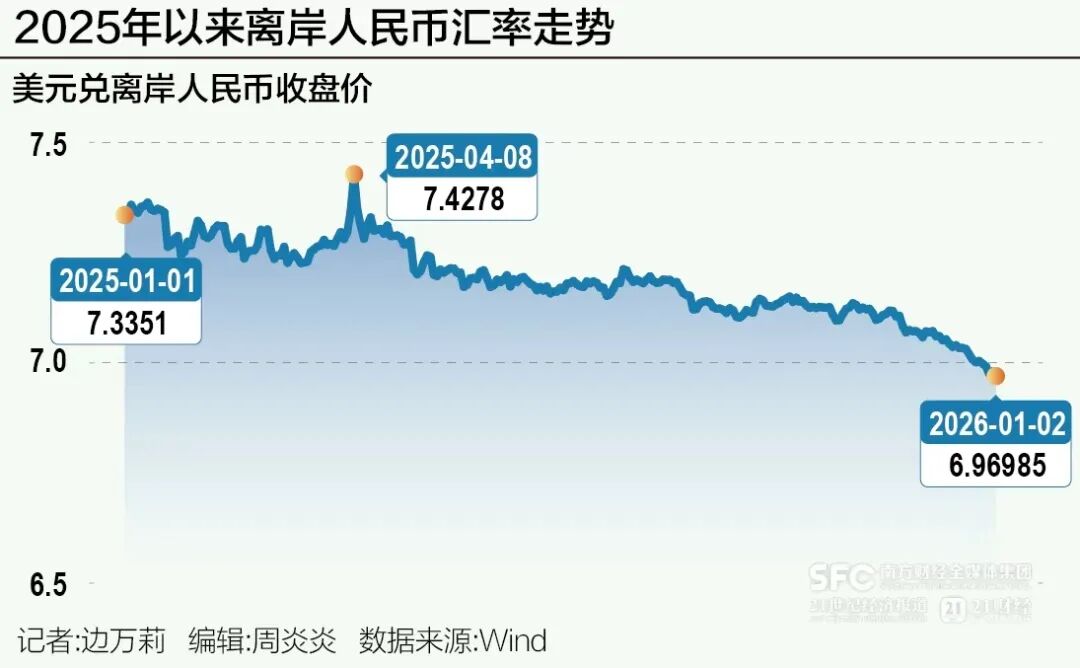
Core Viewpoint - The RMB/USD exchange rate is expected to experience both appreciation momentum and adjustment pressure in 2026, influenced by various economic factors and external uncertainties [1][8]. Group 1: Exchange Rate Trends - In 2025, the RMB/USD exchange rate exhibited a "weak first, strong later" trend, fluctuating between 7.30 and 7.35 until early April, before turning to an upward trend [1][2]. - By the end of 2025, both offshore and onshore RMB rates broke the psychological barrier of "7", reaching new highs since September 2024 and May 2023, respectively [1][3]. - The appreciation of the RMB is attributed to a weaker USD, stable Chinese economic fundamentals, and increased demand for currency settlement at year-end [1][2][3]. Group 2: Factors Influencing RMB Appreciation - The weakening of the USD is identified as a primary driver for the recent RMB appreciation, with the USD index dropping significantly after peaking above 100 in November [3][6]. - Seasonal factors also play a role, as historical trends show that the RMB tends to appreciate at the end of the year due to increased currency settlement needs from exporters [4][5]. - The strong performance of exports and the attractiveness of RMB-denominated assets have further supported the RMB's rise [6][8]. Group 3: Future Outlook - The People's Bank of China (PBOC) aims to maintain the RMB exchange rate at a reasonable and balanced level, emphasizing the prevention of excessive fluctuations [7][8]. - In 2026, the RMB is likely to experience a dual-directional fluctuation rather than a one-sided trend, with potential appreciation driven by favorable domestic and international conditions [1][8][9]. - Analysts predict that the RMB/USD exchange rate will likely remain within the range of 6.9 to 7.3, influenced by various economic factors and market dynamics [9].
人民币汇率破7背后
2 1 Shi Ji Jing Ji Bao Dao· 2026-01-04 14:56
Core Viewpoint - The RMB/USD exchange rate is expected to experience a "weak first, strong later" trend in 2025, with the rate fluctuating between 7.30 and 7.35 until early April, followed by a significant appreciation towards the end of the year, breaking the key psychological level of "7" [1][4][6]. Group 1: Factors Influencing RMB Appreciation - The recent appreciation of the RMB is attributed to multiple factors, including a weakening USD, a stable Chinese economic fundamental, and increased demand for currency settlement at year-end [1][6][8]. - The RMB's rise is supported by the resilience of exports and the attractiveness of RMB-denominated assets, which have contributed to the upward pressure on the currency [8][10]. - The correlation between the USD index and the RMB exchange rate indicates that a 3% depreciation in the USD typically corresponds to a 1% appreciation in the RMB, highlighting the impact of USD movements on RMB valuation [6][8]. Group 2: Seasonal and Market Dynamics - Seasonal factors also play a role in the RMB's appreciation, with historical trends showing stronger appreciation at the end of the year due to increased settlement needs from exporters [7][8]. - The end-of-year settlement demand from export enterprises has been identified as a significant driver for the RMB's rise, as companies accelerate currency conversion to avoid exchange losses [8][10]. - The market sentiment has shifted, with previously bearish views on the RMB reversing as Chinese assets become more attractive compared to US assets, leading to a reversal of previously held foreign capital [8][10]. Group 3: Outlook for 2026 - The People's Bank of China (PBOC) aims to maintain the RMB exchange rate at a reasonable and balanced level, emphasizing the prevention of excessive fluctuations and the need for a stable monetary policy [10][11]. - Factors that may support the RMB in 2026 include a potential weakening of the USD due to economic pressures and a rebound in the Chinese economy, which could sustain the RMB's appreciation momentum [11][12]. - The RMB is expected to maintain a dual-directional fluctuation pattern, with projections indicating a trading range between 6.9 and 7.3 against the USD throughout 2026 [12].