
201

Search documents
东诚药业20260329
2026-03-30 05:15
东诚药业 20260329 摘要 FDG 产品 2025 年增长近 20%,受益于管理区域下沉、新产能贡献及 医保计价政策促使医院自制转外购。 核药布局"一堆两器"战略,Ac-225 加速器项目预计 2026 年底建成, 届时公司将成为全球唯一同时具备两条技术路线的企业。 安迪科平台加速 CMO 业务,已签 11 个协议,预计 2026 年下半年 5-6 个中心投产;替曲林计划 2026 年底完成 20 个中心资质办理。 创新管线 LNC1,016 与 RNC1,005 预计 2026 年进入 III 期或完成入组; Lu-177 RNC1,011 II 期随访数据良好,2027 年 Q1 进 III 期。 肝素原料药价格跌至 30 美元/单位谷底,2026 年仍有降价压力,但需 求回升且整体毛利率维持在 40%以上。 蓝纳成 IPO 已递交申请并完成首轮问询回复,若 2026 年成功上市将显 著减少公司计提的财务费用。 2026 年 5 月新规实施或限制医院自制 FDG,公司作为合规商业供应商 有望获得长期市场增量。 Q&A 2025 年 FDG 产品实现了超过 18%的亮眼增长,请问公司如何看待该产品在 ...

京新药业20260112
2026-01-13 01:10
Summary of the Conference Call for Jinxin Pharmaceutical Industry Overview - Jinxin Pharmaceutical focuses on generic drugs, active pharmaceutical ingredients (APIs), and medical devices, with a strong presence in the CNS and cardiovascular sectors. The impact of centralized procurement has gradually diminished, allowing for stable growth in traditional pharmaceutical business [2][3][5]. Key Points Traditional Pharmaceutical Business - The traditional business includes generic drugs, APIs, and medical devices, with generics being the largest revenue contributor. The company has overcome the pressures from centralized procurement, and major products are expected to maintain steady growth [3][5]. - The integration of APIs and formulations provides cost advantages, and the acquisition of Shenzhen Jufeng has strengthened its position in the medical device market [2][5]. Innovative Drug Development - **Dazaxine (地达西尼)**: A new generation insomnia treatment that avoids safety issues associated with traditional benzodiazepines. It has shown rapid market uptake, with sales reaching 110 million RMB in the first three quarters of 2025, exceeding market expectations. It is expected to experience significant growth in 2026 and 2027 [2][6][8]. - **JX2,201**: A novel small molecule targeting lipid reduction, currently in phase II clinical trials. While it may not contribute significantly to short-term revenue, it has substantial business development (BD) potential and is expected to be a key driver of long-term growth [2][7]. Market Position and Competitive Landscape - Dazaxine competes with three major insomnia treatments, including those from Eisai and Shionogi. Its unique mechanism allows for rapid onset of action and minimal interaction with other medications, making it suitable for patients with multiple comorbidities [6][8]. - Jinxin's small molecule LPA innovation drug has a similar structure to Eli Lilly's drug, which is in phase III trials. If successful, it could enhance Jinxin's market position and BD potential [9]. Future Outlook - The company is expected to maintain steady growth in its traditional business due to the resolution of centralized procurement impacts. The rapid commercialization of Dazaxine and the promising outlook for the small molecule LPA drug contribute to a favorable investment profile [11]. - The potential for significant BD transactions for the LPA drug is highlighted, with upfront payments estimated between 100 to 200 million USD and total deals potentially reaching 2 billion USD [4][11]. Additional Insights - The differences between small molecule and small nucleic acid LPA-targeting drugs lie in their administration methods and mechanisms of action, with no significant efficacy differences reported so far [10]. - The company’s strategic focus on both traditional and innovative drug segments positions it well for future growth and investment opportunities [3][11].

不锈钢周评:钢厂放开限价 市场成交遇冷
Xin Lang Cai Jing· 2025-11-09 04:44
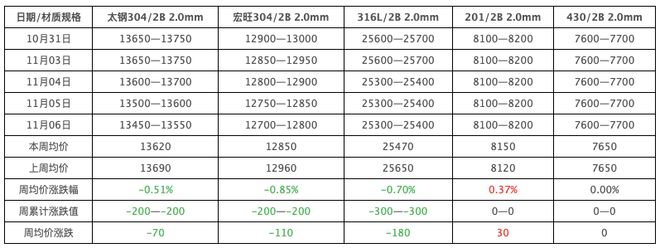
Core Viewpoint - The stainless steel market is experiencing a downward adjustment, with prices declining and a cautious market sentiment prevailing [1][4]. Price Trends - As of November 6, the price of Tai Steel 304 cold rolled sheet in Wuxi is between 13,450-13,550 CNY/ton, down 200 CNY/ton from the previous week, a decrease of 1.46%, and down 5.92% year-on-year [1][2]. - The average price of Tai Steel 304 cold rolled sheet this week is 13,620 CNY/ton, down 70 CNY/ton from the previous week, a decline of 0.51% [1][2]. - The price of Hongwang 304 cold rolled sheet 2mm in Wuxi is between 12,700-12,800 CNY/ton, also down 200 CNY/ton from the previous week, a decrease of 1.54%, and down 6.59% year-on-year [1][2]. Market Drivers - The stainless steel futures market is primarily experiencing a downward trend, with macroeconomic sentiment being cautious, leading to significant pressure on both raw material and finished product prices [4][6]. - Social inventory levels have slightly increased due to demand falling short of expectations, and market participants are adopting a risk-averse stance, leading to some price increases in 201 products [4][6]. Market Outlook - The short-term market supply and demand situation remains unsatisfactory, with transaction volumes struggling to break through effectively [5][6]. - The expectation of reduced production in November is mainly concentrated in the 200 series, while the 300 and 400 series markets have limited reduction expectations, indicating ongoing supply-demand conflicts [5][6]. - Cost support is gradually becoming more evident, limiting further price declines in finished products, with the market likely to stabilize and await a rebound [5][6].

从摩尔上市看国产算力产业机遇!
2025-09-24 09:35
Summary of Conference Call Records Industry Overview - The domestic computing chip industry is experiencing a long-term investment opportunity driven by domestic substitution and market demand growth, with companies like Cambricon, Huawei, and Haiguang showing development potential alongside self-developed ASICs from major firms [1][2][3] Key Points and Arguments - **Revenue Growth and Financial Performance**: - Moer Thread's IPO raised 8 billion, with projected revenues of 438 million in 2024, while Muxi raised 4 billion with projected revenues of 743 million in 2024. Both companies have high gross margins despite negative net profits due to upfront semiconductor design and R&D costs [1][3][4] - **Competitive Positioning**: - Moer Thread's latest Pinghu architecture chip has an IP 32 computing power close to NVIDIA's H20, with an interconnect bandwidth of 800GB per second and memory capacity of 80GB, indicating strong competitiveness against NVIDIA's high-end chips [1][5] - **Policy Impact**: - Recent policies from the National Cyberspace Administration of China require companies like Alibaba and ByteDance to stop testing and purchasing NVIDIA's RTX PRO6,000D, indicating a push for domestic processors that have reached or surpassed NVIDIA's performance levels [1][6] - **Market Growth Projections**: - The domestic computing chip market is expected to see significant growth, with early estimates predicting a market size of 200 billion, potentially reaching 800 billion by 2027 according to NVIDIA [3][8][9] - **Supply Chain and Production Capacity**: - By 2026, domestic computing chip manufacturers are expected to scale up production significantly due to resolved supply chain issues and capacity releases, with major internet companies beginning to test and adopt domestic chips [1][7] Additional Important Insights - **Product Development and Competitiveness**: - Moer Thread has enhanced AI training and inference capabilities in its products, with significant improvements in parameters and performance, indicating a positive trend in product strength and supply chain progress [5][11] - **Market Dynamics**: - The coexistence of self-developed ASICs and traditional chip manufacturers like Huawei and Haiguang is feasible due to the large market size and low domestic penetration rates, providing ample growth opportunities [2][10] - **End-Side Computing Trends**: - Companies like Rockchip are positioned well in the end-side computing sector, with recent product launches showing better performance and price competitiveness compared to Qualcomm and NVIDIA [12][13][15] - **3D Stacking Technology**: - 3D stacking technology is becoming increasingly important for high-bandwidth hardware in model training and inference, with companies like Zhaoyi holding a strong position in this area [17]

