30年期国债ETF(511090)

Search documents
这玩意儿机构都在买,却不是你的投资机会
虎嗅APP· 2025-12-22 11:08
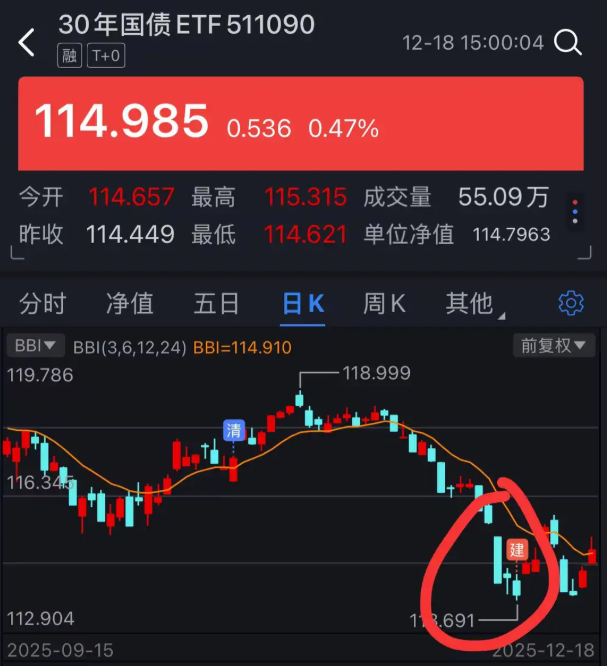
Core Viewpoint - The article discusses the current state of the long-term bond market, particularly focusing on the performance and investment potential of ultra-long government bonds, highlighting the challenges and opportunities present in this segment [4][11]. Group 1: Ultra-Long Government Bonds - Ultra-long government bonds are defined as those with maturities of 20 years or more, primarily held by institutions like insurance companies and pension funds [5]. - The 30-year government bond ETF (511090) saw a significant increase of 23.21% in 2024, but has recently experienced a decline of approximately 4% from early November to December 8, with yields rising from 2.136% to 2.265% [7][9]. - The yield spread between the 30-year and 10-year government bonds has widened to about 41 basis points, indicating a divergence in performance [9]. Group 2: Market Dynamics and Influences - The decline in ultra-long bonds is attributed to several factors, including credit events in the real estate sector affecting market sentiment, leading to a reduction in duration by investors [17]. - Central bank operations and changes in policy expectations have also contributed to the volatility in the ultra-long bond market, with recent net bond purchases signaling uncertainty about future rate movements [19]. - Global trends, such as rising long-term interest rates in other markets, have further pressured China's ultra-long bond yields, making institutions more cautious [19][20]. Group 3: Investment Strategy and Outlook - The article suggests that the current environment presents a mismatch between market expectations and reality, with the 30-year bond yield having risen back above 2.2% due to slower-than-expected easing measures [21][22]. - Investors are advised to adopt a cautious approach, focusing on key policy signals and liquidity conditions, rather than aggressively pursuing directional bets [22][23]. - A specific yield level of 2.35% for the 30-year bond is highlighted as a potential entry point for investors looking to gradually accumulate positions [24].

机构都在买,却不是你的投资机会
Hu Xiu· 2025-12-22 03:46
Core Viewpoint - The overall value proposition of the bond market is low this year, particularly for ultra-long-term government bonds, which have shown significant price declines despite some potential short-term opportunities emerging [1][2]. Group 1: Ultra-Long-Term Government Bonds - Ultra-long-term government bonds are defined as those with maturities of 20 years or more, primarily held by institutions like insurance companies and pension funds [1]. - The 30-year government bond ETF (511090) has shown a notable increase of 23.21% in 2024, but has recently entered a downward trend, with a cumulative decline of approximately 4% from early November to December 8 [2]. - The yield on the 30-year government bond has risen from 2.136% to 2.265%, indicating a significant upward movement in interest rates [2]. Group 2: Market Dynamics and Institutional Behavior - The price movements of ultra-long-term bonds are influenced more by institutional demand rather than direct economic changes, as these bonds are primarily held by entities with long-term commitments [9]. - The recent decline in ultra-long-term bonds is attributed to concentrated selling by trading funds, particularly due to risk aversion stemming from credit events in the real estate sector [13][17]. - Institutional investors, such as insurance and pension funds, have not been the primary sellers but are adopting a wait-and-see approach amid increasing supply and changing policy expectations [17]. Group 3: Future Outlook and Investment Strategy - The current environment suggests that ultra-long-term bonds may experience high volatility and weak trends, with future movements dependent on actual improvements in liquidity rather than macroeconomic rhetoric [19][20]. - Key indicators to monitor include upcoming political and economic meetings that may influence monetary policy and liquidity conditions [19]. - A cautious investment strategy is recommended, focusing on gradual accumulation at lower yield levels, particularly watching for the 30-year bond yield around 2.35% as a critical point for potential entry [21].