
长债

Search documents
华源晨会精粹20260305-20260305
Hua Yuan Zheng Quan· 2026-03-05 10:08
Group 1: Economic Overview - In February 2026, the manufacturing PMI decreased by 0.3 percentage points to 49.0%, primarily influenced by the Spring Festival [2][7] - The non-manufacturing business activity index was 49.5%, showing a slight increase of 0.1 percentage points, indicating overall improvement in non-manufacturing sectors [2][9] - The composite PMI output index was 49.5%, reflecting a slowdown in business activities compared to the previous month [2][7] Group 2: Credit Risk in the Bond Market - In 2025, the number of new bond defaults was 13, the second-lowest level since 2018, indicating a gradual alleviation of overall credit risk in the market [3][12] - The insurance industry faced its first bond default with Tianan Insurance and Tianan Life, highlighting significant structural risks within the sector [3][13] - Real estate companies, particularly private enterprises, were the most affected by credit defaults, with Guangdong, Beijing, and Shanghai leading in default cases [3][12] Group 3: Company-Specific Insights - Development Technology (920029.BJ) is expected to achieve a 20% increase in net profit for 2025, driven by its expansion in Brazil and investments in new energy [3][16] - Tiangong Co. (920068.BJ) anticipates a 143% increase in net profit in Q4 2025, benefiting from a resurgence in demand in the consumer electronics sector [3][20] - Kangnong Seed (920403.BJ) expects a 16% increase in net profit for 2025, supported by strong sales of its hybrid corn variety in key agricultural regions [3][25]
机构都在买,却不是你的投资机会
Hu Xiu· 2025-12-22 03:46
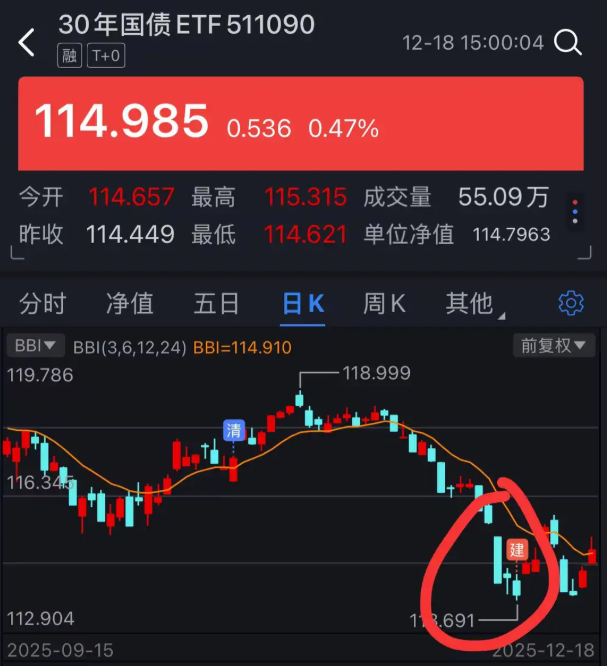
Core Viewpoint - The overall value proposition of the bond market is low this year, particularly for ultra-long-term government bonds, which have shown significant price declines despite some potential short-term opportunities emerging [1][2]. Group 1: Ultra-Long-Term Government Bonds - Ultra-long-term government bonds are defined as those with maturities of 20 years or more, primarily held by institutions like insurance companies and pension funds [1]. - The 30-year government bond ETF (511090) has shown a notable increase of 23.21% in 2024, but has recently entered a downward trend, with a cumulative decline of approximately 4% from early November to December 8 [2]. - The yield on the 30-year government bond has risen from 2.136% to 2.265%, indicating a significant upward movement in interest rates [2]. Group 2: Market Dynamics and Institutional Behavior - The price movements of ultra-long-term bonds are influenced more by institutional demand rather than direct economic changes, as these bonds are primarily held by entities with long-term commitments [9]. - The recent decline in ultra-long-term bonds is attributed to concentrated selling by trading funds, particularly due to risk aversion stemming from credit events in the real estate sector [13][17]. - Institutional investors, such as insurance and pension funds, have not been the primary sellers but are adopting a wait-and-see approach amid increasing supply and changing policy expectations [17]. Group 3: Future Outlook and Investment Strategy - The current environment suggests that ultra-long-term bonds may experience high volatility and weak trends, with future movements dependent on actual improvements in liquidity rather than macroeconomic rhetoric [19][20]. - Key indicators to monitor include upcoming political and economic meetings that may influence monetary policy and liquidity conditions [19]. - A cautious investment strategy is recommended, focusing on gradual accumulation at lower yield levels, particularly watching for the 30-year bond yield around 2.35% as a critical point for potential entry [21].

固定收益点评:弱物价,需继续宽松
GOLDEN SUN SECURITIES· 2025-05-11 06:48
1. Report Industry Investment Rating No information provided in the report. 2. Core Viewpoints of the Report - The inflation data in April reflects weak domestic demand. The CPI's year - on - year decline stabilized while the month - on - month showed an increase, and the PPI's decline widened, indicating overall weak inflation. [5][23] - In April, affected by international and domestic seasonal factors, industrial product prices weakened significantly. The Sino - US trade negotiation had no significant progress, and trade uncertainties remained. [5][23] - On May 7th, a package of monetary policy measures including reserve requirement ratio cuts and interest rate cuts were introduced to stabilize domestic demand and address economic uncertainties. Observe the implementation effects of these policies. [5][23] - The interest rate curve is expected to shift downward as a whole, and long - term bond yields may hit new lows. With the increase in fundamental pressure and loose funds in May, the overall interest rate curve is likely to move down, and long - term bond yields may reach new lows. [5][23][26] 3. Summary by Related Content CPI and Core CPI - In April, the CPI year - on - year decreased by 0.1%, the same as last month, with three consecutive months of negative growth. The month - on - month increased by 0.1%, up 0.5 percentage points from last month. The core CPI year - on - year increased by 0.5%, unchanged from last month, and the month - on - month increased by 0.2%, up 0.2 percentage points from last month. [1][8] - The year - on - year stability of CPI and core CPI may be partly supported by the rise in gold prices. The "Other Goods and Services" sub - item in CPI increased significantly, with a year - on - year increase of 6.6% and a month - on - month increase of 2.4% in April. After excluding this sub - item, the April CPI year - on - year was - 0.3%, indicating weak overall inflation. [2][11] Food CPI - In April, the food CPI's year - on - year decline narrowed, and the month - on - month changed from a decrease to an increase, with a significantly reduced drag. The fresh fruit price was the main driving factor. The food CPI year - on - year fell by 0.2%, with the decline narrowing by 1.2 percentage points from last month; the month - on - month increased by 0.2%, up 1.6 percentage points from last month. [2][13] - Due to the fishing moratorium in some areas, the price of aquatic products increased by 1.2% month - on - month. The supply of new fruits decreased seasonally, and the fresh fruit price increased by 2.2% month - on - month. Affected by the decrease in imports, the beef price increased by 3.9%. The prices of fresh vegetables and pork decreased by 1.8% and 1.6% respectively, with the declines less than the seasonal average. [2][13][14] Non - food CPI - In April, the non - food CPI's year - on - year changed from an increase to a flat state, and the month - on - month turned positive. The transportation and communication CPI was the main drag due to the decline in international oil prices. The non - food price year - on - year was flat, with the growth rate down 0.2 percentage points from last month; the month - on - month changed from a 0.2% decrease last month to a 0.1% increase. [3][16] - Affected by the significant decline in international oil prices, the gasoline price decreased by 10.4%, dragging down the CPI year - on - year by about 0.38 percentage points. The core CPI excluding food and energy prices increased by 0.5% year - on - year, with a relatively stable increase. [3][16] PPI - Affected by international commodity prices and seasonal factors, the year - on - year and month - on - month declines of the production materials PPI both widened in April. The production materials PPI year - on - year decreased by 3.1%, with the decline widening by 0.3 percentage points from last month, and the month - on - month decreased by 0.5%, with the decline widening by 0.1 percentage point. [4][18] - The decline in international crude oil prices led to a month - on - month decline in domestic oil - related industries. The price of the oil and gas extraction industry decreased by 14.2% year - on - year. With the end of heating in the north, the coal demand entered the off - season, and the prices of coal mining and washing and petroleum - coal processing decreased by 15.2% and 11.1% year - on - year respectively. [4][18] - In April, the year - on - year decline of the living materials PPI widened, with a 1.6% decrease, and the decline widened by 0.1 percentage point from last month. The food price decreased by 1.4% year - on - year, the same as last month. The price of general daily necessities rebounded, with a 0.6% year - on - year increase, and the growth rate decreased by 0.1 percentage point. The durable consumer goods decreased by 3.7% year - on - year, still in the negative growth range, and the decline further widened by 0.3 percentage points. [4][20]