5nm刻蚀机

Search documents
2025年中国集成电路行业技术发展分析 高端国产化率仍然较低【组图】
Qian Zhan Wang· 2026-01-07 06:11
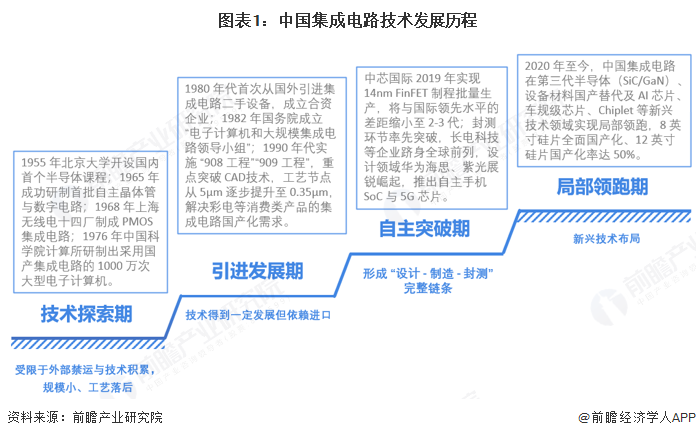
Core Insights - The Chinese integrated circuit industry has evolved from a technology exploration phase to a stage of partial leadership in emerging fields such as third-generation semiconductors and AI chips [1] Group 1: Industry Overview - Major listed companies in the Chinese integrated circuit industry include companies like Chipone (688521.SH), Cambricon (688256.SH), and SMIC (688981.SH/00981.HK) [1] - The development of integrated circuit technology in China has gone through three main phases: foundational exploration (1950s-1978), technology introduction (1978-2000), and independent breakthroughs (2000-2020) [1] Group 2: Core Production Technologies - The integrated circuit technology system focuses on three core areas: design, manufacturing, and packaging/testing [4] - Key design aspects include EDA tools, chip architecture (RISC-V/ARM), and semiconductor IP [4] - Manufacturing focuses on wafer processes (including EUV lithography) and advanced process nodes (such as 7nm and 5nm) [4] - Packaging/testing emphasizes advanced techniques like Chiplet and 3D stacking [4] Group 3: Current Production Status - Chinese companies lead in production volume but lack sufficient autonomy in technology [7] - The design sector has achieved some autonomy in mature process tools and IP, but high-end EDA and core IP still rely on imports [7] - Manufacturing has sufficient capacity for mature processes but faces limitations in advanced processes due to equipment restrictions [7] - The packaging/testing sector is a strength, with leading companies holding significant global market shares [7] Group 4: Market Segmentation - The low-end market (45nm and above) has a self-sufficiency rate exceeding 75%, with companies like Hua Hong Semiconductor leading [10] - The mid-range market (14-28nm) has a domestic production rate of about 35%, with breakthroughs in memory chips [10] - The high-end market (7nm and below) has a self-sufficiency rate of less than 20%, heavily relying on overseas foundries [10] Group 5: Challenges and Future Outlook - The Chinese integrated circuit industry faces challenges such as low domestic production of high-end technologies, risks to industrial security, and the need for improved product quality [13] - Future strategies include focusing on technological breakthroughs, collaborative ecosystem development, and enhancing talent cultivation to support high-quality industry growth [13]




ASML老板突然改口,中国稀土反制击中要害!光刻机战争迎意外转折
Sou Hu Cai Jing· 2025-10-21 08:04
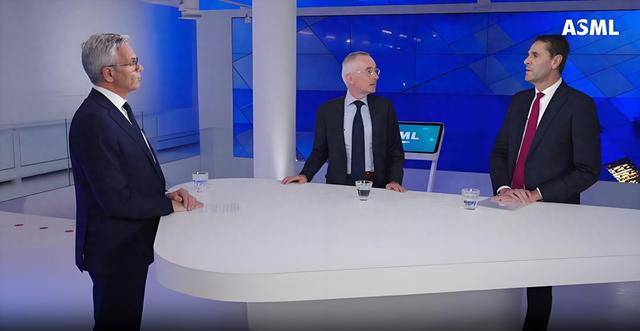
Core Viewpoint - ASML's CEO expressed concerns over China's potential abandonment of its lithography machines and the implementation of rare earth countermeasures, highlighting the intense technological competition between the US and China [1] Group 1: ASML's Concerns - ASML's anxiety stems from recent US regulations that expanded sanctions to subsidiaries controlled by Chinese companies, leading to the freezing of assets of a Chinese semiconductor firm [3] - The Dutch government, feeling supported by the US, took aggressive actions against Chinese investments, underestimating China's ability to retaliate swiftly and effectively [3] Group 2: Impact of Rare Earth Regulations - China announced strict export controls on five types of medium and heavy rare earths, affecting the entire supply chain from mining to manufacturing [3] - ASML's lithography machines require over 10 kilograms of rare earth magnets, with over 90% of these materials sourced from China, leading to a potential production drop of 15-20 machines per month and a loss of up to €3.2 billion annually [5] Group 3: China's Advancements in Lithography Technology - By Q3 2025, China is projected to become ASML's largest customer, with a 42% share of equipment deliveries, despite being blocked from acquiring advanced EUV lithography machines [7] - Chinese companies are making significant strides in developing their own lithography technologies, with local equipment coverage expected to rise from 15% in 2022 to 35% by 2025 [7] Group 4: ASML's Historical Context and Challenges - ASML has been a key player in US-led technology restrictions against China, facing a dilemma between adhering to US regulations and maintaining access to the Chinese market [12] - The company's sales to China peaked at 49% in early 2024 but are expected to drop to 25% by 2025 due to ongoing sanctions, resulting in a projected revenue loss of €2 billion [12] Group 5: Future Dynamics and Industry Implications - The Dutch government has shown signs of softening its stance, seeking negotiations with China, while the automotive industry in Germany expresses significant concern over reliance on Chinese rare earths [14] - The ongoing semiconductor industry struggle reflects a broader battle for control over supply chains, emphasizing the need for cooperation rather than confrontation to ensure sustainable development [15]


ASML CEO:中国正尝试弃用光刻机,还可能掐住光刻机命脉
Xin Lang Cai Jing· 2025-10-21 07:15
Core Viewpoint - ASML's CEO's remarks about China's potential abandonment of its lithography machines and possible rare earth countermeasures highlight the deep-seated contradictions in the global semiconductor supply chain amid the US-China tech rivalry [1][3][9] Group 1: ASML's Dependency and Market Dynamics - ASML has a significant dependency on the Chinese market, with China becoming its largest customer by Q3 2025, accounting for 42% of equipment delivery [3] - The reliance on ASML's technology is characterized by a passive nature, as Chinese companies face restrictions on accessing advanced chip manufacturing technologies due to US-led sanctions [3][5] - The ongoing technological blockade has forced China to pursue self-reliance in lithography technology, with companies like Shanghai Micro Electronics and North China Innovation making strides in this field [3][7] Group 2: Rare Earth Supply Chain and Strategic Responses - ASML's concerns regarding China's rare earth export controls reveal the interdependent nature of the global supply chain, where China's measures are seen as a response to unilateral sanctions [5][9] - Historically, China has provided stable rare earth supplies to global tech firms, including ASML, but the US's dual standards in technology sanctions and resource demands have disrupted this balance [5][9] - China's rare earth controls signal a commitment to maintaining fairness in the supply chain, indicating that the consequences of escalating technology blockades will affect all participants, including ASML [5][9] Group 3: Implications of US-China Tech Decoupling - ASML's anxiety reflects the broader repercussions of the US's tech decoupling strategy, which inadvertently encourages Chinese innovation and the emergence of domestic semiconductor firms [7][9] - The sanctions imposed by the US have led to the rise of Chinese semiconductor equipment companies, which are beginning to penetrate markets previously dominated by foreign firms [7][9] - The situation illustrates that attempts to isolate China may ultimately result in a loss of market share for foreign companies, as local firms develop differentiated technologies [7][9] Group 4: Future of the Semiconductor Industry - The ongoing struggle over lithography technology and rare earth resources transcends individual corporate interests, impacting the future trajectory of the global semiconductor industry [9][11] - China's push for self-reliance in semiconductor technology is not about severing global ties but rather about finding space for survival and growth amid restrictions [9][11] - A sustainable future for the global semiconductor industry hinges on open collaboration rather than closed confrontation, emphasizing the need for shared technological advancements and equitable negotiations [11]