AAA科创债ETF

Search documents
ETF生态周报(2026.03.23-03.27)——ETF市场整体综合面板
华宝财富魔方· 2026-03-31 09:45
Market Overview - As of March 27, 2026, the total market size of ETFs is approximately 5.04 trillion yuan, with a contraction driven mainly by market declines, although net subscriptions indicate a positive contribution from funds [2][7] - The performance of broad-based and thematic ETFs has declined, while strategy ETFs showed slight positive contributions; bond ETFs saw a minor increase in shares, but the overall scale was affected by market conditions [2][3] Performance Disparity - The domestic equity market experienced a slight pullback, with the CSI 300 index dropping to a valuation percentile of 77.51%, indicating a reduction in high valuation pressure [2][25] - Structural highlights were observed in cyclical resources and defensive sectors, with the chemical ETF rising by 3.65% and the power ETF by 2.88%, while the securities ETF faced the largest decline of -3.88% [2][26] Fund Flows - There was a continued trend of funds migrating from equity broad-based ETFs to fixed income, with AAA Sci-Tech bonds leading with a net inflow of 107.83 billion yuan [3][34] - Strategy ETFs saw a net inflow of 46.02 billion yuan, indicating strong support for dividend and free cash flow strategies [3][37] Trading Activity - The trading intensity of bond ETFs showed a decline in turnover rates, with the short-term bond ETF from Hai Fu Tong maintaining a high transaction volume but lower turnover [4][58] - In the stock ETF market, large-cap ETFs dominated trading volumes, while small-cap ETFs led in turnover rates, indicating a preference for larger, more stable investments [4][60] Issuance Dynamics - The issuance market saw a marginal contraction, but the reserve of upcoming ETFs expanded significantly, with 61 ETFs waiting for issuance, indicating a robust pipeline for future offerings [5][66] - The agricultural and fishery sectors are currently active in trading, with new products expected to perform well due to existing subscription support [5][67]


ETF规模年内激增两万亿!聪明钱正在流向这三条核心赛道
Sou Hu Cai Jing· 2026-01-03 23:14
Core Viewpoint - The ETF market in China is experiencing significant inflows despite market volatility, with a total scale reaching 5.78 trillion yuan by December 15, 2025, an increase of over 2 trillion yuan since the beginning of the year. This trend indicates that institutional investors are using ETFs to capitalize on market dips, with nearly 35.8 billion yuan flowing into ETFs on a single day of market decline [1][2]. Group 1: ETF Market Dynamics - The total scale of the ETF market has surged to 5.78 trillion yuan, reflecting a substantial increase of over 2 trillion yuan since the start of the year [1]. - On November 21, a significant market drop saw nearly 35.8 billion yuan in funds entering ETFs, highlighting the trend of "smart money" seeking opportunities during downturns [1]. - The preference for ETFs is attributed to their transparency, liquidity, and risk diversification, making them a favored choice for institutional investors like insurance companies and pension funds [3]. Group 2: Fund Flows into ETFs - Broad-based ETFs are the primary beneficiaries of recent fund inflows, with notable growth in the Huatai-PB CSI 300 ETF and Huaxia CSI 300 ETF, which increased by 63.04 billion yuan and 62.36 billion yuan respectively [4]. - The Southern CSI 500 ETF saw a weekly net inflow of nearly 5.8 billion yuan, while the E Fund ChiNext ETF experienced over 4 billion yuan in weekly inflows, indicating a strong preference for core assets during stable economic growth expectations [4]. - Despite some sectors experiencing pullbacks, funds continue to flow into technology-related ETFs, with the Jia Shi SSE Sci-Tech Innovation Board Chip ETF and Huaxia CSI Robot ETF each seeing net subscriptions exceeding 4.4 billion yuan [5]. Group 3: Defensive Investment Strategies - In a volatile market, defensive ETFs focusing on low volatility and free cash flow have become popular, with the Huatai-PB Low Volatility Dividend ETF attracting over 4.5 billion yuan in net subscriptions [6]. - High-rated credit bond ETFs, such as the AAA Sci-Tech Bond ETF, have also performed well, with a growth of nearly 200 billion yuan this year, appealing to investors seeking stable returns in a low-interest environment [6]. Group 4: Investment Principles for Retail Investors - Retail investors are advised to prioritize leading products in the ETF market, focusing on those managed by top companies like Huaxia and E Fund, which offer better liquidity and reliability [7]. - Caution is recommended against blindly chasing high-flying sectors; instead, a dollar-cost averaging strategy is suggested to mitigate risks associated with short-term volatility [7]. - A diversified investment approach is encouraged, combining broad-based ETFs with sector-specific and defensive ETFs to balance risk and return [7]. Group 5: Conclusion on ETF Trends - The flow of funds into ETFs reflects the market's collective judgment, with investments spanning broad-based, high-growth sectors, and defensive options, indicating a strategic approach to navigating market complexities [8].

ETF年内扩容超2万亿,四只指数挂钩产品增量破千亿
券商中国· 2025-12-14 23:29
Core Viewpoint - The ETF market has significantly accelerated its expansion this year, with notable growth in the scale of products linked to a few core indices [1][3]. Group 1: Market Expansion - As of December 12, the total market ETF scale increase has exceeded 2 trillion yuan this year, with four types of index-linked ETFs (including Sci-Tech Bonds, CSI 300, Gold, and Hang Seng Tech) each surpassing 100 billion yuan in scale increase, representing the most significant structural samples in the ETF expansion process [2][3]. - The growth in ETF scale is driven by continuous capital inflow across various asset classes, enhancing the attractiveness of ETFs as important asset allocation tools [3][4]. Group 2: Key Indices and Their Performance - Four indices have seen ETF products with a scale increase of over 100 billion yuan: the AAA Sci-Tech Bond Index (199.2 billion yuan), CSI 300 Index (193.5 billion yuan), SGE Gold 9999 Index (147.6 billion yuan), and Hang Seng Tech Index (113.8 billion yuan) [3][4]. - The AAA Sci-Tech Bond, Hang Seng Tech, and SGE Gold indices primarily experienced growth driven by net subscriptions, indicating active capital allocation demand, while the CSI 300 ETF's growth was largely due to the appreciation of the underlying index [4][5]. Group 3: Asset Class Characteristics - The CSI 300 Index serves as a representative equity index suitable for long-term allocation, with several fund companies reporting significant scale increases, such as Huatai-PB's CSI 300 ETF, which grew by 63.042 billion yuan [5][6]. - Gold ETFs are primarily used for risk hedging and asset diversification, with notable growth in funds managed by companies like Huaan and Bosera, exemplified by Huaan Gold ETF's increase of 61.953 billion yuan [6]. - The AAA Sci-Tech Bond ETF, launched mid-year, has quickly gained market attention, with over ten products exceeding 10 billion yuan in management scale, showcasing the rapid uptake of new index products [6][7]. Group 4: Evolving ETF Utilization - The ETF market is in a phase of continuous expansion, with a clear trend towards more balanced asset allocation, as funds are increasingly utilized for risk management and asset allocation rather than just thematic speculation [7][8]. - The clarity of index and product positioning is crucial for attracting incremental capital, with established indices like CSI 300, Gold, and Hang Seng Tech being more easily understood and accepted in terms of risk-return characteristics [7][8]. - The ongoing development of the ETF index system and product types is expected to further expand the application scenarios of ETFs in investment portfolios, with a focus on products that have clear positioning and good liquidity [8].

又现赎回风波,债基抱团松动,这两类债券ETF却逆流而上!
Sou Hu Cai Jing· 2025-07-28 07:40
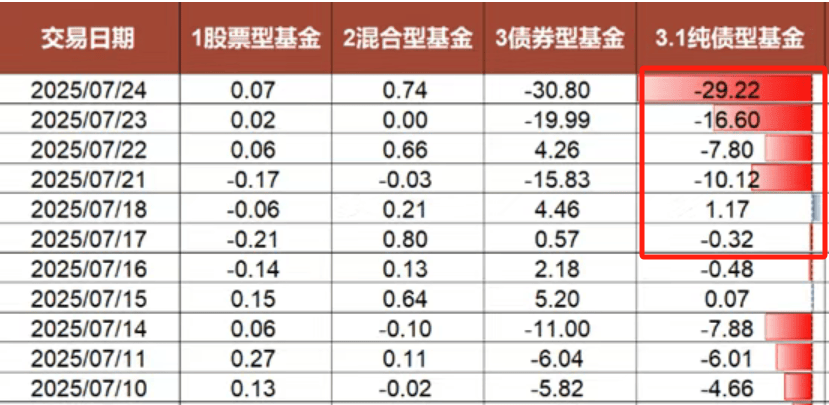
Market Overview - The equity and commodity markets have both risen recently, while the bond market faces significant pressure. The Shanghai Composite Index reached a new high for the year on July 21, closing at 3593.66 points on July 25, with a weekly increase of 1.67% [1] - From July 21 to 25, pure bond funds experienced net redemptions for five consecutive trading days, with nearly 100 billion yuan redeemed on July 24 alone [1] Fund Performance - On July 24, several bond funds, including the Xingyin Zhongdai Preferred Investment Grade Credit Bond Index C, reported large redemptions [1] - Data shows that insurance institutions have reduced their holdings of government bonds for three consecutive months, with reductions of 8.9 billion yuan, 7.4 billion yuan, and 1.2 billion yuan in April, May, and June respectively [2][3] Bond Market Dynamics - Despite the modest reduction in holdings, the shift in insurance capital, which was previously a major investor in long-term government bonds, is noteworthy [3] - As of the end of Q2, the total scale of public bond funds reached a historical high of 10.93 trillion yuan, up 860 billion yuan from the end of Q1 [4] Investment Strategies - The "barbell strategy" remains popular among institutional investors, balancing high-dividend assets with growth sectors like technology and new consumption [7] - There is a notable increase in the assets of bond ETFs, with a total of 510.5 billion yuan across 39 bond ETFs as of July 25, indicating a trend of institutional investors seeking opportunities in long-term government bonds and innovative bonds [8] Performance of Bond ETFs - The BoShi Shanghai 30-Year Government Bond ETF and Pengyang Zhongdai 30-Year Government Bond ETF have shown relatively strong performance in terms of risk-adjusted returns, despite trailing behind the CSI 300 Index [9] - Institutions remain optimistic about the bond market, suggesting that current market fluctuations present good entry points for bond investments [9]