
AED(自动体外除颤仪)

Search documents
张雪峰用生命讲完了最后一课
虎嗅APP· 2026-03-28 09:34
Core Viewpoint - The sudden death of Zhang Xuefeng has sparked a significant public concern regarding heart health, leading to a surge in the demand for health products and emergency medical devices [2][3]. Group 1: Public Reaction and Market Response - Following the news of Zhang Xuefeng's death, there has been an unprecedented increase in public interest in heart health, resulting in a buying frenzy for health products [3]. - Sales of emergency medications and devices, such as nitroglycerin and AEDs (Automated External Defibrillators), have surged by 2 to 5 times since the announcement of his death, with some AEDs selling out in major cities [3]. - The search volume for heart-protective supplements like Coenzyme Q10 increased by 10 times, while the search for emergency heart medications rose by 30 times [3]. Group 2: Health Statistics and Trends - The incidence of sudden cardiac death in China has been rising, with a crude mortality rate of 18.59 per 100,000 people reported in 2021, more than double the rate from 2013 [4]. - Men are approximately twice as likely to experience sudden cardiac death compared to women, and there is a growing trend of such incidents among younger populations, including middle-aged individuals and children [5]. Group 3: Market Potential for Health Products - The market for emergency and preventive health devices is expanding rapidly, with around 3 million AEDs in China and a market size nearing 60 billion yuan [7]. - The potential market for early screening related to sudden cardiac death is estimated to reach 80 billion yuan, with wearable devices for data collection and monitoring projected to have a market potential in the hundreds of billions [7]. - Major tech companies like Apple, Huawei, and Xiaomi are also entering the market with products aimed at preventing sudden cardiac death [7]. Group 4: Technological Developments and Limitations - Wearable devices, such as smartwatches, can monitor heart health indicators and provide valuable data to healthcare professionals, potentially saving lives [8]. - However, the effectiveness of these devices is limited by their reliance on specific technologies, which may not accurately capture heart health data in all situations, particularly during physical activity [9]. - The clinical evidence supporting the efficacy of these devices is still insufficient, and there are concerns regarding their ability to provide comprehensive health assessments [9]. Group 5: Behavioral and Awareness Issues - A significant challenge in preventing sudden cardiac death is the lack of awareness and understanding of health conditions among individuals, particularly those who appear healthy [15][16]. - Many individuals ignore early warning signs of health issues, attributing them to stress or fatigue, which can lead to missed opportunities for timely medical intervention [15][16]. - The need for a cultural shift towards proactive health management is emphasized, as reliance solely on technology without personal awareness and action may not be sufficient [16].


和猝死的对抗
晚点LatePost· 2026-03-25 01:52
Core Viewpoint - Sudden cardiac death is a growing concern among young professionals, particularly in high-pressure work environments, reflecting broader societal anxieties about health and work culture [2][9][22]. Group 1: Incidents and Statistics - Sudden cardiac death incidents have been reported among employees in major companies, including those in the tech industry, highlighting the prevalence of this issue [4][5][6]. - The statistic often cited is that approximately 544,000 people die from sudden cardiac death in China each year, with a more alarming estimate suggesting that the actual number could be around 1 million annually [6][7]. - The perception of sudden cardiac death has shifted from being an "elderly disease" to affecting younger individuals, with cases reported in people as young as 23 [5][6]. Group 2: Lifestyle Factors - Factors contributing to sudden cardiac death include smoking, excessive drinking, lack of sleep, prolonged work hours, and chronic stress [7][13]. - The "996" work culture, characterized by long hours and high stress, exacerbates health risks among young professionals [2][9]. - Many individuals, despite being aware of the risks, feel compelled to continue their high-pressure lifestyles due to societal and economic pressures [8][9]. Group 3: Medical Insights and Emergency Response - Sudden cardiac death is often caused by acute heart conditions such as cardiac arrest, which can occur even in seemingly healthy individuals [10][15]. - The success rate of resuscitation decreases significantly with time; immediate treatment within minutes is crucial for survival [16][17]. - The average response time for ambulances in China is about 15 minutes, which is often too late for effective intervention in cases of sudden cardiac death [17][18]. Group 4: AED and Public Awareness - The availability and awareness of Automated External Defibrillators (AEDs) are critical in emergency situations, yet their distribution and accessibility in public spaces remain inadequate [19][20][21]. - Public discussions and awareness campaigns have increased following high-profile sudden death incidents, leading to some companies installing AEDs and providing training [23][24]. - Despite improvements, there is still a significant gap in public knowledge and readiness to use AEDs effectively during emergencies [29][30].
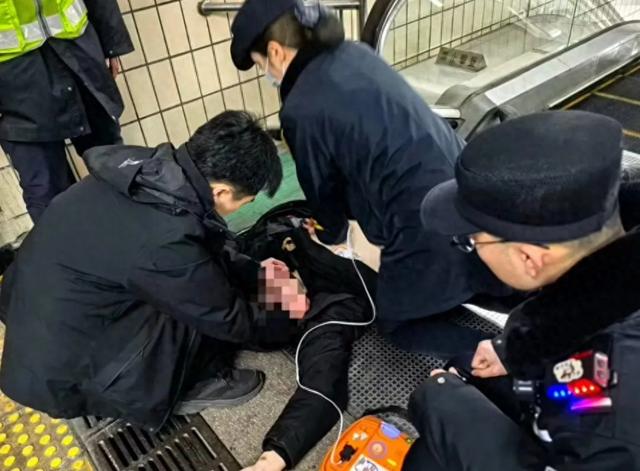
地铁天安门西站一乘客心脏骤停,路过医生紧急施救!
Xin Lang Cai Jing· 2026-02-15 14:48
Core Points - A male passenger in his 30s suddenly collapsed and lost consciousness at Tiananmen West Station on Beijing Subway Line 1, prompting immediate action from a nearby doctor [1][3] - Dr. Chen Biao, an ear specialist from Beijing Tongren Hospital, identified himself and collaborated with subway staff and police to provide timely assistance, which was crucial for the patient's subsequent rescue [1][3] Group 1 - The patient exhibited symptoms of cardiac arrest, including pale complexion, cold sweat, and lack of consciousness, which were confirmed by Dr. Chen through physical examination [3] - Dr. Chen performed chest compressions and artificial respiration while subway staff called for emergency services and retrieved an AED (Automated External Defibrillator) [3] - The collaboration between Dr. Chen and the on-site staff was highlighted as essential for the successful resuscitation of the patient [3] Group 2 - The patient's family later expressed gratitude to Dr. Chen, indicating a positive outcome from the emergency intervention [3] - Dr. Chen emphasized that saving lives is an instinct for doctors and credited the success of the rescue to the teamwork of all involved [3]

跑赢“黄金四分钟”,上海在努力
Xin Lang Cai Jing· 2026-02-15 07:28
Group 1 - The article highlights the importance of emergency medical services in Shanghai, particularly during the Spring Festival travel rush, showcasing a successful case of timely medical intervention [1] - Shanghai has established a robust emergency rescue training system, with the Red Cross Society of Shanghai planning to train nearly 750,000 certified emergency rescuers by the end of the 14th Five-Year Plan [1][3] - The Shanghai Railway Red Cross has trained over 60,000 personnel in emergency rescue, with plans to increase this number to over 100 by the end of the 14th Five-Year Plan [2] Group 2 - The Long Triangle Railway has equipped nearly 700 Automated External Defibrillators (AEDs), with over 30 located at major train stations in Shanghai [2] - Since 2015, the Shanghai Red Cross has been placing AEDs in densely populated public areas, with a total of over 14,000 AEDs installed, exceeding a ratio of 50 AEDs per 100,000 people [3] - The Shanghai Red Cross aims to train over 80,000 certified emergency rescuers in 2026, maintaining an annual training pace of over 100,000 individuals [3]
国家卫健委:鼓励大众学习掌握急救科普知识
Yang Shi Xin Wen· 2026-01-13 07:42
Group 1: Cardiac Arrest First Aid - The golden time for first aid in cases of cardiac arrest is within 4 to 6 minutes, which significantly increases the survival rate of patients [1] - Basic CPR skills are not considered specialized skills, and public first aid training typically includes this knowledge, supported by legal protections for good Samaritans under the Civil Code [1] - The correct steps for first aid include assessing consciousness and breathing, calling for help, performing chest compressions, and using an AED if available [2][3] Group 2: Fainting First Aid - Common misconceptions about fainting first aid include methods like "pinching the middle" or "giving water," which are not scientifically supported and may worsen the condition [4] - Fainting is a sudden, brief loss of consciousness that typically lasts from seconds to minutes, distinct from dizziness or coma [4] - Common causes of fainting include orthostatic hypotension, abnormal neural reflexes, cardiac issues, and neurological factors [5][6][7] Group 3: Prevention and Medical Attention - To prevent fainting, individuals should rise slowly from sitting or squatting positions and seek support if feeling dizzy [8] - It is crucial to seek medical attention after fainting, especially if episodes occur frequently, to rule out underlying health issues [8]
全市首个消防医疗急救联动点启用
Hang Zhou Ri Bao· 2026-01-04 01:57
Core Viewpoint - The establishment of the Zhejiang Province Hangzhou Emergency Center Xiangcheng Fuxing Emergency Point and the Xiangcheng Fuxing Fire-Medical Emergency Coordination Point marks a significant innovation in integrating fire and medical emergency services, aimed at improving rescue efficiency and ensuring public safety [1][2]. Group 1 - The new emergency point represents the first deep integration of fire and medical services in Hangzhou, facilitating resource sharing and collaborative operations between the two sectors [1][2]. - Initial training for firefighters at the joint emergency point includes essential skills such as CPR, trauma care, and AED usage, enabling them to act as critical first responders in emergencies [1]. - The operational model of the Fuxing Fire-Medical Emergency Coordination Point focuses on synchronized response, aiming to minimize response times during emergencies, thereby maximizing the chances of saving lives [1]. Group 2 - The choice of Fuxing Fire Rescue Station as a pilot site is based on its densely populated area and high demand for medical emergency services, creating a replicable model for future integration of fire and medical services [2]. - The launch of the coordination point is seen as a strategic advancement in emergency resource allocation, embodying the principle of prioritizing people's lives and safety [2]. - The operational experience gained from this first model will inform future improvements in emergency station layouts and the development of standards for fire-medical coordination, contributing to the goal of achieving an 8-minute emergency response time in urban areas and 12 minutes in rural areas [2].
知名音乐人病逝,几天前打羽毛球突然昏倒、心脏骤停,林志炫发文悼念
21世纪经济报道· 2025-05-12 10:47
Group 1 - The article discusses the tragic incident of a renowned Taiwanese musician, Han Hsien-Kuang, who suffered a cardiac arrest while playing badminton, highlighting the importance of timely medical intervention in such emergencies [1][4] - It emphasizes the rising incidence of sudden cardiac arrest during sports events, referencing the case of Danish player Christian Eriksen, who survived due to immediate CPR [4][5] - The article presents alarming statistics, indicating that approximately 760,000 people die from cardiac diseases in China annually, with over 90% of these incidents occurring outside hospitals [7][8] Group 2 - The article outlines preventive measures against sudden cardiac death, including regular health screenings and lifestyle modifications such as a balanced diet, exercise, and avoiding smoking and excessive alcohol consumption [8][9] - It stresses the critical "golden 4 minutes" for effective CPR and the use of Automated External Defibrillators (AEDs) in increasing survival rates [10][11] - The Shanghai Health Commission has reported a current AED availability of 26.5 units per 100,000 people, with plans to increase this to 75,000 units by 2025 [11][12] Group 3 - The global AED market was valued at approximately 11.31 billion yuan in 2022, with projections to grow to 16.12 billion yuan by 2028, driven by an aging population and rising cardiovascular disease rates [14][15] - Domestic AED procurement in China has been steadily increasing, with amounts rising from 395 million yuan in 2021 to an expected 600 million yuan in 2024 [14][15] - The article notes that the domestic market for AEDs is becoming increasingly competitive, with a projected 79% localization rate by 2024, as local companies enhance their technological capabilities [15][16]

《单身情歌》制作人“突发心源性猝死”:如何跑赢“黄金4分钟”的生死时速?
2 1 Shi Ji Jing Ji Bao Dao· 2025-05-12 08:29
Group 1: Heart-related Sudden Deaths - Sudden cardiac arrest incidents during sports activities are increasingly reported, often resulting in tragic outcomes [1] - In China, approximately 760,000 people die from sudden cardiac events annually, with over 90% occurring outside hospitals [3] - The demographic most affected by out-of-hospital cardiac arrests are males aged 60-89, with a significant occurrence in the elderly population [3] Group 2: AED and CPR Importance - The survival rate for patients receiving CPR is significantly higher when performed within the first four minutes of cardiac arrest [5][6] - AEDs (Automated External Defibrillators) combined with CPR can greatly enhance the chances of survival during cardiac emergencies [1][7] - Japan's AED Foundation reported survival rates of 54.2% when AEDs are used, highlighting their effectiveness in emergency situations [7] Group 3: AED Deployment and Market Growth - China's AED market is projected to grow from 11.31 billion yuan in 2022 to 16.12 billion yuan by 2028, with a CAGR of 6.1% [9] - The current AED deployment in Shanghai is 26.5 units per 100,000 people, indicating a need for improvement compared to developed regions [7] - The Chinese government has initiated projects to increase AED availability, with plans to add 7,500 units in Shanghai by 2025 [7][8] Group 4: Domestic AED Development - Domestic companies are rapidly advancing AED technology, with a projected 79% localization rate in the market by 2024 [10] - Major local manufacturers like Mindray and Yuwell are launching new AED models with enhanced features, indicating a competitive landscape [11] - The focus on social benefits drives government procurement of AEDs, leading to a concentrated market with domestic brands gaining a competitive edge [10]