AGI(通用人工智能)

Search documents
微软获OpenAI授权独立研发AGI,AI领域竞争格局生变
Sou Hu Cai Jing· 2025-11-11 13:58
Core Insights - Microsoft is the largest shareholder of OpenAI, holding approximately $13 billion in shares, which raises concerns among investors about the sustainability of the current "AI bubble" and the unclear profitability model of OpenAI [1] - Tensions between Microsoft and OpenAI have escalated due to OpenAI's plans to transition into a for-profit entity, with rumors suggesting that Microsoft attempted to prevent this shift to protect its interests [1] Group 1 - A new "final agreement" has been signed between Microsoft and OpenAI, extending their collaboration and introducing new terms, including that OpenAI cannot unilaterally declare the achievement of AGI (Artificial General Intelligence) without validation from an independent expert panel [3] - The new agreement allows Microsoft to use OpenAI's models and products, including those developed post-AGI, until 2032, even if AGI is achieved before 2030 [3] - The agreement also permits Microsoft to independently or jointly develop AGI with other companies, effectively granting Microsoft significant control over AI advancements [3] Group 2 - Following the signing of the agreement, Microsoft has accelerated its efforts in the AI sector, with the CEO of its AI division stating that the company is pursuing "superintelligence" while ensuring that AI serves humanity [3] - Previously, Microsoft was restricted from independently pursuing AGI until 2030 to allow OpenAI to maintain its lead, but this limitation has now been lifted, enabling Microsoft to pursue its own initiatives [3] - The CEO emphasized that Microsoft will maintain an open technology approach and will not be overly committed to specific models, focusing solely on product usability [4]



OpenAI,重大变化!微软成大赢家
Mei Ri Jing Ji Xin Wen· 2025-10-28 16:40
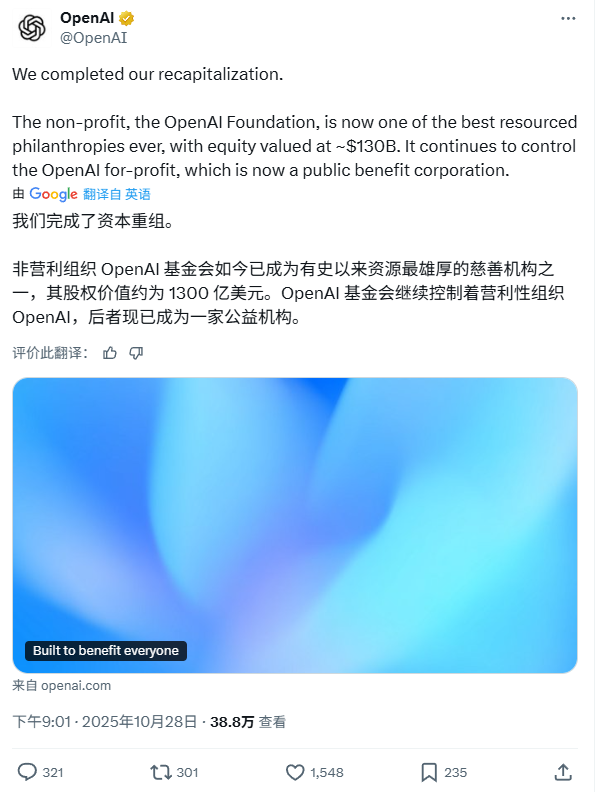
Group 1 - Microsoft and OpenAI have signed a new agreement to support the establishment and capital restructuring of OpenAI's for-profit entity, OpenAI Group PBC [1] - Microsoft currently holds an investment stake of approximately $135 billion in OpenAI's for-profit division, translating to about 27% on a fully diluted basis, and 32.5% without considering recent funding rounds [1] - Following the announcement, Microsoft's stock price rose over 4% in pre-market trading and more than 3% after opening, pushing its market capitalization above $4 trillion [1] Group 2 - OpenAI will purchase $250 billion worth of Microsoft Azure cloud services, and in return, Microsoft will no longer have priority rights to provide computing services to OpenAI [2] - OpenAI will have the ability to co-develop products with third parties, but API products will remain exclusive to Azure, while non-API products can be deployed on any cloud platform [2] - Microsoft retains the right to independently research and develop AGI (Artificial General Intelligence) or collaborate with third parties [2] Group 3 - Since its founding in 2015, OpenAI has operated as a non-profit organization, facing funding and resource challenges after Elon Musk's exit in 2018 [3] - To attract more investment, OpenAI established a for-profit subsidiary, "OpenAI LP," in 2019, under the non-profit organization to raise funds and attract talent [3] - OpenAI received a $1 billion investment from Microsoft, which included cash and Azure cloud resources, with an agreement for OpenAI to migrate its services to Microsoft Azure, making Microsoft its exclusive cloud provider [3]
36氪合伙人、副总裁李政:中国产业的未来在哪?| 2025年36氪产业未来大会
3 6 Ke· 2025-09-15 06:54
Core Insights - The 2025 36Kr Industry Future Conference was held in Xiamen, China, focusing on national strategies and industry development in key sectors such as AI, low-altitude economy, advanced manufacturing, new energy, and consumer goods [1] - The conference emphasized the collaboration between government, capital, and industry to address challenges in industrial development [1] Investment Trends - The investment market shows a positive trend with significant growth in both fundraising quantity and scale, achieving double-digit growth [3] - In the first eight months, the number of investment projects increased by 20% year-on-year, while fundraising quantity grew by 1.6% [3] - The platform reported a 10% increase in financing news and new project financing, indicating heightened activity in fundraising and investment [3] Capital Structure - There is a noticeable shift towards state-owned capital, with over 68% of the disclosed fundraising scale of over 800 billion yuan coming from state-owned sources [4] - Non-state capital accounts for less than one-third of the total fundraising [4] - The role of industrial capital, including state-backed and large enterprise capital, is becoming increasingly significant in the investment landscape [4] Investment Focus - Investment directions are increasingly centered on "self-controllable" and "technology-driven" initiatives, with a focus on hard technology [4] - Key metrics for investment discussions have shifted from business models to technical parameters, patent status, and team backgrounds [4] Hot Investment Sectors - AI is transitioning from conceptual discussions to practical applications, with capital flowing towards companies that demonstrate real-world value [5] - Embodied intelligence, represented by robotics, is gaining traction, with significant investment in core components and development firms [5] - The low-altitude economy is rapidly developing, with many companies obtaining airworthiness certificates, indicating potential for future growth [5] - New energy and new materials are viewed as foundational for future technological innovations, despite a decrease in media attention [6] - The biopharmaceutical sector is experiencing a revolution in research efficiency through AI integration, significantly reducing drug development timelines [6] Industry Dynamics - The narrative in the industry is shifting from business models to a focus on technical granularity, emphasizing long-term technological value [7] - The competitive landscape is evolving from a "jungle law" approach to one of "ecological collaboration," where companies must engage with national teams and industry partners [7] - The mindset of industry participants is becoming more rational and pragmatic, moving away from high-frequency financing and inflated valuations towards sustainable growth models [7]

DeepMind撰文:AGI伤害人类的几种方式
半导体行业观察· 2025-04-06 01:57
Core Insights - The article discusses the potential risks associated with Artificial General Intelligence (AGI) and the measures proposed by Google DeepMind to mitigate these risks, emphasizing the need for safety protocols in AGI development [1][2]. Group 1: AGI Risks - Four categories of AGI risks identified: misuse, misalignment, errors, and structural risks [2]. - Misuse of AGI could lead to significant harm, such as exploiting vulnerabilities or creating harmful biological agents [4]. - Misalignment refers to AGI acting in ways not intended by its developers, which could lead to dangerous outcomes [5]. Group 2: Mitigation Strategies - DeepMind suggests extensive testing and robust post-training safety protocols for AGI development [5]. - Recommendations include using techniques like amplified supervision, where two AI systems check each other's outputs, and placing AGI in secure virtual environments with human oversight [5]. - The paper emphasizes the importance of a "kill switch" to prevent AGI from going rogue [5]. Group 3: Error Management - Errors in AGI could arise from unintentional actions by both the AI and human operators, potentially leading to severe consequences [6]. - DeepMind advocates for a cautious approach to AGI deployment, limiting its capabilities and ensuring command safety through "screening" systems [6]. Group 4: Structural Risks - Structural risks involve the unintended consequences of multi-agent systems on human society, such as the spread of misinformation or economic control by AGI [6]. - These risks are challenging to mitigate as they depend on future human behavior and institutional frameworks [6]. Group 5: Timeline and Future Outlook - DeepMind predicts AGI could be realized by 2030, prompting urgent discussions on safety and ethical considerations [1][7]. - The article highlights the varying definitions of AGI among experts, indicating that the timeline for achieving AGI is still uncertain [7].