AI训推一体芯片

Search documents
摩尔线程跌1.71%创新低 2个月前上市募80亿元
Zhong Guo Jing Ji Wang· 2026-02-05 08:41
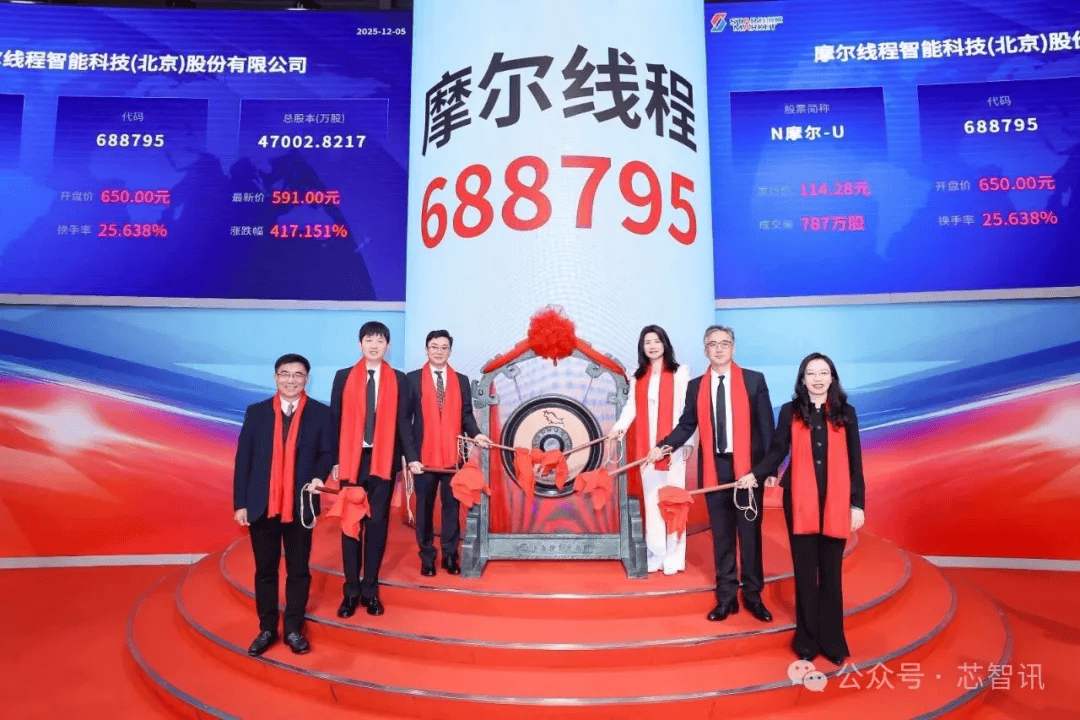
Core Viewpoint - The stock price of Moore Threads (688795.SH) has reached a new low since its listing, closing at 534.58 yuan with a decline of 1.71% on February 5, 2023 [1]. Group 1: Company Overview - Moore Threads was listed on the Shanghai Stock Exchange's Sci-Tech Innovation Board on December 5, 2025, with a total of 70 million shares issued, accounting for 14.89% of the total share capital post-issuance [1]. - The company raised a total of 799.96 million yuan from its initial public offering, with a net amount of 757.61 million yuan after deducting issuance costs, which is 42.39 million yuan less than the original plan [1]. Group 2: Fund Utilization - The funds raised are intended for the development of new generation self-controlled AI training and inference integrated chips, new generation self-controlled graphics chips, new generation self-controlled AI SoC chips, and to supplement working capital [1]. - The total issuance costs for the public offering amounted to 42.35 million yuan, with underwriting fees constituting 39.20 million yuan [2].
摩尔线程跌2.65%创新低 2个月前上市募80亿元
Zhong Guo Jing Ji Wang· 2026-02-03 08:54
Summary of Key Points Core Viewpoint - Moer Technology (688795.SH) has seen its stock price decline, closing at 554.92 yuan with a drop of 2.65%, reaching a new low of 536.20 yuan since its listing [1] Group 1: IPO Details - Moer Technology was listed on the Shanghai Stock Exchange's Sci-Tech Innovation Board on December 5, 2025, with a total of 70 million shares issued, representing 14.89% of the post-issue total share capital [1] - The IPO was entirely new shares, with no existing shareholders selling shares, and the issue price was set at 114.28 yuan per share [1] - The total funds raised from the IPO amounted to 799.96 million yuan, with a net amount of 757.61 million yuan after deducting issuance costs, which was 42.39 million yuan less than the original plan [1] Group 2: Use of Proceeds - The funds raised are intended for the development of Moer Technology's next-generation self-controlled AI training and inference integrated chips, next-generation self-controlled graphics chips, next-generation self-controlled AI SoC chips, and to supplement working capital [1]
摩尔线程2025年预亏约10亿元 上个月上市募资80亿元
Zhong Guo Jing Ji Wang· 2026-01-22 07:03
Core Viewpoint - Moore Threads (688795.SH) anticipates significant revenue growth for 2025, projecting revenues between 1.45 billion to 1.52 billion yuan, representing an increase of 230.70% to 246.67% compared to the previous year [1] Group 1: Financial Performance - For 2025, the company expects a net loss attributable to shareholders of 950 million to 1.06 billion yuan, which is a reduction in losses by 34.50% to 41.30% year-over-year [1] - The net loss attributable to shareholders, excluding non-recurring gains and losses, is projected to be between 1.04 billion to 1.15 billion yuan, with a loss reduction of 29.59% to 36.32% compared to the previous year [1] - Historical financial data shows revenues of 46.09 million yuan in 2022, 123.98 million yuan in 2023, and 438.46 million yuan in 2024, with net losses of 1.89 billion yuan, 1.70 billion yuan, and 1.62 billion yuan respectively [2] Group 2: IPO and Fundraising - Moore Threads went public on the Shanghai Stock Exchange's Sci-Tech Innovation Board on December 5, 2025, issuing 70 million shares, which is 14.89% of the total post-issue share capital [2] - The total amount raised from the IPO was approximately 799.96 million yuan, with a net amount of 757.61 million yuan after deducting issuance costs, which was 42.39 million yuan less than originally planned [3] - The company plans to use the raised funds for the development of new AI training and inference chips, graphics chips, and AISoC chips, as well as to supplement working capital [3]
摩尔线程9成募资委托理财 13个交易日市值蒸发1067亿
Zhong Guo Jing Ji Wang· 2025-12-31 09:28
Core Viewpoint - The company, Moore Threads, has experienced a significant decline in market value, losing over 1,066.87 billion yuan in just 13 trading days following its IPO, raising concerns about its financial management and investment strategies [1][3]. Group 1: IPO and Financial Performance - Moore Threads' stock closed at 587.90 yuan, reflecting a drop of 3.50% [1]. - The company went public on December 5, 2025, on the Shanghai Stock Exchange's Sci-Tech Innovation Board, issuing 70 million shares at a price of 114.28 yuan per share, which accounted for 14.89% of the total post-issue share capital [1]. - The total funds raised from the IPO amounted to 799.96 million yuan, with a net amount of 757.61 million yuan after deducting issuance costs, which were 42.35 million yuan [2][1]. Group 2: Use of Funds - The company plans to use the raised funds for the development of new AI training and inference chips, graphics chips, and AI SoC chips, as well as to supplement working capital [1]. - A significant portion of the raised funds, up to 750 million yuan, will be allocated for cash management to enhance the efficiency of fund utilization, without affecting the implementation of investment projects [2][3]. - The decision to manage idle funds has sparked controversy, as over 90% of the raised capital is being directed towards financial management rather than direct investment in projects [3].
今年以来新股发行募资1308.35亿元,科创板占比28.93%
Zheng Quan Shi Bao Wang· 2025-12-23 07:56
Summary of Key Points Core Viewpoint - The article discusses the issuance of new stocks in the market, highlighting the total amount raised by various companies and the distribution of these funds across different sectors and regions. Group 1: New Stock Issuance - A new stock, 蘅东光, issued 10.25 million shares at a price of 31.59 yuan, raising 324 million yuan [1] - As of December 23, 112 companies have gone public this year, raising a total of 130.83 billion yuan, with an average of 1.168 billion yuan per company [1] - Among these, 32 companies raised over 1 billion yuan, with one company exceeding 10 billion yuan [1] Group 2: Fundraising by Sector - The Shanghai Stock Exchange saw 23 new stocks issued, raising 43.97 billion yuan; the Shenzhen Stock Exchange had 15 new stocks raising 17.64 billion yuan; the ChiNext Board issued 31 new stocks raising 24.07 billion yuan; the Sci-Tech Innovation Board had 18 new stocks raising 37.85 billion yuan; and the Beijing Stock Exchange issued 25 new stocks raising 7.31 billion yuan [1] - 华电新能 is the company with the highest fundraising this year, raising 18.171 billion yuan primarily for wind and solar power projects [2] - Other notable fundraisers include 摩尔线程 with 8 billion yuan for AI chip development and 西安奕材 with 4.636 billion yuan [2] Group 3: Pricing and Regional Distribution - The average initial public offering (IPO) price this year is 24.34 yuan, with 10 companies priced above 50 yuan and 2 above 100 yuan [2] - The highest IPO price was for 摩尔线程 at 114.28 yuan, while the lowest was for 华电新能 at 3.18 yuan [2] - New stock issuances are concentrated in Jiangsu, Guangdong, and Zhejiang, with the highest fundraising amounts from Fujian, Jiangsu, and Beijing, totaling 22.447 billion yuan, 20.684 billion yuan, and 19.908 billion yuan respectively [2]
今年以来新股发行募资1305.11亿元,科创板占比29.00%
Zheng Quan Shi Bao Wang· 2025-12-22 08:38
Group 1 - Two new stocks were issued today: Shaanxi Tourism issued 19.33 million shares at a price of 80.44 yuan, raising 1.555 billion yuan; Xin Guangyi issued 36.72 million shares at a price of 21.93 yuan, raising 805 million yuan [1] - As of December 22, a total of 111 companies have gone public this year, raising a cumulative amount of 130.511 billion yuan, with an average fundraising of 1.176 billion yuan per company [1] - Among the companies, 32 raised over 1 billion yuan, with 1 company raising over 10 billion yuan, 39 companies raising between 500 million and 1 billion yuan, and 40 companies raising less than 500 million yuan [1] Group 2 - Huadian New Energy is the company with the highest fundraising this year, raising 18.171 billion yuan primarily for wind and solar power projects [2] - Other notable fundraisers include Moer Thread with 8 billion yuan for AI chip development, and Xi'an Yicai, China Uranium Industry, and C Muxi raising 4.636 billion yuan, 4.440 billion yuan, and 4.197 billion yuan respectively [2] - The average initial public offering price this year is 24.27 yuan, with 10 companies priced above 50 yuan and 2 companies above 100 yuan [2] Group 3 - The majority of new stock issuances this year are concentrated in Jiangsu, Guangdong, and Zhejiang, with 28, 19, and 17 companies respectively [2] - The top three provinces by fundraising amount are Fujian, Jiangsu, and Beijing, raising 22.447 billion yuan, 20.684 billion yuan, and 19.908 billion yuan respectively [2]
明年将发债支持国补,摩尔线程回应拿钱理财
Xin Lang Cai Jing· 2025-12-16 04:45
Group 1 - The Ministry of Finance plans to issue 150 billion yuan of special long-term bonds in 2024 to support consumer subsidies for vehicle trade-ins and related appliances, with an additional 300 billion yuan expected in 2025 [1][17] - The "national subsidy" policy has positively impacted domestic consumption over the past two years, leading to a significant increase in sales, with over 25 trillion yuan in sales generated from trade-in programs benefiting over 360 million people [1][17] - The coverage of the "national subsidy" policy is expected to continue expanding, particularly for durable consumer goods like refrigerators and televisions [1][17] Group 2 - In November, the average sales prices of residential properties in 70 major cities showed a month-on-month decline, with first-tier cities down by 0.4% and second and third-tier cities down by 0.3% and 0.4% respectively [3][18] - The introduction of "home purchase interest subsidy" policies in several cities has led to a short-term increase in new home transactions, with some cities reporting over a 15% month-on-month growth in sales [3][18] - The real estate market is experiencing a downturn, with new home prices remaining relatively stable due to high-quality listings, while second-hand homes are seeing more aggressive price reductions [3][18] Group 3 - In November, the industrial added value for large-scale enterprises grew by 4.8% year-on-year, with a month-on-month increase of 0.44%, while the growth rate for the manufacturing sector was 4.6% [5][20] - High-tech manufacturing sectors, such as 3D printing and industrial robotics, showed significant growth, with production increases of 100.5% and 20.6% respectively [5][21] - The overall industrial growth rate has slowed, with traditional manufacturing sectors like cement and steel continuing to decline, indicating a need for structural adjustments in the economy [5][21] Group 4 - Vanke has faced challenges in extending a 2 billion yuan bond, with all proposed extension plans failing to meet the required approval threshold [7][22] - The company is in a precarious financial situation, with a potential default looming if an agreement with bondholders is not reached within the grace period [7][22] - Vanke's reliance on state-owned shareholders for support has diminished, raising concerns about its ability to navigate its financial difficulties independently [7][23] Group 5 - iRobot has filed for Chapter 11 bankruptcy protection, indicating severe financial distress despite being a pioneer in the robotic vacuum market [9][24] - The company has seen a significant decline in market share due to increased competition from lower-cost Chinese manufacturers and slow product innovation [9][25] - iRobot's financial situation is dire, with liabilities exceeding 500 million dollars and cash reserves dwindling to 24.8 million dollars [9][24] Group 6 - Samsung is reportedly in discussions with AMD regarding a potential partnership for 2nm chip manufacturing, aiming to enhance its position in the high-end semiconductor market [11][26] - Despite previous attempts, Samsung has struggled to gain a significant share in the high-end chip market due to issues with process maturity and yield rates [11][26] - The collaboration with AMD could provide Samsung with leverage in negotiations with other clients, particularly in the context of increasing demand for AI chips [11][26]



明年将发债支持国补,摩尔线程回应拿钱理财 | 财经日日评
吴晓波频道· 2025-12-16 00:30
Group 1: National Policies and Economic Measures - The Ministry of Finance plans to issue 1.5 billion yuan in special long-term bonds in 2024 to support consumer subsidies for vehicle trade-ins and related appliances, with an additional 3 billion yuan expected in 2025 [2] - The "national subsidy" policy has positively impacted domestic consumption over the past two years, with consumer goods trade-ins generating over 2.5 trillion yuan in sales from January to November, benefiting over 360 million people [2] - The coverage of the "national subsidy" policy is expected to continue expanding, particularly for durable consumer goods like refrigerators and televisions [2] Group 2: Real Estate Market Trends - In November, the sales prices of new residential properties in major cities showed a month-on-month decline, with first-tier cities down 0.4% and second and third-tier cities down 0.3% and 0.4% respectively [4] - The introduction of "home purchase interest subsidies" in several cities has led to a short-term increase in new home transactions by over 15% [4] - The real estate market is experiencing a downturn, with second-hand homes showing stronger sales performance compared to new homes due to price reductions by individual landlords [4][5] Group 3: Industrial Growth and Economic Indicators - In November, the industrial added value for large-scale enterprises grew by 4.8% year-on-year, with a month-on-month increase of 0.44% [6] - High-tech manufacturing sectors, such as 3D printing and industrial robotics, saw significant growth, with production increasing by 100.5% and 20.6% respectively [6] - The overall industrial growth rate is being constrained by weak demand and ongoing adjustments in the real estate market, leading to a cautious economic recovery [6] Group 4: Corporate Debt and Financial Challenges - Vanke's attempt to extend the maturity of a 2 billion yuan bond faced obstacles, as none of the proposed extension plans received the required 90% approval from bondholders [7][8] - The company is at risk of default if an agreement is not reached within the grace period following the bond's maturity [7] - Vanke's financial struggles are compounded by reduced support from state-owned shareholders, indicating a challenging path ahead for the company [8] Group 5: Technology and Market Developments - iRobot has filed for Chapter 11 bankruptcy protection, facing significant financial difficulties with liabilities exceeding 500 million dollars and cash reserves of only 24.8 million dollars [9][10] - The company, once a leader in the robotic vacuum market, has struggled to keep up with competitors offering better technology at lower prices [10] - Samsung is in discussions with AMD regarding potential collaboration on 2nm chip manufacturing, aiming to enhance its position in the high-end semiconductor market [11]

摩尔线程回应质疑!
半导体行业观察· 2025-12-14 03:34
Core Viewpoint - The company, Moer Technology, announced plans to utilize part of its idle raised funds for cash management, with a maximum amount of 7.5 billion yuan within a 12-month period, aiming to enhance the efficiency of fund usage while ensuring the safety of the raised funds [2][4]. Fund Management Details - The purpose of the investment is to improve the efficiency of the raised funds, utilizing idle funds without affecting the implementation of investment projects or the safety of the raised funds [4]. - Investment types include but are not limited to agreement deposits, notice deposits, time deposits, structured deposits, large certificates of deposit, and other safe, liquid, principal-protected products [4]. - The total amount raised from the initial public offering (IPO) was approximately 8 billion yuan, with a net amount of 7.58 billion yuan after deducting issuance fees [4]. Project Allocation - The raised funds are allocated as follows: 2.51 billion yuan for the development of a new generation of self-controlled AI training and pushing integrated chips, 2.502 billion yuan for the development of a new generation of self-controlled graphics chips, 1.982 billion yuan for the development of a new generation of self-controlled AI SoC chips, and 1.006 billion yuan for supplementing working capital [4][5]. Cash Management Strategy - The company emphasized that the cash management of 7.5 billion yuan is a maximum limit and the actual amount will be significantly lower, adjusting as project progress continues [6]. - The company will continue to increase R&D investment to accelerate product iteration and overcome core technological barriers, ensuring that cash management does not affect the normal implementation of investment projects or the company's main business [6]. Stock Performance - Moer Technology, known as the "first domestic GPU stock," saw its stock price surge by 468.78% on its first trading day, reaching a peak of 688 yuan per share, with a closing price increase of 723.49% by December 11 [7]. - The company issued a risk warning regarding its stock price, which has risen significantly compared to related indices, indicating potential short-term volatility [8]. Financial Performance - The company has experienced continuous revenue growth, with revenue increasing from 46 million yuan in 2022 to 438 million yuan in 2024, reflecting a compound annual growth rate of 208.44% [8]. - Despite the revenue growth, the company has reported significant net losses, totaling 5.939 billion yuan over the past three years and nine months, with expectations to achieve profitability by 2027 [8].
募资75亿元做理财?摩尔线程回应
Sou Hu Cai Jing· 2025-12-14 03:25
Core Viewpoint - Moore Threads announced the use of idle raised funds for cash management to improve efficiency without affecting project implementation or fund safety [2][4]. Group 1: Fund Management - The company plans to use up to RMB 750 million of idle raised funds for cash management within 12 months from the board's approval [2]. - The total amount raised from the initial public offering was approximately RMB 8 billion, with a net amount of RMB 7.58 billion after deducting issuance fees [4]. - The cash management amount is a maximum limit and will be less than this cap, with the amount decreasing as projects progress [4][5]. Group 2: Project Allocation - The funds raised are allocated to several projects: RMB 2.51 billion for AI chip development, RMB 2.502 billion for graphics chip development, RMB 1.982 billion for AI SoC chip development, and RMB 1.006 billion for working capital [4]. - The company emphasizes that cash management will not impact the normal operation of fundraising projects or the main business [5]. Group 3: Response to Concerns - The company has addressed external concerns by stating that the cash management strategy is in line with legal requirements and will not hinder project progress [5]. - The company is committed to increasing R&D investment to accelerate product iteration and overcome technical barriers [5].