购房贴息政策

Search documents
多地购房贴息政策落地,对购房者来说意味着啥|卜房者说
Sou Hu Cai Jing· 2025-12-22 13:09
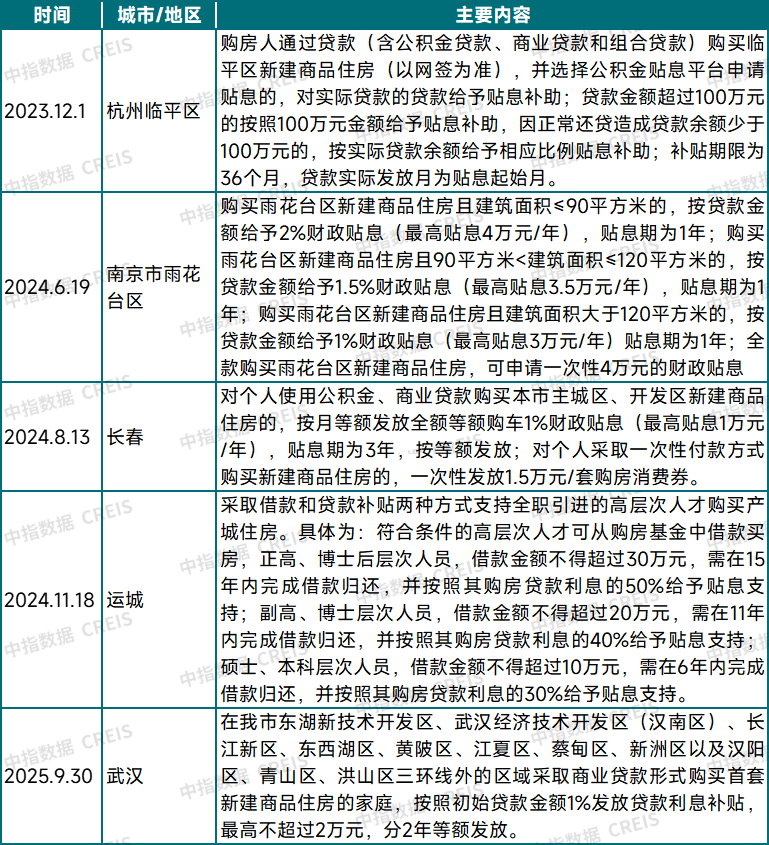
Core Insights - Several cities in China, including Hangzhou, Wuhan, and Guangzhou, are implementing home purchase interest subsidies to alleviate financial burdens for homebuyers [1][2] - The subsidies typically cover 1% of the loan amount for a period of 1 to 3 years, with specific examples showing potential savings of up to 36 million yuan over 30 years [1][2] - The introduction of these policies has led to significant increases in new home transactions, with reported monthly increases of 17.5% in Nanjing and 18.7% in Wuhan following the implementation of similar measures [1] Policy Details - In Wuhan, families purchasing their first new home can receive a subsidy of up to 20,000 yuan based on 1% of the total loan amount [1] - Guangzhou offers a more direct approach, providing a monthly subsidy of 1,000 yuan for designated properties, amounting to a total potential saving of 36 million yuan over 30 years [1] Financial Impact - According to the China Index Academy, a loan of 2 million yuan over 30 years at an interest rate of 3.1% with a 1% subsidy can reduce monthly payments by 1,048 yuan, resulting in annual savings of 12,600 yuan [2] - This financial relief is particularly beneficial for ordinary families, allowing for increased disposable income [2] Regional Considerations - While there is demand for similar policies in Changsha, the city has already implemented measures like "old-for-new" policies, making large-scale adoption of interest subsidies less likely in the short term [2] - If Changsha were to adopt such a policy, it would likely target specific areas and first-time homebuyers, similar to Wuhan's approach [2]
多地购房贴息政策落地,长沙会跟进吗
Xin Lang Cai Jing· 2025-12-22 11:05
Core Viewpoint - The recent discussions on housing interest subsidies have gained significant attention, with cities like Hangzhou and Wuhan exploring these subsidies to stimulate the housing market recovery [1][2]. Group 1: Policy Implementation and Effects - Multiple cities have initiated pilot programs for housing interest subsidies, with Wuhan offering a 1% subsidy on the initial loan amount for first-time homebuyers in specific districts, with a maximum subsidy of 20,000 yuan [1][2]. - In Guangzhou, a new project is providing a monthly subsidy of 1,000 yuan for 30 years, potentially totaling up to 360,000 yuan for eligible buyers [1]. - The implementation of these policies has shown initial positive effects, with new home transaction volumes in Nanjing and Wuhan increasing by 17.5% and 18.7% respectively following the introduction of the subsidies [2]. Group 2: Market Impact and Benefits - The housing interest subsidy policy is expected to lower the barriers to home purchasing, enhance transaction activity, stabilize market expectations, and promote recovery in the real estate market [3]. - For homebuyers, these subsidies directly reduce purchasing costs, alleviating monthly payment pressures and potentially releasing consumer spending [3]. - Financial institutions may benefit from reduced early repayment rates, easing operational pressures on banks [3]. Group 3: Considerations for Broader Implementation - While the initial effects of the housing interest subsidy policies are promising, broader implementation faces challenges, including significant fiscal pressures that could reach hundreds of billions if applied nationwide [3]. - The disparity in regional economic conditions poses a challenge, as high housing prices and loan volumes in core cities contrast with the fiscal constraints in lower-tier cities [3]. - The likelihood of cities like Changsha adopting similar policies may depend on existing programs and the focus on specific demographics, such as first-time buyers and those seeking improved housing [4].
明年将发债支持国补,摩尔线程回应拿钱理财
Xin Lang Cai Jing· 2025-12-16 04:45
Group 1 - The Ministry of Finance plans to issue 150 billion yuan of special long-term bonds in 2024 to support consumer subsidies for vehicle trade-ins and related appliances, with an additional 300 billion yuan expected in 2025 [1][17] - The "national subsidy" policy has positively impacted domestic consumption over the past two years, leading to a significant increase in sales, with over 25 trillion yuan in sales generated from trade-in programs benefiting over 360 million people [1][17] - The coverage of the "national subsidy" policy is expected to continue expanding, particularly for durable consumer goods like refrigerators and televisions [1][17] Group 2 - In November, the average sales prices of residential properties in 70 major cities showed a month-on-month decline, with first-tier cities down by 0.4% and second and third-tier cities down by 0.3% and 0.4% respectively [3][18] - The introduction of "home purchase interest subsidy" policies in several cities has led to a short-term increase in new home transactions, with some cities reporting over a 15% month-on-month growth in sales [3][18] - The real estate market is experiencing a downturn, with new home prices remaining relatively stable due to high-quality listings, while second-hand homes are seeing more aggressive price reductions [3][18] Group 3 - In November, the industrial added value for large-scale enterprises grew by 4.8% year-on-year, with a month-on-month increase of 0.44%, while the growth rate for the manufacturing sector was 4.6% [5][20] - High-tech manufacturing sectors, such as 3D printing and industrial robotics, showed significant growth, with production increases of 100.5% and 20.6% respectively [5][21] - The overall industrial growth rate has slowed, with traditional manufacturing sectors like cement and steel continuing to decline, indicating a need for structural adjustments in the economy [5][21] Group 4 - Vanke has faced challenges in extending a 2 billion yuan bond, with all proposed extension plans failing to meet the required approval threshold [7][22] - The company is in a precarious financial situation, with a potential default looming if an agreement with bondholders is not reached within the grace period [7][22] - Vanke's reliance on state-owned shareholders for support has diminished, raising concerns about its ability to navigate its financial difficulties independently [7][23] Group 5 - iRobot has filed for Chapter 11 bankruptcy protection, indicating severe financial distress despite being a pioneer in the robotic vacuum market [9][24] - The company has seen a significant decline in market share due to increased competition from lower-cost Chinese manufacturers and slow product innovation [9][25] - iRobot's financial situation is dire, with liabilities exceeding 500 million dollars and cash reserves dwindling to 24.8 million dollars [9][24] Group 6 - Samsung is reportedly in discussions with AMD regarding a potential partnership for 2nm chip manufacturing, aiming to enhance its position in the high-end semiconductor market [11][26] - Despite previous attempts, Samsung has struggled to gain a significant share in the high-end chip market due to issues with process maturity and yield rates [11][26] - The collaboration with AMD could provide Samsung with leverage in negotiations with other clients, particularly in the context of increasing demand for AI chips [11][26]



明年将发债支持国补,摩尔线程回应拿钱理财 | 财经日日评
吴晓波频道· 2025-12-16 00:30
Group 1: National Policies and Economic Measures - The Ministry of Finance plans to issue 1.5 billion yuan in special long-term bonds in 2024 to support consumer subsidies for vehicle trade-ins and related appliances, with an additional 3 billion yuan expected in 2025 [2] - The "national subsidy" policy has positively impacted domestic consumption over the past two years, with consumer goods trade-ins generating over 2.5 trillion yuan in sales from January to November, benefiting over 360 million people [2] - The coverage of the "national subsidy" policy is expected to continue expanding, particularly for durable consumer goods like refrigerators and televisions [2] Group 2: Real Estate Market Trends - In November, the sales prices of new residential properties in major cities showed a month-on-month decline, with first-tier cities down 0.4% and second and third-tier cities down 0.3% and 0.4% respectively [4] - The introduction of "home purchase interest subsidies" in several cities has led to a short-term increase in new home transactions by over 15% [4] - The real estate market is experiencing a downturn, with second-hand homes showing stronger sales performance compared to new homes due to price reductions by individual landlords [4][5] Group 3: Industrial Growth and Economic Indicators - In November, the industrial added value for large-scale enterprises grew by 4.8% year-on-year, with a month-on-month increase of 0.44% [6] - High-tech manufacturing sectors, such as 3D printing and industrial robotics, saw significant growth, with production increasing by 100.5% and 20.6% respectively [6] - The overall industrial growth rate is being constrained by weak demand and ongoing adjustments in the real estate market, leading to a cautious economic recovery [6] Group 4: Corporate Debt and Financial Challenges - Vanke's attempt to extend the maturity of a 2 billion yuan bond faced obstacles, as none of the proposed extension plans received the required 90% approval from bondholders [7][8] - The company is at risk of default if an agreement is not reached within the grace period following the bond's maturity [7] - Vanke's financial struggles are compounded by reduced support from state-owned shareholders, indicating a challenging path ahead for the company [8] Group 5: Technology and Market Developments - iRobot has filed for Chapter 11 bankruptcy protection, facing significant financial difficulties with liabilities exceeding 500 million dollars and cash reserves of only 24.8 million dollars [9][10] - The company, once a leader in the robotic vacuum market, has struggled to keep up with competitors offering better technology at lower prices [10] - Samsung is in discussions with AMD regarding potential collaboration on 2nm chip manufacturing, aiming to enhance its position in the high-end semiconductor market [11]


中指研究:购房贴息即将落地,影响有多大?
智通财经网· 2025-12-11 03:45
Core Viewpoint - The recent discussions around housing interest subsidy policies have garnered significant attention, with potential implications for the real estate market and macroeconomic stability [1][8]. Group 1: Policy Implementation - Various cities and regions in China have already implemented housing loan interest subsidy policies, which have positively impacted short-term market activity [2]. - Specific examples include Hangzhou, Nanjing, and Wuhan, where subsidies are provided based on loan amounts and property types, leading to increased transaction volumes in the months following policy announcements [2][4]. Group 2: Market Impact - The implementation of interest subsidies is expected to lower the cost of home purchases, thereby increasing housing transaction activity and stabilizing market expectations [8]. - According to predictions, the total sales of new and second-hand residential properties in China could reach approximately 14 trillion yuan by 2025, with a potential subsidy amount of around 70 billion yuan if a 1% interest subsidy is applied [1][8]. Group 3: Financial Implications - For homebuyers, the interest subsidy directly reduces the cost of borrowing, easing monthly repayment pressures and potentially releasing consumer spending [8]. - Financial institutions may benefit from reduced early repayment rates, alleviating operational pressures [8].