
AI设计

Search documents
【高端访谈】土巴兔CEO王国彬开出家装行业“御寒良方”:强化用户价值,以AI与共生破局
Sou Hu Cai Jing· 2025-12-24 09:57
Core Insights - The home decoration industry is experiencing significant challenges, including price wars and homogenization of services, which necessitates a focus on user value and platform collaboration to navigate the current market conditions [1][5]. Group 1: Industry Challenges - The home decoration industry faces unique attributes such as low frequency, high unit price, labor-intensive processes, long project cycles, and non-standardization, leading to increased price competition among companies [5]. - The homogenization of services has resulted in a price war, prompting the need for companies to innovate and create differentiated offerings rather than engaging in price competition [5]. Group 2: AI and Industry Upgrade - The advent of AI presents a significant opportunity for the home decoration industry, as it creates new supply capabilities and enhances service delivery through personalized design, customer service, and quality inspection [6]. - Companies like 土巴兔 are actively investing in AI technologies, including AI design, customer service, and marketing, to improve user experience and operational efficiency [6]. Group 3: International Expansion - Some home decoration companies are establishing production bases in Malaysia, indicating a trend towards international expansion, with 土巴兔 also considering overseas plans, though specific timelines remain undecided [7]. Group 4: Future Opportunities - The upcoming "15th Five-Year Plan" period is expected to bring new development opportunities for the home decoration industry, particularly as the government encourages consumer spending [8]. - The industry is anticipated to evolve towards more precise, integrated, and intelligent solutions, with a focus on aging-friendly, smart, and quality-oriented services [8].

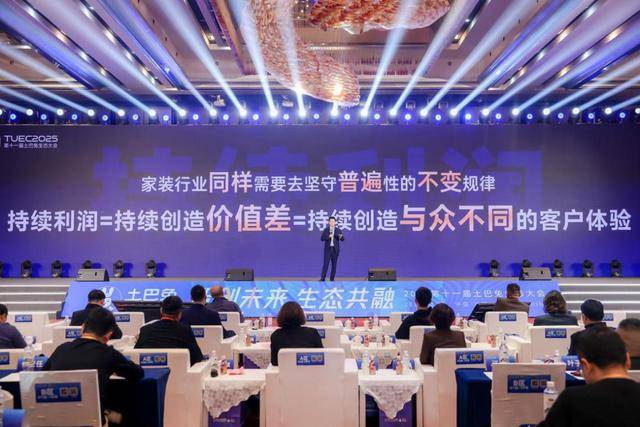
土巴兔第十一届生态大会:启动装修保3.0服务
Qi Lu Wan Bao· 2025-12-18 08:44
Group 1 - The core theme of the 2025 Tuba Ecological Conference is "Intelligent Creation of the Future, Ecological Integration," focusing on the home decoration ecosystem's year-end review and future development strategies [1] - Tuba's CEO Wang Guobin emphasizes the importance of adhering to the value creation belief while embracing the trends of artificial intelligence, indicating that user decision-making has been replaced by AI agents [1][2] - Tuba has launched a three-pronged service approach focusing on materials, construction periods, and additional items, marking the comprehensive upgrade of its renovation guarantee service [1] Group 2 - Wang Guobin highlights the unique characteristics of the home decoration industry, such as low frequency, high unit price, and long non-standard work cycles, while stressing the need for a customer-first service approach [1][2] - The shift towards AI-driven decision-making necessitates platforms and partners to focus on value communication directed at AI rather than just users [2] - Tuba is actively developing AI infrastructure in design, customer service, quality inspection, and marketing to enhance user experience and streamline the renovation process [2] Group 3 - Wang Guobin asserts that the future of the home decoration industry lies in leveraging AI to record every transaction, service, and reputation, which will serve as the basis for AI recommendations [3] - The platform is viewed as a ladder that helps businesses seize future opportunities in the face of the AI wave [3]
AI赋能建筑行业 10分钟即可完成一份行业标书初稿
Xin Jing Bao· 2025-11-14 11:19
Core Viewpoint - Guanglian Da (002410) is the first A-share listed company in China's construction engineering informationization sector, focusing on digital building platform services and providing comprehensive digital solutions for the entire lifecycle of construction projects [1] Group 1: Company Overview - Guanglian Da has established a dedicated AI research and development team since 2015, indicating its commitment to integrating advanced technologies into its services [1] - The company has launched AecGPT, the first self-developed large model for the construction industry in China, along with an industry AI platform [1] Group 2: Product Offerings - Guanglian Da offers various AI-driven solutions, including AI design, AI trading, and AI quantity surveying, showcasing its capability to address specific needs within the construction sector [1] - The company plans to release the "AI Application Action Guide for Construction Enterprises" in 2025, further promoting the deep application and development of AI in the industry [1]

科技赋能制造业,北京智造助力制造强国建设
Xin Jing Bao· 2025-10-31 02:01
Group 1: Event Overview - The "京彩不设限·经济热力站" monthly thematic visit event was held in Beijing, focusing on "Technology Leading the Way, Beijing Intelligent Manufacturing" [1] - The event involved a collective interview with 12 media outlets, highlighting the development of intelligent manufacturing enterprises in Beijing [1] Group 2: Company Highlights - Guanglianda Technology Co., Ltd. is the first A-share listed company in China's construction engineering information sector, providing digital solutions for the entire lifecycle of buildings [2] - Guanglianda has established an AI research team since 2015 and is entering a results-intensive phase in 2024, with the launch of AecGPT and various AI models for the construction industry [2] - Beijing Automotive Co., Ltd. (Beijing Off-road) showcases advanced intelligent manufacturing technologies in its smart factory, including welding robots and AGV unmanned transport vehicles [3] - Beijing Off-road has developed a diverse product matrix covering various off-road vehicle scenarios, enhancing its market recognition [3] - Kaiyun Group, a national-level specialized "little giant" enterprise in commercial aerospace, has established the first space data operation center in China and is focused on space safety [4][5] - Kaiyun Group has built a comprehensive space observation network with 30 ground observation stations and 108 satellites, addressing domestic data gaps in space [5] - Helis Group focuses on industrial intelligence, transportation intelligence, and food and drug intelligence, providing customized solutions and services [5][6] - Helis Group plans to launch the XMagital intelligent system in 2025, integrating production control and management [6] Group 3: Industry Trends - The integration of new information technology and advanced manufacturing is accelerating the digital and intelligent transformation of the global manufacturing industry [4] - Intelligent manufacturing is becoming a significant trend in industrial transformation, with Beijing promoting high-quality economic development through innovation [6]
漏洞百出的AI,快把设计师逼疯了 | 海斌访谈
Di Yi Cai Jing· 2025-06-06 03:52
Core Insights - The article discusses the limitations and potential of AI in design, particularly in architecture and graphic design, highlighting that while AI can generate designs quickly, it often lacks the precision and creativity of human designers [1][3][5]. Group 1: AI in Design - AI platforms can generate hundreds of images in seconds, but these designs often contain significant errors, such as misaligned structural elements [1][5]. - In China, AI design tools are widely used in e-commerce, with platforms like Alibaba's LuBan claiming to produce millions of promotional images during peak shopping seasons [1][2]. - The commercial viability of AI design tools is questioned, as evidenced by the planned discontinuation of LuBan's services by June 30, 2025, which will be reduced to "Taobao LuBan" [2][3]. Group 2: Designer Perspectives - Designers express concern that AI-generated designs may not meet professional standards, particularly in architecture where structural integrity is crucial [5][6]. - While AI can assist in specific tasks, such as generating stairwell designs in a fraction of the time, it struggles with more complex, creative architectural solutions [6][7]. - The consensus among industry professionals is that AI lacks the imagination and creativity that are essential in design, making it less useful for experienced designers [3][5][6]. Group 3: Future of AI in Design - The evolution of design tools has transitioned from hand-drawing to computer-aided design, and now to AI, but current AI tools are still not fully satisfactory for professional use [7]. - There is a need for human oversight in AI-generated designs to ensure quality and adherence to design objectives, as AI may produce errors due to a lack of understanding of the design purpose [6][7].