
ASIC(专用集成电路)芯片

Search documents
美银筛出2026年六大芯片股,看好半导体行业销售额突破1万亿美元
Feng Huang Wang· 2025-12-24 22:34
Arya 依然保持乐观,认为当前的投入既具有"进攻性",也具有"防御性"。换言之,科技巨头别无选 择,必须投资以守住他们现有的商业帝国。 Arya特别提到,英伟达就像是在"另一个星系"中运营。年初至今,英伟达股价已累计上涨超40%,过高 的估值令部分投资者"望而却步"。 12月25日,美国银行分析师Vivek Arya表示,人工智能(AI)热潮并未降温,反而正在进一步扩大。 尽管一些AI怀疑论者认为过高的估值是回避该板块的理由,但Arya认为,这一行业仍处在为期十年的 结构性变革"中点",而这场变革是由英伟达和博通引领的。 Arya在题为《2026年展望:颠簸但仍充满希望》的报告中预计,明年全球半导体销售额将同比增长 30%,这将最终推动该行业首次突破具有里程碑意义的1万亿美元年销售额。 Arya指出,他尤其看好那些"护城河可以通过利润率结构量化"的公司。除英伟达和博通外,他还将泛林 集团、科磊、亚德诺以及铿腾电子列为2026年的首选标的。 "我经常说,投资半导体其实很简单,"Arya在12月19日电话会议上表示,"你根本不需要卖方分析师。 只要把所有公司按毛利率排序,买前五名,基本不会错得太离谱。" 美银预 ...


谷歌TPU芯片崛起,英伟达短期需要慌吗?
Hua Er Jie Jian Wen· 2025-11-26 08:51
Core Insights - The AI chip market is experiencing turbulence as rumors suggest that Meta, a key customer of Nvidia, is considering adopting Google's custom AI chips, Tensor Processing Units (TPUs), potentially starting next year [1] - This news led to a significant market reaction, with Nvidia's stock dropping by 6% and AMD's by 10%, while Alphabet's stock rose by 4% [1] - Both Google and Nvidia responded to the market concerns, emphasizing their commitment to supporting both TPUs and Nvidia GPUs [1] Group 1: Market Reactions - Nvidia's stock ultimately closed down approximately 2.6%, while Alphabet's stock closed up 1.6%, reaching a new historical high [1] - The market's reaction indicates heightened competition and uncertainty surrounding Nvidia's dominance in the AI chip sector [1][4] Group 2: Analyst Perspectives - Citigroup's report acknowledges the growing competition from custom AI accelerators like Google's TPUs and Amazon's Trainium, but maintains that Nvidia's market share will remain high, predicting a decline from 90% in 2025 to 81% by 2028 [2] - Analysts note that major companies like Microsoft and Meta still heavily rely on Nvidia's platform due to delays in their own custom chip projects [2] Group 3: Nvidia's Defensive Strategy - Nvidia has taken unusual defensive communication measures, publicly asserting its technological superiority over TPUs and emphasizing its ability to run all AI models [5] - The company also distributed a detailed memo to Wall Street analysts addressing various criticisms, which some analysts interpreted as a sign of insecurity [5][7] Group 4: Competitive Landscape - Google's AI model, Gemini 3, has been trained entirely on its TPUs, enhancing the credibility of TPUs as a viable alternative to Nvidia's products [6] - The competitive landscape is shifting, with major players like Google demonstrating significant capabilities in AI chip development [6]


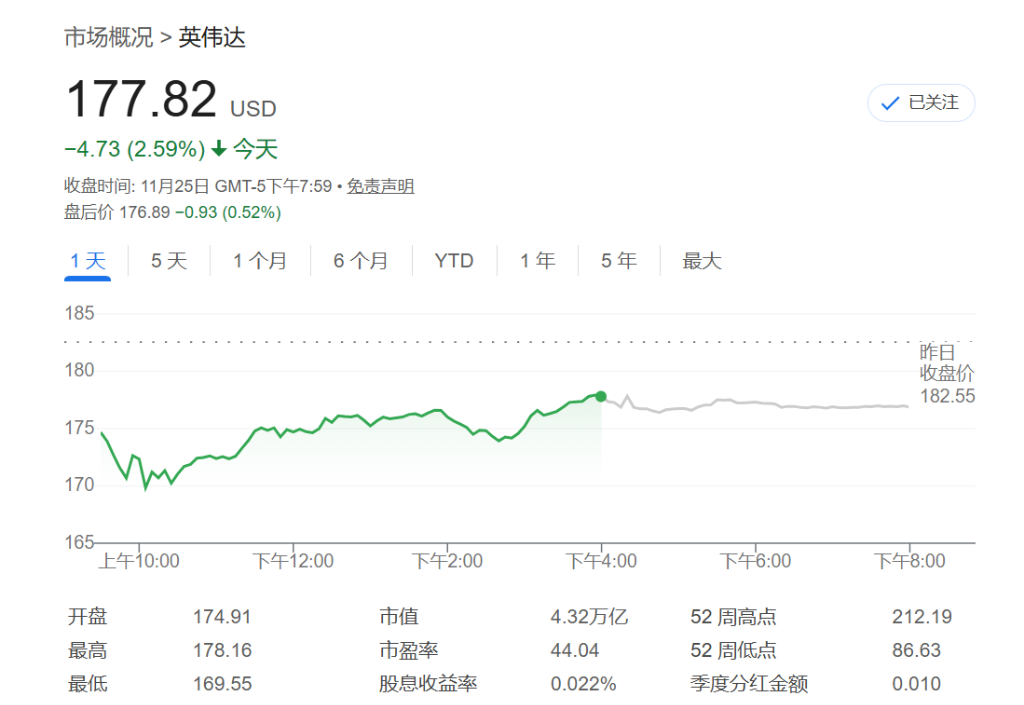
美国重磅数据公布,道指涨超600点,原油收跌!英伟达紧急发声,盘中重挫7%,美联储大消息
Sou Hu Cai Jing· 2025-11-26 01:13
Group 1: Market Performance - Major tech stocks showed mixed performance, with Meta rising over 3%, Google and Amazon up over 1%, while AMD fell over 4%, Netflix down over 2%, and Oracle down over 1% [1] - Nvidia's stock experienced a significant drop, falling over 7% at one point, closing at $177.82, down 2.59%, resulting in a market cap loss of approximately $114.94 billion (around 81.43 billion RMB) [1][2] Group 2: Nvidia and Google Competition - Analysts noted that Google is making substantial progress in challenging Nvidia's leading AI acceleration chips, prompting investors to reassess the tech landscape and potential shifts among market leaders [4] - Nvidia acknowledged Google's success in AI advancements and emphasized its unique position in the market, claiming to be the only platform capable of running all AI models across various computing scenarios [4] - Reports suggest that Meta may be considering a partnership with Google to utilize Google's Tensor Processing Units (TPUs) in its data centers, indicating a potential shift in client relationships [4] Group 3: Google’s Advantages - Google possesses several advantages over OpenAI, including a vast existing data corpus for training AI models, continuous profits, and its own computing infrastructure [5] Group 4: Economic Indicators - The latest U.S. economic data showed a 2.7% year-over-year increase in the Producer Price Index (PPI) for September, matching expectations, while the core PPI rose 2.6% year-over-year, slightly below forecasts [12] - Retail sales in September increased by 0.2%, below the expected 0.4% [12] - Consumer confidence in the U.S. fell significantly, with the index dropping 6.8 points to 88.7, indicating growing concerns about the labor market and overall economic outlook [12]

签下OpenAI大单 亚马逊股价创历史新高
Bei Jing Shang Bao· 2025-11-04 16:13
Core Insights - The partnership between Amazon and OpenAI, involving a seven-year cloud service procurement agreement worth $38 billion, is driving significant interest and investment in AI, leading to a surge in stock prices for major players like Amazon and Nvidia [1][2]. Company Developments - Amazon's stock rose by 4% to reach a historic high, adding over $100 billion to its market capitalization following the announcement of the OpenAI deal [1]. - OpenAI is set to receive hundreds of thousands of Nvidia GPUs through this agreement, which is a strong endorsement for Amazon Web Services (AWS) amidst concerns about its competitiveness against Microsoft and Google [1]. - AWS reported robust growth in its third-quarter earnings, alleviating investor concerns about its position in the AI market [1][3]. AI Infrastructure Investments - OpenAI has committed to investing $1.4 trillion to develop 30 gigawatts (GW) of computing resources, which could power approximately 25 million American households [3]. - Nvidia announced a potential investment of up to $100 billion to assist OpenAI in building and deploying AI data centers with at least 10 GW of capacity [2]. - OpenAI is also exploring partnerships with other GPU manufacturers like AMD and is working on developing custom ASIC chips for AI acceleration [2][3]. Market Outlook - Citigroup forecasts that global AI industry revenue will reach $975 billion by 2030, reflecting a compound annual growth rate of 86% from $43 billion in 2025, driven by accelerated adoption and commercialization of AI technologies [4]. - There is ongoing debate in the market regarding the potential for an AI bubble, with concerns about whether the substantial investments in AI infrastructure will yield the expected returns [4].

七折询价“甩卖”5%股份芯原股份六大股东为何大幅折价也要跑?
Xin Lang Cai Jing· 2025-08-26 01:39
Core Viewpoint - The article discusses the recent pricing and business performance of Chip Origin Technology Co., Ltd. (芯原股份), highlighting its revenue structure and market positioning in the semiconductor IP industry. Group 1: Shareholder Transfer and Pricing - Chip Origin plans to transfer 5% of its total shares at a price of 105.21 yuan per share, following inquiries from institutional investors [1] - The company's market capitalization is reported at 83.01 billion yuan, with a closing stock price of 157.90 yuan as of August 25 [1] Group 2: Revenue Structure - The revenue from knowledge property licensing fees for the first half of 2025 reached 281 million yuan, marking an 8.20% year-on-year increase, while the franchise fee was 50.74 million yuan, showing a slight decline of 0.03% [1] - In the first half of 2025, knowledge property licensing fees accounted for 84.64% of the IP business, while franchise fees made up 15.36% [2] Group 3: Business Model Comparison - Chip Origin's revenue model is primarily based on one-time licensing fees, contrasting with the industry trend where semiconductor IP firms typically rely more on royalty income [1][6] - For comparison, Arm's royalty income constituted 65%, 58%, and 63% of its total revenue in 2021, 2022, and 2023, respectively [3] Group 4: Market Position and Growth - Chip Origin is recognized as a leader in AI ASIC chip design, with significant growth attributed to its ASIC chip offerings [7][8] - The company has developed a comprehensive platform for AI applications, serving major international clients and shipping nearly 200 million AI chips globally [8] Group 5: Profitability Concerns - The gross margin for Chip Origin's one-stop custom chip service is reported at 18.17%, significantly lower than competitors like Broadcom and Marvell, which have margins around 60% [8] - The company acknowledges the need for continuous technological upgrades and innovation to maintain competitiveness in the market [8]
