亚马逊云科技(AWS)

Search documents
新浪财经资讯AI速递:昨夜今晨财经热点一览 丨2026年2月28日
Xin Lang Cai Jing· 2026-02-27 23:39
Group 1: Currency and Economic Policy - The offshore RMB appreciated over 600 basis points against the USD in three consecutive days after the Spring Festival, prompting the central bank to lower the foreign exchange risk reserve ratio for forward sales from 20% to 0% starting March 2, 2026, to stabilize exchange rate expectations and reduce corporate costs for forward purchases [10][10]. - The adjustment of the foreign exchange risk reserve ratio is aimed at guiding the RMB exchange rate to maintain basic stability at a reasonable and balanced level [10]. Group 2: Commodity Market Movements - International commodity markets experienced significant movements due to escalating tensions in the Middle East, with silver prices rising over 5% and gold prices also increasing on February 27 [11][11]. - The rise in commodity prices is attributed to the U.S. approving the evacuation of personnel from Israel and military buildup in the region, raising expectations of direct conflict between the U.S. and Iran [11]. Group 3: Stock Market Performance - The Dow Jones index fell by 1.59% to close at 48,710.54 points, with most bank stocks declining, including Citigroup down over 5% and Bank of America and Wells Fargo down over 4% [15][15]. - The Nasdaq index opened down 1.2%, with significant declines in technology stocks, including Microsoft and Nvidia, both dropping over 2% [17][17]. Group 4: Corporate Developments - Warner Bros. Discovery and Paramount Global reached a merger agreement valued at $110 billion, including approximately $29 billion in debt, marking one of the largest mergers in Hollywood in recent years [13][13]. - OpenAI announced a new investment of $110 billion, raising its valuation to $730 billion, with Amazon contributing $50 billion to the investment [17][17]. Group 5: Real Estate Transactions - Wanda Group sold the Shanghai Zhuangqiao Wanda Plaza for 2.048 billion yuan, marking the latest in a series of asset disposals, having sold over 80 Wanda Plazas since 2023 [18][18]. - The asset sales reflect ongoing liquidity pressures for Wanda, with asset monetization being a key strategy to alleviate debt and recover funds [18].
亚马逊(AMZN.US)、谷歌(GOOGL.US)、微软(MSFT.US)成最大赢家?Anthropic至2029年或支付超800亿美元云费用
智通财经网· 2026-02-18 15:41
Core Insights - Anthropic is expected to pay at least $80 billion to Amazon, Google, and Microsoft by 2029 for running its Claude AI model on their cloud platforms [1] - The cloud service providers will also earn revenue shares from Anthropic's AI sales, which is projected to grow significantly over the next few years [1] Group 1 - Anthropic's AI sales revenue share to cloud providers is projected to increase from approximately $1.3 million in 2024 to about $640 million by 2027 [1] - This revenue-sharing mechanism is seen as a key incentive for cloud partners, with Microsoft encouraging its Azure sales team to promote Anthropic's models [1] - The revenue share is expected to account for about 10% of Anthropic's total projected revenue in the coming years, indicating a significant financial impact [1] Group 2 - Anthropic is required to share about 50% of its gross profit from AI sales through Amazon Web Services (AWS) [2] - The management believes that collaborating with all three major cloud providers gives them a competitive edge in reaching enterprise customers compared to OpenAI [2] - Anthropic anticipates that its model training expenses could reach as high as $100 billion by 2029, highlighting the increasing costs associated with cloud computing and chip expenses for generative AI [2]



亚马逊终结9日连跌,期间市值蒸发超4500亿美元
Xin Lang Cai Jing· 2026-02-17 22:31
Group 1 - Amazon's stock price rose over 1% on Tuesday, ending a nine-day decline during which its market value evaporated by approximately $450 billion, marking the worst consecutive drop since 2006 with an 18% decrease in market value [2] - The decline in Amazon's stock was directly related to its fourth-quarter earnings report, which indicated a projected capital expenditure of $200 billion for the year, a nearly 60% increase from the previous year and over $50 billion higher than Wall Street expectations [2] - Concerns among investors are growing regarding the substantial AI investments by tech companies, which may compress or deplete free cash flow [2] Group 2 - Alphabet and Microsoft both saw their stock prices drop over 1% on Tuesday, with both companies experiencing five consecutive days of declines, while Meta's stock fell by less than 1% [4] - Amazon's CEO Andy Jassy defended the company's significant investments, expressing confidence that these expenditures will yield substantial capital returns [4] - Analysts from Wedbush noted that Amazon is currently in a "self-proof stage," needing to demonstrate to investors that its capital expenditures will generate returns, with spending growth likely to suppress stock prices until more tangible returns are observed [4]


继微软后,亚马逊成第二家跌入熊市的“七巨头”
Di Yi Cai Jing Zi Xun· 2026-02-14 01:31
Core Viewpoint - The market remains concerned about excessive AI spending, leading to significant stock declines among major tech companies, particularly Amazon, which is facing fears of becoming the first cloud giant with negative free cash flow by 2026 [2][3]. Group 1: Amazon's Stock Performance - Amazon's stock has fallen for nine consecutive trading days, marking its longest losing streak since 2006 and officially entering a technical bear market, with a drop of nearly 23% from its historical closing price of $254 on November 3 to below $200 [3]. - Following its earnings report, Amazon has joined Microsoft as the second member of the "seven tech giants" to enter a bear market, with Microsoft's stock also down over 25% from its historical closing price of $542.07 on October 28 [3]. Group 2: AI Investment Concerns - Amazon's substantial AI investment plan, projected at $200 billion, has surprised investors and overshadowed the impressive 24% growth of its AWS segment in the fourth quarter [3]. - Analysts express concerns that such high capital expenditures could lead Amazon to become the first cloud giant with negative free cash flow, raising alarms about the sustainability of its investment strategy [3]. Group 3: Analyst Perspectives - Some analysts, like Deutsche Bank's Lee Horowitz, argue that Amazon's increased capital spending is a proactive measure for future cloud computing needs, suggesting that the risk of underinvestment is greater than that of overinvestment [4]. - William Blair analyst Dylan Carden acknowledges the risks associated with increased capital spending but believes it reflects Amazon's inherent advantages in upgrading its AWS infrastructure, potentially allowing for faster capacity deployment than competitors [4]. Group 4: Market Sentiment and Comparisons - The market's negative sentiment towards AI investments has persisted for months, with Meta also experiencing a significant stock drop after raising capital expenditure expectations last year [5]. - Recent market trends indicate a divergence among the "seven tech giants," with companies like Google benefiting from a more integrated technology system, while Amazon, Microsoft, and Meta face greater stock price pressures due to investor skepticism about their AI investments [6]. Group 5: Future Catalysts - The next key catalyst for the AI sector is Nvidia's earnings report on February 25, which will provide insights into whether the AI boom is cooling and if Nvidia can deliver substantial returns on its large customer investments [7].

继微软后,亚马逊成第二家跌入熊市的“七巨头”
第一财经· 2026-02-14 01:27
Core Viewpoint - The article discusses the ongoing concerns regarding excessive AI spending by major tech companies, particularly Amazon, which has led to significant stock price declines among the "Big Seven" tech giants [3][5]. Group 1: Amazon's Financial Performance - Amazon's stock has fallen for nine consecutive trading days, marking its longest losing streak since 2006, and has entered a technical bear market with a drop of over 20% from its peak [5]. - The stock price fell to nearly $200, down approximately 23% from its historical closing price of $254 on November 3 [5]. - Amazon is projected to have a capital expenditure of $200 billion for AI by 2026, the highest among cloud service giants, contributing to concerns about it becoming the first cloud giant with negative free cash flow [6]. Group 2: Market Reactions and Analyst Opinions - Analysts express mixed views on Amazon's AI investments, with some believing that the market's pessimism is overblown and that the company is strategically investing for future growth [7]. - Deutsche Bank analyst Lee Horowitz argues that the risk of underinvestment is greater than that of overinvestment, suggesting that Amazon's capital expenditures are aimed at driving digital transformation [7]. - William Blair analyst Dylan Carden acknowledges the risks but sees the increased spending as a sign of Amazon's competitive advantage in upgrading its AWS infrastructure [7]. Group 3: Broader Market Trends - The article highlights a trend of investors withdrawing from stocks related to Microsoft, Nvidia, and Oracle due to concerns over their AI investments, while favoring companies like Google and Broadcom [9]. - Google has managed to avoid severe stock declines due to its integrated technology system, which provides a buffer against excessive spending concerns [9]. - The upcoming Nvidia earnings report on February 25 is anticipated to be a key catalyst for the AI sector, potentially indicating whether the AI boom is cooling off [10].

继微软后 亚马逊成第二家跌入熊市的“七巨头” 下一个或是这家
Di Yi Cai Jing· 2026-02-14 00:43
Core Viewpoint - Concerns over excessive AI spending have led to significant stock declines among major tech companies, particularly Amazon, which is facing fears of becoming the first cloud giant with negative free cash flow by 2026 [2][3]. Group 1: Stock Performance - Amazon's stock has fallen for nine consecutive trading days, marking its longest losing streak since 2006 and entering a technical bear market with a drop of over 20% from its peak [3]. - As of the latest close, Amazon's stock price has decreased nearly 23% from its historical closing price of $254 on November 3, now trading below $200 [3]. - Microsoft also entered a bear market earlier this year, with its stock down over 25% from its historical closing price of $542.07 on October 28 [3]. Group 2: AI Investment Plans - Amazon plans to invest $200 billion in AI capital expenditures by 2026, the highest among the four major cloud service providers, contributing to a total expected AI capital expenditure of $650 billion across Amazon, Microsoft, Meta, and Google [3]. - Despite a strong 24% growth in Amazon Web Services (AWS) for the fourth quarter, investor skepticism remains regarding the alignment of Amazon's AI strategy with its cloud business growth [3]. Group 3: Analyst Perspectives - Some analysts believe the market's negative sentiment towards Amazon's AI investments is overblown, arguing that the company is strategically investing in future cloud computing capabilities [4]. - Deutsche Bank analyst Lee Horowitz suggests that the risk of underinvestment is greater than that of overinvestment for Amazon, and he has set a target price of $290 for Amazon's stock [4]. - William Blair analyst Dylan Carden acknowledges the risks associated with increased capital spending but sees it as a sign of Amazon's competitive advantage in rapidly scaling its AWS infrastructure [4]. Group 4: Market Dynamics - The recent sell-off in tech stocks reflects a growing divide among the "Seven Giants," with concerns about AI spending impacting companies like Amazon, Microsoft, and Meta more severely than others like Google [5][6]. - Google has managed to avoid the worst of the sell-off due to its vertically integrated technology system, which provides a buffer against excessive spending concerns [6]. - The upcoming Nvidia earnings report on February 25 is anticipated to be a key catalyst for the AI sector, potentially revealing whether the AI boom is cooling off [7].
继微软后,亚马逊成第二家跌入熊市的“七巨头”,下一个或是这家
Di Yi Cai Jing Zi Xun· 2026-02-14 00:41
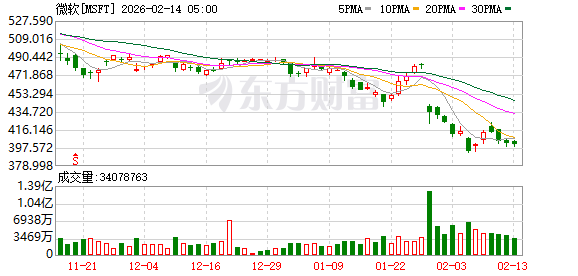
Core Viewpoint - Concerns over excessive AI spending have led to significant stock declines among the "Seven Giants," particularly Amazon, which is facing fears of becoming the first cloud giant with negative free cash flow by 2026 [1][2]. Group 1: Amazon's Stock Performance - Amazon's stock has fallen for nine consecutive trading days, marking its longest losing streak since 2006 and officially entering a technical bear market, down nearly 23% from its historical closing price of $254 on November 3 [2]. - The company's substantial AI investment plans have not been well-received by investors, leading to skepticism about the alignment of its AI strategy with cloud business growth [2][3]. Group 2: AI Capital Expenditure - Amazon, along with Microsoft, Meta, and Google, is projected to spend a total of $650 billion on AI capital expenditures by 2026, with Amazon's share being $200 billion, the highest among global cloud service giants [2]. - This unexpected capital expenditure has overshadowed Amazon Web Services' (AWS) impressive 24% growth in the fourth quarter, raising concerns that such large investments could result in negative free cash flow [2]. Group 3: Analyst Perspectives - Some analysts believe that the market's pessimism towards Amazon is overblown, arguing that the company is not becoming more capital-intensive but is instead investing in future cloud computing capabilities to drive digital transformation [3]. - Analysts from Deutsche Bank and William Blair acknowledge the risks associated with increased capital spending but suggest that it may reflect Amazon's inherent advantages in upgrading its existing AWS infrastructure [3]. Group 4: Support for Amazon - Notable investors, such as Bill Ackman's Pershing Square Capital, have disclosed holdings in Amazon, indicating confidence in the company's long-term prospects despite current market challenges [4]. - The fund's report highlights expectations for AWS to double its data center capacity by 2027, driven by demand from AI inference business expansion [4]. Group 5: Market Trends and Comparisons - The recent sell-off in tech stocks has highlighted a divergence in performance among the "Seven Giants," with concerns about AI spending impacting companies like Amazon, Microsoft, and Meta more severely than others like Google [5][6]. - The upcoming earnings report from Nvidia is anticipated to be a key catalyst for the AI sector, potentially revealing whether the AI boom is cooling and if Nvidia can deliver substantial returns on its large customer investments [6].
计算机行业点评报告:云涨价已现,关注AI Agent需求带动下的云投资机会
Soochow Securities· 2026-02-02 05:24
Investment Rating - The report maintains an "Overweight" investment rating for the computer industry [1] Core Insights - Cloud service providers like Google Cloud and Amazon Web Services have announced price increases, marking a significant shift in the market [5][10] - The demand for AI Agents is accelerating, with notable growth in applications and user engagement [11][13] - Supply-side pressures are leading to rising hardware costs, including storage and CPU prices [16] - The report suggests that the upcoming Chinese New Year will boost domestic AI application demand, potentially leading to further price increases in cloud services [17] Summary by Sections Price Increases by Major Cloud Providers - Google Cloud announced price hikes effective May 1, 2026, with data transfer costs in North America increasing from $0.04/GB to $0.08/GB (100% increase), Europe from $0.05/GB to $0.08/GB (60% increase), and Asia from $0.06/GB to $0.085/GB (42% increase) [10] - Amazon Web Services raised prices for its EC2 machine learning capacity blocks by approximately 15% [10] Demand Side: Acceleration of AI Agent Adoption - The rapid growth of AI Agents is exemplified by the success of Moltclaw, which has seen exponential user growth [11] - Google has integrated its Gemini 3 into Chrome, transforming it into a comprehensive AGI platform for 3.8 billion users [13] Supply Side: Hardware Price Increases - Storage prices are expected to rise by 40% to 50% in Q1 2026 and by about 20% in Q2 2026 [16] - Intel and AMD plan to increase server CPU prices by 10-15% due to high demand and limited supply [16] - Prices for G.652.D optical fibers in China have surged by approximately 80% compared to November 2025, with some prices exceeding 50 yuan per core kilometer [16] Investment Recommendations - The report identifies potential investment opportunities in the AI cloud industry, particularly as hardware costs rise and demand for AI applications increases [17] - Recommended companies include cloud service providers like Wangsu Science and Technology, Yike Technology, and Alibaba, as well as CPU manufacturers like Lianqi Technology and Longxin Zhongke [18][19][20]
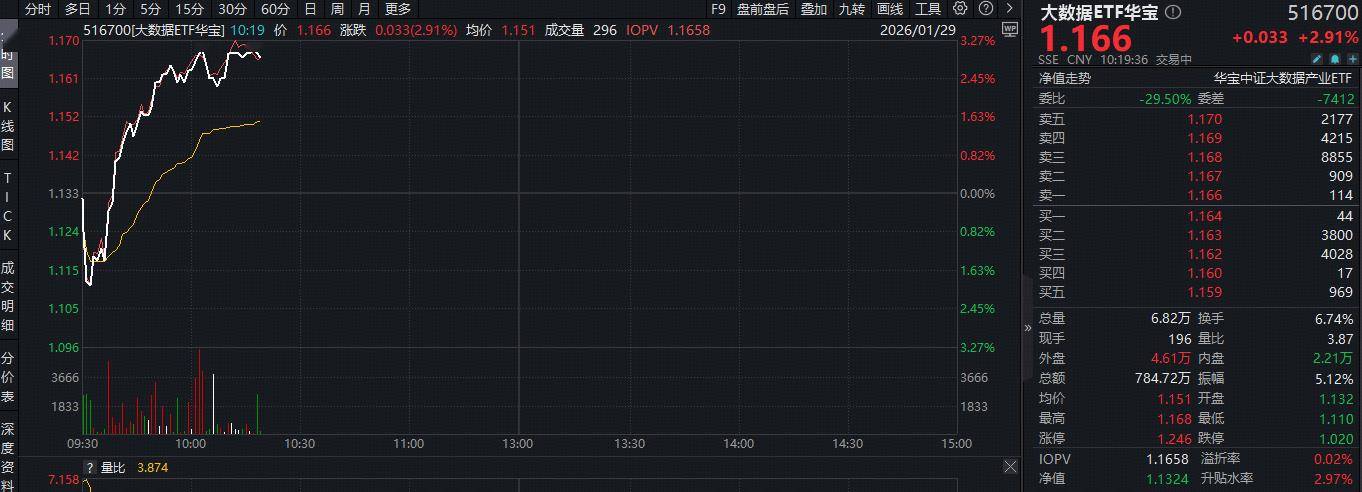
ETF盘中资讯|谷歌打响“云涨价”第一枪!国产云厂商有望跟进!大数据ETF华宝(516700)盘中大涨3%,科大讯飞涨停
Sou Hu Cai Jing· 2026-01-29 02:46
Group 1 - The core viewpoint of the news highlights the strong performance of the Huabao Big Data ETF (516700), which focuses on computing power and AI applications, with a notable increase in its stock price and significant gains among its constituent stocks [1][6] - Amazon Web Services (AWS) has raised its EC2 machine learning capacity block prices by approximately 15%, while Google Cloud plans to double data transfer prices in North America starting in May [3][4] - The increase in cloud service prices by AWS and Google is expected to prompt domestic cloud providers to follow suit, driven by rising CPU and storage costs and a surge in computing power demand due to complex task execution [4] Group 2 - The Huabao Big Data ETF's index composition shows that computing power concepts account for 40.91% and AI application concepts account for 37.43% as of the end of 2025 [5] - The ETF is positioned to track the CSI Big Data Industry Index, focusing on sectors such as data centers, cloud computing, and big data processing, with major holdings in leading companies like Inspur, iFlytek, and China Software [6] - The industry is witnessing a robust growth trend in the data center sector, driven by increased demand for computing power, particularly in North America and China, with significant projects still pending in overseas markets [4]

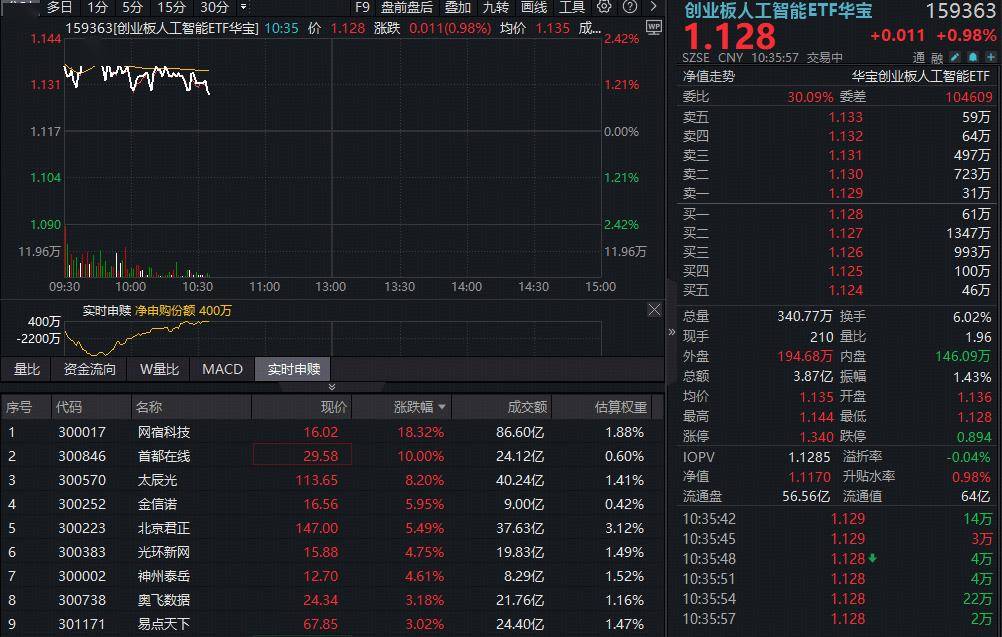
ETF盘中资讯|云服务涨价驱动!网宿科技,3天斩获2个20CM涨停!创业板人工智能ETF(159363)涨逾1%冲击前高
Sou Hu Cai Jing· 2026-01-28 03:03
Core Viewpoint - The AI sector is experiencing significant growth, with a notable increase in stock prices for companies involved in AI and cloud computing, indicating a strong demand for AI computing power and a shift in pricing dynamics within the cloud services industry [1][2][3]. Group 1: Market Performance - The AI computing sector, particularly the ChiNext AI ETF (159363), has seen a rise of over 1%, approaching previous highs, reflecting investor confidence in AI technologies [1]. - Companies like Wangsu Science & Technology and Capital Online have reported substantial stock price increases, with Wangsu achieving two consecutive 20% daily limits and Capital Online rising over 12% [1]. - The largest and most liquid ChiNext AI ETF has also shown a positive trend, increasing by approximately 1% [1]. Group 2: Pricing Dynamics - Google announced a price adjustment for data transmission, set to double in North America by May 1, 2026, following a 15% price increase by Amazon Web Services (AWS) for its EC2 machine learning capacity blocks, indicating a significant shift in cloud computing pricing logic amid AI resource scarcity [1][2]. - The AI industry is witnessing a trend of price increases across various segments, including storage and CPU, marking a departure from the long-standing trend of declining cloud service prices [2]. Group 3: Investment Insights - Analysts suggest that the database sector may benefit significantly from the rising demand for AI, with expectations of a substantial increase in the number of tokens globally, potentially growing by 100 to 1000 times [2]. - The ChiNext AI ETF is positioned to capitalize on the commercialization of AI technologies, with a portfolio that includes approximately 60% in computing power and 40% in AI applications, reflecting a balanced approach to investment in both sectors [3].