
AiMe陪伴机器人

Search documents
专访TCL李东生:未来五年,是中国科技高突破的黄金机遇期
Nan Fang Du Shi Bao· 2026-01-20 15:11
Core Viewpoint - The article discusses the strategic outlook for Chinese technology manufacturing companies, particularly TCL, in the context of the 14th Five-Year Plan and the evolving global economic landscape, emphasizing the need for companies to adapt to uncertainties and leverage their strengths for sustainable competitive advantages. Group 1: Strategic Outlook - 2026 marks the beginning of China's 14th Five-Year Plan, presenting both opportunities and challenges for technology manufacturing companies [1] - The global environment is characterized by uncertainty, including trade barriers and geopolitical tensions, which will be a long-term reality for Chinese companies [2] - TCL's core strategy for the next five years focuses on "going deeper" rather than just "going out," aiming to establish five operational centers overseas that function as independent entities [3][4] Group 2: Globalization and Localization - The concept of "recreating five TCLs overseas" involves not just scaling operations but restructuring the business logic to adapt to local markets [3][4] - TCL's overseas revenue from smart terminals has surpassed 70%, indicating a significant shift towards localized operations [5] - The company's global strategy emphasizes building local capabilities and adapting products to meet regional needs, thereby enhancing resilience against global uncertainties [5] Group 3: Technological Innovation - TCL is committed to integrating AI into its manufacturing processes, aiming to enhance efficiency and product quality [6][7] - The company is focusing on developing advanced technologies in the display and photovoltaic sectors, with specific goals for improving production efficiency and product performance [6][8] - AI is being utilized to streamline design and manufacturing processes, significantly reducing development cycles and improving defect management [7][8] Group 4: Sustainability and Green Initiatives - Green development is viewed as a necessity for competitiveness, with TCL implementing a carbon tracking system to manage emissions effectively [10] - The company has committed to significant carbon reduction goals, including a pledge to achieve net-zero emissions across its operations by 2030 [10] - TCL is transforming its business model to include renewable energy production, positioning itself as a leader in sustainable manufacturing practices [10]


聚焦“屏显+AI” TCL携多项“硬科技”亮相CES 2026
Ren Min Wang· 2026-01-11 01:40
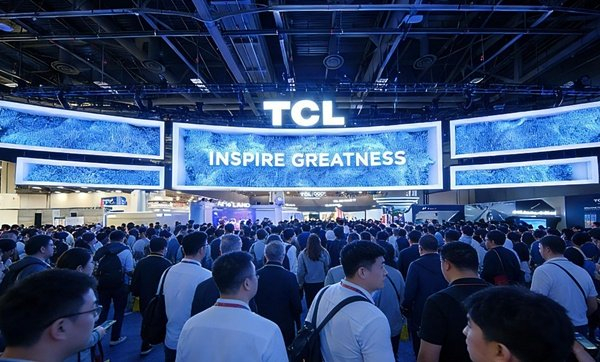
Core Insights - TCL showcased its innovations at CES 2026, focusing on "Screen Universe" and "AI Life" with a booth area of 2,453 square meters, marking its 33rd appearance at the event [1] Display Technology Innovations - TCL highlighted several cutting-edge products, including the X11L series SQD-MiniLED TV, which features super quantum dot and super butterfly wing technology, offering advantages such as high color gamut, no color bleeding, more zones, higher brightness, and a thinner design [3] - The SQD-MiniLED TV Q10M series was launched domestically on January 5, further lowering the barrier for high-end picture quality [3] - The TCL Huaxing printed OLED vehicle screen was also presented, designed for high-end smart cockpit interaction, with a material utilization rate exceeding 90%, and its high-generation production line commenced operations in October 2025 [3] AI Integration and Product Offerings - TCL showcased AI applications, including the Thunder X3 Pro Project eSIM, a consumer-grade AR smart glasses with independent communication capabilities, supporting features like phone calls, multimodal AI conversations, and real-time AI translation [5] - Other products such as the Xiaolan Wing AI air conditioner and AiMe companion robot cover various life scenarios, with TCL's global air conditioner sales projected to exceed 20 million units in 2024, reflecting a year-on-year growth of 29.6% [5] Research and Development Commitment - From 2019 to 2024, TCL invested over 60 billion yuan in R&D, with a total of 119,352 patent applications filed by November 2025 [5] - The company has established a R&D center in Silicon Valley and a manufacturing base in Mexico, ranking second in TV shipments in the North American market [5] - TCL aims to strengthen its focus on technology-intensive industries and advance upstream in the supply chain, emphasizing R&D in AI applications and next-generation display technologies [5]
2026科技春晚开幕:AI与机器人站上舞台中央,这些产业迎来新机遇
Xin Lang Cai Jing· 2026-01-09 09:00
Group 1: CES 2026 Overview - CES 2026 is taking place in Las Vegas from January 6 to 9, 2026, and is considered a significant event for observing global technology trends [1][11] - The theme of CES 2026 prominently features AI and robotics, with the introduction of the "AI and Quantum Innovation Integration Zone" showcasing cutting-edge technologies [3][13] - Over 4,000 companies are participating in CES 2026, with Chinese companies numbering 942, accounting for approximately 22% of total exhibitors, making China the second-largest participating country [3][13] Group 2: Key Exhibitors and Innovations - TCL is a major presence at CES 2026, showcasing products like the X11L series and the world's first printed OLED car screen, with a booth area of 2,453 square meters [4][14] - Hisense debuted new RGB-Mini LED technology and the Air Master smart air conditioner, emphasizing its role as an official sponsor of the 2026 World Cup [5][15] - Emerging tech companies like Chase Technology are highlighting a complete product matrix focused on smart home ecosystems, including innovative products like the dual-arm air conditioner X-Wind [7][17] Group 3: Robotics and AI Developments - The cleaning robot sector is seeing significant advancements, with Stone Technology unveiling the G-Rover, a robot capable of autonomously cleaning stairs, marking a shift to three-dimensional space coverage [9][19] - Ecovacs introduced a new brand philosophy aimed at simplifying life through technology, showcasing its full range of products at the event [9][19] - The integration of AI into household appliances and robotics is evolving from mere functionality to system-level capabilities, indicating a clear growth direction for the technology industry in 2026 [11][21]

