Amazon DevOps Agent

Search documents
从App到Agent,亚马逊云科技助推的软件范式跃迁
Sou Hu Cai Jing· 2025-12-11 06:13
Core Insights - The emergence of AI Agents is seen as a pivotal moment in AI development, transforming various industries and altering work, life, and learning practices [2][11] - Software is shifting from a process and function-centric model to one focused on capabilities and execution, marking a transition from App to Agent models [2][11] Group 1: AI Agents and Their Impact - AI Agents possess capabilities such as perception, understanding, planning, action, and self-feedback, enabling them to autonomously complete tasks without relying on manual instructions [4] - The successful deployment of Agents requires four core elements: AI infrastructure, reasoning systems, enterprise data, and Agent construction tools [4][6] - Amazon Web Services (AWS) introduced the Amazon AI Factory service, allowing AI infrastructure to be deployed in customer data centers, providing a similar experience to public cloud without data upload concerns [4] Group 2: Amazon Bedrock AgentCore - Amazon Bedrock AgentCore is a new platform that enables enterprises to scale, securely build, deploy, and operate Agents, significantly reducing the time from proof of concept to production [6] - The platform features a modular design with seven delivered components, enhancing the ease and speed of Agent construction [6][7] - AWS emphasizes addressing challenges in Agent deployment, such as security and management, through features like AgentCore Policy and AgentCore Evaluations [7] Group 3: Development Tools and Paradigm Shift - The introduction of Kiro, a platform for building and managing Agents, allows for automation in task execution and analysis, transforming traditional software development practices [9][10] - Kiro Autonomous Agent acts as a virtual developer, automating various tasks and learning from team interactions, while Amazon Security Agent functions as a virtual security engineer [10] - The transition to Agent-based software development signifies a shift from application-centric to task-centric approaches, leading to lower development costs and faster delivery [11]



数十亿AI员工上岗倒计时,云计算一哥“没有魔法,只有真能解决问题的Agent”
3 6 Ke· 2025-12-04 01:41
Core Insights - The AI industry is experiencing a silent differentiation, shifting from "model capability demonstration" to "Agent actual deployment" as the path to realizing AI value [1][24] - Amazon Web Services (AWS) CEO Matt Garman emphasized that the emergence of Agents marks a transition from a technological marvel era to a time of actual value realization [1][24] Group 1: AI Infrastructure Revolution - AWS introduced the Amazon EC2 Trainium 3 UltraServers, powered by self-developed 3nm chips, showcasing a significant leap in computing power with 362 PFLOPS and over 700 TB/s bandwidth [5][6] - The new Trainium 3 servers offer 4.4 times the computing performance and 3.9 times the memory bandwidth compared to the previous generation [6] - AWS plans to launch the next-generation Trainium 4, promising 6 times the FP4 performance and 4 times the memory bandwidth, addressing the needs of large model training [8] Group 2: Diverse Model Ecosystem - AWS adopts a diversified model strategy, rejecting the notion of a single "universal model" and instead promoting multiple excellent models [9] - The number of models available on the Amazon Bedrock platform has doubled, with 18 new managed open-source models, including four top Chinese models [9][12] - The newly launched Amazon Nova 2 series models cater to various needs, outperforming existing lightweight models in several areas [10][12] Group 3: Data and Model Integration - AWS introduced the Amazon Nova Forge service, allowing businesses to mix proprietary data with AWS training datasets to create customized models [14][16] - This service addresses the limitations of traditional data-model integration methods, enabling models to retain core reasoning abilities while learning new domain knowledge [13][16] - Sony is an early adopter of this service, successfully creating a customized model that significantly improves compliance review efficiency [16] Group 4: Advanced Agent Deployment - AWS unveiled three types of "frontier Agents" that demonstrate a significant leap in AI capabilities, showcasing their potential to transform software development and operations [17][19] - The Kiro autonomous agent can autonomously handle complex tasks, drastically reducing the time and manpower required for software projects [17][19] - The Amazon Security Agent and Amazon DevOps Agent enhance security and operational response mechanisms, ensuring continuous validation and efficient troubleshooting [19][20] Group 5: Comprehensive Agent Ecosystem - AWS's AgentCore features provide real-time control and evaluation of Agent interactions with enterprise tools and data, addressing core concerns in Agent deployment [20][22] - The introduction of new instances and services across various domains supports the infrastructure needed for effective Agent deployment [23] - The overall strategy positions AWS as a leader in the Agent era, emphasizing a full-stack capability to convert AI investments into tangible business returns [24]
AI 越用越亏本,企业哪里做错了?
Sou Hu Cai Jing· 2025-12-03 14:44
Core Insights - The year 2025 marks the rise of both "AI bubble theory" and "AI utility theory," which, despite appearing contradictory, share a common core [2] - The expansion of the AI industry has not fully translated into utility and value, with both consumer applications and enterprise efficiency lagging behind market expectations [2] - The current bottleneck in AI applications is not the "intelligent capability" but rather the "engineering capability" needed for low-cost, scalable deployment in production environments [2] Group 1: AI Application Paradigm - The focus has shifted to rethinking AI application paradigms to enhance core efficiency, with Amazon Web Services (AWS) aiming to build a customizable AI framework for enterprises [4] - The introduction of Agentic AI technology aims to automate the deployment of agents, addressing the inefficiencies faced by enterprises in utilizing AI [4] - Agents, built on large models, can perform complex tasks through a complete cycle of perception, thinking, decision-making, execution, and feedback, thus simplifying and automating workflows [4][5] Group 2: Agent Functionality and Examples - For e-commerce, training an agent to create an automated customer service system can be achieved by providing existing product databases and customer records, allowing the agent to learn from this data [5] - AWS's three advanced agents focus on efficiency optimization, enabling users to set broad goals while the agents autonomously seek to achieve them [5] - The Kiro autonomous agent addresses issues like context switching and manual coordination in software development, maintaining context across multiple interactions [6] Group 3: Security and Compliance in AI - Amazon Security Agent and Amazon DevOps Agent enhance security throughout the development lifecycle and automate operations, transforming reactive maintenance into proactive optimization [8] - These agents signify a trend towards integrating enterprise processes and experiences into AI knowledge, which can be automatically applied to workflows, improving efficiency [8] Group 4: Future of AI Operations - The future of AI applications involves creating a true "AI operating system," with agents being a crucial paradigm that raises questions about flexibility, security, and efficiency evaluation [9] - Amazon Bedrock serves as a foundational platform for building agents, allowing for the integration of various models and ensuring compliance and security [9][10] - The efficiency of agents stems from their ability to execute actions, but this also introduces risks that necessitate robust security and evaluation systems [10] Group 5: Infrastructure and Support for AI - AWS provides comprehensive support for AI agents across infrastructure, models, data, and tools, ensuring that AI is scalable, understandable, and trustworthy [12] - The analogy of AI utilization as a car illustrates that computational power is the fuel, models are the engine, and Amazon Bedrock is the overall powertrain, with agents acting as control systems [12] - The goal is to transform AI from a tool into an integral part of organizational capability, helping enterprises unlock value [12]

AI 越用越亏本,企业哪里做错了?
虎嗅APP· 2025-12-03 14:31
Core Insights - The article discusses the dual emergence of "AI bubble theory" and "AI utility theory" in 2025, highlighting that the expansion of the AI industry has not fully translated into practical value or efficiency, both in consumer applications and enterprise returns [2] - The current bottleneck in AI applications is not the "intelligent capability" but rather the "engineering capability" required for deployment in production environments [2][3] Group 1: AI Application Paradigms - The need to rethink AI application paradigms to enhance core efficiency has become a focal point of discussion, with Amazon Web Services (AWS) aiming to build a customizable AI framework for enterprises [3][4] - The introduction of Agentic AI technology aims to automate the deployment of agents, addressing the inefficiencies enterprises face in utilizing AI tools [5][10] Group 2: Agentic AI Features - Agents, built on large models, can perform complex tasks through a complete cycle of perception, thinking, decision-making, execution, and feedback, thus simplifying and automating many tedious processes [5][10] - An example provided by AWS CEO Matt Garman compares AI agents to children that need to be nurtured and trained, emphasizing the balance between oversight and autonomy [6] Group 3: Specific Agent Applications - AWS introduced three advanced agents focused on efficiency optimization, allowing users to set broad goals while the agents autonomously seek to achieve them [7] - The Kiro autonomous agent is designed for software development, addressing issues like context switching and manual coordination of code changes [9] - Amazon Security Agent and Amazon DevOps Agent enhance security and operational efficiency throughout the development lifecycle, transforming reactive maintenance into proactive optimization [9] Group 4: Future of AI Operations - The future of AI applications lies in creating a true "AI operating system" that integrates seamlessly with enterprise processes, enhancing automation while ensuring flexibility and security [11][12] - Amazon Bedrock serves as a foundational platform that supports the development and management of agents, allowing for the integration of enterprise workflows and compliance strategies [12][15] - The efficiency of agents stems from their ability to execute actions, but this also introduces risks that necessitate robust security and evaluation systems [13][15] Group 5: Conclusion - The article concludes that for AI to transition from a tool to an integral part of organizational capabilities, all components—computing power, models, and frameworks—must work in harmony [15] - AWS is focused on addressing every pain point and optimizing core metrics to provide a solid foundation for enterprises to embrace AI, moving towards a collaborative role for AI within organizations [15]

数十亿AI员工上岗倒计时!云计算一哥“没有魔法,只有真能解决问题的Agent”
Xin Lang Cai Jing· 2025-12-03 13:24
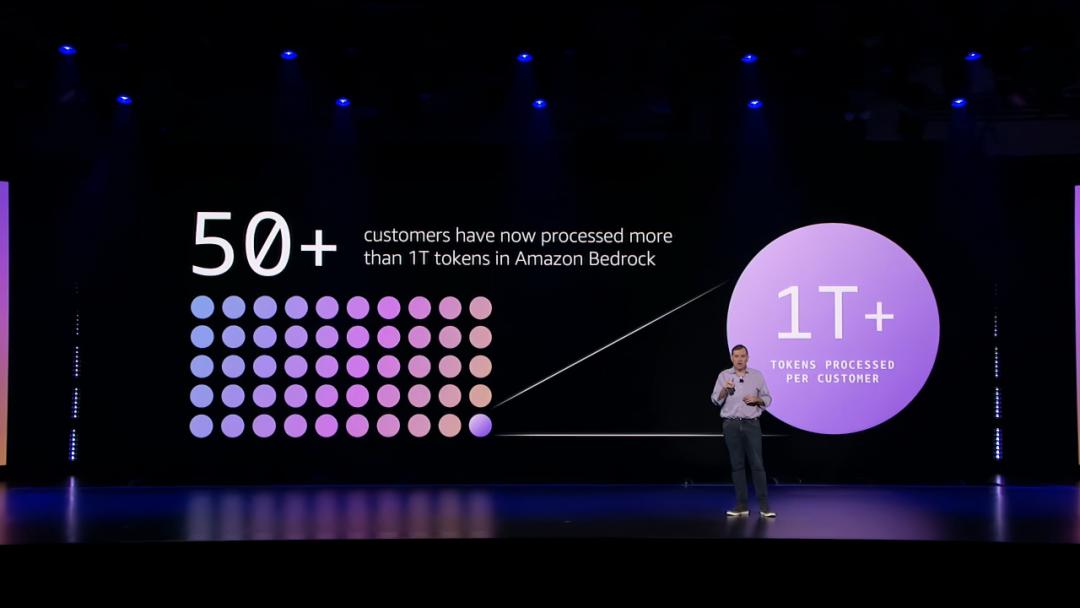
Core Insights - The core perspective of the article emphasizes the shift in AI value realization from "model capability demonstration" to "Agent actual deployment" as highlighted by Amazon Web Services (AWS) CEO Matt Garman during the 2025 re:Invent keynote [2][26][27] Group 1: AI Infrastructure Redefinition - AWS has introduced the Amazon EC2 Trainium 3 UltraServers, powered by self-developed 3nm chips, showcasing a significant leap in computing performance with 362 PFLOPS (FP8) and over 700 TB/s bandwidth [6][30][31] - The new Trainium 3 servers offer 4.4 times the computing performance and 3.9 times the memory bandwidth compared to the previous generation [7][31] - AWS also launched Amazon AI Factories, allowing enterprises to deploy dedicated AI infrastructure in their data centers while maintaining data sovereignty and compliance [8][32] Group 2: Diverse Model Ecosystem - AWS adopts a diversified model strategy, rejecting the notion of a single "universal model," with the Amazon Bedrock platform doubling its model offerings over the past year, including four top Chinese models [9][33] - The newly introduced Amazon Nova 2 series models cater to various needs, outperforming existing models in multiple areas, particularly in agent scenarios [10][34][37] - The Amazon Nova 2 Pro model has shown impressive performance in agent capability benchmarks, addressing enterprise concerns about the reliability of generative AI in practical business scenarios [13][37] Group 3: Data and Model Integration - AWS introduces the Amazon Nova Forge service, allowing businesses to create customized models by blending proprietary data with AWS training datasets, overcoming limitations of traditional retrieval-augmented generation (RAG) techniques [14][38][41] - This service enables companies to develop agents that truly understand their business logic and processes, rather than relying solely on generic AI tools [41] Group 4: Deployment of Advanced Agents - The introduction of three types of "frontier agents" at the 2025 re:Invent showcases a significant enhancement in AI capabilities, emphasizing autonomy and scalability [18][42] - The Kiro autonomous agent can autonomously handle complex tasks, significantly reducing the time and resources needed for software development projects [18][42] - The Amazon Security Agent and Amazon DevOps Agent redefine security practices and operational response mechanisms, ensuring continuous validation and efficiency in global business operations [19][43] Conclusion: The Era of AI Agents - The 2025 re:Invent event illustrates AWS's comprehensive strategy for the Agent era, highlighting the importance of a full-stack capability in transforming AI investments into tangible business returns [25][47][48]
“云计算春晚”又来了!不止自研AI芯片和模型,亚马逊云科技回答了一个核心问题
Tai Mei Ti A P P· 2025-12-03 06:59
Core Insights - Amazon Web Services (AWS) is focusing on enabling innovation by providing developers with the necessary technology and infrastructure to build their ideas, which was not possible two decades ago [2][4] - AWS has achieved significant growth, with a business scale of $132 billion and a year-on-year growth rate of 20%, adding $22 billion in revenue in the past year [5][4] - The introduction of AI Agents marks a pivotal shift in the AI landscape, transitioning from AI assistants to more capable AI Agents that can understand intent and execute tasks autonomously [6][5] AI Infrastructure - AWS emphasizes the importance of having a scalable and powerful AI infrastructure, which includes both NVIDIA GPUs and its own Trainium chips [7][8] - AWS has deployed over 1 million Trainium chips, significantly enhancing deployment efficiency due to its control over the entire technology stack [11][10] - The latest Trainium 3 chip offers substantial improvements in computing power and memory bandwidth, making it one of the most advanced AI training and inference systems available [13][14] Model Development - AWS believes in a diverse model ecosystem rather than a single model dominating all tasks, expanding its model offerings on Amazon Bedrock [17][18] - The Nova series has been upgraded to Nova 2, which provides high-performance models for various applications, including a new speech-to-speech model [20][21] - Amazon Nova Forge allows enterprises to create proprietary models by integrating their unique data with AWS's advanced models, enhancing their competitive edge [23][21] Agent Deployment - AWS introduced Amazon Bedrock AgentCore, a platform designed for enterprise-level applications that enables the deployment of AI Agents in a secure and modular manner [25][26] - The AgentCore includes a memory mechanism to manage context, allowing Agents to accumulate experience and optimize performance over time [26][27] - AWS has implemented a policy system within AgentCore to ensure that Agent behavior is predictable and aligned with user intentions, addressing enterprise concerns about AI autonomy [28][29] Addressing Technical Debt - AWS launched Amazon Transform to assist clients in migrating from legacy systems, addressing the significant costs associated with technical debt [30][33] - The company aims to support all modernization needs, allowing developers to create custom code transformation processes for various programming languages and frameworks [33][34] Internal Agent Development - AWS has developed its own Agents, such as Kiro, which can convert natural language instructions into executable code, significantly improving development efficiency [34][35] - The Kiro Autonomous Agent can handle routine development tasks, learning team preferences and enhancing collaborative efforts [35][36] - AWS also introduced the Amazon Security Agent to ensure security best practices are followed throughout the development lifecycle [36][38] Conclusion - AWS's comprehensive approach to AI, from infrastructure to model development and Agent deployment, positions it as a leader in the emerging Agentic AI era, redefining the capabilities of enterprise-level AI solutions [38][39]