Atlas 350

Search documents
半导体涨价攻入终端,华为重磅发布新一代算力加速卡
Huaxin Securities· 2026-03-23 00:12
证 券 研 究 报 告 行业周报 半导体涨价攻入终端,华为重磅发布 新一代算力加速卡 半导体行业周报 投资评级: ( ) 报告日期: 推荐 维持 2026年03月23日 ◼ 分析师:何鹏程 ◼ SAC编号:S1050525070002 投 资 要 点 半导体涨价攻入终端:手机率先调价,家电汽车亦承压 上周,手机品牌OPPO刚宣布调价;本周,vivo紧随其后,宣布从2026年3月18日10时起,调整部分产品的建 议零售价。二者涨价原因均指向全球半导体及存储成本上升。本轮涨价潮始于AI需求带动的存储芯片价格飙涨, 进而影响整条产业链。如今,价格已经传导至终端,各大厂商陆续上调价格或下调产品配置。从行业影响来看, 消费电子销量阶段性承压难以避免,行业资源与定价能力或进一步向具备规模与供应链优势的头部品牌集中。 同时,随着半导体产品普遍提价,不仅是手机、电脑,家电、汽车等大量使用半导体的产品或也面临提价压力。 华为重磅发布新一代算力加速卡 在本次华为中国合作伙伴大会上,昇腾950PR随标卡Atlas 350如约亮相,受到业界的广泛关注。与前一代昇腾 芯片相比,昇腾950PR在低精度数据格式、向量算力、互联带宽及自研H ...
腾讯研究院AI速递 20260323
腾讯研究院· 2026-03-22 16:03
Group 1: Huawei's AI Computing Power - Huawei officially launched the Atlas 350 accelerator card equipped with the Ascend 950PR processor at the China Partner Conference 2026, with seven core ecosystem partners simultaneously introducing server systems [1] - The Atlas 350 single card computing power reaches 2.87 times that of NVIDIA H20, making it the first commercial inference product in China to support FP4 low-precision computing, with an HBM capacity of 112GB and a 60% improvement in multi-modal generation efficiency [1] - Over 400 industry-integrated machines were launched in collaboration with ecosystem partners, serving more than 2,700 customers and capturing over 80% of the domestic AI integrated machine market [1] Group 2: Developments in AI Agents - OpenAI is integrating ChatGPT, Codex, and the Atlas browser into a desktop super app, while acquiring the Python toolchain Astral to fully commit to the Agent space [2] - Google is pursuing a dual strategy with AI Studio integrating the Antigravity coding agent, backed by a $2.4 billion acquisition of the Windsurf team, and secretly testing the Gemini Mac desktop version [2] - Anthropic has rapidly launched Cowork, Dispatch, and Claude Code Channels within two months, embedding Claude into local user systems at a fast product pace [2] Group 3: WeChat's ClawBot Plugin - WeChat has launched the ClawBot plugin, allowing users to connect OpenClaw agents via QR code or command, enabling task completion through chat [3] - Tencent's entire product line is aligned, including cloud shrimp Lighthouse (with an enterprise version Claw Pro), self-developed shrimp WorkBuddy, and local shrimp QClaw, all supporting direct connection via WeChat [3] - The plugin is gradually being rolled out, requiring users to update to the latest version and check installation instructions through the settings menu [3] Group 4: Cursor's Model Controversy - Cursor released its self-developed model Composer, claiming performance surpassing Claude Opus 4.6, but users discovered the underlying model is actually Kimi K2.5 from the Moonlight team [4] - The open-source agreement for Kimi mandates that commercial products with over 100 million monthly active users or $20 million in monthly revenue must disclose their source, while Cursor's valuation is $50 billion with a monthly revenue of approximately $167 million, yet no attribution was made [4] - The founder of Cursor admitted to using Kimi and stated it was an oversight not to credit, but as of the report's publication, no clarification had been added to the Composer 2 blog [4] Group 5: Musk's Chip Manufacturing Facility - SpaceX, xAI, and Tesla are jointly constructing the TERAFAB chip manufacturing facility in Austin, Texas, aiming for an annual production capacity of 1 terawatt, which is about 50 times the current global chip production capacity [5][6] - TERAFAB will produce two types of chips: edge inference chips for the Optimus robot and Tesla vehicles, and high-power chips designed for space AI satellites, with Musk predicting that costs for deploying AI chips in space will be lower than on Earth within 2 to 3 years [6] - Musk defines TERAFAB as a crucial step towards humanity's advancement into a solar system-level civilization, with future plans to build an electromagnetic mass driver on the Moon to scale computing power to petawatt levels [6] Group 6: YC Partners Discussion on Agent Products - YC partners observed that Agents are autonomously selecting development tools, with Supabase being set as the default database due to its superior documentation, and Resend becoming the preferred email sender for its Agent-friendly knowledge base design [7] - An Agent economy is forming alongside the human economy, with infrastructure specifically designed for Agents emerging, such as Agent Mail providing AI-specific inboxes, and the rapid growth of OpenClaw following its popularity [7] - Entrepreneurs need to immerse themselves in the Agent experience to design products from the Agent's perspective, as the developer tool market expands from 20 million professional developers to a broader audience [7] Group 7: AI's Limitations in Autonomous Learning - Researchers from Meta, NYU, and UC Berkeley argue that AI lacks the ability to learn autonomously like humans, as current models are fixed post-deployment, with data selection and training schemes entirely reliant on human engineers [8] - The paper proposes a dual-system framework integrating observational learning (System A) and action learning (System B), with a meta-controller (System M) dynamically coordinating both to address cold start challenges [8] - Researchers believe it may take decades to achieve fully autonomous learning systems, while also highlighting that increased autonomy complicates alignment and may introduce new ethical challenges such as goal misalignment and emotional attachment [8] Group 8: Anthropic's AI Time Study - Anthropic conducted in-depth interviews with 80,508 people across 159 countries, revealing that what people desire most is not stronger AI but more time, with one-third of respondents wanting to free up time to spend with family [9] - The report found that the benefits and harms of AI occur simultaneously for the same individuals: those who enjoy learning assistance face the highest risk of cognitive decline, while those using AI to save time are accelerated into competition [9] - 16.3% of respondents admitted to a decline in thinking ability, and 19% felt AI did not deliver on its promises, indicating that while the benefits of AI are immediately perceivable, the harms are slow and systemic [9] Group 9: Karpathy's AI Experience - Karpathy shared that since December last year, he has not written a line of code, spending 16 hours a day interacting with Agents to drive multiple tasks, feeling anxious when his token limit is not fully utilized, which he describes as "AI psychosis" [10][11] - He utilized OpenClaw for home automation, allowing Agents to autonomously scan the local network for devices like Sonos and build an API control panel, suggesting that apps will eventually disappear and Agents will become the new operating system [10][11] - After running an automation research system overnight, he discovered optimization points he had overlooked in his 20 years of experience, advocating for removing researchers from the loop to maximize token throughput [11]



华为重磅发布新一代算力加速卡
新华网财经· 2026-03-22 00:48
Core Viewpoint - Huawei has officially launched the AI training inference acceleration card Atlas 350, powered by the new Ascend 950PR processor, marking the commercial phase of the Ascend 950 series [1][3][7]. Group 1: Product Launch and Features - The Atlas 350 is equipped with the Ascend 950PR processor and has been showcased at the Huawei China Partner Conference 2026, receiving significant attention from the industry [1][7]. - The Atlas 350's single-card computing power is 2.87 times that of NVIDIA's H20, with a FP4 precision computing power of 1.56P and a bandwidth of 1.4TB/s, while its power consumption is 600W, which is 1.5 times that of H20 [9][11]. - The Atlas 350 supports multiple precision formats, including FP4, FP16, and FP8, enabling it to handle larger models and lower latency inference, making it suitable for high-concurrency scenarios like short videos and e-commerce [11][12]. Group 2: Industry Partnerships and Applications - Seven core partners of Huawei, including Kunlun and Baode, have launched server products based on the Atlas 350, indicating a collaborative effort to enhance AI capabilities [3][5]. - The Ascend 950 series aims to support various AI applications across industries, with a focus on lightweight deployment and rapid implementation, addressing the complexities of intelligent deployment [12]. - Huawei has collaborated with 20 leading industry partners to release AI application solutions for 2026, covering key scenarios such as smart customer service and electronic medical records, with a significant market presence in integrated machines [12].

2025华为全联接大会解读:昇腾铸芯、超节点织网,华为算力跃升新纪元
NORTHEAST SECURITIES· 2025-09-19 02:41
Investment Rating - The report maintains an "Outperform" rating for the industry [6] Core Insights - Huawei's new products, including Ascend chips and supernodes, are set to lead a new era in computing power, with a clear roadmap for product iterations from 2025 to 2028 [1][14] - The introduction of self-developed HBM technology marks a significant advancement in memory bandwidth, enhancing the efficiency of large model training [3][23] - The supernode architecture is designed to integrate hundreds of processors, reshaping the competitive landscape in AI infrastructure [22][24] Summary by Sections 1. Huawei Computing Power Product Launch - Ascend chips will follow a yearly iteration schedule, with the 910C launching in Q1 2025 and subsequent models (950PR, 950DT, 960, 970) planned through 2028 [14][15] - The Ascend 950 series introduces low-precision data formats and self-developed HBM, enhancing training efficiency for large models [15][16] - The Ascend 960 and 970 are expected to double performance metrics across various parameters, including computing power and memory bandwidth [18][19] 2. Supernode Products - The supernode data center (Atlas 900/950/960 SuperPoD) is designed for large-scale AI training, achieving EFLOPS-level computing power with high bandwidth and low latency [2][27] - The supernode cluster (Atlas 950/960 SuperCluster) enhances network performance and energy efficiency, reaching ZFLOPS-level computing power [2][37] - The enterprise-grade air-cooled supernode server (Atlas 850) is tailored for post-training and multi-scenario inference, supporting flexible scaling [2][38] 3. Related Investment Targets - Key investment targets include hardware partners for Ascend, domestic wafer foundries, and companies involved in copper connections, optical connections, power supplies, PCBs, and cooling solutions [4][46]
华为宣布推出超节点架构,可将多台物理机器深度互联
Xin Lang Ke Ji· 2025-09-18 06:39
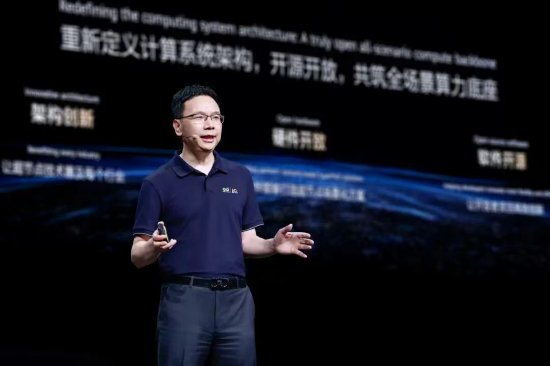
Core Viewpoint - Huawei has introduced an innovative super node architecture aimed at redefining large-scale effective computing power, emphasizing open-source and hardware openness to foster industry collaboration and innovation [2][3]. Group 1: Super Node Architecture - The super node architecture allows multiple physical machines to be deeply interconnected, enabling them to function as a single logical unit for learning, reasoning, and thinking [2]. - This architecture is designed to meet the computing needs of large data centers, enterprise-level data centers, and small workstations across various industries [2]. - Key features of the super node architecture include resource pooling, scalable expansion, and reliable performance, facilitating high bandwidth and low latency interconnections for computing and storage units [2]. Group 2: New Product Launch - Huawei has launched several new products based on the super node architecture, including the AI super node Atlas 950 SuperPoD, enterprise-level AI super node servers Atlas 850 and Atlas 860, AI next-generation cards Atlas 350, and the first universal super node Taishan 950 SuperPoD [2]. - These products are designed to enhance the capabilities of data centers and support a wide range of computing scenarios [2]. Group 3: Open Source Commitment - Huawei is fully opening its super node technology to share the technological benefits with the industry, promoting inclusive and collaborative innovation [3]. - The operating system components of the Lingqu protocol will be open-sourced, with code being integrated into various upstream open-source communities such as openEuler [3].