Baltra芯片

Search documents
苹果首款AI服务器芯片曝光,联手博通
3 6 Ke· 2025-12-17 02:51
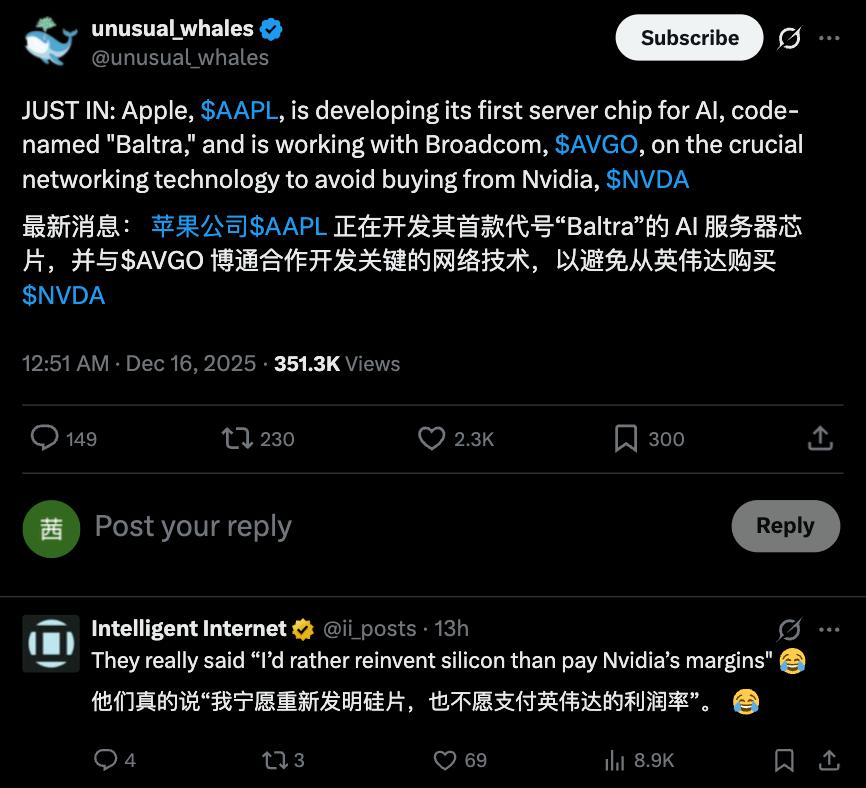
Core Viewpoint - Apple is developing its first AI server chip, codenamed "Baltra," in collaboration with Broadcom to avoid purchasing chips from Nvidia, indicating a strategic shift towards in-house chip development for AI applications [1][7]. Group 1: Chip Development and Collaboration - Apple is working with Broadcom to develop the Baltra chip, which is expected to be produced using TSMC's 3nm process and enter mass production in 2026, with deployment anticipated in 2027 [1][2]. - The Baltra chip is designed to meet Apple's significant AI inference needs, as the company has opted not to train large models internally but instead will pay approximately $1 billion annually to use Google's custom Gemini model [2][7]. Group 2: Technical Specifications and Design Focus - The architecture of the Baltra chip will prioritize latency and throughput optimization, utilizing low-precision computation designs such as INT8 precision, which is crucial for inference tasks [2]. - Apple may adopt a chip architecture similar to Nvidia's GB300, featuring 64 interconnected chips with high-bandwidth LPDDR memory, potentially reducing costs while meeting specific performance requirements [2]. Group 3: Future Directions and Innovations - Apple has submitted a patent for an "optical-based distributed unified memory system," suggesting a focus on advanced computing technologies that could influence the design of future chips like Baltra [4][6]. - The development of the Baltra chip is seen as a critical step for Apple to enhance its AI capabilities and regain competitiveness in the AI sector, especially after setbacks in large model training [7].


苹果自研AI芯片…带动手机、NB功能再进化 鸿海大赢家
Jing Ji Ri Bao· 2025-12-16 23:30
Core Viewpoint - Apple is entering the AI chip development arena with its first self-developed AI chip "Baltra," expected to be deployed in AI servers by 2027, aiming to enhance its Apple Intelligence services and drive sales of its hardware devices like iPhone, iPad, and MacBook [1] Group 1: Apple and AI Chip Development - Apple is collaborating with Broadcom to create the "Baltra" AI chip, which will utilize TSMC's 3nm N3E process, with design work expected to be completed within a year [1] - The "Baltra" chip will primarily address Apple's significant AI inference needs, as the company has partnered with Google to deploy a customized Gemini AI model with 3 trillion parameters for its cloud-based Apple Intelligence [1] Group 2: Impact on Supply Chain and Partnerships - Foxconn (Hon Hai Precision Industry Co.) is expected to benefit from Apple's AI server chip development, as it is currently Apple's largest customer and the main assembler of iPhones [2] - Foxconn's AI server orders span both NVIDIA and ASIC server segments, with the company planning to provide solutions based on customer needs, leveraging its extensive production experience [2] - Foxconn holds over 40% market share across various AI platforms, with projections indicating that its ASIC server segment will maintain rapid growth or potentially double by 2026 [2]
腾讯研究院AI速递 20251217
腾讯研究院· 2025-12-16 16:32
Group 1: Apple AI Server Chip - Apple is developing its first AI server chip, codenamed "Baltra," in collaboration with Broadcom, utilizing TSMC's 3nm process, expected to be deployed in 2027 [1] - Apple has shifted from building its own large models to paying approximately $1 billion annually for Google's customized 1.2 trillion parameter Gemini model, with Baltra primarily aimed at meeting significant AI inference demands [1] - The chip architecture will focus on optimizing latency and throughput, employing low-precision operations like INT8, and may utilize a configuration of 64 interconnected chips with large-capacity LPDDR memory [1] Group 2: NVIDIA Nemotron 3 Series - NVIDIA has launched the Nemotron 3 series of open models, which includes Nano, Super, and Ultra scales, featuring a breakthrough heterogeneous mixture expert architecture [2] - The Nemotron 3 Nano has a throughput that is four times higher than its predecessor, achieving leading token generation rates per second in large-scale multi-agent systems, significantly enhancing inference efficiency [2] - The model achieves exceptional accuracy through advanced reinforcement learning techniques and large-scale parallel multi-environment post-training, providing a complete training dataset and reinforcement learning library [2] Group 3: ChatGPT Memory System - Developer Manthan Gupta has reverse-engineered ChatGPT's memory system, revealing a four-layer architecture: session metadata, user memory, recent conversation summaries, and a sliding window [3] - The system does not utilize vector databases or RAG retrieval but instead relies on pre-generated lightweight summaries and explicitly stored structured information to achieve the effect of "remembering users" [3] - GPT-4 has a maximum context window of 128k tokens, beyond which the earliest content is forgotten, and users can request the model to delete or modify memory content at any time [3] Group 4: Tencent Yuanbao Writing Mode - Tencent Yuanbao has launched a writing mode that supports automatic completion of plot character outlines and one-click generation of manuscripts, capable of producing tens of thousands of words in a single session [4] - The feature is adaptable to various genres, including historical, science fiction, and fan fiction, allowing users to set a single sentence to let AI complete the outline and chapter structure, with customizable story direction and endings [4] - Yuanbao can generate approximately 30,000 words in about 14 minutes and 50,000 words in half an hour, with support for one-click export to local documents or Tencent documents [4] Group 5: Tongyi Wanxiang 2.6 Release - Tongyi Wanxiang 2.6 has become the first video model in China to support role-playing functions, featuring audio-visual synchronization, multi-camera generation, and voice-driven capabilities, making it the most comprehensive video generation model globally [5] - The video generation supports 15-second long videos, multi-camera narratives, and natural audio-visual synchronization, allowing for single and multi-person collaborations based on input video character appearance and voice [5] Group 6: ByteDance Seedance 1.5 Pro Model - ByteDance has released the Seedance 1.5 Pro audio-video generation model, which supports precise audio-visual synchronization, multilingual dialects, cinematic-level camera movements, and 15-second long video generation [6] - The model employs the MMDiT architecture to achieve precise audiovisual collaboration, natively supporting multiple languages, including Chinese, English, Japanese, Korean, and dialects like Sichuanese and Cantonese, with audio instructions at industry-leading levels [6] - In comprehensive evaluations, SeedVideoBench 1.5 demonstrated rich dynamic performance, vivid character expressions, and significantly reduced audio-visual misalignment, applicable in film, advertising, and short drama scenarios [6] Group 7: L3 Autonomous Driving Models - The Ministry of Industry and Information Technology has conditionally approved Chang'an's Deep Blue SL03 and Arcfox Alpha S as the first L3 autonomous driving models in China [8] - The Deep Blue SL03 can achieve single-lane autonomous driving at a maximum speed of 50 km/h in congested environments, limited to designated routes like the Chongqing Inner Ring; the Arcfox Alpha S can reach 80 km/h, restricted to routes like the Beijing-Jingtai Expressway [8] - Both companies have completed product testing and safety evaluations, with plans to conduct on-road trials in designated areas through Chang'an Vehicle Networking Technology and Beijing Travel Automotive Services [8] Group 8: Eric Schmidt's Views on AI - Former Google CEO Eric Schmidt proposed the "San Francisco Consensus," suggesting that the combination of language agents and reasoning capabilities will approach human core abilities, leading to recursive self-improvement in AI as technology converges [9] - He predicts that AI mathematicians will emerge within the next year, driving the birth of new mathematical theories, with industry consensus on this transformation occurring within 2-4 years, while emphasizing the need to maintain human agency and decision-making authority [9] - The paths of US-China AI competition are diverging: the US focuses on superintelligence development but faces power shortages, while China is fully promoting AI commercial applications with ample power supply, both relying on the private sector for development [9] Group 9: AI "Finger Problem" - Multiple AI models failed to accurately count the number of fingers in images depicting six-fingered hands, even when prompts explicitly stated there were six fingers, with models insisting on five [10] - The root of the problem lies in the strong association in training data of "human hands = five fingers" and the lack of explicit structural constraints in the Transformer architecture, which cannot track state information in a single forward pass [10] - Diffusion models excel at capturing overall distributions and textures but struggle with precise control of local discrete structures, revealing current AI's Achilles' heel in visual reasoning and causal relationship understanding [10]




苹果2026年MacBook Pro升级计划曝光:OLED显示屏与M6芯片齐亮相
Huan Qiu Wang· 2025-06-18 06:54
Group 1 - Apple plans a comprehensive upgrade for the MacBook Pro in 2026 to celebrate the product line's fifth anniversary [1] - The 2026 MacBook Pro is expected to feature OLED display technology for the first time, enhancing brightness, color vibrancy, and contrast [3] - The new MacBook Pro will adopt a thinner design and introduce the new M6 chip series, which is based on TSMC's advanced 2nm process, promising significant performance and energy efficiency improvements [3][4] Group 2 - The 2026 MacBook Pro series is likely to include M6, M6 Pro, and M6 Max versions, available in 14-inch and 16-inch sizes [4] - Apple is also developing a custom chip for its upcoming smart glasses, expected to begin production by the end of 2026 or in 2027, which will also be manufactured by TSMC [4] - The company is collaborating with Broadcom to develop its first chip specifically designed for AI servers, codenamed Baltra, expected to be completed by 2027 [4]