
Blackwell图形处理器(GPU)

Search documents
黄仁勋:希望特朗普帮帮忙
半导体芯闻· 2025-10-29 10:40
Core Insights - The article highlights NVIDIA's advancements in AI technology and its collaborations with major companies like Uber, Palantir, Amazon, and Microsoft, emphasizing the significance of domestic manufacturing in the U.S. [1][2] - NVIDIA's CEO Jensen Huang showcased the capabilities of the Blackwell GPU, which has seen substantial demand, with 6 million units shipped and 14 million units ordered, translating to potential sales of $500 billion [1][2] - Huang's remarks reflect a strategic push for U.S. manufacturing and a desire to reduce reliance on foreign products in the AI sector [2][3] Group 1 - Huang praised the Blackwell GPU's computational power and highlighted the integration of 72 GPUs in a single server rack, weighing 3,000 pounds and costing millions [1] - The company has begun mass production of Blackwell chips in Arizona, although not all production processes are completed in the U.S. [1][2] - Huang expressed concerns about the U.S. potentially losing its market in AI technology due to reliance on foreign products and called for solutions from government officials [2][3] Group 2 - NVIDIA's partnerships include collaborations with Lucid Motors for autonomous driving and Eli Lilly for supercomputing in drug development [3] - The company is investing $1 billion in Nokia to integrate AI into 6G wireless networks, showcasing its commitment to enhancing energy efficiency in data centers [3][4] - Huang indicated the intention to hold annual AI conferences in Washington, reflecting a growing influence in the tech policy landscape [5]



黄仁勋:近半年AI需求大增,英伟达参投马斯克的xAI,可惜没投更多,对OpenAI也这样遗憾
美股IPO· 2025-10-08 23:59
Core Insights - The demand for AI computing, particularly for Nvidia's Blackwell chips, is extremely high, marking the beginning of a new industrial revolution [1][4][5] - Nvidia's CEO Jensen Huang expressed regret over not investing more in OpenAI, despite the company's significant investment plans [2][10] - Nvidia's stock rebounded over 2% following the surge in AI demand [3] AI Demand and Market Dynamics - Over the past six months, there has been a substantial increase in AI computing demand, with Blackwell chips being at the forefront due to their advanced technology [2][4] - Analysts predict that global spending on AI infrastructure could reach $2 trillion by 2026, driven by the evolution of AI models towards more complex reasoning capabilities [3] Nvidia's Strategic Moves - Nvidia plans to invest a total of $100 billion in OpenAI over the next decade to support the deployment of systems requiring 10 gigawatts of power, equivalent to 4 to 5 million GPUs [5] - Nvidia is reportedly investing $2 billion in xAI, which is seeking to raise $20 billion in total funding [7][8] Competitive Landscape - Huang expressed surprise at AMD's recent agreement with OpenAI, which involves a significant equity stake exchange, indicating a competitive challenge to Nvidia's dominance in the AI chip market [9][10] - AMD's stock surged by 35% following the announcement of its deal with OpenAI, highlighting the competitive dynamics in the AI sector [9] Energy Infrastructure and AI - Huang noted that China is significantly ahead of the U.S. in building the energy infrastructure necessary to support AI, emphasizing the need for new power generation capabilities [11] - OpenAI plans to construct a data center with a capacity of 10 gigawatts, which is equivalent to the annual electricity consumption of 8 million American households [11]


英伟达业绩持续向好,但也有一大利空
财富FORTUNE· 2025-06-08 13:53
Core Viewpoint - Nvidia's recent quarterly earnings report revealed strong financial performance but also included a significant negative impact due to a $4.5 billion asset impairment related to undelivered chips intended for Chinese customers, following new export restrictions imposed by the U.S. government [1][4]. Group 1: Financial Performance - Nvidia reported a first-quarter revenue of $44.1 billion, a year-on-year increase of 69%, with a net profit of $18.8 billion, maintaining a healthy net profit margin of 42.6% [5]. - The company initially anticipated a $5.5 billion write-down on chip inventory but managed to recover about $1 billion through material reuse, reducing the actual write-down to $4.5 billion [4]. Group 2: Impact of Export Restrictions - The new export regulations, particularly those from the Trump administration, have significantly impacted Nvidia's revenue, with expected losses of $2.5 billion in the first quarter and projected losses of $8 billion in the second quarter [4]. - Nvidia's H20 chips, designed specifically for the Chinese market, may not be suitable for other regions without substantial re-engineering, leading to potential additional costs for the company [1][2]. Group 3: Market Strategy and Perception - Selling the H20 chips at a discount could harm Nvidia's reputation as a top-tier innovator, especially with the launch of the new Blackwell GPU series, which supports advanced AI technologies [2][3]. - Analysts suggest that the H20 chips were developed primarily for the Chinese market, and if sold at a significant discount in the U.S., it could erode sales of higher-quality products [3]. Group 4: Future Outlook - Despite the impairment, Nvidia's business is expected to remain robust, with analysts indicating that the tax benefits from the write-down could outweigh the financial losses from selling the chips at a discount [5]. - There is speculation about the potential for Nvidia to find a way to sell the H20 chips to Chinese customers in the future, depending on the evolving political landscape [6].

英伟达营收再超预期 一切只会越来越好
Jin Shi Shu Ju· 2025-05-30 10:02
Core Viewpoint - Nvidia has reported strong Q1 earnings, exceeding revenue expectations and alleviating market concerns regarding supply chain issues and trade restrictions [2] Group 1: Financial Performance - Nvidia's data center revenue reached $39.1 billion, which was below market consensus, yet analysts interpreted this as a positive sign [2] - The company's overall outlook and market environment appear encouraging, with demand for computing power continuing to rise [2] Group 2: Product Development and Market Demand - Nvidia's Blackwell GPU is being launched at the fastest pace in the company's history, driven by increasing demand from super data center clients for AI inference models [3] - Analysts from Morgan Stanley noted that Nvidia is growing at a rate that exceeds expectations, despite supply constraints, and this growth is significantly outpacing competitors [3][4] Group 3: Future Opportunities - Nvidia is expected to benefit from new sovereign AI revenue opportunities following investments from Saudi Arabia and the UAE in US industries [5] - The company has partnered with Saudi AI firm Humain to deploy 18,000 chips for a data center project that could reach 500 megawatts over the next five years [5]
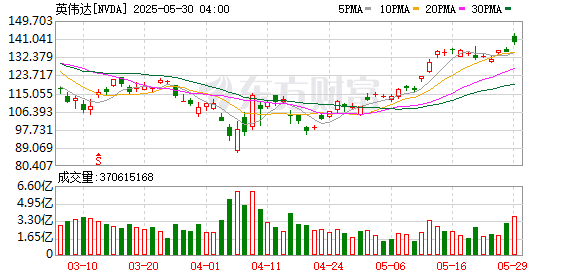
5月29日电,英伟达CFO表示,微软已经部署了数万个Blackwell图形处理器(GPU),预计将增加至数十万个GB200系列,OpenAI是其主要客户之一。
news flash· 2025-05-28 21:12
Core Insights - Nvidia's CFO stated that Microsoft has deployed tens of thousands of Blackwell GPUs, with expectations to increase to hundreds of thousands of the GB200 series, indicating strong demand for advanced graphics processing units [1] Company Summary - Microsoft is a significant customer for Nvidia, particularly in the deployment of Blackwell GPUs and the upcoming GB200 series [1] - OpenAI is highlighted as one of the main clients benefiting from this GPU deployment, showcasing the intersection of AI and advanced computing technology [1]

5月14日电,英伟达将与沙特人工智能公司(SDAIA)部署5000个Blackwell图形处理器(GPU)。
news flash· 2025-05-13 18:27
Core Viewpoint - Nvidia is partnering with the Saudi Data and Artificial Intelligence Authority (SDAIA) to deploy 5,000 Blackwell graphics processing units (GPUs) [1] Group 1 - Nvidia will provide 5,000 Blackwell GPUs to SDAIA [1]