C2000

Search documents
AI掀起的“芯片狂潮”终于蔓延至模拟芯片! 德州仪器(TXN.US)给出强劲展望 数据中心营收猛增70%
Zhi Tong Cai Jing· 2026-01-27 23:49
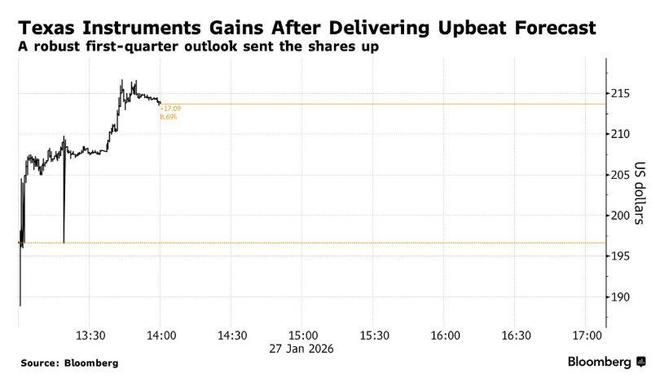
Core Viewpoint - Texas Instruments (TXN) reported slightly lower Q4 earnings than market expectations but provided a strong revenue and profit forecast for the upcoming quarter, indicating a significant recovery in demand for analog chips and MCUs, particularly driven by the AI data center construction boom [1][2][3] Financial Performance - Q4 revenue increased by 10% year-over-year to $4.42 billion, with earnings per share (EPS) of $1.27, which was slightly below analyst expectations of $4.43 billion and $1.30 EPS [2] - The core analog chip business generated $3.615 billion in revenue, a 14% year-over-year increase, while the embedded processing solutions segment (including MCUs) saw an 8% increase to $662 million [2] - The data center business experienced a remarkable 70% year-over-year growth in Q4, prompting the company to consider reporting data center sales separately [2][6] Future Outlook - Texas Instruments anticipates Q1 total revenue between $4.32 billion and $4.68 billion, with an EPS forecast of $1.22 to $1.48, exceeding analyst expectations [1][2] - The management indicated that major customers have begun to significantly reduce their inventory backlog accumulated during the pandemic and are now placing large orders, primarily driven by AI data center needs [2][5] Market Reaction - Following the earnings report and optimistic outlook, Texas Instruments' stock surged approximately 10% in after-hours trading, reflecting investor confidence in the strong demand for analog chips driven by AI data centers [3] - The stock has risen 13% year-to-date, outperforming the S&P 500 index, and has positively influenced the stock prices of other analog chip companies, such as Analog Devices [3] Industry Trends - The global semiconductor market is expected to grow significantly, with projections indicating a 22.5% increase in 2025, reaching a total value of $772.2 billion, and further expansion to $975.5 billion in 2026 [6][9] - The growth is anticipated to be driven by strong demand in the AI GPU/TPU logic chip sector and storage systems, particularly in AI inference systems and cloud computing infrastructure [9][10] Competitive Position - Texas Instruments is recognized as a leading manufacturer of analog chips and MCUs, with a market share of approximately 19%-20% in the analog segment and ranking among the top five in the MCU market [11][12] - The company's extensive product line, which includes over 80,000 analog, power, signal chain, and MCU products, allows it to serve a diverse range of end markets, making its quarterly performance a key indicator of global semiconductor demand [11][12]


利空突袭,芯片巨头直线大跳水
Zheng Quan Shi Bao· 2025-10-22 13:21
Core Viewpoint - Texas Instruments, a leading analog chip manufacturer, has issued a disappointing earnings forecast for Q4, causing its stock to drop over 9% in pre-market trading, reflecting concerns about the semiconductor industry's recovery [1][3][4] Financial Performance - In Q3, Texas Instruments reported revenue of $4.74 billion, a 14% year-over-year increase, slightly above market expectations, but earnings per share of $1.48 fell short of forecasts [3][4] - The company predicts Q4 revenue will be between $4.22 billion and $4.58 billion, with a midpoint of $4.4 billion, significantly below analysts' average expectation of $4.5 billion [3][4] - Expected Q4 earnings per share are approximately $1.26, while analysts anticipated $1.39 [3][4] Market Position and Industry Impact - Texas Instruments holds a market share of approximately 19%-20% in the analog chip segment and is a key player in the MCU chip market, with products used across various sectors including automotive, industrial, and consumer electronics [6][7] - The company's performance is viewed as a barometer for global semiconductor demand, indicating broader market trends [7] Strategic Outlook - The CEO noted a slowdown in recovery speed in the semiconductor market, attributed to macroeconomic uncertainties and trade tensions, leading to reduced order volumes from major clients [3][4][8] - Texas Instruments is considering slowing its expansion plans, with capital expenditures expected to decrease from $5 billion this year to $2-3 billion next year [8] - The company has reached optimal inventory levels and is reducing factory output to avoid excess stock, which may impact short-term profitability [8] Competitive Landscape - The company faces intense competition in the Chinese market, where it has not experienced the previous trend of "advance orders" [8] - Barclays Bank has maintained a "underweight" rating on Texas Instruments, citing ongoing weakness in the industrial and automotive markets and the risk of further downward adjustments to earnings expectations [8]

利空突袭!芯片巨头,直线大跳水!
Zheng Quan Shi Bao Wang· 2025-10-22 12:59
Core Viewpoint - Texas Instruments, a leading analog chip manufacturer, has issued a pessimistic revenue forecast for Q4, causing its stock to drop over 9% in pre-market trading, indicating concerns about the semiconductor industry's recovery [1][2]. Financial Performance - In Q3, Texas Instruments reported revenue of $4.74 billion, a 14% year-over-year increase, slightly above market expectations. However, earnings per share (EPS) of $1.48 fell short of analyst predictions [2]. - The company forecasts Q4 revenue between $4.22 billion and $4.58 billion, with a midpoint of $4.4 billion, significantly below the analyst average expectation of $4.5 billion. Expected EPS for Q4 is approximately $1.26, compared to the analyst forecast of $1.39 [2][3]. Market Position and Industry Impact - Texas Instruments holds a market share of approximately 19%-20% in the analog chip segment and is a key player in the MCU chip market, with products used across various end markets including automotive, industrial, and consumer electronics [5]. - The company's performance is viewed as a "barometer" for global semiconductor demand, reflecting broader market trends [6]. Supply Chain and Economic Factors - The CEO noted that industrial clients are adopting a "wait and see" approach due to uncertainties related to potential tariff increases and geopolitical tensions, which are disrupting global supply chains [1][4]. - The company is experiencing intensified competition in the Chinese market, which has returned to normal operations without the previous trend of "advance orders" [6]. Inventory and Capital Expenditure - Texas Instruments has reached optimal inventory levels and is slowing down factory operations to avoid excessive stock, which may impact short-term profitability [7]. - The company plans to reduce capital expenditures for equipment and facilities from approximately $5 billion this year to an estimated $2-3 billion next year, reflecting a cautious approach amid weak demand growth [7]. Analyst Sentiment - Barclays Bank has maintained a "underweight" rating on Texas Instruments, citing ongoing weakness in the industrial and automotive markets, and highlighting risks of further downward adjustments to earnings expectations [7].
芯片巨头财报季遭遇“开门黑”:关税阴影之下 “模拟之王”德州仪器(TXN.US)暗示复苏放缓
Zhi Tong Cai Jing· 2025-10-22 00:39
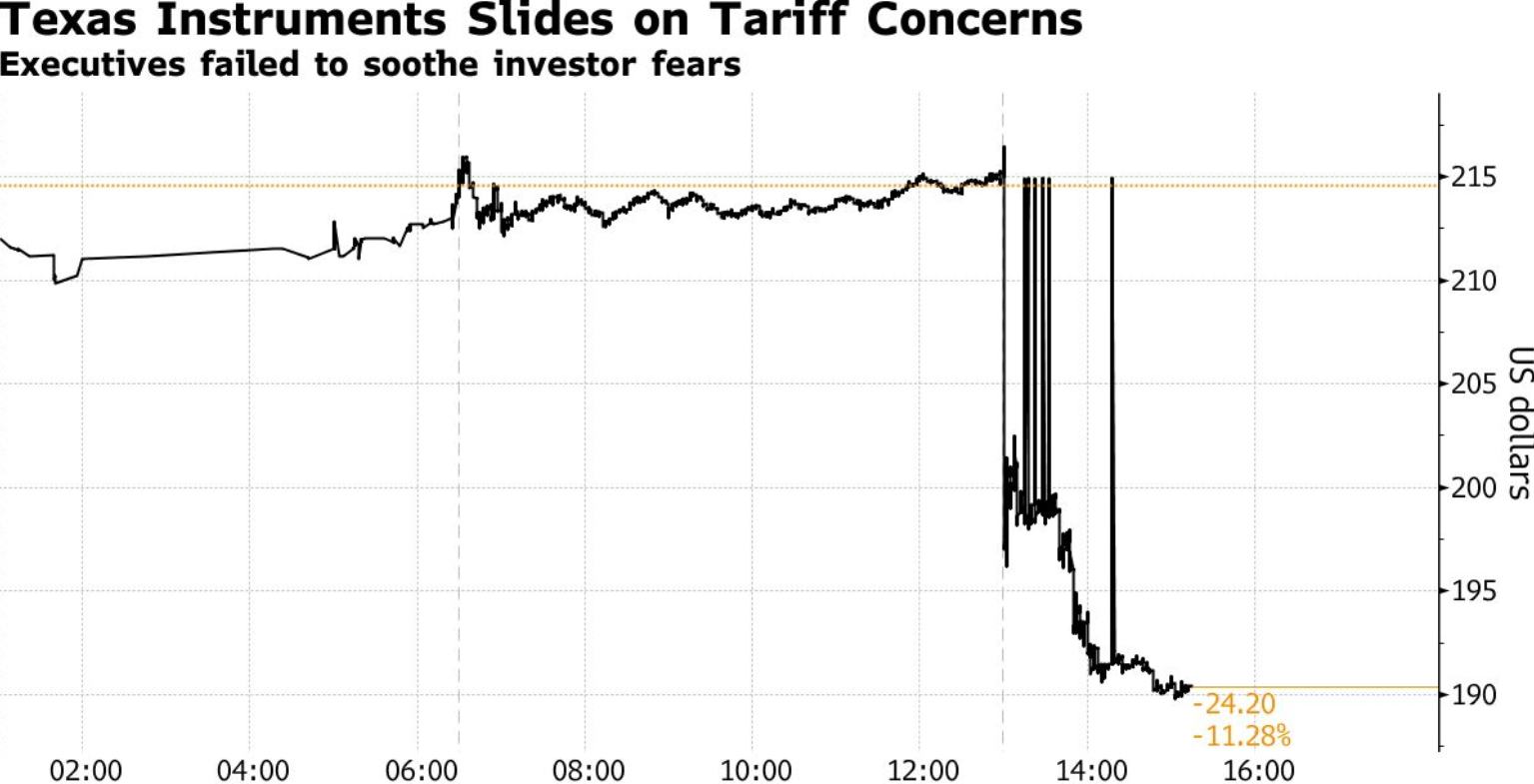
Core Viewpoint - Texas Instruments (TXN.US) reported disappointing earnings and outlook, leading to an over 8% drop in stock price after hours, raising concerns about the semiconductor industry's recovery process [1][2] Financial Performance - In Q3, Texas Instruments reported revenue of $4.74 billion, a 14% year-over-year increase, and earnings per share (EPS) of $1.48, slightly above revenue expectations but below EPS forecasts [3] - For Q4, the company expects revenue between $4.22 billion and $4.58 billion, with an EPS midpoint of approximately $1.26, both below Wall Street's average expectations [1][3] Market Dynamics - The company indicated that customers are slowing down orders due to escalating global trade tensions and a weak economic environment [1][2] - Texas Instruments' stock has underperformed compared to the broader semiconductor sector, with a nearly 2% decline year-to-date, while the Philadelphia Semiconductor Index has risen by 37% [2] Industry Context - The semiconductor market's recovery is ongoing but at a slower pace than previous cycles, influenced by macroeconomic dynamics and external uncertainties [2] - The automotive and industrial sectors are particularly cautious, with clients adopting a "wait and see" approach regarding capacity expansion plans [2][7] Competitive Landscape - Texas Instruments faces increasing competition from domestic analog chip companies, especially as the "domestic substitution" trend intensifies in China, where approximately 20% of its revenue is generated [3][6] - The company has invested significantly in R&D and capital expenditures, totaling around $39 billion and $48 billion respectively over the past year, while returning about $66 billion to shareholders [3][6] Future Outlook - CFO Rafael Lizardi indicated that capital expenditures are expected to decrease next year, allowing the company to refocus on shareholder returns once expansion is complete [6] - Analysts remain cautious about the analog chip sector, with Barclays maintaining a "underweight" rating on Texas Instruments, citing ongoing weakness in the industrial and automotive markets [8]

?芯片巨头财报季遭遇“开门黑”:关税阴影之下 “模拟之王”德州仪器(TXN.US)暗示复苏放缓
Zhi Tong Cai Jing· 2025-10-21 23:54
Core Viewpoint - Texas Instruments (TXN.US) reported disappointing earnings and outlook, leading to an over 8% drop in stock price post-announcement, raising concerns about the semiconductor industry's recovery pace [1][3][8] Financial Performance - Q3 revenue increased by 14% year-over-year to $4.74 billion, with earnings per share (EPS) of $1.48, slightly above revenue expectations but below EPS forecasts [3][4] - For Q4, the company expects revenue between $4.22 billion and $4.58 billion, with an EPS midpoint of $1.26, both below Wall Street's average expectations [1][2] Market Dynamics - Customers are slowing down orders due to escalating global trade tensions and a weak economic environment, impacting demand for analog chips and microcontrollers (MCUs) [2][8] - The semiconductor market's recovery is ongoing but at a slower pace than previous cycles, influenced by broader macroeconomic uncertainties [2][8] Competitive Landscape - Texas Instruments faces increasing competition from domestic analog chip manufacturers in China, which poses a threat to its market share [4][6] - The company has a significant portion of its revenue (approximately 20%) coming from China, where market dynamics have shifted towards local suppliers [4][6] Investment Sentiment - Wall Street remains cautious about the analog chip sector, reflected in Texas Instruments' stock underperformance compared to the broader semiconductor market [3][8] - Analysts from Barclays maintain a "underweight" rating on Texas Instruments, citing ongoing weakness in industrial and automotive markets [9]
突然爆雷!刚刚,全线大跌!
券商中国· 2025-07-23 11:45
Core Viewpoint - The article highlights the significant impact of Texas Instruments' disappointing earnings guidance on the semiconductor sector, indicating potential challenges ahead for the industry as a whole [2][3][6]. Financial Performance - Texas Instruments' stock price fell over 12% in pre-market trading on July 23 due to its earnings outlook not meeting market expectations [2][4]. - The company projected third-quarter revenue between $4.45 billion and $4.8 billion, with a midpoint of $4.625 billion, slightly above the expected $4.59 billion. However, the earnings per share guidance of $1.48 was below the analyst expectation of $1.50 [5]. - For the second quarter, Texas Instruments reported revenue of $4.45 billion, a 16% year-over-year increase, and a net profit of $1.3 billion, also a 15% increase, both exceeding analyst expectations [10]. Market Sentiment - Analysts view Texas Instruments as a "barometer" for semiconductor demand, and its cautious outlook has raised concerns about the industry's future [3][13][18]. - The company's CEO indicated that tariffs and geopolitical issues are disrupting global supply chains, contributing to a slow recovery in the automotive sector [7][9]. Industry Context - Texas Instruments is the largest manufacturer of analog chips and microcontrollers (MCUs), with a market share of approximately 19%-20% in the analog segment and ranking among the top five in the MCU market [17]. - The company plans to invest $60 billion to expand its chip manufacturing facilities in Texas and Utah, focusing on 300mm wafer manufacturing technology [12]. - The semiconductor industry is facing uncertainties due to tariff policies and geopolitical tensions, which have been echoed by other major players like ASML and TSMC [19][20].

芯片巨头财报季开场即哑火 模拟霸主德州仪器(TXN.US)“关税虚火”遭戳破
智通财经网· 2025-07-23 00:21
Core Viewpoint - Texas Instruments (TXN.US) reported earnings on July 23, leading to a significant drop of over 11% in its stock price during after-hours trading, primarily due to concerns that the surge in chip demand driven by Trump's tariff policies may be temporary [1][2]. Financial Performance - Texas Instruments' Q2 revenue reached $4.45 billion, a year-on-year increase of 16%, with earnings per share at $1.41, also up 16% year-on-year [8]. - The company projected Q3 revenue between $4.45 billion and $4.8 billion, slightly below Wall Street's average expectation of $4.57 billion [1][2]. - The anticipated earnings per share for Q3 is approximately $1.48, which is also below analyst expectations [1]. Market Dynamics - The overall revenue trajectory for Texas Instruments has been recovering since 2024, but the tariff-induced uncertainty has clouded demand forecasts [2]. - The company noted a strong domestic demand in the early part of Q2 due to tariffs, but order levels have since returned to normal recovery expectations [2]. - Texas Instruments holds a market share of approximately 19%-20% in the analog chip sector and ranks among the top five in the MCU market [6]. Industry Position - Texas Instruments is recognized as a leading manufacturer of analog chips and MCUs, with a diverse product range that is critical in various applications, including electric vehicles [5][6]. - The company serves over 100,000 customers across multiple sectors, making its performance a key indicator of overall industry demand [6]. - The demand for analog chips is expected to grow due to their essential role in automotive and industrial applications [5][8]. Future Outlook - Despite the current challenges, Texas Instruments remains optimistic about long-term growth opportunities, expecting to eventually surpass $20 billion in annual revenue [2]. - The company is cautious about the automotive market, which has not yet recovered, and anticipates continued positive demand in other sectors [7]. - Analysts predict a strong recovery in global semiconductor demand by 2025, with Texas Instruments' performance likely influencing broader market trends [11][14].
业绩下滑股价却逆天改命,热景生物股东趁势套现9703万元
Guo Ji Jin Rong Bao· 2025-05-22 12:06
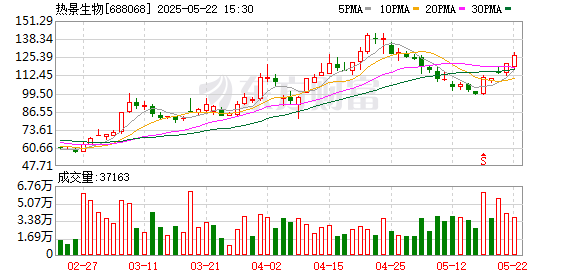
Core Viewpoint - Beijing Hotgen Biotech Co., Ltd. is undergoing a significant transformation by diversifying into innovative drug development while facing challenges in its core in vitro diagnostic (IVD) business, leading to a mixed performance in stock price and financial results [2][3][4]. Company Overview - Founded in 2005, Hotgen Biotech specializes in in vitro diagnostic reagents and was listed on the Shanghai Stock Exchange's Sci-Tech Innovation Board in September 2019 [3]. - The company’s testing projects cover various diseases, including inflammation, cardiovascular issues, diabetes, and cancers [3]. Recent Developments - On May 22, 2024, the company held its annual shareholder meeting, discussing executive compensation, financial reports, and profit distribution [2]. - Prior to the meeting, it was announced that the controlling shareholder, Qingdao Tongcheng, reduced its stake from 28.00% to 26.99% through a share sale, raising approximately 97.03 million yuan [2]. Financial Performance - For the fiscal year 2024, the company reported a revenue of 510 million yuan, a year-on-year decrease of 6.74%, and a net loss of 191 million yuan, a significant decline of 760% [7][8]. - Despite a 26.15% growth in its magnetic microparticle chemiluminescence business, overall performance was negatively impacted by high R&D costs and losses from joint ventures [8]. Strategic Initiatives - The company is pursuing a "diagnostics + innovative drugs" dual-driven strategy, investing in strategic partnerships with innovative drug companies to develop differentiated drug pipelines focusing on antibody and nucleic acid drugs [3][4]. - Notable investments include ShunJing Pharmaceutical, which is developing a first-in-class antibody drug for acute myocardial infarction, and ZhiYuan Biotech, which is working on a monoclonal antibody for Alzheimer's disease [4][5]. Market Reaction - The stock price of Hotgen Biotech has seen significant volatility, increasing from a low of 22.94 yuan per share to a peak of 142 yuan, representing a 550% rise [4]. - The dynamic price-to-earnings ratio has surpassed that of peers in the IVD sector, despite the company's declining performance in its core business [4][6]. Investment Landscape - As of the end of last year, 143 funds held shares in Hotgen Biotech, with a total market value of 1.38 billion yuan, but this number has decreased to 52 funds holding 177.4 million shares by the first quarter of this year [10]. - The company faces increasing pressure for funding due to its cross-industry transformation and tightening regulations on refinancing in the Sci-Tech Innovation Board [7][9].