
CKBA

Search documents
泰恩康(301263.SZ):公司目前重点聚焦国内2-12岁儿童白癜风适应症的注册上市
Ge Long Hui A P P· 2026-01-30 01:27
Core Viewpoint - The company is focusing on the registration and market launch of treatments for pediatric vitiligo in the domestic market, which has significant potential [1] Group 1: Domestic Market Focus - The company is concentrating on the registration and market launch of treatments for children aged 2-12 with vitiligo [1] - The domestic market for this indication is already substantial [1] Group 2: Global Market Potential - There is a global gap in the treatment of pediatric vitiligo, with no FDA-approved products available [1] - The company acknowledges that expanding into overseas markets will involve time and challenges [1] Group 3: Product Confidence and Future Plans - The company expresses strong confidence in the market prospects of its product due to its unique mechanism of action and good safety profile [1] - Plans are in place to initiate the IND application process with the FDA in the United States this year to explore overseas market opportunities [1]
泰恩康:公司目前重点聚焦国内2-12岁儿童白癜风适应症的注册上市
Ge Long Hui· 2026-01-30 01:21
Core Viewpoint - The company is focusing on the registration and market launch of treatments for pediatric vitiligo in the domestic market, which has significant potential [1] Group 1: Domestic Market Focus - The company is primarily targeting the registration and market launch of treatments for children aged 2-12 with vitiligo [1] - The domestic market for this indication is already substantial, indicating a strong potential for growth [1] Group 2: Global Market Potential - There is a global gap in the treatment of pediatric vitiligo, with no FDA-approved products currently available [1] - The company acknowledges the challenges and time costs associated with expanding into overseas markets [1] Group 3: Product Confidence and Future Plans - The company expresses confidence in the market prospects for its product due to the unique mechanism of action and good safety profile of CKBA [1] - Plans are in place to initiate the IND application process with the FDA in the United States this year, aiming to explore development opportunities in international markets [1]
泰恩康分析师会议-20260129
Dong Jian Yan Bao· 2026-01-29 14:45
1. Reported Industry Investment Rating - No information provided in the given content 2. Core Viewpoints of the Report - The company's 2026 Employee Stock Ownership Plan (Draft) shows management's confidence in future development and the core team's optimism about the market prospects of core business products [26]. - The company has set three - year (2026 - 2028) performance assessment targets for the employee stock ownership plan, aiming to achieve revenue of 1 billion yuan in 2026, 1.5 billion yuan in 2027, and 2 billion yuan in 2028, and考核利润 of 300 million yuan in 2026, 500 million yuan in 2027, and 800 million yuan in 2028 [26]. - With the approval of multiple core products, the company's existing business revenue is expected to grow significantly in 2026, and there will be explosive growth in 2027 and 2028 [28]. 3. Summary by Relevant Catalogs 3.1 Research Basic Situation - Research object: Taienkang [16] - Industry: Pharmaceutical commerce [16] - Reception time: January 29, 2026 [16] - Listed company reception personnel: Li Ting, Director, Deputy General Manager, and Secretary of the Board of Directors [16] 3.2 Detailed Research Institutions - Securities companies: Huatai Securities, China Merchants Securities, Ping An Securities, Zhongtai Securities, Founder Securities, Huachuang Securities, Cinda Securities, CITIC Securities Co., Ltd., Tianfeng Securities, Shenwan Hongyuan, Guotai Haitong, Industrial Securities, Guohai Securities, Huafu Securities, Huaxi Securities, Galaxy Securities [17][18][20] - Fund management companies: Dacheng, Huabao, Huian, Huatai - PineBridge Fund, China Asset Management, Galaxy, Jianxin, Hangzhou Youyizeng Private Equity, Puyin AXA, Anxin, Hehe (Beijing) Private Equity, Morgan Stanley Fund Management (China), Hainan Ling Private Equity, Guoshou Anbao [17][18][19] - Asset management companies: Yong'an Guofu, Shanghai Yuxiu, Guangdong Hongyi, Huafu Securities, Zhongyin International Securities Co., Ltd. Asset Management, Ping An Insurance Asset Management, Fushun Asset Management (Shanghai), Zhonghuili Asset Management, Shanghai Qingding, Beijing Hanhe and Hanhua [18][19][20] - Investment companies: Shanghai Hengfu, Shanghai Zige, Zhejiang Yiheng, Beijing Zhuoyu, Shanghai Guanche [18][19] - Others: Western Medicine, Dongfang Investment Consulting, Dongcai Medicine, Hwa Site Asset Management, Northeast Medicine, Dongfang Medicine, Xiangwang Fund [18][19][20] 3.3 Research Institution Proportion - No information provided in the given content 3.4 Main Content Data - **Employee Stock Ownership Plan** - Fund - raising: The total amount of funds to be raised is 33.608 million yuan, with no more than 145 participants including directors, senior managers, and core employees, and all funds come from employees' legal salaries and self - raised funds [26]. - Assessment targets: From 2026 - 2028, the assessment indicators are revenue and考核利润 (deducted non - recurring profit and loss attributable to the parent + R & D expenses - investment income from associated and joint - venture enterprises - share - based payment expenses) [26]. - Incentive form: Employee stock ownership plan, employees need to contribute funds first and obtain shares through non - trading transfer [26]. - Unlock ratio: Unlock in three phases from 2026 - 2028, with 40%, 40%, and 20% respectively [28]. - Incentive shares: Approximately 1.98 million shares, sourced from the company's previous share repurchases [28]. - **Revenue and Profit Targets** - The company's existing products such as "Aitingjiu" for sexual health, "Wolitin" for ophthalmology, and Chinese patent medicines will maintain stable income [28]. - Multiple core products will be approved or applied for, including "Aitinglie" non - finasteride - tadalafil compound capsule (domestic first imitation) approved in December 2025, lidocaine - prilocaine aerosol (domestic first imitation) expected to be accepted by the drug administration soon, compound sodium sulfate tablets (domestic first imitation) expected to be approved in the first half of 2026, Heweizhengchang Pills (domestic exclusive) for localized production registration expected to be approved in the first half of 2026, and pilocarpine hydrochloride eye drops for presbyopia (domestic first imitation) expected to be approved in the second half of 2026 [28]. - **Heweizhengchang Pills Localized Production** - Since the second half of 2025, the company has carried out brand promotion in traditional advantageous regions such as Guangdong, Guangxi, and Fujian through platforms like Focus Media, Xiaohongshu, and Douyin [28]. - Actively expand third - party terminal channels such as clinics and Internet hospitals, and increase investment in online platforms such as Douyin, JD, and Tmall. Sales on the Douyin platform have increased significantly in January [28]. - After the domestic localization of Heweizhengchang Pills, multiple product specifications will be added to meet different needs and maintain the price system, with good sales expected in the first and second quarters of this year [28]. - **CKBA for Alzheimer's Disease** - Developed from AKBA, a natural triterpenoid compound from frankincense, CKBA can specifically target MFE - 2, a key metabolic enzyme in the peroxisomal β - oxidation pathway, maintaining lipid metabolism homeostasis in microglia and inhibiting the release of pro - inflammatory factors [28][29]. - Animal experiments show that oral CKBA can cross the blood - brain barrier, has no obvious toxic side effects, and has multiple therapeutic effects in Alzheimer's disease model mice [29]. - **Commercialization Preparation for New Products** - Increase brand promotion investment, cooperate with Meituan in addition to existing channels, and the sales on online platforms such as Meituan, Tmall, JD, and Douyin are increasing [29]. - Establish a specialized third - party terminal team to develop clinic and Internet hospital channels and adjust the sales team [29]. - For specific products, promote the inclusion of compound sodium sulfate tablets in medical insurance after approval; start medical insurance - related work for non - finasteride - tadalafil compound capsules, and continue in - depth brand promotion [30]. - **Progress of Child Vitiligo and Rosacea** - Rosacea may progress faster and is expected to be the first indication for CKBA to submit a registration application. The company aims to complete Phase III clinical trials by the end of 2027 [30]. - Child vitiligo Phase II clinical trials aim to enroll the first patient in March - April 2026 and basically complete Phase II clinical trials in the first half of 2027 [31]. - **Overseas Market of Child Vitiligo** - The company focuses on the domestic registration and listing of child vitiligo in 2 - 12 - year - old children. There is currently no approved product globally, and the company plans to start the IND application for the US FDA this year [32].
泰恩康:CKBA有望成为国内首个玫瑰痤疮1类创新药,争取2027年底前完成III期临床
2 1 Shi Ji Jing Ji Bao Dao· 2026-01-29 08:10
Core Viewpoint - The company TianKang has indicated that the development progress of the rosacea indication is faster than that of pediatric vitiligo, and it is expected to be the first indication for CKBA to submit a registration application [1] Group 1: Development Progress - The rosacea indication has over 50 million patients in China with a strong willingness to pay [1] - The company aims to complete Phase III clinical trials by the end of 2027 [1] Group 2: Market Opportunity - There are currently few innovative drug developments globally for this indication [1] - If clinical data is favorable, the drug could become the first Class 1 innovative drug for this indication in China [1]
泰恩康(301263) - 2026年1月29日投资者关系活动记录表
2026-01-29 07:58
Group 1: Investor Relations Activity - The investor relations activity involved specific targeted research with participation from various fund management companies and securities firms [2][3]. - The meeting was held online on a Thursday morning, with a duration of 50 minutes [2]. Group 2: Employee Stock Ownership Plan - The company disclosed a draft for an employee stock ownership plan aiming to raise a total of CNY 33.608 million, involving directors, senior management, and core employees [3]. - The performance assessment period for the plan is set from 2026 to 2028, with specific revenue and profit targets: - Revenue targets: CNY 1 billion in 2026, CNY 1.5 billion in 2027, and CNY 2 billion in 2028 - Profit targets: CNY 300 million in 2026, CNY 500 million in 2027, and CNY 800 million in 2028 [3][4]. Group 3: Product Development and Market Strategy - The company has several core products expected to be approved or submitted for approval, including "Aitinglie" and "Lidocaine" aerosol, with anticipated revenue growth from existing products and new approvals [4][5]. - The company is actively promoting the "Hewei Zhengchang Wan" product through various media channels and expanding its sales through clinics and online platforms [5][8]. - The company plans to enhance brand promotion and has established a dedicated team for third-party channels, focusing on clinics and internet hospitals [8]. Group 4: Alzheimer's Disease Research - The company is developing CKBA for Alzheimer's disease, which has shown promising results in animal models, including cognitive improvement and reduced neuroinflammation [6][7]. - CKBA's mechanism targets MFE-2, a key enzyme in lipid metabolism, which is crucial for maintaining the homeostasis of microglial cells [7]. Group 5: Clinical Trials and Market Potential - The company is prioritizing the registration of treatments for pediatric vitiligo and rosacea, with rosacea expected to progress faster due to a shorter treatment cycle [9][10]. - The domestic market for pediatric vitiligo is significant, with no existing treatments approved by the FDA, indicating potential for market expansion [11]. Group 6: Forward-Looking Statements - The report includes forward-looking statements regarding future plans and performance forecasts, emphasizing the need for investors to recognize associated risks [11].
泰恩康:公司正加速推进CKBA的临床研发进程
Zheng Quan Ri Bao Wang· 2026-01-08 11:40
Group 1 - The core viewpoint of the article highlights that the company, 泰恩康 (301263), is accelerating the clinical development of CKBA in response to national policies supporting pharmaceutical innovation [1] Group 2 - For the adult vitiligo indication, the company is steadily advancing the application process for the Phase III clinical trial [1] - The application for the Phase II clinical trial for the 2-12 years old children's vitiligo indication has been accepted by the drug regulatory authority, and the company will disclose updates if approved [1] - CKBA has obtained the seamless adaptive clinical trial approval for the Phase II/III indication of rosacea, and the company is actively preparing for ethical review and subject enrollment [1]
深化创新药研发布局 打造业绩增长新引擎
Zhong Guo Zheng Quan Bao· 2025-12-03 20:28
Core Viewpoint - 泰恩康 is committed to deepening its focus on the pharmaceutical industry and implementing an innovation-driven development strategy during the "14th Five-Year Plan" period, aiming to contribute more to the construction of a healthy China [1] R&D Progress - 泰恩康's subsidiary, Jiangsu Bochuangyuan Biopharmaceutical Technology Co., Ltd., received a notice from the National Medical Products Administration for the acceptance of a Phase II clinical trial application for CKBA cream in treating non-segmental vitiligo in children aged 2-12 [1][2] - The company successfully completed a Phase II clinical trial for CKBA in adult vitiligo and plans to submit a Phase III clinical trial application soon [2] - CKBA is a novel immune modulator derived from traditional Chinese medicine, showing targeted action and safety for treating pediatric vitiligo [2] Clinical Research and Potential - CKBA has shown significant potential in treating other immune-related diseases, including Alzheimer's disease, with research published in the journal Nature Aging [3] - 泰恩康 has initiated preclinical research for CKBA in Alzheimer's treatment, with plans to submit an IND application by the second half of 2026 [3] Innovation Development Strategy - 泰恩康 has transformed its business model from a sales-production-research model to a research-production-sales model, with R&D investment increasing from 6.9% to 21.96% of revenue from 2022 to 2024 [4] - The company emphasizes a "pyramid" R&D strategy, focusing on generic drug development at the base, modified chemical drugs and biological drugs in the middle, and innovative drug research at the top [4] Product Structure Enhancement - 泰恩康 has established three main product segments: sexual health, gastrointestinal, and ophthalmology, with core products gaining high recognition in their respective fields [4][5] - The company has several core drugs in the pipeline, including domestic first generics, expected to be approved or submitted by the end of this year to next year, which will further enhance its product structure [5]
泰恩康CKBA联合光疗早期研究疗效显著 临床申请获国家药监局受理
Zhong Zheng Wang· 2025-11-20 13:08
Core Insights - Guangdong Taiankang Pharmaceutical Co., Ltd. has made significant progress in the innovative treatment of pediatric vitiligo with the acceptance of its clinical trial application for CKBA cream combined with narrowband ultraviolet B (NB-UVB) for children aged 2-12 [1][2] - The global prevalence of vitiligo, a chronic autoimmune disease characterized by skin pigment loss, is high, with children accounting for 32%-40% of cases, highlighting a substantial unmet clinical need in this demographic [1] Group 1 - The acceptance of the clinical trial application marks a key advancement for the company in the pediatric vitiligo treatment sector, potentially providing new options for affected children and their families [1] - Currently, there are no approved products for treating vitiligo in children globally, indicating a significant market opportunity for the company [1] - The company aims to address unmet clinical needs and enhance its innovative drug pipeline, reinforcing its commitment to public health and long-term value creation for investors [2] Group 2 - CKBA, a First-in-Class innovative drug with global intellectual property rights, is progressing steadily in its indication layout, with adult vitiligo in Phase II trials and plans for Phase III submission [2] - The company is also preparing for II/III phase trials for rosacea and advancing preclinical research for Alzheimer's disease, with an IND application planned for the second half of 2026 [2] - The acceptance of the pediatric vitiligo indication further enriches the company's indication matrix, showcasing its deep accumulation in innovative drug research and development [2]
社保基金大举建仓!泰恩康布局阿尔茨海默症千亿蓝海,业绩进入高增长期
Zheng Quan Shi Bao Wang· 2025-11-07 07:08
Core Viewpoint - The company, TianKang, has officially announced the initiation of preclinical research for its innovative drug CKBA targeting Alzheimer's disease (AD), based on significant findings from a research team at Shanghai Jiao Tong University [1][2]. Group 1: Drug Development and Mechanism - CKBA is a first-in-class innovative drug that targets the newly identified MFE-2 pathway, which plays a crucial role in the lipid metabolism and neuroinflammation associated with AD [2][4]. - The drug demonstrates a differentiated advantage by being orally administered and capable of crossing the blood-brain barrier, showing improvements in cognitive function, reduction of neuroinflammation, and decreased Aβ plaque accumulation in AD model mice [4]. Group 2: Market Potential and Financial Outlook - The Alzheimer's drug market in China is projected to grow from approximately 6 billion yuan in 2023 to over 26 billion yuan by 2030, with a compound annual growth rate (CAGR) of 19.2%, while the global market is expected to reach 31.44 billion USD [4]. - The company anticipates submitting its phase I clinical application for CKBA in the second half of 2026, supported by cash flow from its existing generic drug business [4]. Group 3: Broader Product Pipeline and Growth Strategy - In addition to AD, CKBA is part of a broader pipeline that includes treatments for vitiligo and rosacea, with ongoing clinical trials showing promising results [5]. - The company is also expanding its generic and modified drug segments, with several products in the pipeline expected to contribute to revenue growth [5][6]. Group 4: Institutional Support and Market Confidence - The company has gained recognition from institutional investors, with significant increases in holdings from the basic pension insurance fund, indicating confidence in the company's growth potential [7][9]. - Management has shown commitment to the company's long-term success, with no plans for share reduction post-lockup and active participation in shareholding [9].

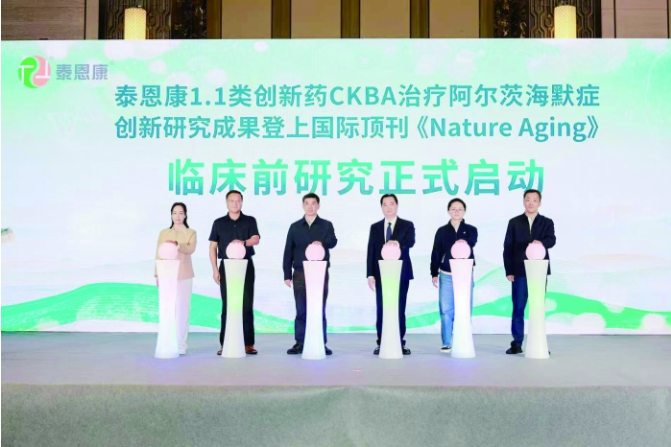
泰恩康正式启动CKBA药物治疗阿尔茨海默适应症研发
Xin Lang Cai Jing· 2025-11-05 13:47
Core Insights - The company, TianKang, has officially launched the development of its innovative drug CKBA for the treatment of Alzheimer's Disease (AD) [1] - TianKang is accelerating the research and development of AD indications while also preparing for Phase III clinical trials for CKBA in vitiligo and submitting applications for pediatric medications, as well as conducting Phase II/III clinical trials for rosacea [1] - The establishment of dedicated business units for certain indications aims to expedite the commercialization process post-approval [1] - Existing products and several upcoming generic drugs are expected to provide stable cash flow to support the company's innovative drug development [1] - Recent research findings on CKBA for AD have been published in the prestigious journal Nature Aging, highlighting key targets in the early metabolic inflammatory coupling pathways of AD and confirming CKBA's potential as a new generation small molecule candidate drug derived from natural products [1] - The research demonstrates a complete chain from mechanism study to translational application [1]