Claude for Life Sciences

Search documents
Anthropic cofounder Daniela Amodei says trusted enterprise AI will transcend the hype cycle
Yahoo Finance· 2026-01-27 10:00
Core Insights - Anthropic has launched Claude Cowork, an AI capability designed for general knowledge workers, which can autonomously perform multistep tasks on a user's computer, raising concerns about the durability of software-as-a-service businesses in the face of general-purpose AI [1] - The company emphasizes trust and reliability in regulated industries, positioning its AI models as core enterprise infrastructure rather than consumer products [3][4] - Anthropic's revenue has seen significant growth, projected to reach over $9 billion by the end of 2025, reflecting deep integration of its AI tools in enterprise workflows [6] Product Developments - Claude for Healthcare and Life Sciences was launched to support regulated workflows, enhancing earlier tools for clinical trials with HIPAA-ready infrastructure [2] - Claude Code, a tool for writing and managing code, has gained popularity among engineers, enabling the development of various applications [5] - The company has expanded integrations with platforms like Medidata and ClinicalTrials.gov to enhance its capabilities in clinical trial management [9][10] Market Trends - AI spending in healthcare is projected to reach $1.4 billion in 2025, with healthcare organizations adopting AI at a rate 2.2 times faster than the broader economy [7] - The fastest-growing segments in AI spending include patient engagement and prior authorization, with spending increasing 20 times and 10 times year over year, respectively [8] - Competitors like OpenAI are also entering the healthcare sector, but Anthropic's focus on specialized domains requiring structured reasoning gives it a competitive edge [14][15] Strategic Partnerships - Major clients include Novo Nordisk, Banner Health, and Eli Lilly, with reports indicating that over 85% of providers at Banner Health have improved their workflow efficiency using Claude [11] - Travelers is set to deploy Claude AI assistants to nearly 10,000 employees, marking one of the largest enterprise AI rollouts in the insurance sector [16] - Anthropic's capital posture reflects confidence, with a $13 billion Series F funding round at a $183 billion valuation, indicating strong investor interest [17]
一周之内,Open AI、谷歌、Anthropic AI三大AI巨头集体入局AI医疗
GLP1减重宝典· 2026-01-18 09:43
Core Insights - The article discusses the recent advancements in AI applications within the healthcare sector, highlighting the shift from model capabilities to productization and integration into real medical workflows [3][32]. Group 1: OpenAI Developments - OpenAI launched ChatGPT Health on January 7, 2026, designed as a dedicated health experience within ChatGPT, focusing on aggregating health information from various sources while ensuring privacy and compliance [6][11]. - The acquisition of health tech company Torch for approximately $100 million aims to enhance the integration of lab results, medication information, and medical records into a cohesive product [11][13]. - ChatGPT Health supports connections to health applications like Apple Health and MyFitnessPal, emphasizing a shift towards data aggregation and traceability [8][13]. Group 2: Google's Initiatives - Google updated its MedGemma 1.5 and MedASR models on January 14, 2026, focusing on medical image understanding and voice transcription capabilities [14][20]. - MedGemma 1.5 is designed to interpret medical images, including complex scenarios, and can operate offline, which is crucial for deployment in various healthcare settings [17][20]. - MedASR aims to improve the transcription of medical voice recordings, addressing challenges related to specialized terminology and environmental noise [20][24]. Group 3: Anthropic's Strategy - Anthropic introduced Claude for Healthcare on January 11, 2026, positioning it as an enterprise-level assistant capable of integrating with real healthcare workflows while ensuring compliance [24][27]. - Claude can access key healthcare databases, facilitating tasks such as prior authorization reviews and claims processing, thereby reducing the time spent on fragmented information handling [31][27]. - The focus is on embedding Claude into existing systems rather than creating standalone solutions, addressing the need for structured data integration [35][31]. Group 4: Industry Trends - The actions of OpenAI, Google, and Anthropic indicate a collective focus on addressing existing healthcare demands rather than creating new ones, emphasizing the importance of data, tools, and process optimization [32][35]. - High-frequency healthcare needs are often related to understanding and organizing information rather than direct diagnosis, highlighting the potential for AI to streamline these processes [34][35]. - The key to healthcare innovation lies in making previously overlooked demands scalable, with AI providing solutions for long-standing inefficiencies in areas like health information management and medical record transcription [35][36].



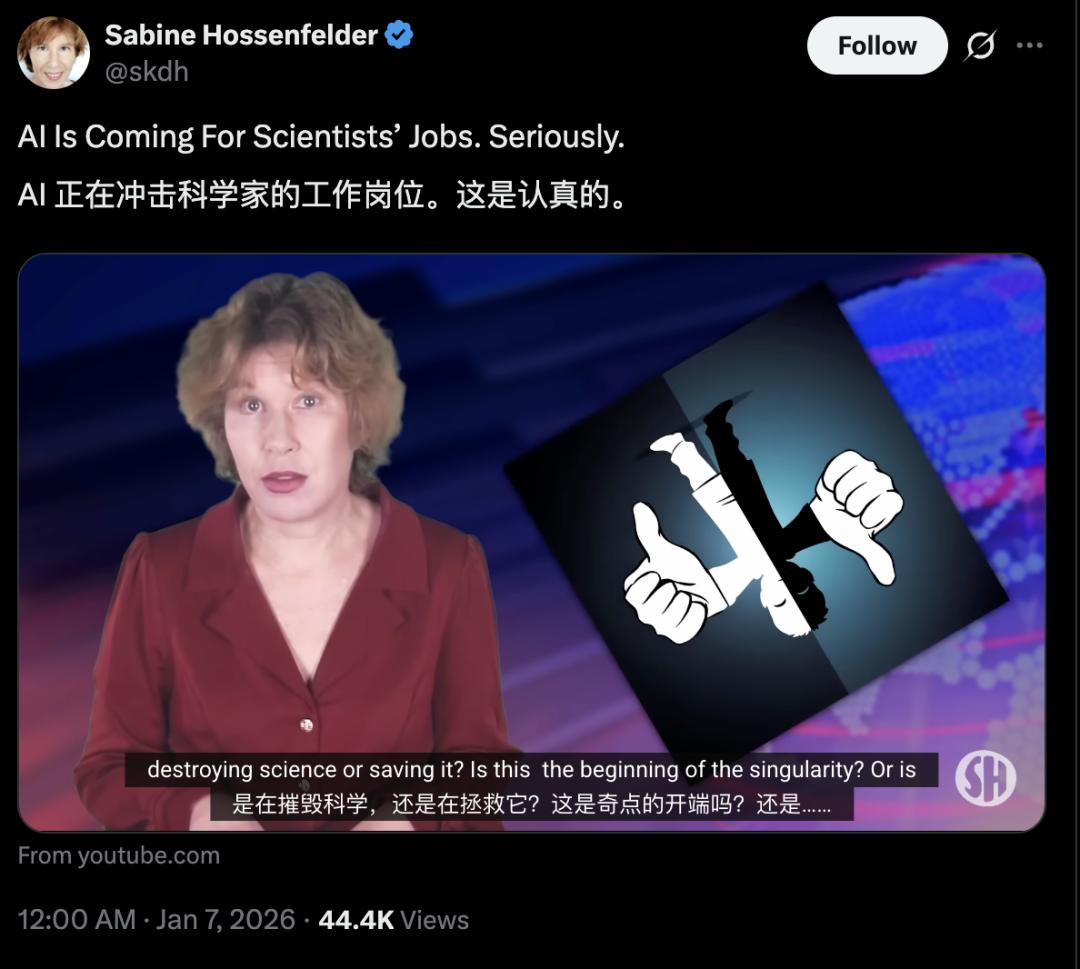
思考已成白菜价?黄仁勋一语成谶,物理学家:人类科研只剩3年
3 6 Ke· 2026-01-16 08:44
Core Viewpoint - The rapid advancement of AI is threatening the traditional roles of scientists, potentially leading to the obsolescence of familiar scientific research practices within three years [2][5][20]. Group 1: Impact of AI on Scientific Research - AI is expected to replace tasks traditionally performed by students and postdocs, significantly reducing costs and time associated with scientific research [3][7]. - The efficiency of research output is projected to increase by an average of 40%, with non-native English speakers seeing improvements of up to 80% [11]. - The adoption of AI tools in research is anticipated to approach nearly 100%, leading to a surge in the number of published papers and overwhelming the peer review process [11][22]. Group 2: Changes in Academic Landscape - The integration of AI in research is reshaping the academic environment, with institutions like MIT and Oxford beginning to adopt AI-based services [8][19]. - The reliance on AI tools is not limited to junior researchers; even top scientists like Terence Tao are utilizing AI for various aspects of their work [12]. - The U.S. government's "Genesis Mission" aims to leverage AI to accelerate scientific discoveries, indicating a strategic push at the national level [14][15][18]. Group 3: Future of Scientific Roles - The traditional roles of researchers, particularly in theoretical physics and mathematics, are at risk as AI can perform complex calculations and analyses more efficiently [6][8]. - The shift towards AI-driven research may lead to a breakdown in the traditional academic hierarchy, making entry-level positions more challenging to attain [25]. - Future scientists will need to evolve from being mere "knowledge carriers" to "wisdom commanders," focusing on problem formulation and interdisciplinary connections rather than rote knowledge [25][26].
强化学习环境与科学强化学习:数据工厂与多智能体架构 --- RL Environments and RL for Science_ Data Foundries and Multi-Agent Architectures
2026-01-07 03:05
Summary of Key Points from the Conference Call Industry Overview - The focus of the conference call is on the scaling of Reinforcement Learning (RL) and its applications across various domains, including AI capabilities, coding environments, and data foundries [2][3][51]. Core Insights and Arguments 1. **Scaling RL as a Critical Path**: The scaling of RL is identified as essential for unlocking further AI capabilities, with significant performance gains attributed to increased RL compute [2][4]. 2. **OpenAI's Model Performance**: OpenAI has demonstrated that improvements in model performance over the past 18 months were primarily driven by post-training and scaling up RL compute, using the same base model across various flagship models [4][6]. 3. **Challenges in Scaling RL**: The scaling of RL faces challenges due to the need for a continuous stream of tasks for models to learn from, which is labor-intensive compared to pre-training that utilizes vast internet data [7]. 4. **Task Aggregation**: Companies like Windsurf and Cursor have managed to create competitive models by aggregating tasks and data, even without lab-level resources [9]. 5. **Utility and Capability Evaluation**: OpenAI's GDPval evaluation measures model improvements across 1,000+ tasks in 44 occupations, indicating a shift from abstract intelligence measurement to real-world utility [10][14]. 6. **Autonomous AI Development**: Companies like OpenAI and Anthropic are targeting the development of autonomous AI researchers by 2028 and 2027, respectively, indicating a trend towards models that can operate independently for longer periods [16]. Additional Important Content 1. **Outsourcing Data Tasks**: The need for significant data and task curation has led to outsourcing, with companies like Scale AI historically being major contractors but now absorbed by Meta [19][21]. 2. **Emergence of New Companies**: Over 35 companies have emerged to provide RL environments, focusing on various domains, including website cloning and more sophisticated software environments [24][29]. 3. **Demand for Coding Environments**: There is a high demand for coding environments, with companies acquiring defunct startups for their GitHub repositories to create these environments [37][38]. 4. **Expert Contractors**: Firms like Surge and Mercor are utilized to hire domain-specific experts for task creation, with Surge being a significant player with an estimated annual recurring revenue of around $1 billion [55]. 5. **Chinese Market Dynamics**: Chinese VC firms are attempting to establish local data foundry competitors to serve the ecosystem at lower costs, with most Chinese labs still in early stages of scaling RL [58][59]. This summary encapsulates the key points discussed in the conference call, highlighting the advancements, challenges, and market dynamics within the RL and AI landscape.
Why big pharma is teaming up with AI giants to speed up drug discovery and make work easier for health care workers
Fortune· 2025-11-19 17:36
Core Insights - Nvidia's partnerships with Eli Lilly and Johnson & Johnson highlight a growing trend in the pharmaceutical industry to leverage AI for accelerating drug discovery and enhancing healthcare operations [1][4]. Group 1: AI in Drug Discovery - Eli Lilly aims to expedite drug discovery processes by creating a new Nvidia-chip powered "supercomputer" and "AI factory" set to launch by early 2026, utilizing AI models trained on extensive experimental data [3]. - The average cost and time for new drug discovery exceed $2 billion and over a decade, respectively, indicating a significant opportunity for AI to streamline these processes [2]. Group 2: Applications in Healthcare - Johnson & Johnson's partnership with Nvidia focuses on using AI to create simulated environments for surgical teams, enhancing training and improving clinical outcomes [4]. - The potential for generative AI in the pharmaceutical and medical products sectors could unlock tens of billions in value by improving drug discovery, clinical trials, and treatment administration [5]. Group 3: Customization and Specificity - There is a growing demand for AI solutions tailored to specific business needs within the pharmaceutical industry, moving away from generic platforms [7][8]. - Eli Lilly's Chief AI Officer emphasizes the importance of proprietary data and customized AI models to drive significant advancements in drug discovery [8]. Group 4: Future of AI in Surgery - The integration of physical AI in surgical settings could lead to a hybrid model where human surgeons collaborate with robots and digital agents, potentially transforming surgical techniques [10][11]. - The World Health Organization projects a global shortfall of 11 million health workers by 2030, underscoring the need for AI to assist in healthcare delivery [10].



Inside the "Dreamforce of healthcare," where AI hype and fear were hand in hand
Business Insider· 2025-10-26 06:00
Core Insights - The HLTH 2025 conference showcased significant enthusiasm for health AI, but also revealed underlying concerns about AI fatigue, competition, and a potential AI bubble [1][2][16] Investment Trends - Healthcare venture capital is experiencing a surge, with digital health startups raising $6.4 billion in the first half of 2025, 62% of which was allocated to AI startups [6] - Investors are optimistic about healthcare AI, with some startups reportedly growing faster and more efficiently than ever before [18] Competitive Landscape - Established companies like Epic are entering the healthcare AI space, planning to sell their own AI tools, which adds pressure on startups [7][19] - OpenAI's involvement in healthcare is seen as a significant threat by investors, as it has rapidly expanded its reach compared to traditional tech giants [13][20] Conference Atmosphere - The HLTH conference featured a prominent "AI Zone" and numerous companies promoting AI solutions, leading to a sense of sameness and fatigue among attendees [4][5][22] - Attendees expressed frustration over the generic nature of many AI pitches, highlighting a lack of differentiation among startups [5][22] Innovations and Developments - Notable advancements in AI applications were discussed, particularly in biotech and pharma, with companies like GSK and Novartis integrating AI into their operations for improved research and clinical trial processes [23] - New initiatives aimed at responsible AI development were introduced, such as Spring Health's benchmark for mental health chatbots and the American Heart Association's AI assessment lab for cardiovascular diseases [25][26]

Vidu Q2参考生全球上线,最长5分钟视频延长功能;我国科研团队提出全球首个“力位混合控制算法”丨AIGC日报
创业邦· 2025-10-22 00:23
Group 1 - Anthropic has launched an AI product named Claude for Life Sciences, aimed at assisting researchers in various stages of their work, including literature review, hypothesis generation, data analysis, and drafting regulatory applications. This marks Anthropic's official entry into the life sciences sector [2] - Vidu has upgraded its Q2 reference video service, focusing on high consistency, faster speeds, and more affordable pricing to meet the growing content creation demands of professional and semi-professional creators. The service now includes a video extension feature, allowing free users to extend videos by 30 seconds and paid users by up to 5 minutes [2] - Huawei is actively recruiting top global AI talent to build a world-class AI team and develop leading large models, with a goal of reaching the pinnacle of Artificial General Intelligence (AGI) [2] Group 2 - A Chinese research team has made a significant breakthrough in robotics by proposing the world's first unified theory of "force-position hybrid control algorithm," which improves the success rate of robotic operations by approximately 39.5% without relying on force sensors [3]

泡泡玛特股价大跌,盘后财报第三季度收益增长245%;阿迪达斯回应羽绒服由雪中飞代工;马斯克:得不到高额薪酬,将离开特斯拉丨邦早报
创业邦· 2025-10-22 00:23
Group 1 - Fengchao's IPO process is stalled due to a lawsuit from investors, particularly Aiyu Capital, over a buyback disagreement, which has not been resolved after multiple discussions [3] - The company submitted its IPO prospectus to the Hong Kong Stock Exchange in August last year, but it expired in February 2025 due to failure to submit supplementary documents within the required timeframe [3] Group 2 - Pop Mart's stock price fell sharply by 8.08%, marking its largest single-day drop in nearly six months, approaching a recent low of 246.6 HKD per share [6] - The company announced a revenue forecast for Q3, expecting an overall increase of 245% to 250%, with domestic revenue growing by 185%-190% and overseas revenue increasing by 365%-370% [6] Group 3 - The restructuring of Suning Group is facing complications as a potential investor's qualification was unexpectedly changed, leading to a request for a delay in the creditor voting process [8] - The restructuring process is critical as it approaches the final voting stage for creditors [8] Group 4 - Yili Group announced the closure of its first factory in Guangzhou as part of a business restructuring plan, aiming to optimize production systems and enhance competitiveness in the Chinese market [12] - The closure is set for November 30, with production functions being transferred to other facilities [12] Group 5 - The China Automobile Industry Association reported that in September, over 600,000 vehicles were exported, with a significant increase in new energy vehicle exports, which grew by 89.4% year-on-year [20] - Passenger car exports reached 560,000 units in September, marking a 22.4% year-on-year increase [20] Group 6 - The Chinese film industry has seen overseas box office revenue exceed that of the entire year of 2024, with a total of 140 million USD (approximately 1 billion RMB) as of October 20 [22] - The number of countries and regions where Chinese films were released reached 46, with 13 films earning over 1 million USD at the overseas box office [22]

腾讯研究院AI速递 20251022
腾讯研究院· 2025-10-21 16:01
Group 1 - Anthropic has launched the web version of Claude Code, allowing users to delegate programming tasks directly from the browser, with tasks running on cloud infrastructure [1] - The Claude Code feature supports parallel execution of multiple programming tasks and can connect to GitHub repositories to automatically create pull requests [1] - The iOS app has also synchronized the Claude Code feature, enabling developers to program anytime and anywhere, particularly useful for handling backlog issues and routine fixes [1] Group 2 - Tsinghua University and Zhizhu have jointly launched the Glyph framework, which renders text information into images for processing with visual models, achieving a text compression rate of 3-4 times [2] - Glyph employs a three-stage method of continuous pre-training, LLM-driven rendering search, and post-training, using genetic algorithms to find optimal rendering configurations [2] - Glyph complements the DeepSeek-OCR path, with DeepSeek extracting information from images to validate the feasibility of visual compression, while Glyph verifies contextual expansion capabilities by converting text to images [2] Group 3 - Elon Musk announced that the X platform will completely remove heuristic recommendation algorithms in favor of Grok, which will automatically match user interests by reading and watching all content [3] - Heuristic algorithms rely on human-set rules, leading to dominance by large accounts and lack of exposure for quality content from new accounts; Grok will allow for fairer content distribution [3] - Users can dynamically adjust content recommendations with Grok, sparking discussions about the "death of the internet" theory, suggesting AI is ending the essence of human interaction in social media [3] Group 4 - Adobe has launched the AI Foundry service, allowing businesses to collaborate with Adobe to build proprietary generative AI models based on their own brand and intellectual property [4] - The service is supported by the Firefly series of models, which are trained using fully licensed data, and operates on a pay-per-use basis [4] - Since the launch of Firefly, businesses have generated over 25 billion creative assets, with future integration into Microsoft core products like Copilot and Bing Image Creator [4] Group 5 - Sogou Input Method has introduced the first AI companion assistant for computers, "Xiao Wan," based on Tencent's mixed Yuan model, providing emotional support and companionship in the workplace [6] - Tencent Video has launched an exclusive AI companion for the drama "Allow Me to Shine," featuring a character-based AI that engages in realistic conversations through text and voice [6] - The mixed Yuan AI companion is capable of understanding dialogue context, multi-turn conversations, and tool invocation, enhancing character role-play through deep training [6] Group 6 - McKinsey received a token consumption award from OpenAI, indicating significant spending on strategic consulting presentations that were largely generated by ChatGPT [7] - Since launching its internal AI Lilli in 2023, over 70% of McKinsey's 40,000 employees use the platform, which responds to over 500,000 queries monthly, despite a workforce reduction of over 5,000 employees [7] - AI startups like PromptQL and Parable AI are capturing market share from second-tier consulting firms, leading to a 54% year-on-year drop in entry-level job postings in the consulting industry [7] Group 7 - Anthropic has launched Claude for Life Sciences, a specialized version of Claude designed for life sciences, achieving a score of 0.83 on the Protocol QA benchmark, surpassing the human benchmark of 0.79 [8] - The new version includes connectors for various research platforms, supporting large-scale bioinformatics analysis [8] - It offers specialized skills for literature reviews, experimental design, bioinformatics analysis, and regulatory compliance, covering the entire process from early discovery to results translation [8] Group 8 - DeepSeek has released the open-source model DeepSeek-OCR, which proposes a "contextual optical compression" approach, achieving a compression rate of 10 times with an OCR decoding accuracy of 97% [9] - The model utilizes a DeepEncoder and DeepSeek3B-MoE-A570M architecture, supporting various input modes and achieving new state-of-the-art results on OmniDocBench [9] - The research introduces the idea of simulating human memory mechanisms through optical compression, providing new directions for constructing infinitely long contextual architectures [9] Group 9 - Jason Wei, a former core researcher at OpenAI, outlined three key ideas for understanding AI development in 2025: the verifier's law, the commodification of intelligence, and the jagged edge of intelligence [10] - The verifier's law includes five dimensions of verifiability: objectivity, verification speed, batch verifiability, low noise, and continuous feedback, suggesting that any task that is solvable and easily verifiable will eventually be tackled by AI [10] - The most significant impact of AI will be in digital tasks that are not difficult for humans and are data-rich, with areas like software development seeing accelerated progress, while non-digital tasks will remain unchanged [10]


10x Genomics and Anthropic Partner to Make Single Cell and Spatial Analysis More Accessible Through Claude for Life Sciences
Prnewswire· 2025-10-20 16:30
Core Insights - 10x Genomics and Anthropic have announced a collaboration to integrate 10x's single cell and spatial biology analysis tools into Anthropic's Claude for Life Sciences, enabling researchers to interact with complex datasets using natural language [1][2][3] Company Overview - 10x Genomics is a life science technology company focused on products that enhance the understanding of biological systems, particularly in single cell and spatial biology, which are crucial for advancements in fields like oncology and immunology [4] - Anthropic is an AI research and development company known for creating reliable and interpretable AI systems, with its flagship product being Claude, a large language model designed for business applications [5] Collaboration Details - The collaboration aims to lower the technical barriers traditionally associated with accessing 10x's analysis capabilities, allowing researchers to perform tasks such as clustering and data interpretation through a conversational interface [2][3] - This partnership is positioned as a significant step towards making complex biological analysis more intuitive and accessible, fostering a synergy between human expertise and AI capabilities [3]