
GIS设备

Search documents
韩股突破5000点!韩国AI战略全面提速,打造“亚洲AI基础设施枢纽”
Hua Er Jie Jian Wen· 2026-01-22 04:15
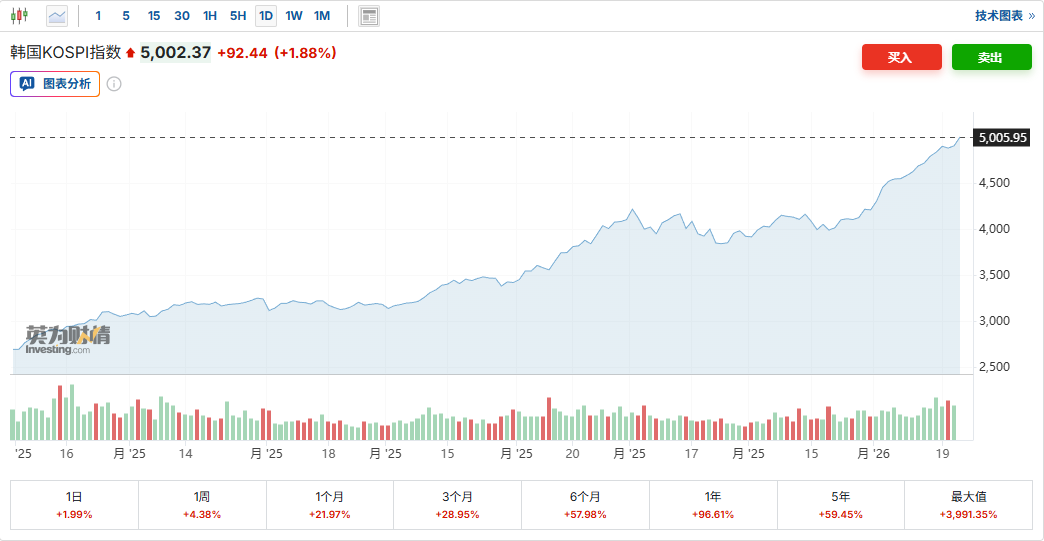
Core Viewpoint - The South Korean stock market, represented by the Kospi index, has surpassed the 5000-point mark, indicating a significant revaluation of the economy, previously seen as a cyclical export market, now recognized as a key beneficiary in the global AI industry chain [1][3]. Group 1: Market Performance - The Kospi index rose by 2.2% on a recent Thursday, exceeding the target set by President Yoon Suk-yeol, with a total increase of over 95% in the past 12 months, making it one of the best-performing major stock indices globally [1]. - Major stocks leading this surge include Samsung Electronics, SK Hynix, and Hyundai Motor, with the Korean won also showing slight appreciation against the US dollar [1]. Group 2: AI Infrastructure and Investment Cycle - The current market rally is driven by technology-weighted stocks, with a deeper shift in perception regarding South Korea's role in the AI infrastructure, transitioning from a traditional export economy to a critical player in AI computing and data centers [3][4]. - Morgan Stanley suggests that South Korea is entering a new "infrastructure reinvestment cycle" driven by AI, comparable in significance to the semiconductor capital expenditure wave of the past decade [3]. Group 3: AI Service Penetration - AI services have rapidly penetrated both enterprise and consumer sectors, with significant applications in high-value scenarios such as coding, video production, and logistics [4]. - The monthly active users of ChatGPT in South Korea have reached 18 million, indicating a shift from niche technology users to mainstream adoption [4]. Group 4: Data Center Projects - Multiple large-scale AI data center projects, termed "Neocloud," have been announced, indicating a shift towards heavy asset cycles in the data center sector [5]. - Notable projects include a 100MW AI data center by SK Telecom and AWS, and a 120MW AI data center by Samsung SDS, with significant investments involved [5]. Group 5: Government Policies - The South Korean government, under President Yoon, is promoting AI through policies focused on sovereignty, infrastructure, regulatory reform, and talent development, with the "AI Superhighway" initiative being a key component [6]. - The government aims to decentralize data centers to stimulate local economies and reduce centralized power consumption, aligning with the Kospi's recent performance [6]. Group 6: Energy Infrastructure Challenges - The expansion of AI data centers is encountering structural issues within South Korea's energy system, particularly in the Jeollanam-do region, which has renewable energy potential but faces transmission bottlenecks [7]. - The "Energy Highway" project aims to address these challenges by utilizing high-voltage direct current (HVDC) technology to enhance the efficiency of power transmission [7]. Group 7: Investment Opportunities - Following the Kospi's rise, the focus is shifting towards structural investment opportunities, particularly in AI infrastructure, with Samsung SDS identified as a key beneficiary in the AI data center investment theme [9]. - Companies involved in power equipment and transmission are also being reassessed for their potential, as the demand for high-capacity and quality power increases due to AI data centers [9].

西北首套特高频局放组网监测系统投用
Zhong Guo Dian Li Bao· 2025-09-02 07:21
Core Insights - The State Grid Xinjiang Electric Power Company has successfully built and operated the first high-frequency partial discharge online monitoring system in the Northwest region, marking a significant advancement in intelligent operation and maintenance of equipment in the Xinjiang power grid [1][2] - The system enables real-time monitoring of circuit breakers and GIS equipment, providing early warning and diagnosis of partial discharge, thereby greatly enhancing operational efficiency and ensuring the safe operation of the power grid [1] Group 1 - The newly established system has been in stable operation for 10 days after passing acceptance tests [1] - The GIS equipment acts as a "capsule" for the power grid, enclosing live components in a metal shell filled with sulfur hexafluoride gas, which helps prevent insulation breakdown and potential power outages [1] - Traditional maintenance methods were limited, requiring manual inspections that could take nearly a day for a single substation, making it difficult to capture sporadic discharge signals [1] Group 2 - Starting from July 2024, Xinjiang Electric Power will initiate the construction of a wired network for GIS, HGIS, and tank-type circuit breaker equipment, incorporating advanced features such as cumulative PRPD, PRPS diagram analysis, and AI diagnosis for partial discharge [2] - The new system will utilize an online platform for sound and light alarms, warning pop-ups, intelligent discharge type recognition, and three-dimensional twin model positioning, significantly reducing on-site testing time and errors [2]
中国西电(601179):公司点评:业绩符合预期,盈利能力持续提升
SINOLINK SECURITIES· 2025-08-21 01:25
Investment Rating - The report maintains a "Buy" rating for the company, expecting significant profit growth in the coming years [5]. Core Insights - The company reported a revenue of 11.33 billion RMB for the first half of 2025, representing an 8.9% year-on-year increase, with a net profit of 600 million RMB, up 30.1% year-on-year [2]. - The company is experiencing steady growth in domestic and international markets, with a notable 64% increase in overseas revenue for the first half of 2025 [3][4]. - The company is enhancing its profitability through effective cost control and increased R&D investment, achieving a gross margin of 21.6% in the first half of 2025, up 2.7 percentage points year-on-year [4]. Summary by Sections Financial Performance - In Q2 2025, the company achieved a revenue of 6.07 billion RMB, a 7.8% increase year-on-year, and a net profit of 300 million RMB, up 21.8% year-on-year [2]. - The gross margin for Q2 2025 was 22.1%, an increase of 2.3 percentage points compared to the previous year [2]. Market Position - The company has a market share of 7.4% in the domestic power transmission and transformation equipment sector, maintaining a leading position [3]. - The company has successfully secured significant contracts in both domestic and international markets, including major projects with state-owned enterprises and overseas clients [3]. Future Projections - The company is projected to achieve net profits of 1.48 billion RMB, 1.98 billion RMB, and 2.44 billion RMB for the years 2025, 2026, and 2027, respectively, with growth rates of 40%, 34%, and 23% [5]. - The expected price-to-earnings ratios for the years 2025, 2026, and 2027 are 23, 17, and 14 times, respectively [5].

21亿订单引涨停潮!5家上市公司深夜放猛料,引发市场高度关注
Sou Hu Cai Jing· 2025-07-30 21:54
Core Viewpoint - The recent surge in the A-share market for the power infrastructure sector is driven by significant order announcements from five leading companies, indicating a robust investment trend in the sector [1][3]. Group 1: Market Performance - On July 25, the power infrastructure sector's total market value increased by nearly 78 billion yuan, with trading volume rising by 215% compared to the previous trading day [1]. - Following the announcements of large orders, the stock prices of the involved companies saw a collective limit-up, contributing to a positive market sentiment [3][10]. Group 2: Investment Trends - The National Grid's 2025 ultra-high voltage construction plan is expected to significantly boost power infrastructure investments, with a projected total investment of 760 billion yuan for 2025, a 15.3% increase from 2024 [3]. - In the first half of 2025, nationwide investment in power grid projects reached 287.6 billion yuan, marking a 26.4% year-on-year growth [1]. Group 3: Company Announcements - The five companies, including Guodian NARI, XJ Electric, and Pinggao Electric, announced substantial contracts, with Guodian NARI securing a contract worth 2.13 billion yuan, representing 5.2% of its projected 2024 revenue [3]. - XJ Electric and Pinggao Electric also reported significant contracts worth 1.87 billion yuan and 1.56 billion yuan, respectively, contributing to the overall positive market reaction [3]. Group 4: Future Outlook - Analysts predict that the power infrastructure investment will exceed 1.3 trillion yuan in 2025, setting a historical record [7]. - The approval pace for power engineering projects has accelerated, with 165 projects approved in the first half of 2025, a 37.5% increase year-on-year [6]. Group 5: Industry Dynamics - The power equipment sector's revenue growth rate reached 23.8% in the first half of 2025, ranking third among all A-share industries, with an average price-to-earnings ratio of 25.6, indicating a valuation advantage [4]. - The ongoing energy transition and the increasing share of renewable energy generation are driving the demand for grid upgrades and investments [6][11].


雅下水电站专家交流
2025-07-22 14:36
Summary of the Mêdog Hydropower Station Conference Industry Overview - The Mêdog Hydropower Station project is a significant infrastructure initiative in the hydropower sector, with a total investment of approximately 2 trillion yuan, which is six times that of the Three Gorges Project, but with only three times its power generation capacity [1][5]. Key Points and Arguments Project Investment and Capacity - The core power generation capacity of the Mêdog Hydropower Station is designed to be 49 million kilowatts, utilizing a 2,200-meter drop at the bend of the Yarlung Tsangpo River [3][5]. - The total investment is projected to be around 1.2 trillion yuan, with approximately 200 billion yuan allocated to address high-altitude equipment premiums and 200 billion yuan for international dispute conflicts [3][13]. - The investment recovery period is estimated to be 17 years, with an operational lifespan of 60 to 80 years [5]. Construction Timeline and Phases - The project will be executed in phases, with preliminary surveys and foundational construction from 2025 to 2027, followed by major construction from 2028 to 2035 [1][6]. - Key milestones include the start of tunnel construction in 2026, with 40% of annual funding directed towards this, and the first unit's pre-installation tendering expected between late 2028 and early 2029 [1][9]. Equipment and Technology - The project will require various types of equipment, including small shield machines (7-8 meters) for transportation tunnels and larger shield machines (around 15 meters) for the main construction phase [10][14]. - The demand for shield machines is significant, with an estimated procurement of 21-24 units, primarily from China Railway Construction Corporation [10][24]. Environmental and Ecological Considerations - The project includes ecological compensation measures and fish protection initiatives, with a focus on sustainable development [6][9]. - The local power consumption is expected to absorb about 20%-25% of the generated electricity, with the remainder being transmitted to major economic zones such as the Guangdong-Hong Kong-Macao Greater Bay Area and the Yangtze River Delta [41]. Challenges and Solutions - High-altitude construction presents unique challenges, including the need for equipment that can withstand extreme conditions, which has delayed the project’s initiation until recent technological advancements were made [2][30]. - The project has a comprehensive procurement strategy to ensure that over 92% of the equipment is sourced domestically, minimizing political and economic risks associated with foreign procurement [31]. Additional Important Information - The project will also involve significant geological exploration, with major contracts awarded to China National Petroleum Corporation and Sinopec for core drilling, totaling a budget of approximately 4.5 billion yuan [17]. - The construction will include various auxiliary facilities, such as a 600 MW regulating station and small photovoltaic and pumped storage facilities, bringing the total capacity to 60 million kilowatts [4][3]. - The project is expected to create a substantial number of jobs and stimulate local economies during its construction and operational phases [5][41]. This summary encapsulates the critical aspects of the Mêdog Hydropower Station project, highlighting its scale, investment, construction phases, technological requirements, and environmental considerations.
【省工业和信息化厅】宝塔山换流站GIS设备开始安装
Shan Xi Ri Bao· 2025-07-20 23:56
Core Viewpoint - The installation of GIS equipment for the Shaanxi to Anhui ±800 kV UHVDC transmission project has commenced, marking a significant advancement in the project, which is a key initiative in China's 14th Five-Year Plan for power development [1] Group 1: Project Overview - The Shaanxi to Anhui ±800 kV UHVDC transmission project spans 1,065.4 kilometers across Shaanxi, Henan, and Anhui provinces, starting from the Baota Mountain converter station in Shaanxi and ending at the Hefei converter station in Anhui [1] - Upon completion, the project will integrate 11 million kW of renewable energy, including wind and solar power, and is expected to deliver over 36 billion kWh of electricity annually to Anhui [1] Group 2: Technical Aspects - GIS equipment, which is gas-insulated metal-enclosed switchgear, plays a crucial role in ensuring the safe control, power distribution, and equipment protection of high-voltage power systems through integrated design and gas insulation technology [1] - The project team from Xi'an Xidian Switchgear Co., Ltd. has implemented a series of training programs for its members, focusing on practical skills such as site cleaning, connection points, and installation procedures [1] Group 3: Project Management - The project has been designated as a key initiative for the company, with a dedicated installation team deployed to the site to ensure effective project management and execution [1] - The technical team has provided detailed explanations of the installation plan and key points to the project owner, receiving positive feedback for their proactive approach to dust control and project progress management [1]