
Gemini 3 pro

Search documents
千问 3.5 发布,四成参数超越万亿模型,大模型的竞赛逻辑变了
Sou Hu Cai Jing· 2026-02-16 16:07
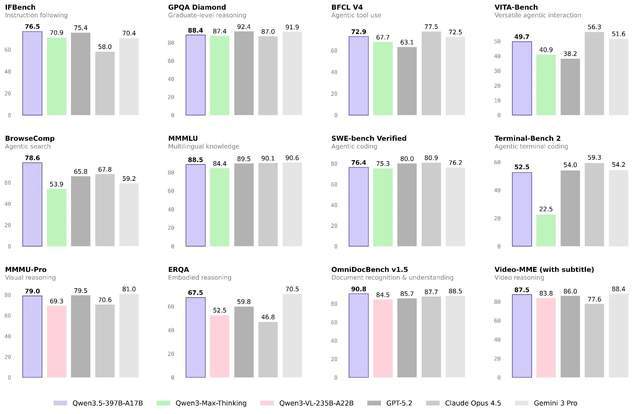
Core Insights - The main theme in the large model industry over the past two years has been "scaling up," but this has led to increased deployment costs, making it harder for companies to afford these models. The performance curve and adoption curve are diverging [1] - Alibaba's release of the Qwen 3.5-Plus model, with 397 billion total parameters and only 17 billion activated, demonstrates a shift in focus from merely increasing parameters to enhancing model efficiency and cost-effectiveness [1][3] Model Performance and Efficiency - Qwen 3.5-Plus surpasses the previous generation Qwen 3-Max and competes favorably with models like GPT-5.2 and Gemini 3 pro in various benchmarks, achieving scores such as 87.8 in MMLU-Pro and 88.4 in GPQA [1][3] - The model's API pricing is significantly lower, at 0.8 yuan per million tokens, which is 1/18 of Gemini 3 pro's price, indicating a new cost structure in the industry [1][8] Architectural Innovation - The industry is experiencing a shift from parameter accumulation to architectural innovation, similar to the transition in the chip industry from single-core to multi-core architectures [3] - Qwen 3.5 achieves efficiency by using only 17 billion parameters for inference, resulting in an 8.6 times increase in throughput for 32K context scenarios and up to 19 times for 256K context scenarios, while reducing deployment memory usage by 60% [3][4] Multi-Modal Capabilities - Qwen 3.5 represents a generational leap to a native multi-modal model, integrating text and visual data from the start, which enhances its capabilities compared to models that assemble components separately [4][7] - The model supports direct input of 2-hour videos and can convert hand-drawn sketches into executable front-end code, showcasing its advanced multi-modal functionalities [7] Strategic Implications - Alibaba's commitment to native multi-modal capabilities positions Qwen as a foundational model for enterprise applications, which inherently require multi-modal functionalities [8] - The collaboration between model architecture, chip optimization, and cloud infrastructure results in a sustainable cost structure, challenging closed-source competitors who rely on performance exclusivity [8][9] Market Position and Growth - Qwen is ranked first in the Chinese enterprise-level large model market, with Alibaba Cloud's market share reaching 35.8% in the AI cloud market, surpassing the combined share of the second to fourth competitors [11][12] - The open-source model ecosystem is rapidly expanding, with over 400 models released and more than 200,000 derivative models created, indicating strong developer engagement and market traction [12] Future Considerations - The competition in the large model industry is transitioning from a parameter race to an architecture race, where efficiency and cost become the core competitive dimensions [12][13] - Questions remain about the sustainability of closed-source models in light of open-source alternatives that match performance and cost, as well as the viability of current assembly methods in multi-modal training [13]


我把这一年的AI聊天记录,让AI做人生总结后,我破防了。
数字生命卡兹克· 2025-12-26 01:21
Core Viewpoint - The article reflects on the author's year-long interactions with various AI tools, emphasizing the importance of analyzing these conversations to understand personal growth and professional identity. Group 1: AI Tools and Data Management - The author utilized multiple AI tools including ChatGPT, Gemini, DeepSeek, and others for various tasks throughout the year [2][12]. - A significant challenge arose when exporting chat records from ChatGPT, resulting in a massive file of over 200MB containing 9.59 million words, making it difficult to analyze [8][11]. - Other AI tools lacked the functionality to export chat records, with DeepSeek being the only exception, but it was not used extensively [11][12]. Group 2: Data Collection and Analysis - The author discovered a tool called Chat Memo, which allows for the backup and export of chat records from various AI tools, ensuring privacy and ease of access [15][16]. - The process of collecting relevant chat records was labor-intensive, requiring manual selection to filter out irrelevant data, ultimately resulting in 857 meaningful conversations [22][24]. - The final dataset was exported in a text format for further analysis, highlighting the importance of careful data curation [26]. Group 3: Personal Reflection and Insights - The analysis of chat records revealed a persona characterized by high standards and sincerity, focusing on practical outcomes rather than abstract theories [29][31]. - The author expressed a deep commitment to their work, often taking on excessive responsibility and feeling the weight of leadership [34][35]. - Acknowledging the challenges faced throughout the year, the author recognized a shift from individual content creation to organizational management, emphasizing the need for structure and clarity in team dynamics [51][53]. Group 4: Future Aspirations and Conclusion - The reflections culminate in a desire to balance personal integrity with professional success, aiming to create a meaningful impact in the industry [60][61]. - The author encourages resilience and faith in the face of challenges, suggesting that the struggles of the past year will contribute to future growth and understanding [63].

AI洗牌,机会均等
Bei Jing Shang Bao· 2025-11-27 16:13
Core Insights - The AI industry is experiencing rapid changes, with major players like Google and Alibaba making significant advancements in AI models and chips, indicating a competitive landscape that is constantly evolving [1][2] - The emergence of new players like DeepSeek demonstrates that established companies are not guaranteed dominance, as the speed of technological iteration can disrupt traditional market leaders [1][2] - The shift from closed development to open collaboration in AI research is fostering a more equitable competitive environment, allowing for faster innovation and shared technological advancements [2][3] Group 1 - Major companies are launching new AI models and chips, with Google nearing a market valuation of $4 trillion and Alibaba aggressively entering the AI to C market [1] - The rapid pace of AI development is creating opportunities for new entrants, as seen with DeepSeek's rise, which challenges established players like Nvidia and ChatGPT [1][2] - The diverse needs across industries, such as banking and healthcare, highlight the importance of specialized solutions over general models, allowing smaller teams to excel in niche markets [2] Group 2 - The competitive landscape is shifting towards a focus on technological advantages and execution efficiency, rather than traditional strengths like user base and funding [3] - The AI sector is characterized by a lack of permanent leaders, with new companies emerging as potential frontrunners based on their ability to adapt and innovate [3] - Investors are becoming more discerning, emphasizing the need for practical applications and scenario breakthroughs, which is leading to a more rational valuation system in the AI market [2]


谷歌阿里百度加码AI竞争,技术迭代加速行业洗牌
Bei Jing Shang Bao· 2025-11-27 14:34
Core Viewpoint - The AI industry is experiencing rapid changes, with no permanent leaders, as new players emerge and established companies face challenges from innovative technologies and competitors [1][3]. Group 1: Industry Dynamics - The AI landscape is characterized by intense competition, with major players like Google and Alibaba launching new models and technologies to capture market share [1][2]. - The emergence of new AI models, such as DeepSeek, demonstrates that established companies can be disrupted by innovative newcomers, highlighting the unpredictable nature of AI advancements [1][2]. - The decreasing cost of computing power and the availability of open-source code have leveled the playing field, allowing global participants to compete more equally [2]. Group 2: Technological Evolution - The rapid pace of technological iteration in AI means that traditional advantages, such as user base and financial strength, are becoming less reliable [3]. - Companies are shifting from closed development to open collaboration, which fosters a shared technological foundation and accelerates innovation across the industry [2]. - The diverse needs of various sectors, such as banking and healthcare, create opportunities for specialized teams to excel in niche markets, despite the heavy investments made by larger firms in general models [2]. Group 3: Investment Landscape - Investors are becoming more discerning, focusing on practical applications and scenario breakthroughs rather than just concepts, which encourages a more rational valuation system [2]. - The evolving investor attitude supports fair competition, allowing promising projects to receive necessary backing despite the competitive landscape [2].

【西街观察】AI洗牌,机会均等
Bei Jing Shang Bao· 2025-11-27 14:25
Core Insights - The AI industry is experiencing rapid changes, with major players like Google and Alibaba launching new models and technologies to compete in the market [1][2] - The emergence of new competitors, such as DeepSeek, demonstrates that established companies are not guaranteed dominance in the AI space [1][3] - The fast-paced technological advancements in AI are reshaping user expectations and competitive dynamics, making traditional advantages less relevant [3] Group 1: Market Dynamics - Google is pushing its market value close to $4 trillion with the introduction of its Gemini 3 pro model and self-developed TPU chips [1] - Alibaba is aggressively entering the AI to C market with multiple initiatives, while Baidu is establishing new model development departments [1] - The AI landscape is characterized by rapid iterations and unexpected shifts, as seen with the rise of DeepSeek and the challenges faced by established players like Nvidia [2] Group 2: Competitive Landscape - The AI sector allows for a level playing field, with decreasing computing costs and abundant open-source resources enabling new entrants [2] - Companies are facing diverse demands across industries, leading to a situation where specialized teams can outperform larger firms in niche areas [2] - The shift from closed development to open collaboration is changing the competitive landscape, allowing for faster innovation and shared technological advancements [2] Group 3: Future Outlook - The rapid pace of technological change means that traditional advantages such as user base and financial strength are becoming less secure [3] - Future competition will hinge on technological prowess and execution efficiency, with teams that can effectively integrate resources and optimize products having a better chance of success [3] - The AI industry is marked by a lack of permanent leaders, with new entrants continuously emerging to challenge established players [3]

【西街观察】AI洗牌 机会均等
Bei Jing Shang Bao· 2025-11-27 14:21
Core Insights - The AI industry is experiencing rapid changes, with major players like Google and Alibaba making significant advancements in AI models and chips, indicating a competitive landscape that is constantly evolving [1][2] - The emergence of new players like DeepSeek demonstrates that established companies are not guaranteed dominance, as the speed of technological iteration can disrupt traditional market leaders [1][3] Group 1: Industry Dynamics - The AI sector is characterized by a unique trait of rapid technological advancement, allowing for opportunities for disruption at every stage from theory to implementation [2] - The decreasing cost of computing power and the availability of open-source code have leveled the playing field for global participants in the AI industry [2] - Competition can sometimes be misaligned, as seen with Nvidia's market fluctuations due to challenges from new algorithms like those from DeepSeek, which undermine Nvidia's hardware advantages [2] Group 2: Market Trends - The diverse needs across industries, such as banking, healthcare, and manufacturing, create a demand for specialized AI solutions, allowing smaller, knowledgeable teams to thrive despite the investments of larger companies in general models [2] - The shift from closed development to open collaboration in AI research is changing the competitive landscape, enabling faster innovation and shared technological advancements [2] - Investors are becoming more discerning, focusing on practical applications and scenario breakthroughs rather than just concepts, which is leading to a more rational valuation system in the AI market [2] Group 3: Future Outlook - The rapid pace of technological change is outpacing traditional advantages like user base and financial strength, suggesting that the leading companies in AI will frequently change [3] - Future competition will hinge on technological superiority and execution efficiency, with teams that can effectively integrate resources and optimize products having a better chance of success [3] - The AI landscape is dynamic, with no permanent leaders, only emerging new players [3]