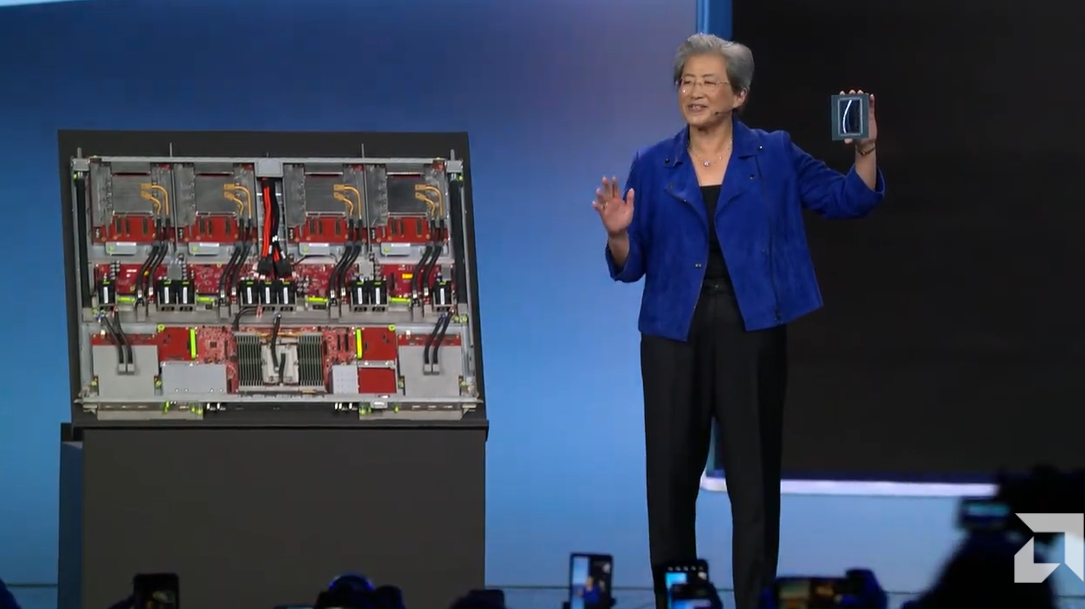
Helios服务器

Search documents
苏姿丰和她的“去英伟达”战争
创业邦· 2026-03-18 03:40
Core Viewpoint - AMD has experienced significant growth under CEO Lisa Su, with its market value increasing from less than $3 billion in 2014 to over $315 billion today, marking a growth of more than 100 times [5] - The competition in the AI chip market has evolved into a multi-dimensional battle involving performance, cost optimization, and sustainable energy reliance, with key players like TSMC and Samsung playing crucial roles in supply chain dynamics [5] Group 1: AMD's Strategic Moves - AMD's shift towards AI began in 2018 with the launch of the Instinct series data center GPUs, marking its entry into AI workloads [9] - Lisa Su has emphasized the accelerating demand for AI, predicting a ten-year AI supercycle, and highlighted the importance of inference capabilities with the introduction of the MI300X series [9][11] - The MI350 series, announced in mid-2025, boasts a 35 times performance improvement over its predecessor, indicating AMD's commitment to advancing AI technology [11] Group 2: Partnerships and Collaborations - AMD has signed a 6-gigawatt GPU supply agreement with OpenAI, which includes warrants for AMD stock, indicating a strategic partnership that aligns both companies' interests [19] - A similar agreement was established with Meta, further solidifying AMD's position in the AI infrastructure market [19] - These partnerships are seen as transformative for AMD, accelerating procurement and ecosystem development [20] Group 3: Supply Chain and Production Capacity - AMD has secured 8% of TSMC's advanced packaging capacity, which is critical for its production of AI chips [27] - The company anticipates producing 900,000 MI400 chips in 2026, necessitating a stable supply of HBM memory, which is currently a challenge due to competition with Nvidia [27][28] - Lisa Su's upcoming visit to South Korea aims to secure memory supply agreements with key partners like Samsung, highlighting the importance of supply chain management in AMD's strategy [28][29] Group 4: Financial Performance and Future Outlook - AMD reported record revenue, net profit, and free cash flow in 2025, with data center revenue growing 39% year-over-year to $5.4 billion [30] - The company aims for a compound annual growth rate of over 35% in the next three to five years, driven by the expansion of its data center AI business [30] - AMD's strategy focuses on deepening ties with major clients, investing in future technologies, and building a robust supply chain ecosystem to reduce reliance on Nvidia [30]



苏姿丰和她的“去英伟达”战争
3 6 Ke· 2026-03-17 00:38
Core Insights - AMD's market capitalization has increased from under $3 billion in 2014 to over $315 billion, marking a growth of more than 100 times [1] - The surge in AMD's valuation began in 2018, coinciding with the publication of a pivotal AI research paper that introduced the Transformer architecture, which significantly boosted the demand for GPUs [1] - The competition in the AI chip market has evolved into a multi-dimensional battle involving performance, cost optimization, and sustainable energy reliance, with key players like TSMC and Samsung playing crucial roles in supply chain capacity [1] Group 1: AMD's Strategic Moves - AMD has shifted its focus towards the cloud computing sector, launching the Instinct series of data center GPUs designed for AI workloads, positioning itself as a challenger in the AI space [2] - Lisa Su, AMD's CEO, acknowledged the accelerating demand for AI and indicated that the company is just beginning a decade-long AI supercycle [2][3] - AMD's MI350 series, announced in mid-2025, boasts a 35 times performance improvement over its predecessor, highlighting the company's advancements in AI inference capabilities [3][5] Group 2: Market Predictions and Collaborations - Su revised her market expectations, predicting that the global AI processor market revenue will exceed $500 billion by 2028, potentially being reached earlier [5][6] - AMD's MI400 series, set to debut in 2026, is expected to significantly outperform NVIDIA's offerings, showcasing AMD's ambition to lead in AI performance [6][8] - AMD has entered into a strategic partnership with OpenAI, signing a 6-gigawatt GPU supply agreement, which includes a unique stock warrant structure to incentivize performance milestones [13][14][19] Group 3: Supply Chain and Production Capacity - AMD has secured approximately 8% of TSMC's advanced CoWoS packaging capacity, which is critical for its production of MI400 chips [25] - The company anticipates producing around 900,000 MI400 chips in 2026, necessitating a stable supply of HBM memory to fulfill its commitments to OpenAI and Meta [25][26] - Lisa Su's upcoming visit to South Korea aims to strengthen relationships with key suppliers like Samsung to ensure adequate supply of high-bandwidth memory [27][30] Group 4: Financial Performance and Future Outlook - AMD reported record revenues, net profits, and free cash flow in 2025, with a 39% year-over-year growth in its data center segment [34] - The company aims for a compound annual growth rate of over 35% in the next three to five years, driven by the rapid expansion of its data center AI business [34][35] - AMD's strategy focuses on deepening ties with major clients, investing in future technologies, and building a robust supply chain ecosystem to facilitate its growth in the data center market [34][35]
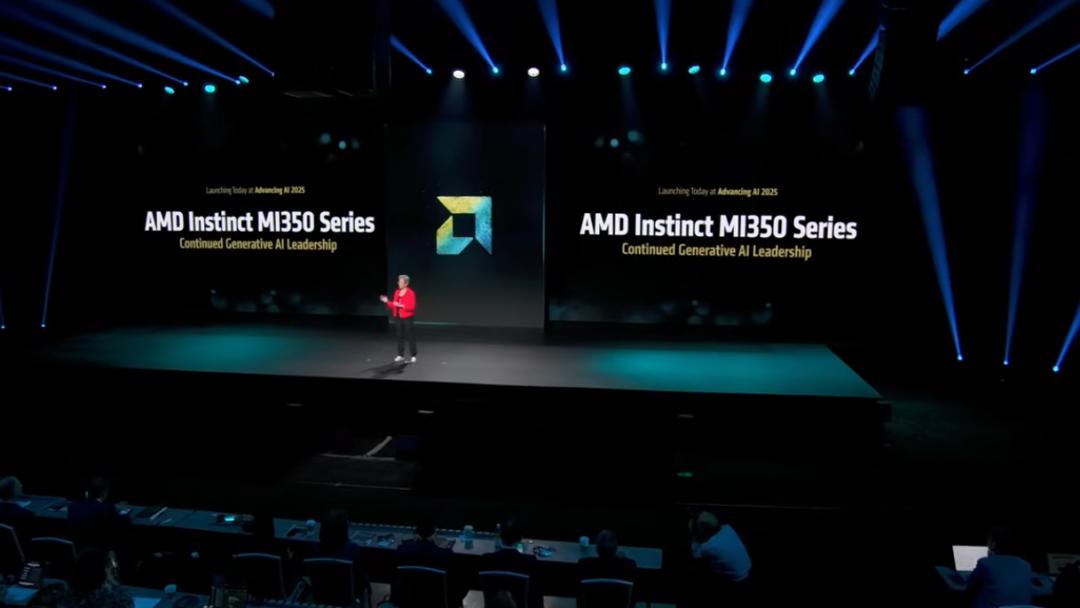
CES 2026开幕前夕 芯片巨头密集上新品、提出千倍AI性能提升目标
Zheng Quan Shi Bao Wang· 2026-01-06 14:36
Group 1: Nvidia's Innovations - Nvidia launched the Rubin platform, consisting of six new chips, focusing on physical AI and large-scale AI factory construction, targeting autonomous driving and robotics [1][2] - The Rubin platform offers 50 Petaflops of NVFP4 inference performance, with a 5x increase in inference performance and a 3.5x increase in training performance compared to the previous Blackwell platform [2] - The cost of generating tokens on the Rubin platform is reduced to about one-tenth of the previous generation, enhancing efficiency [2] Group 2: AMD's AI Performance Goals - AMD's CEO, Dr. Lisa Su, announced the new MI455X GPU, which offers a 10x performance improvement over the MI355X, with a target of 1000x AI performance increase over four years [4] - AMD predicts global computing infrastructure demand will grow from 1 ZettaFLOPS in 2022 to over 100 ZettaFLOPS by 2025, with future capabilities reaching YottaFLOPS levels [4] - The Ryzen AI 400 series processors were introduced, featuring up to 60 TOPS of NPU performance, emphasizing AI as a default capability in PCs [4] Group 3: Intel's New Offerings - Intel introduced the Core Ultra 3 series processors, the first consumer-grade products based on Intel's 18A process, featuring up to 16 CPU cores and 50 TOPS of NPU performance [5] - The flagship model of the Core Ultra 3 series offers a 60% improvement in multi-threaded performance [5] - Initial consumer laptops with the Core Ultra 3 processors will be available for pre-order starting January 6, 2026, with shipments expected in the second quarter of 2026 [5]
苏姿丰CES演讲全文来了!尧字节时代来临,Helios登场,“未来四年,要实现AI性能1000倍的提升”!
Hua Er Jie Jian Wen· 2026-01-06 09:47
Core Insights - AMD's CEO, Dr. Lisa Su, highlighted the explosive growth in AI usage, with active users increasing from 1 million to 1 billion since the launch of ChatGPT, and projected to reach 5 billion by 2030 [1][24] - AMD introduced the MI455X GPU, which offers a tenfold performance improvement over its predecessor, the MI355X, and unveiled the Helios server platform designed for large-scale AI computing [1][5][34] - The company aims to enhance global AI computing capacity from 1 zettaflop per second in 2022 to 10 yottaflops per second within five years, a 10,000-fold increase [3][25] AI Demand and Market Trends - The demand for AI computing is expected to surge, necessitating a significant increase in global computing infrastructure to support the projected growth in AI users [24][25] - AI is anticipated to become an integral part of daily life, similar to the internet and smartphones, with a focus on making AI accessible to everyone [24][23] Technological Innovations - AMD's Helios platform features a modular design with liquid cooling, housing 72 MI455X GPUs and 18 Venice CPUs, achieving 2.9 exaflops of AI performance [5][9][34] - The MI500 series, set to launch in 2027, is expected to utilize 2nm technology and achieve a 30-fold performance increase over the MI455X [1][7] Product Launches - The Ryzen AI 400 series processors were introduced, featuring up to 60 TOPS of NPU performance and designed for various computing devices [6][12] - The Ryzen AI Max platform was also launched, aimed at high-performance developers and creators, integrating advanced AI capabilities [12][15] Strategic Vision - AMD's strategy emphasizes a "full-stack open" approach, integrating CPUs, GPUs, NPUs, and custom accelerators to optimize computing power for diverse workloads [4][26] - The company is committed to building an open ecosystem to accelerate innovation in AI, leveraging partnerships and industry standards [47]