Helios AI机架

Search documents
AMD抢购HBM
半导体芯闻· 2026-03-18 10:15
Core Viewpoint - AMD has signed a memorandum of understanding (MOU) with Samsung Electronics to enhance collaboration in next-generation AI memory and computing technologies, specifically focusing on high-bandwidth memory (HBM4) for its Instinct MI series GPUs [1][2]. Group 1: Partnership and Collaboration - AMD has designated Samsung Electronics as the preferred supplier for HBM4 memory, which will be integrated into the Instinct MI455X GPU accelerator, set to be supplied to cloud service providers and large-scale data centers starting in Q3 [1]. - The partnership aims to leverage Samsung's advanced memory technologies to enhance AMD's competitiveness in the AI sector, with a focus on performance, reliability, and energy efficiency [1][2]. - Both companies have agreed to discuss future collaboration in the foundry sector, indicating potential expansion of their partnership beyond memory supply [2]. Group 2: AI Infrastructure Development - AMD plans to deploy the Helios AI architecture in the second half of this year, utilizing the sixth-generation EPYC processors and customized GPUs based on the Instinct MI450, along with Samsung's high-performance DDR5 memory and HBM4 [2]. - Samsung's DS division head emphasized the shared goals of both companies in advancing AI computing, highlighting the importance of this agreement in broadening their collaborative efforts [2]. - AMD's CEO noted the critical nature of industry collaboration for implementing next-generation AI infrastructure, expressing enthusiasm for integrating Samsung's memory technology with AMD's processing platforms [2]. Group 3: Broader Industry Engagement - Prior to the meeting with Samsung, AMD's CEO discussed plans to strengthen AI infrastructure with Naver, which has decided to utilize AMD's EPYC processors and Instinct MI series GPUs for infrastructure diversification [3].


AI产业跟踪:海外:HPE携手博通推出AMD"Helios"AI机架,搭载业界首创纵向扩展以太网
GUOTAI HAITONG SECURITIES· 2025-12-10 08:58
Investment Rating - The report does not explicitly state an investment rating for the AI industry Core Insights - The AI industry is witnessing significant developments, including acquisitions and new product launches, indicating a robust growth trajectory - Major companies like OpenAI, Meta, and Marvell are actively expanding their capabilities through strategic acquisitions and innovative product offerings - The introduction of advanced AI models and technologies is expected to enhance operational efficiencies and create new market opportunities Industry Dynamics - OpenAI announced its fourth acquisition in 2025, acquiring Neptune, a startup providing AI model training tracking tools [4] - Meta is forming a design team led by former Apple VP Alan Dye to develop next-generation AI glasses and wearable devices [5] - Marvell's acquisition of Celestial AI focuses on photonic interconnect technology, crucial for addressing AI computing power bottlenecks [6] AI Application Insights - Apple is leveraging AI to extract deeper cardiovascular health insights from Apple Watch optical sensors, introducing a "hypertension alert" feature based on long-term data trends [8] - Google launched Workspace Studio, allowing users to create AI agents using natural language, enhancing automation and collaboration [9] Large Model Insights - Amazon Web Services (AWS) introduced the Nova 2 series of AI models and a new service for customizing model versions for enterprise clients [11] - NVIDIA released the Alpamayo-R1, a visual language action model focused on autonomous driving, marking a significant advancement in the field [12] - Mistral AI launched the Mistral 3 series models, including a large model with 675 billion parameters, which is open-sourced under Apache 2.0 [13] Technology Frontiers - AWS unveiled the Trainium3 AI training chip, achieving over four times the speed improvement in training and inference compared to its predecessor [15] - Blue Origin introduced an AI device capable of converting lunar dust into energy, showcasing innovative applications of AI technology [16] - HPE and Broadcom launched the "Helios" AI rack solution, featuring vertical scaling Ethernet networks and significant computational capabilities [14]
AMD:推理之王
美股研究社· 2025-07-25 12:13
Core Viewpoint - AMD's stock performance has lagged behind major indices like the S&P 500 and Nasdaq 100 due to previous overvaluation, but the upcoming MI400 series GPU, set to launch in 2026, is expected to significantly change the landscape by capturing the growing demand for inference and narrowing the technological gap with Nvidia [1][3]. Group 1: Market Position and Growth Potential - AMD's market capitalization is approximately $255 billion, significantly lower than Nvidia's $4.1 trillion, indicating a potential undervaluation given the narrowing technological gap [1]. - The global AI infrastructure investment could reach $7 trillion by 2030, with inference being a critical need, positioning AMD favorably in this market [3]. - AMD anticipates a total addressable market (TAM) of $500 billion by 2028, with inference expected to capture a larger share [4][15]. Group 2: Product Advancements - The MI355X GPU, released in June 2025, is seen as a game-changer in the GPU market, with significant advantages in memory capacity and bandwidth, crucial for AI inference [8][10]. - The MI400 GPU will feature a memory capacity increase from 288GB to 432GB and bandwidth enhancement from 8TB/s to 19.6TB/s, showcasing substantial technological advancements [12]. - AMD's Helios AI rack system integrates its own CPU, GPU, and software, enhancing deployment efficiency and directly competing with Nvidia's systems [13]. Group 3: Financial Performance - In Q1 2025, AMD's data center revenue grew by 57% year-over-year, while client and gaming revenue increased by 28%, indicating strong market demand [26][27]. - AMD's expected price-to-earnings ratio is around 78, higher than most peers, including Nvidia at 42, reflecting investor confidence in future growth [29]. - The company has approved a $6 billion stock buyback, totaling $10 billion, demonstrating confidence in its growth trajectory and commitment to shareholder value [25]. Group 4: Competitive Landscape - AMD has been gradually increasing its CPU market share, projected to reach approximately 39.2% by 2029, as it continues to outperform Intel in various performance metrics [19][24]. - Major clients like Google Cloud are increasingly adopting AMD's EPYC CPUs, further solidifying its position in the cloud computing market [23]. - The competitive edge in inference capabilities could lead to increased demand for AMD's GPUs, especially as companies like Meta explore AI advancements [25].

AMD甩出最猛两代AI芯片,全球首推432GB HBM4,OpenAI CEO现场夸
3 6 Ke· 2025-06-13 02:04
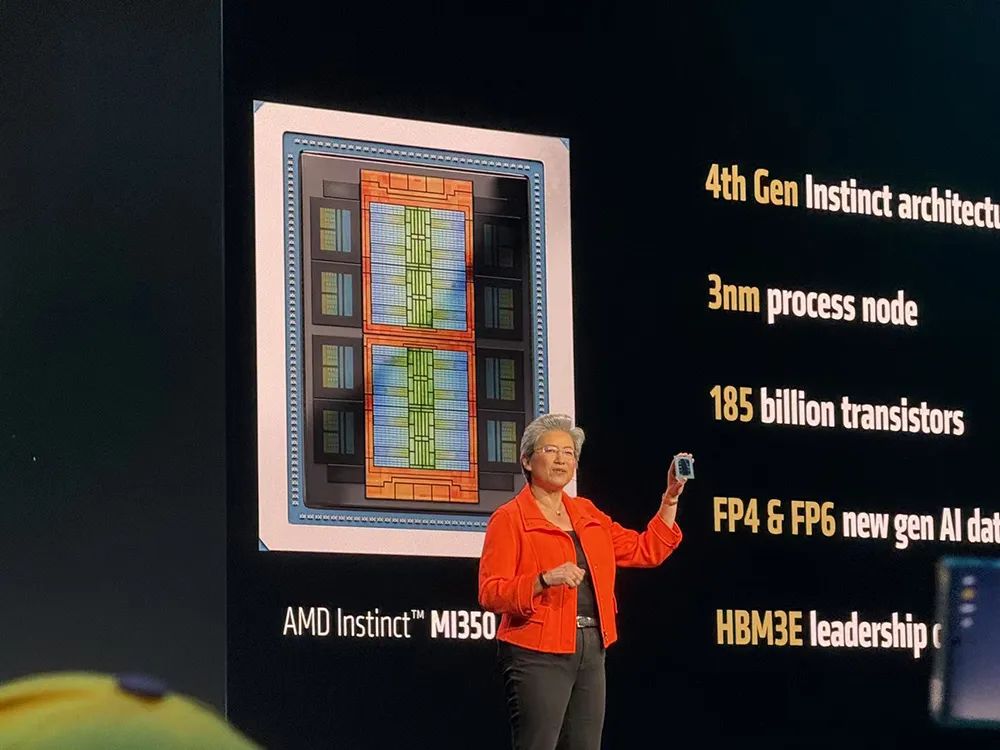
Core Insights - AMD showcased its strongest AI product lineup at the AMD Advancing AI conference, aiming to compete with NVIDIA in the AI chip market [1][2] - Key products include the AMD Instinct MI350 series and MI400 series AI chips, which feature significant performance improvements over previous generations [5][12] Product Highlights - The AMD Instinct MI350 series features a 3nm process, 185 billion transistors, 288GB HBM3e memory, and peak performance of 20 PFLOPS, which is four times that of the previous MI300X [5][12] - The upcoming MI400 series, set to launch next year, will double the peak performance to 40 PFLOPS and support 432GB HBM4 memory with a bandwidth of 19.6 TB/s [12][9] - The new AI software stack ROCm 7.0 will enhance inference performance by over four times and training performance by three times, supporting major models like GPT and Llama [12][75] Infrastructure Developments - The "Helios" AI rack infrastructure, launching next year, will support up to 72 MI400 GPUs and provide a peak performance of 2.9 EFLOPS [14][19] - AMD's AI infrastructure aims to improve AI computing density and scalability, with significant enhancements in memory capacity and bandwidth compared to NVIDIA's offerings [19][21] Strategic Vision - AMD's three strategic pillars for AI include leading computing engines, an open ecosystem, and full-stack solutions, emphasizing the importance of open-source collaboration in AI development [23][121] - The company aims to increase rack-level energy efficiency by 20 times by 2030, significantly reducing operational electricity costs and carbon emissions [118][120] Market Position - AMD is the second-largest AI chip supplier globally, with seven of the top ten AI companies deploying AMD Instinct GPUs [30][34] - The AI data center accelerator market is projected to grow over 60% annually, reaching $500 billion by 2028, with inference expected to be a major growth driver [30][121]