MI400系列GPU

Search documents
卖掉330万颗GPU,AMD急了?
半导体行业观察· 2026-02-25 01:14AI Processing
公众号记得加星标⭐️,第一时间看推送不会错过。 你可能感觉似曾相识,但事实并非如此。AMD刚刚宣布与Meta Platforms达成的协议,与它去年10 月与模型构建公司OpenAI签署的协议极其相似,从6吉瓦的数据中心总容量(涵盖计算、存储和网 络)到为了促成交易而提供的1.6亿股AMD认股权证,都如出一辙。 再达成八笔类似的交易,五年内十家公司将持有AMD 100%的股份。(不,这不会发生,没错,我 只是开个玩笑。不过,我们希望它真的发生了……)说真的,OpenAI和Meta Platforms可以在认股 权证转换后出售其持有的股份(前提是技术安装量达到一定里程碑,并且AMD股价因这些安装的成 功而上涨)——这样,OpenAI和Meta Platforms就有更多资金投入GPU了! 我们生活在一个疯狂的新世界里,不是吗? 总之,Meta Platforms 和 OpenAI 交易的一个显著区别在于,我们相当肯定前者(同样渴望成为世 界顶尖的 AI 模型构建商之一)确实有足够的资金来履行其硬件采购承诺。而 OpenAI 年收入只有数 百亿美元,人们仍在猜测它如何筹集到数千亿美元的现金。我们认为它会想方设法, ...



AMD发布2025年Q4财报,数据中心业务创新高但股价波动显著
Jing Ji Guan Cha Wang· 2026-02-11 20:54
Core Viewpoint - AMD reported strong Q4 2025 earnings with revenue of $10.27 billion, a 34% year-over-year increase, and adjusted EPS of $1.53, exceeding market expectations [1] Financial Performance - Data center revenue reached a record high of $5.38 billion, growing 39% year-over-year [1] - Q1 2026 revenue guidance is set at $9.8 billion, indicating a 5% quarter-over-quarter decline, with a projected gross margin of approximately 55% [1] Recent Stock Performance - AMD's stock experienced significant volatility, rising 8.28% to $208.44 on February 6, 2026, with a trading volume exceeding $11.2 billion [2] - The stock continued to rise by 3.63% to $216.00 on February 9, 2026, but faced slight pullbacks of 1.13% and 0.24% on February 10 and 11, respectively, closing at $213.05 [2] - The stock's price fluctuation reached 12.06%, reflecting market divergence regarding earnings and AI business prospects [2] Recent Events - On February 9, 2026, the tech sector saw a broad rally, with AMD's stock rising 3.63%, driven by Google's plan to issue $20 billion in bonds to boost AI spending [3] - Concerns arose regarding AMD's partnership with OpenAI, particularly about OpenAI's financial health potentially impacting AMD's long-term order stability [3] Institutional Perspectives - Guojin Securities reported on February 4, 2026, that AMD's data center business remains robust, with expectations for AI GPU deployment in the second half of 2026 to drive growth, maintaining a "buy" rating [4] - Huachuang Securities noted on the same date that the MI400 series is progressing well, but cautioned about potential risks related to AI chip production capacity and market competition [4]
AMD财报解读:下跌就是机会
美股研究社· 2026-02-06 10:55
Core Viewpoint - AMD reported strong performance for the fiscal year 2025, with optimistic revenue growth and significant improvement in profit margins. The company plans to launch the MI400 series GPU in the second half of 2026 and the MI500 series GPU in fiscal year 2027, positioning itself for new growth opportunities as AI developers and enterprises expand their AI inference capabilities. Following the release of the Q4 2025 financial report and a significant stock price correction, analysts upgraded AMD's rating to Strong Buy [1]. AMD Business Operations - In Q4 2025, AMD achieved impressive sales performance driven by the MI350 series GPU and EPYC CPU, with net revenue increasing by 37.58% year-over-year. The deployment of EPYC instances saw a notable increase, with cloud service providers (CSPs) growing by over 50% and enterprise deployments more than doubling [4]. - Key highlights for Q4 2025 include the next-generation Instinct series AI acceleration GPUs: MI455X and Helios for AI supercomputing clusters, MI430X for high-performance computing (HPC) and sovereign AI deployments, and MI440X targeting enterprise customers for both AI training and inference [5]. AMD Financial Performance - AMD's operational efficiency improved significantly in Q4 2025, with profit margins across data center, client, and computing segments rising, while only the embedded business saw a decline of 164 basis points. For Q1 2026, analysts expect net revenue to reach $9.9 billion, with adjusted EPS projected at $1.36. The MI350 series product ramp-up is anticipated to further enhance gross margins, although the introduction of the MI400 series in late 2026 may temporarily pressure margins [10][11]. AMD Financial Position - AMD's balance sheet remains robust, with cash and cash equivalents at $10.55 billion and long-term debt at $3.22 billion, resulting in a net cash position of $7.33 billion. This financial flexibility supports potential mergers and acquisitions as well as internal growth initiatives. Inventory levels increased slightly in Q3 and Q4 2025 due to MI350 series production ramp-up and the reversal of inventory write-downs for the MI308 series [11][12]. Market Outlook - The optimistic scenario suggests that as more AI developers focus on optimizing inference performance, AMD could capture a larger share of the data center GPU market. The urgent demand for high-speed computing in enterprise services, coupled with OpenAI's push for supplier diversification, may provide AMD with additional growth opportunities [13]. - Conversely, the increasing importance of customized chips for AI inference, exemplified by Google's TPU chips and its collaboration with Anthropic, indicates that competitive barriers in the industry are rising [14]. Valuation and Shareholder Value - AMD's current stock price corresponds to a price-to-sales ratio of 9.56x, which is relatively high compared to its one-year trading range. Despite short-term premium valuations, analysts believe that AMD has upward potential as it capitalizes on the growth in data centers, particularly with the rising demand for AI inference [16][18]. - Following the Q4 2025 financial report, AMD's stock experienced a significant drop of 17%. Analysts attribute this decline more to external factors rather than a deterioration in the company's operational fundamentals [16].

高盛CES总结会:AI基建的增量需求来自“具身智能”和“代理”
Hua Er Jie Jian Wen· 2026-01-08 11:27
Core Insights - The market is experiencing a deep evolution in AI infrastructure rather than a simple cyclical peak, with strong demand continuing but structural changes in drivers [1] - The focus for investors should shift from merely stacking computing power to hardware that supports longer context and more complex reasoning capabilities [1] Group 1: Nvidia - Nvidia's Rubin platform is set to ramp up production significantly in the second half of 2026, with assembly time reduced from 2 hours to approximately 5 minutes, breaking supply bottlenecks [2] - The new platform allows each GPU to access up to 16TB of context memory, a substantial increase from the previous 1TB, which is expected to greatly benefit the NAND market [2] - Nvidia is also advancing in physical AI with the release of the open-source model "Alpamayo" for L4-level autonomous driving development [2] Group 2: AMD - AMD is focusing on closing the gap with competitors, targeting "agent AI" and "physical AI" as key growth areas, with the MI400 series GPU set to launch in 2026 and the MI500 series in 2027 [3] - The company aims to offer competitive pricing with the MI440X GPU for enterprises and Ryzen AI Max for PCs, which is positioned against Nvidia's offerings [3] - The Ryzen AI Halo development platform will be available in Q2 2026, supporting models with up to 200 billion parameters for edge computing [3] Group 3: Micron - Micron is experiencing a strong supply-demand environment for DRAM, with pricing remaining firm and entering a supply allocation mode due to high demand [4] - The NAND market is expected to see significant growth driven by AI data center demand for SSDs, marking a shift in focus from HBM to NAND as an additional growth engine [4] Group 4: Marvell - Marvell is strengthening its position in data center interconnects through the acquisition of XConn Technologies for $540 million, expected to contribute revenue starting in the second half of 2026 [6] - The company has aggressive growth targets, projecting 25% and 40% year-over-year growth for its data center business in 2026 and 2027, respectively [6] Group 5: Analog Chips - The analog chip sector, exemplified by ADI, is facing a "bottoming" phase with channel inventory below 6 weeks, indicating a supply shortage [7] - Despite low inventory levels, OEM customers have not begun to replenish stock, leading to a cautious recovery outlook [7] - ON expects a normalization in pricing in 2026, while Skyworks is relying on its major customer to withstand market pressures [7] Group 6: Synopsys - The battlefield for chip design is shifting towards the integration of design and physical simulation, with Synopsys showcasing a collaborative product with Ansys for advanced packaging expected in the first half of 2026 [8] - This integration signifies a move beyond traditional logic design to precise simulations of the physical world [8]

AMD利润大跌后,市场警告泡沫破裂风险
Guo Ji Jin Rong Bao· 2025-08-06 10:19
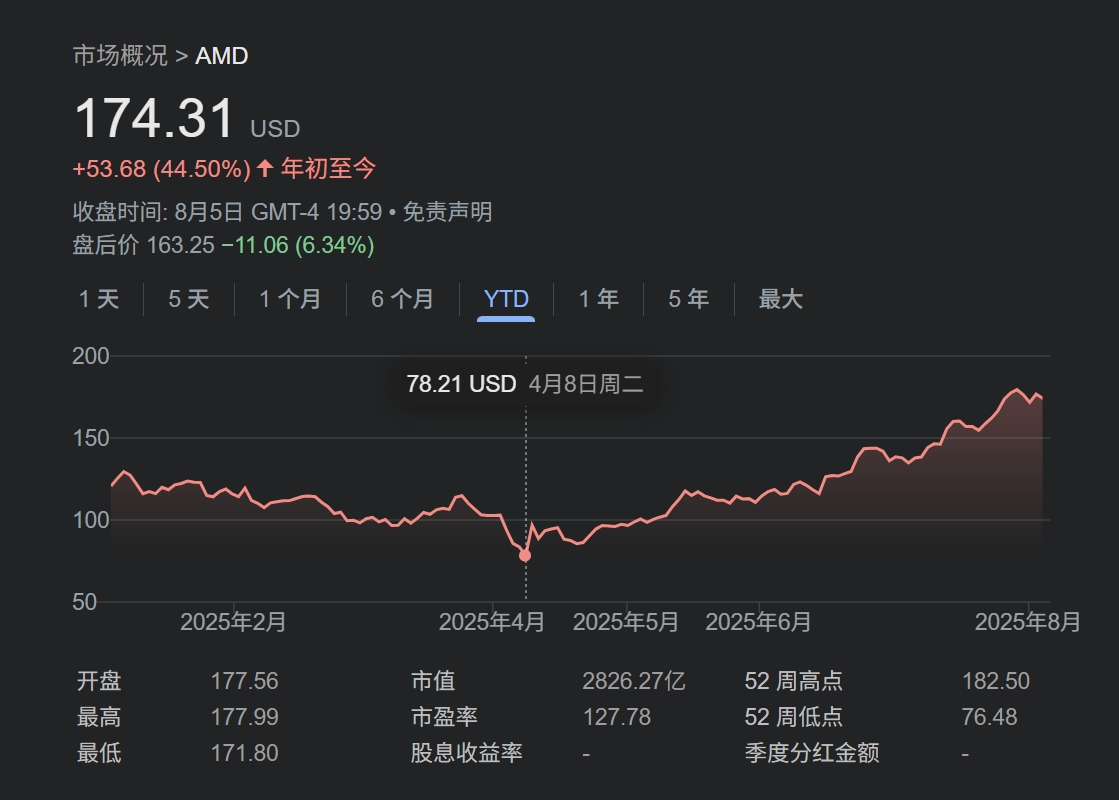
Group 1: Financial Performance - AMD reported a record revenue of $7.67 billion for Q2, maintaining over 30% year-on-year growth, although net profit decreased by 31% year-on-year and 50% quarter-on-quarter [1][2] - The company's gross margin fell by 10 percentage points to 43%, with earnings per share (EPS) down 30% year-on-year [2][4] - AMD's data center revenue for the quarter was $3.2 billion, aligning with average expectations, but was impacted by U.S. government restrictions on the MI308 data center GPU [4][5] Group 2: Market Reaction and Stock Performance - Following the earnings report, AMD's stock price dropped over 5% in after-hours trading, indicating that the current situation is insufficient to sustain the stock's previous gains [1][2] - Since the beginning of the year, AMD's stock has risen over 40%, and it has rebounded approximately 120% from its year-to-date low [1][4] Group 3: Product Developments and Future Outlook - AMD launched the Instinct MI350 series GPU in June, with the MI355X expected to be released later this year, showing performance comparable to NVIDIA's B200 chip [5] - The company anticipates strong demand for its Epyc processors, which is expected to offset the negative impacts from restrictions on shipments to China [4][5] - AMD's CEO expressed optimism about the company's position compared to 90 days prior, highlighting the potential of new products and AI opportunities [4][5]
AMD:推理之王
美股研究社· 2025-07-25 12:13
Core Viewpoint - AMD's stock performance has lagged behind major indices like the S&P 500 and Nasdaq 100 due to previous overvaluation, but the upcoming MI400 series GPU, set to launch in 2026, is expected to significantly change the landscape by capturing the growing demand for inference and narrowing the technological gap with Nvidia [1][3]. Group 1: Market Position and Growth Potential - AMD's market capitalization is approximately $255 billion, significantly lower than Nvidia's $4.1 trillion, indicating a potential undervaluation given the narrowing technological gap [1]. - The global AI infrastructure investment could reach $7 trillion by 2030, with inference being a critical need, positioning AMD favorably in this market [3]. - AMD anticipates a total addressable market (TAM) of $500 billion by 2028, with inference expected to capture a larger share [4][15]. Group 2: Product Advancements - The MI355X GPU, released in June 2025, is seen as a game-changer in the GPU market, with significant advantages in memory capacity and bandwidth, crucial for AI inference [8][10]. - The MI400 GPU will feature a memory capacity increase from 288GB to 432GB and bandwidth enhancement from 8TB/s to 19.6TB/s, showcasing substantial technological advancements [12]. - AMD's Helios AI rack system integrates its own CPU, GPU, and software, enhancing deployment efficiency and directly competing with Nvidia's systems [13]. Group 3: Financial Performance - In Q1 2025, AMD's data center revenue grew by 57% year-over-year, while client and gaming revenue increased by 28%, indicating strong market demand [26][27]. - AMD's expected price-to-earnings ratio is around 78, higher than most peers, including Nvidia at 42, reflecting investor confidence in future growth [29]. - The company has approved a $6 billion stock buyback, totaling $10 billion, demonstrating confidence in its growth trajectory and commitment to shareholder value [25]. Group 4: Competitive Landscape - AMD has been gradually increasing its CPU market share, projected to reach approximately 39.2% by 2029, as it continues to outperform Intel in various performance metrics [19][24]. - Major clients like Google Cloud are increasingly adopting AMD's EPYC CPUs, further solidifying its position in the cloud computing market [23]. - The competitive edge in inference capabilities could lead to increased demand for AMD's GPUs, especially as companies like Meta explore AI advancements [25].

华鑫证券:AMD发布MI350系列GPU性能升级 继续看好海外算力链
贝塔投资智库· 2025-06-20 03:35
Group 1: AMD GPU Launch - AMD launched MI350X and MI355X GPUs on June 13, achieving a 4x increase in computing power and a 35x improvement in inference speed compared to the previous MI300X [1][3] - The MI350 series competes with NVIDIA's B200, featuring 1.6 times the memory capacity and comparable or superior training and inference speeds [3] - The MI350X has a maximum total board power (TBP) of 1000W, while the MI355X reaches 1400W, enhancing performance [3][4] Group 2: Future Developments - AMD plans to release the next-generation MI400 series in 2026, developed in collaboration with OpenAI, with expected performance improvements of 10x over the MI300 series [4] - The MI400 series will utilize the next-generation CDNA architecture, featuring 432GB HBM4 memory and 19.6TB/s memory bandwidth [4] Group 3: AI Applications and Innovations - The Chinese Academy of Sciences launched the "Enlightenment" system for fully automated chip design, which aims to surpass human-level design capabilities [5] - The system will continue to evolve through iterative cycles and explore various AI methodologies to enhance its design capabilities [5] Group 4: AI Financing Trends - Multiverse Computing completed a €1.89 billion (approximately $2.17 billion) Series B funding round, focusing on AI model compression technology that can reduce model size by up to 95% without performance loss [6][7] - The technology allows for significant speed improvements and cost reductions in inference, making it applicable for edge devices [7] Group 5: Investment Recommendations - The industry outlook remains positive for overseas computing power chains, with specific companies recommended for investment, including 嘉和美康, 科大讯飞, and 寒武纪, among others [2][8]

帮主郑重:AMD飙涨8%藏着啥?分析师力挺的新产品才是中长线看点!
Sou Hu Cai Jing· 2025-06-17 00:12
Core Viewpoint - AMD's stock surged by 8.81% on a trading volume of $12.6 billion, driven by a target price increase from Piper Sandler from $125 to $140, reflecting strong market confidence in AMD's latest innovations [1][3]. Group 1: Product Innovations - The recent surge in AMD's stock is attributed to the launch of the Helios rack, designed as a "super engine" for data centers, enhancing the performance of AMD's Instinct series GPUs [3]. - AMD's MI350 series GPU, utilizing TSMC's 3nm process, features 185 billion transistors and boasts a 35-fold increase in inference performance compared to its predecessor [3][4]. - AMD has ambitious plans for the MI400 series GPU, which will have 432GB of memory and a bandwidth of 19.6TB/s, positioning the company ahead of competitors like NVIDIA [4]. Group 2: Strategic Positioning - Despite facing a $1.5 billion loss due to U.S. export restrictions, AMD is leveraging this challenge to accelerate technological innovation and reduce dependency on specific markets [5]. - The semiconductor industry is undergoing rapid consolidation, and AMD is actively building a more complete supply chain through acquisitions and partnerships [5]. - The recent stock increase is not just a reaction to product launches but also reflects AMD's long-term technological accumulation and strategic adjustments [5].