LiFSI(双氟磺酰亚胺锂)

Search documents
出售永太高新25%股权,宁德时代反向入股永太科技
Huan Qiu Lao Hu Cai Jing· 2026-02-10 05:33
Core Viewpoint - Yongtai Technology plans to acquire a 25% stake in Yongtai High-tech held by CATL through a share issuance, which will make Yongtai High-tech a wholly-owned subsidiary of Yongtai Technology, enhancing collaboration between the two companies [1][3] Group 1: Transaction Details - Yongtai Technology currently holds a 75% stake in Yongtai High-tech, and if the transaction is completed, CATL will become a shareholder of Yongtai Technology [1] - Yongtai Technology's stock will be suspended from trading starting February 9, with a specific transaction plan expected to be disclosed within 10 trading days [1] Group 2: Historical Context - The acquisition is not the beginning of the partnership; in November 2021, Yongtai High-tech's shareholder transferred a 25% stake to CATL for 500 million yuan, marking CATL's entry as an industrial investor [2] - Yongtai High-tech has been a significant profit contributor to Yongtai Technology, accounting for over half of its profits [2] Group 3: Business Overview - Yongtai High-tech, established in June 2016, focuses on new material technology research and production of chemical products, being a key player in the lithium battery electrolyte sector [3] - Yongtai Technology is a leading enterprise in the fluorine fine chemical field, with a focus on lithium battery electrolyte core materials, holding a significant market share in products like lithium hexafluorophosphate and LiFSI [3] Group 4: Financial Performance - In 2022, Yongtai Technology reported revenues of 6.336 billion yuan and a net profit of 554 million yuan [4] - However, in 2023 and 2024, revenues are projected to decline to 4.128 billion yuan and 4.589 billion yuan, with net losses of 620 million yuan and 478 million yuan respectively [4] - The company anticipates a recovery in 2025, with expected revenues of 5 to 5.5 billion yuan and a reduced net loss of 25.6 to 48.6 million yuan, driven by demand in the new energy vehicle and energy storage sectors [4]

宁德时代反向入股,260亿锂电龙头停牌前涨停
2 1 Shi Ji Jing Ji Bao Dao· 2026-02-09 12:44
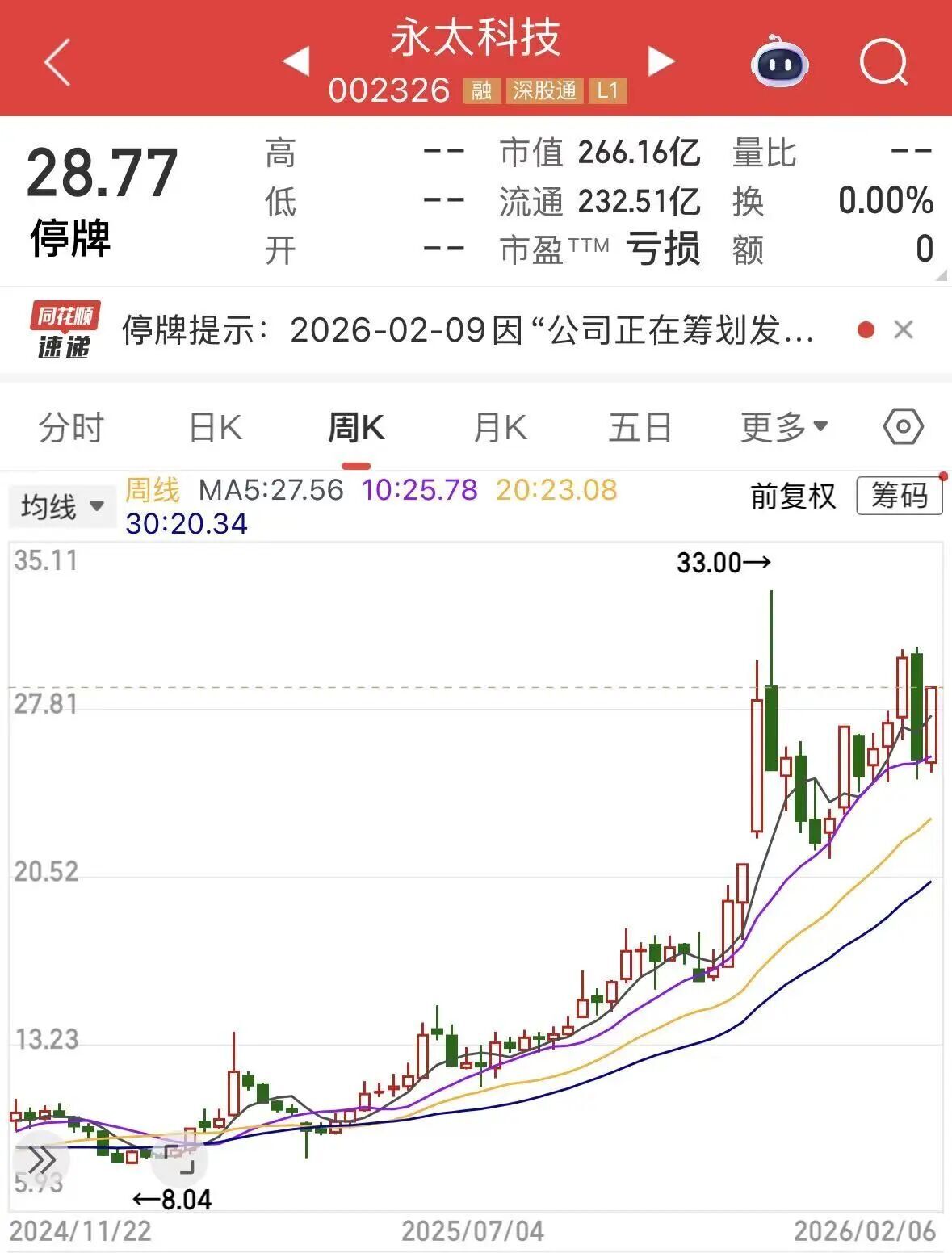
Core Viewpoint - The announcement by Yongtai Technology regarding the acquisition of a 25% stake in Yongtai High-tech from CATL marks a strategic shift, allowing Yongtai Technology to regain full ownership and CATL to transition from a subsidiary shareholder to a public company shareholder [1][3]. Group 1: Transaction Details - Yongtai Technology plans to issue shares to acquire the 25% stake in Yongtai High-tech held by CATL, along with raising matching funds [1]. - Following the announcement, Yongtai Technology's stock was suspended from trading starting February 9, with a plan to disclose the transaction details within ten trading days [1]. - As of February 6, Yongtai Technology's stock price reached a limit-up of 28.77 yuan per share, giving it a market capitalization of 26.616 billion yuan [1]. Group 2: Strategic Implications for CATL - This "reverse equity investment" allows CATL to strengthen its connection with upstream core material suppliers while utilizing capital tools for risk management [3]. - The transaction is expected to convert CATL's heavy asset investment into high liquidity equity, enhancing its financial flexibility [5]. - With the global battery market entering a fast-charging era by 2026, the performance of electrolytes will be crucial, and Yongtai High-tech's products are key to improving battery conductivity [5]. Group 3: Financial Outlook - Yongtai Technology's electrolyte production capacity includes 150,000 tons per year, with various products already in production, indicating strong operational capabilities [5]. - Although Yongtai Technology is not expected to turn a profit in 2025, it is projected to reduce losses by over 90% compared to 2024, suggesting a positive growth outlook [5]. - The acquisition will allow all profits from Yongtai High-tech's quality assets to be consolidated into Yongtai Technology's financial statements [5]. Group 4: Industry Context and Relationships - CATL's strategy of deepening ties with core suppliers is not unique; it has previously invested in other companies to secure supply chains and enhance its market position [6]. - The historical relationship between Yongtai Technology and CATL has evolved, with Yongtai High-tech previously being a significant profit contributor to Yongtai Technology [8]. - The shift in ownership structure is also a strategic move to mitigate legal risks associated with ongoing litigation involving Yongtai High-tech [10].


宁德时代反向入股,260亿锂电龙头停牌前涨停
21世纪经济报道· 2026-02-09 12:30
Core Viewpoint - The announcement of Yongtai Technology's acquisition of a 25% stake in Yongtai High-tech from CATL marks a strategic shift, allowing Yongtai Technology to regain full ownership and CATL to become a shareholder in a listed company, enhancing their relationship and operational synergy in the lithium battery supply chain [1][2]. Group 1: Strategic Implications - The "reverse equity investment" by CATL is a strategic maneuver to strengthen ties with upstream material suppliers while mitigating risks through capital tools, showcasing a clever approach to market positioning [2]. - The acquisition allows Yongtai Technology to consolidate its profitable assets, with all profits from Yongtai High-tech now reflected in the listed company's financial statements, potentially leading to significant value creation for shareholders [4][6]. Group 2: Market Dynamics - By 2026, the global battery market is expected to enter a fast-charging era, with electrolyte performance becoming a critical factor. Yongtai High-tech's products, such as lithium hexafluorophosphate and LiFSI, are essential for enhancing battery conductivity [4]. - Yongtai Technology's production capacity includes 150,000 tons/year of electrolytes, 18,000 tons/year of solid lithium hexafluorophosphate, and 67,000 tons/year of liquid LiFSI, indicating a robust operational foundation to support future growth [4]. Group 3: Historical Context and Future Outlook - The relationship between CATL and Yongtai Technology has evolved significantly since 2021, with Yongtai High-tech previously contributing over half of Yongtai Technology's profits. The recent acquisition reflects changing industry dynamics and Yongtai Technology's strategic repositioning [6]. - CATL's increasing investments in upstream suppliers, such as Tianhua New Energy and Jiangxi Shenghua, illustrate a broader strategy to create a resilient "CATL ecosystem" that enhances supply chain stability and profitability [5]. Group 4: Legal and Compliance Considerations - The ongoing legal disputes involving Yongtai High-tech, with claims amounting to 887 million yuan, pose compliance risks for CATL. Transitioning to a shareholder role in a listed company provides a legal buffer against potential liabilities from these disputes [7].
LiFSI(双氟磺酰亚胺锂)不仅仅是添加剂
猛兽派选股· 2025-12-24 03:15
Core Viewpoint - LiFSI (Lithium bis(fluorosulfonyl)imide) is transitioning from a performance-enhancing additive to a core material in high-end battery formulations, with its usage in leading battery manufacturers increasing from 5% to 15% as the industry moves towards high-nickel ternary, fast-charging, and solid-state batteries [1] Group 1: Advantages and Shortcomings of LiFSI - Core advantages include high efficiency and safety, with an ionic conductivity of 10.2 mS/cm at 25°C, which is 15% higher than traditional LiPF₆, and a capacity retention rate of 82.3% after 1000 cycles with high-nickel cathodes [3] - LiFSI remains conductive at -40°C, addressing range reduction issues for electric vehicles in cold climates, and shows excellent compatibility with silicon-carbon anodes and high-voltage cathodes above 4.4V, making it a standard material for 800V platforms [4] - As a primary salt, LiFSI can create high-concentration electrolytes, meeting the interface control needs of semi-solid batteries, with CATL's Kirin battery requiring at least 20% addition [5] - Current production costs are high, ranging from 120,000 to 200,000 yuan per ton, which is 2-3 times that of LiPF₆, despite a significant decrease from 800,000 yuan per ton in 2021 [6] - There is a risk of aluminum foil corrosion at high voltages, necessitating the use of additives like LiPO₂F₂ or blending with LiPF₆, complicating formulations [7] - The synthesis process is complex, requiring multiple reactions and a product purity of over 99.99%, with metal impurities needing to be controlled below 5 ppm [8] Group 2: Capacity Landscape - The domestic LiFSI market is highly concentrated, with over 85% market share held by five companies, including Tianqi Materials and Dongyue Group, as of Q3 2025, with effective capacity reaching 32,000 tons [9] - Tianqi Materials leads the industry with a capacity of 30,000 tons, expected to expand to 90,000 tons by 2026, benefiting from a cost advantage of 15% due to its integrated supply chain [10] - Dongyue Group operates at full capacity with 8,000 tons, achieving over 90% self-sufficiency in intermediates and maintaining top-tier impurity control [11] - New Zhongbang and Yongtai Technology focus on high-end markets with capacities of 5,000 tons and 6,000 tons, respectively, with the latter reducing energy consumption by 30% through continuous flow processes [12] - By 2026, planned domestic capacity is expected to exceed 50,000 tons, but only 30% will be high-end electronic-grade, leading to price competition in mid-to-low-end products [13] Group 3: Development Pathways - In the short term (2025-2027), LiFSI is expected to penetrate the market as an additive, increasing its proportion in power batteries from 8.5% to 20%, with high-end consumer electronics penetration exceeding 68% [15] - In the medium term (2028-2030), the demand for LiFSI as a primary salt will grow due to the mass production of semi-solid batteries, with usage in 4680 cylindrical batteries rising to over 5% per ton [16] - In the long term (post-2030), LiFSI is anticipated to adapt to new scenarios such as sodium-lithium hybrid batteries and hydrogen energy storage, with global demand potentially exceeding 200,000 tons [18] Group 4: Upstream and Downstream Dynamics - The upstream supply chain faces constraints, particularly with chlorosulfonic acid, which is essential for LiFSI production, leading to a 50% price surge to 2,050 yuan per ton due to increased demand [20] - The domestic effective capacity for chlorosulfonic acid is locked at 565,000 tons, with environmental approvals causing supply gaps, while Kaisheng New Materials monopolizes 40% of the market with 150,000 tons [20] - The downstream battery manufacturers are shifting from passive procurement to joint development, customizing LiFSI formulations to suit silicon-carbon anodes and solid electrolytes, with the average mixing ratio reaching 8.5% in 2024, up 6 percentage points from 2022 [22] - Three pathways for overcoming bottlenecks include upstream integration of raw materials, promoting process innovations, and establishing green approval channels for chlorosulfonic acid production [23][24][25] Conclusion - The evolution of LiFSI reflects the lithium battery industry's shift towards higher energy density and safety, with short-term raw material constraints supporting industry growth, while long-term leaders with integrated capabilities and technological barriers are expected to dominate [27]


华神科技(000790) - 000790华神科技投资者关系管理信息20250912
2025-09-12 13:27
Group 1: Product Development and Market Focus - LiFSI is used as an additive in lithium-ion battery electrolytes, enhancing conductivity and thermal stability; currently in technical modification and customer trial phases [2] - The company is focusing on the core business of the Sanqi industry chain and ecosystem, considering both internal investment and external mergers and acquisitions to enhance resource integration [3] - The Shandong Lingkai project is in the technical modification and customer trial stage, with no revenue generated yet [4] Group 2: Financial Performance and Strategic Adjustments - The company has experienced significant performance declines and losses due to price reductions after core product bidding, adjustments in customer procurement strategies, and a strategic contraction of the steel structure business [4] - The company is actively divesting non-core business investments, including transferring subsidiaries and shares in Shanghai Lingkai and Tibet Kangyu [4] - The company is evaluating potential acquisitions, such as Sichuan Meifeng, which has a strong balance sheet and a low debt ratio of around 20% [3] Group 3: Innovation and Product Diversification - The company is committed to enhancing the stability and safety of drug efficacy, with successful clinical trials for Sanqi Tongshu capsules in treating ischemic stroke [4] - The company aims to strengthen its market position in the bottled water sector, holding the top market share in Chengdu and second in Sichuan [4] - The company is exploring new product development and strategic partnerships to diversify its product offerings [4] Group 4: Investor Relations and Future Outlook - The company assures that it is not at risk of delisting and is operating normally [4] - The management emphasizes that recent divestitures were strategic decisions aimed at consolidating resources to enhance core competitiveness and long-term profitability [4] - The company is continuously monitoring market opportunities and will make investment decisions based on strategic alignment and risk assessment [3]