
MI500系列芯片

Search documents
三星无折痕折叠屏OLED面板亮相CES;江淮汽车公布多模态飞行汽车专利,可降低噪音和能耗丨智能制造日报
创业邦· 2026-01-07 03:22
Group 1 - Jianghuai Automobile Group has announced a patent for a multi-modal flying car that can reduce noise and energy consumption, featuring foldable wings and vertical lift fans for flight control [2] - AMD's CEO revealed at CES that the next-generation AI chip MI455 GPU, built on 2nm and 3nm processes, is expected to enhance AI performance by 1000 times within four years [2] - Star River Power plans to launch the "Ceres-1 Sea Launch (Remote 7)" commercial rocket soon, with the mission code named "Wanghai Tide" [2] - Samsung showcased a crease-free foldable OLED panel at CES 2026, which may be used in the upcoming Galaxy Z Fold8 and potentially in Apple's first foldable iPhone, promising a seamless display experience [2]


苏姿丰:未来几年,全世界算力需增加100倍!
新华网财经· 2026-01-06 14:57
Core Viewpoint - AMD is positioning itself for the Yotta Flops era of AI computing, aiming to significantly enhance AI performance and capabilities through new product launches and technological advancements [2][4]. Group 1: New Product Launches - AMD unveiled several new products at CES 2026, including the MI455X GPU, Ryzen AI 400 series processors, and the Ryzen AI Max+ series [2]. - The MI455X is AMD's most advanced processor to date, featuring 320 billion transistors, a 70% increase from the previous MI355, and equipped with 432GB of HBM4 memory [5]. - The Ryzen AI 400 series processors utilize Zen 5 CPU architecture and RDNA 3.5 GPU, integrating up to 60 TOPS of NPU computing power, with the first Ryzen AI 400 PCs set to launch later this month [6]. Group 2: Future Plans and Innovations - AMD plans to release the MI500 series chips in 2027, which will utilize 2nm technology and HBM4e memory, potentially increasing AI performance by 1000 times over the next four years [5]. - The Helios platform, designed for the Yotta-level AI era, features a dual-width design and can accommodate up to 72 GPUs, emphasizing AMD's commitment to high-performance computing [4]. Group 3: AI Integration and Market Strategy - AMD views AI as a fundamental capability of PCs rather than an additional feature, indicating a shift towards integrating AI across various computing platforms [5][6]. - The company is targeting enterprise markets with the MI440X chip, designed for smaller data centers, allowing for local hardware deployment and data privacy [5].


CES2026: AMD CEO苏姿丰发布多项AI新成果
Huan Qiu Wang Zi Xun· 2026-01-06 09:07
Core Insights - AMD's CEO, Lisa Su, discussed significant advancements and plans in AI technology during the keynote at CES 2026, highlighting the company's focus on AI-driven personal computers as a core future direction [1][2] Group 1: AI User Growth and Market Demand - Since the launch of ChatGPT, the number of active AI users has surged from 1 million to 1 billion, a milestone that took the internet decades to achieve [2] - It is projected that by 2030, the number of active AI users will reach 5 billion, necessitating a 100-fold increase in global computing power in the coming years [2] Group 2: New AI Processors and Performance - AMD introduced the Ryzen AI 400 series processors, which are designed for AI-driven PCs, showcasing superior performance with multitasking speeds 1.3 times faster and content creation speeds 1.7 times faster than competitors [2] - The new chips feature 12 CPU cores and 24 threads, providing a robust foundation for efficiently handling complex tasks [2] Group 3: Future AI Chip Developments - AMD's next-generation AI chip, the MI455 GPU, will utilize advanced 2nm and 3nm manufacturing processes and will incorporate advanced packaging technology along with HBM4 [3] - The MI455 GPU will be integrated with EPYC CPUs, and the next-generation Helios rack will include 72 GPUs, enabling the construction of large-scale AI clusters for extensive AI computing tasks [3] - AMD is also developing the MI500 series chips, expected to launch in 2027, with a goal of increasing AI performance by 1000 times over the next four years [3]
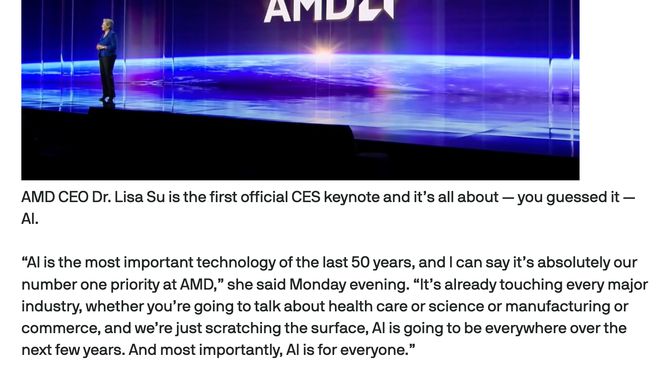
AMD推出下一代新品,4年内AI芯片性能有望提升1000倍
第一财经· 2026-01-06 04:04
Core Viewpoint - AMD is advancing its AI chip technology with the introduction of the next-generation MI455 GPU, which utilizes 2nm and 3nm manufacturing processes and advanced packaging, featuring HBM4 memory [1] Group 1: Next-Generation AI Chips - The MI455 GPU will be integrated with the EPYC CPU, and the next-generation AI rack, Helios, will include 72 GPUs, enabling the construction of large AI clusters by connecting thousands of Helios racks [1] - The MI500 series chips are also under development and will adopt the 2nm process [2] - With the launch of the MI500 series in 2027, AMD aims to enhance AI performance chips by 1000 times over the next four years [3]
AMD推出下一代新品,4年内AI芯片性能有望提升1000倍
Xin Lang Cai Jing· 2026-01-06 03:59
Core Insights - AMD's CEO Lisa Su announced the next-generation AI chip MI455 GPU at CES, which will be manufactured using 2nm and 3nm processes and will feature advanced packaging with HBM4 [1] - The MI455 GPU will be integrated with the EPYC CPU, and the next-generation AI rack, Helios, will include 72 GPUs, enabling the construction of large AI clusters by connecting thousands of Helios racks [1] - The MI500 series chips are also in development, expected to utilize 2nm technology, with AMD aiming to enhance AI performance by 1000 times over the next four years with the launch of the MI500 series in 2027 [1]
AMD叫板英伟达,盘前涨约6%
21世纪经济报道· 2025-11-12 14:48
Core Viewpoint - AMD's CEO, Lisa Su, presented optimistic projections for the AI market, forecasting that the total addressable market (TAM) for AI data centers will exceed $1 trillion by 2030, with a compound annual growth rate (CAGR) of over 40% from the current approximately $200 billion [1][6]. Group 1: Market Outlook and Financial Projections - AMD aims to capture a "double-digit" market share in the data center AI chip market, with annual revenue from data center chips expected to reach $100 billion within five years [6]. - The company anticipates overall business growth of 35% annually over the next three to five years, with data center business growth projected at 60% [6]. - AMD's earnings per share (EPS) is expected to increase to $20 within the same timeframe [6]. Group 2: Product Development and Competitive Positioning - AMD's data center business, which includes server CPUs and GPUs, generated $4.3 billion in revenue in Q3, marking a 22% year-over-year increase and setting a historical record [8]. - The MI350 series AI chips are reported as the fastest-growing products in AMD's history, with major cloud providers already deploying them [8]. - AMD plans to achieve over 50% market share in server CPU revenue, with the next-generation "Venice" processors enhancing AI and general computing performance [9]. Group 3: Strategic Partnerships and Collaborations - AMD has secured significant AI chip orders, including a strategic partnership with OpenAI to deploy 6GW of AMD GPU chips for next-generation AI infrastructure [12]. - Collaborations with Oracle and the U.S. Department of Energy have also been established, with Oracle set to deploy 50,000 units of AMD's latest AI chips by Q3 2026 [12]. - AMD's partnership with the U.S. Department of Energy involves a $1 billion investment to build two new supercomputers for research in various fields [12]. Group 4: Competitive Landscape - AMD faces significant competition from NVIDIA, which is projected to achieve $500 billion in sales from its AI chips over the next five quarters [11]. - Other tech giants like Google and Amazon are developing their own AI chips, posing additional challenges for AMD [13]. - Qualcomm has also entered the data center AI chip market, launching new products and forming partnerships to provide AI inference services globally [13].

AMD宣示野心:争夺AI芯片市场“两位数”份额
2 1 Shi Ji Jing Ji Bao Dao· 2025-11-12 13:04
Core Insights - AMD's CEO, Lisa Su, presented optimistic projections for the AI market, forecasting a total addressable market (TAM) for AI data centers to exceed $1 trillion by 2030, with a compound annual growth rate (CAGR) of over 40% from approximately $200 billion this year [1] - AMD aims to capture a "double-digit" market share in the data center AI chip market, with projected annual revenue from data center chips reaching $100 billion within five years and profits expected to more than double by 2030 [1][2] Group 1: Market Outlook and Financial Projections - AMD anticipates a 35% annual growth across its entire business over the next three to five years, with data center business growth projected at 60% [2] - The company expects earnings per share (EPS) to rise to $20 within the same timeframe [2] - The data center business is identified as the core driver for AMD's future market goals, with a historical revenue high of $4.3 billion in Q3, a 22% year-over-year increase [3] Group 2: Product Development and Competitive Landscape - AMD's AI chip product line, while starting later than NVIDIA's, is gaining traction, with the MI350 series being described as the fastest-growing product in the company's history [4] - AMD plans to achieve over 50% market share in server CPU revenue, with the next-generation EPYC processor, codenamed "Venice," aimed at enhancing AI and general computing performance [4] - Despite facing significant competition from NVIDIA, AMD is positioned as a cost-effective alternative as global enterprises invest heavily in AI infrastructure [5] Group 3: Strategic Partnerships and Collaborations - AMD has secured major partnerships, including a strategic collaboration with OpenAI to deploy 6GW of AMD GPU chips for AI infrastructure [5][6] - Additional collaborations include a partnership with Oracle to deploy 50,000 units of the latest AI chip MI450 by Q3 2026 and a $1 billion project with the U.S. Department of Energy for new supercomputers [6] - Competitors like Google and Amazon are also developing their own AI chips, indicating a highly competitive environment in the AI data center chip market [6]
