NZDUSD

Search documents
美银:历史数据显示石油价格冲击往往利好这些货币
美股IPO· 2026-03-08 00:48
Group 1 - The core viewpoint of the article highlights that historical oil supply shocks tend to favor certain currencies, particularly the US dollar and Canadian dollar, while currencies like the New Zealand dollar and Australian dollar face pressure [1][3] Group 2 - The analysis indicates that the foreign exchange market has reacted moderately to recent US-Israel military actions in Iran, with price movements largely aligning with expectations, including a general strengthening of the US dollar [3] - Historical analysis of geopolitical events disrupting global oil supply reveals a consistent pattern where currencies of oil-producing countries perform well, while those of energy-importing countries tend to weaken [3] - The Canadian dollar (CAD) and US dollar (USD) typically show strong performance during oil shocks, whereas the New Zealand dollar (NZD), Australian dollar (AUD), Swedish krona, and occasionally the Japanese yen (JPY) perform poorly [3] - The occasional weakness of the yen during oil shocks may reflect Japan's heavy reliance on energy imports, which can offset its traditional safe-haven status during market stress [3] Group 3 - Despite increased currency volatility due to Middle Eastern tensions, many hedging strategies remain attractively priced compared to past oil supply disruptions [3] - The article emphasizes that the volatility of CADJPY and NZDUSD may present valuable trading opportunities, with potential benefits from CADJPY positions in a rising oil price environment and shorting NZDUSD if conflicts persist [3] - The analysis notes that while volatility in the foreign exchange market has increased, many hedging trades are still below levels typically observed during previous oil shock events, suggesting that the market may be underestimating tail risks associated with geopolitical escalations [3]


ATFX汇评:新西兰联储降息25基点,年内第六次降息
Sou Hu Cai Jing· 2025-11-26 10:45
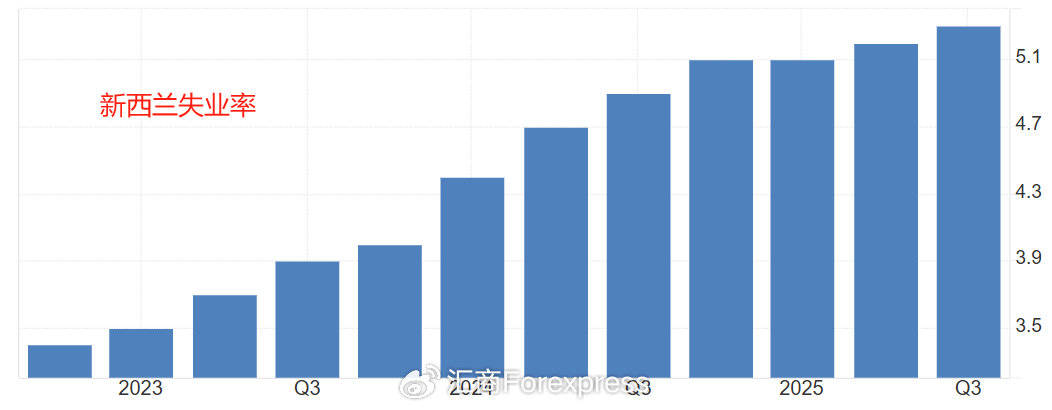
Core Viewpoint - The Reserve Bank of New Zealand (RBNZ) announced a 25 basis point rate cut, bringing the official cash rate (OCR) down to 2.25%, in response to rising inflation and a weak labor market [1][3]. Monetary Policy - The RBNZ's decision to lower the OCR is influenced by the Consumer Price Index (CPI) reaching 3% in Q3, which is at the upper limit of the official target range of 1%-3% [1]. - The RBNZ expects inflation to decline to around 2% by mid-2026, indicating a long-term outlook on inflation management [1]. - Since August 2024, the RBNZ has cut rates eight times, totaling a reduction of 300 basis points, which is significantly higher than the 150 basis points cut by the Federal Reserve [5]. Labor Market Insights - The labor market remains weak, with a rising unemployment rate that reached 5.3% in Q3, surpassing the 5% threshold for full employment [3]. - The RBNZ's rationale for the rate cut mirrors that of the Federal Reserve, focusing on the challenges within the labor market [3]. Interest Rate Context - The current cash rate of 2.25% is close to the neutral rate estimates of the Federal Reserve (2.5%-3.0%) and the European Central Bank (1.75%-2.25%), suggesting limited room for further significant rate adjustments [5]. - The RBNZ has not explicitly defined its neutral rate range, but the current rate is seen as supportive and stimulative for the economy [5]. Technical Analysis - The NZD/USD currency pair is in a medium-term bearish trend, with significant support levels identified around 0.5500, which has historically been a rebound point [7]. - The current market price of 0.5675 is close to this long-term support level, indicating potential for a significant rebound [7].
全球速览美元进一步下行
2025-08-25 01:38
Summary of Key Points from the Conference Call Industry Overview - The conference call primarily discusses the foreign exchange (FX), interest rates, and commodities markets, with a focus on the implications of stagflationary risks and monetary policy adjustments in various regions. Core Points and Arguments Foreign Exchange (FX) Market - The EUR-USD forecast has been revised upwards, with expectations of further USD weakness. The end-2025 forecast is now set at 1.20 (up from 1.17) and 1.25 for end-2026 (up from 1.20) [3][22][39]. - The dollar is expected to depreciate further due to rising stagflationary risks and potential rate cuts by the Federal Reserve, which could lead to lower relative real interest rates [20][21][22]. Interest Rates - US interest rates have been revised lower, with the end-2025 forecast for the 2-year Treasury yield at 3.5% and the 10-year yield at 4.25% [4][16][19]. - The Federal Reserve is anticipated to reassess its risk balance, potentially leading to lower rates in response to cooling employment data and inflation concerns [14][17]. - The Bank of England (BoE) is expected to cut rates further, with a forecast of 3.5% by the end of 2026, reflecting ongoing economic challenges [58][64]. Commodities - There have been revisions to core energy commodity price forecasts, including Brent and WTI oil, while forecasts for industrial and precious metals remain unchanged [8]. Regional Insights - **Emerging Markets (EM) Asia**: The forecast for the Chinese Yuan (CNY) remains stable at 7.10, with a mildly bullish outlook for the Indian Rupee (INR) [5]. - **Latin America (LatAm)**: The GDP growth forecast for the region has been upgraded due to stronger expected growth in Mexico, despite external volatility [7]. - **EEMEA**: A structurally bullish outlook is maintained for EEMEA FX, driven by US stagflationary risks and concerns over Federal Reserve independence [6]. Important but Overlooked Content - The potential erosion of US data credibility poses additional risks for the dollar, complicating the market's outlook [20][23]. - The ECB's recent hawkish tilt may not be sustainable, as the economic implications of the US-EU trade deal could negatively impact the euro area [27][29]. - The Japanese government is expected to adopt a more expansionary fiscal policy, which could influence the JGB market and yield forecasts [43][45]. Conclusion - The conference call highlights significant shifts in FX and interest rate forecasts due to evolving economic conditions, particularly in the context of stagflationary risks and monetary policy adjustments across major economies. The outlook for commodities remains stable, with specific regional insights indicating varied growth trajectories.
香港第一金PPLI金评:黄金短期技术性回落 下方重点关注3350支撑位
Sou Hu Cai Jing· 2025-08-11 07:41
Group 1: Economic and Political Developments - President Trump vowed to remove homeless individuals from Washington D.C. and imprison criminals, despite the mayor's assertion that crime rates have not significantly increased [1] - The White House is preparing to deploy hundreds of National Guard troops to Washington, although the final decision on troop numbers and specific roles is still pending [1] - The U.S. trade representative confirmed that a 15% tariff is not being imposed, leading to a significant drop in European exports to the U.S., particularly a 36% decline in automobile exports [2] Group 2: Market Reactions and Commodity Prices - Gold prices reached a record high due to tariff uncertainties, with futures rising over 2% before the White House clarified that no tariffs on gold would be imposed [2] - Gold closed at $3,397.79 per ounce, with a trading range between $3,379.26 and $3,408.18 per ounce, indicating strong demand for safe-haven assets [2] - The market is closely monitoring the implementation of tariff policies, changes in Federal Reserve personnel, and geopolitical risks [2] Group 3: Technical Analysis of Gold - The daily chart for gold shows an expanding BOLL channel and a KD death cross, while the four-hour chart indicates an upward BOLL channel and a KD golden cross [3] - The one-hour chart suggests a narrowing BOLL channel with a KD golden cross, indicating potential short-term upward movement [3] - The key support level for gold is identified at $3,350 per ounce, which is crucial for maintaining bullish momentum [3] Group 4: Trading Strategies - For gold, buy recommendations include entering at $3,365.00 with a stop loss of $7 and a take profit target of $3,400/$3,410 [5] - Another buy strategy suggests entering at $3,350.00 with the same stop loss and a take profit target of $3,395/$3,400 [5] - The strategies emphasize the importance of adjusting stop losses to mitigate risks while trading [20]