通货膨胀率

Search documents
美联储理事沃勒:若2月就业数据强劲 可能倾向于暂停加息
Sou Hu Cai Jing· 2026-02-23 13:24
Core Viewpoint - The Federal Reserve Governor Waller indicated that if the employment data for February is strong, there may be a tendency to pause interest rate hikes, as the potential inflation rate is close to the target level of 2% [1] Group 1 - Waller's comments suggest a cautious approach to monetary policy, contingent on upcoming employment data [1] - The emphasis on a strong employment report highlights its significance in influencing the Federal Reserve's decisions regarding interest rates [1] - The mention of inflation nearing the 2% target indicates a focus on maintaining price stability while considering economic growth [1]
US Q4 GDP Grows Smaller-Than-Forecast 1.4% on Shutdown Impact
Youtube· 2026-02-20 14:29
Economic Indicators - December inflation numbers remain concerning, with the PC core at 3%, significantly above the Federal Reserve's target [1] - Wages and salaries increased by only 0.2% in December, a notable decline from November's figures [2] GDP and Spending - GDP growth came in at 1.4%, which was significantly lower than anticipated, reflecting a decline in consumption [3] - Business spending increased, primarily driven by investments in software and intellectual property, while inventories and trade contributed minimally [3] Government Shutdown Impact - The government shutdown is estimated to have reduced GDP by one percentage point, as it affected government spending due to unpaid wages [4] - The impact of the shutdown is expected to reverse in the first quarter as back pay is distributed to affected workers [4]

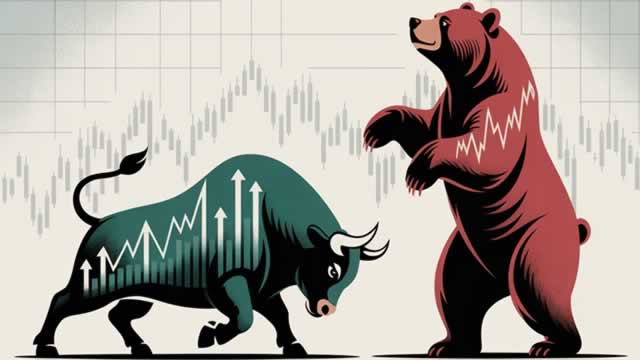
“美联储传声筒”:美联储未提及的内容更值得人关注
Sou Hu Cai Jing· 2026-02-19 02:09
Core Viewpoint - The Federal Reserve's meeting minutes indicate a shift in inflation predictions, with the timeline for reaching a 2% inflation rate being extended from 2027 to 2028, and the specific timeline for achieving this target was not mentioned in the latest minutes [1] Group 1 - The Federal Reserve staff's forecasts for inflation have been adjusted, with predictions indicating a slight increase compared to December's estimates, maintaining a balanced outlook [1] - The impact of tariffs is expected to conclude mid-year, which may lead inflation to revert to its previous downward trend [1] - The critical statement from December's minutes regarding achieving a 2% inflation rate by 2028 has been omitted in the January minutes [1]
莫桑比克2025年累计通胀率为3.23%
Shang Wu Bu Wang Zhan· 2026-02-10 02:12
Group 1 - The core viewpoint of the article indicates that Mozambique's overall price level increased by 3.23% in 2025, primarily driven by rising prices in the food and non-alcoholic beverages sector, as well as the restaurant and hotel industry [1] - From April to July 2025, Mozambique's consumer price index recorded eight consecutive months of decline (deflation), followed by a recovery in the upward trend starting in August [1] - The government had previously predicted an inflation rate of approximately 7% for 2025, but the current data shows only half of that forecast [1] Group 2 - The cumulative inflation rate for Mozambique in 2024 was reported at 4.15%, while the inflation rate for 2023 was 5.3% [1]
加纳的通货膨胀率降至3.8%
Shang Wu Bu Wang Zhan· 2026-02-06 16:18
Group 1 - Ghana's inflation rate significantly decreased to 3.8% in January 2026, marking the lowest level since the price adjustment in 2021 and the 13th consecutive month of decline [1] - The Consumer Price Index (CPI) rose to 262.3 in January 2026, up from 252.6 in January 2025, with a year-on-year inflation rate of 3.8%, down 19.7 percentage points from 23.5% in January 2025 and 1.6 percentage points from 5.4% in December 2025 [1] - Food inflation decreased to 3.9% in January 2026, lower than 4.9% in December 2025, while non-food inflation also fell from 5.8% to 3.9%, despite a 0.4% month-on-month increase in non-food prices [1] Group 2 - Local production goods saw a more significant slowdown in inflation, dropping to 2.0%, while imported goods had an inflation rate of 4.3%, indicating ongoing cost pressures from imports [2] - There are notable regional price differences, with the Northeast region experiencing the highest inflation rate at 11.2%, while the Savannah region had the lowest at 2.6%, attributed to variations in supply conditions, transportation costs, and market access [2]
新西兰第四季失业率升至5.4% 创10年高位
Xin Lang Cai Jing· 2026-02-04 00:06
Core Insights - New Zealand's unemployment rate rose to a 10-year high of 5.4% in Q4, driven by an increase in job seekers that offset employment growth [1][2] - The report indicates that interest rates will need to remain low for some time, with the current Official Cash Rate (OCR) at 2.25% [1][2] - The rise in unemployment was above market expectations of 5.3% and slightly higher than the Reserve Bank of New Zealand's forecast, which is disappointing given recent signs of economic improvement [1][2] Employment Data - The private sector annual salary growth remains low at 2.0%, significantly below the consumer price inflation rate of 3.1% [1][2] - On a positive note, employment numbers increased by 0.5% quarter-on-quarter, surpassing the expected 0.3%, marking the first growth in 18 months [1][2] - The labor force participation rate rose to 70.5%, indicating a slight improvement in labor market engagement [1][2] Market Reactions - Following the news, the New Zealand dollar slightly declined to 0.6045 USD, and interest rate futures rebounded as the market adjusted the likelihood of rate hikes, at least until September [1][2] - Investors anticipate that the Reserve Bank of New Zealand will not adjust rates in the upcoming policy meeting on February 18, with the first potential rate hike expected in July [1][2]
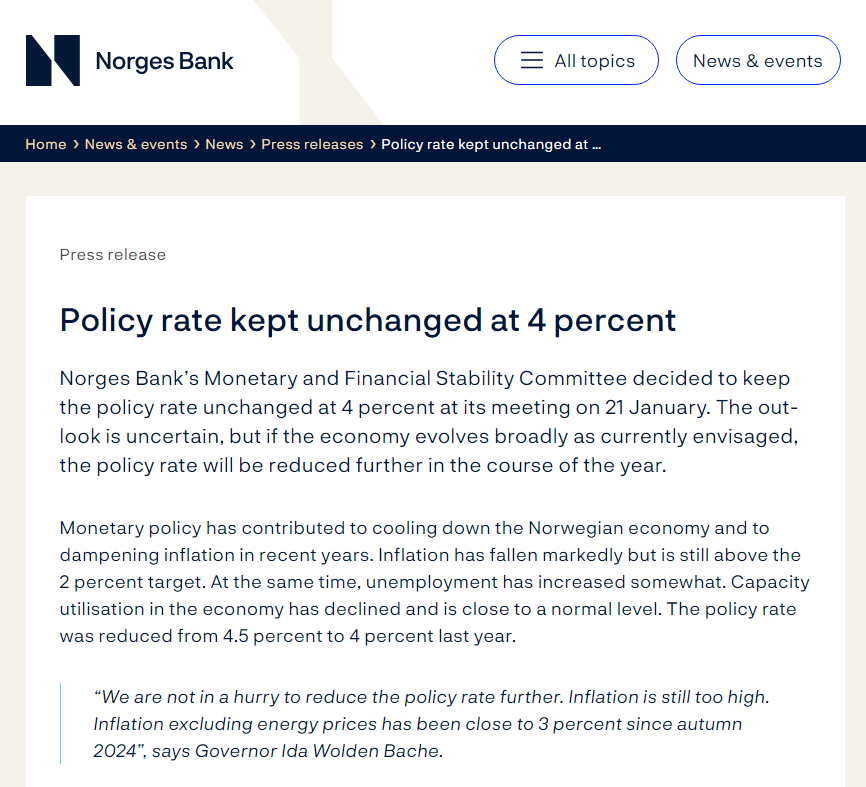
挪威央行维持基准利率不变 暗示不急于降低借贷成本
Xin Lang Cai Jing· 2026-01-22 10:08
Group 1 - The Norwegian central bank announced on January 22 that it will maintain the benchmark interest rate at 4% [2][5] - The central bank indicated that it is not in a hurry to lower borrowing costs due to persistently high inflation, which remains concerning [2][5] - Since the fall of 2024, the inflation rate in Norway, excluding energy prices, has approached 3% [2][5]
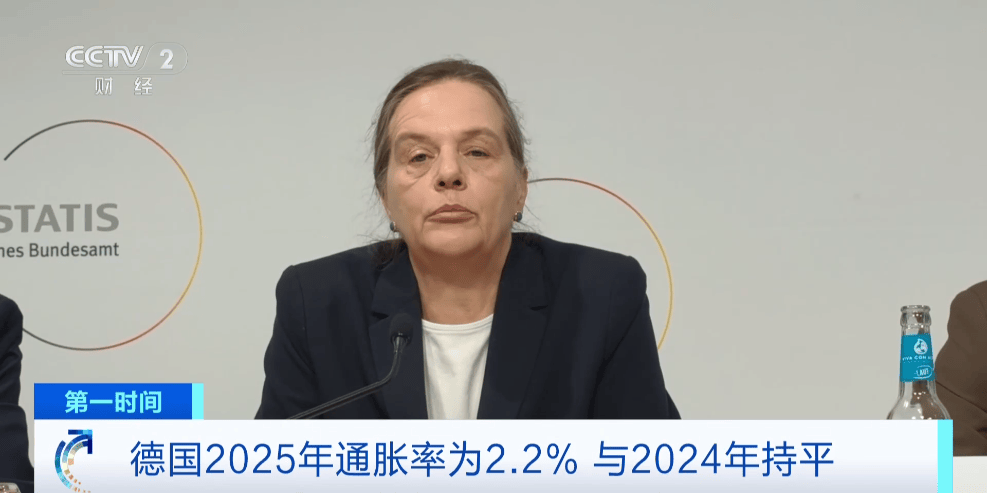
德国2025年通胀率为2.2% 与2024年持平
Sou Hu Cai Jing· 2026-01-17 10:10
Group 1 - The core viewpoint of the articles indicates that Germany's inflation rate for the year 2025 is projected to be 2.2%, remaining stable compared to 2024, with a core inflation rate of 2.8% when excluding energy and food prices [2][4] - The data shows that the inflation rates in Germany were significantly higher in 2022 and 2023, reaching 6.9% and 5.9% respectively, primarily due to substantial increases in energy and food prices [2] - The German Federal Statistical Office reported a decrease in energy prices by 2.4% in 2025, while food prices are expected to rise by 2%, and service prices are projected to increase by 3.5% [4] Group 2 - By December 2025, Germany's inflation rate is expected to drop to 1.8%, marking the first time it falls below 2% for that year [4] - In December 2025, energy prices are anticipated to decrease by 1.3% year-on-year, while food prices are expected to rise by 0.8%, and service prices are projected to increase by 3.5% [4]
德国2025年通胀率为2.2%
Xin Lang Cai Jing· 2026-01-16 12:57
Core Viewpoint - The inflation rate in Germany is projected to remain stable at 2.2% in 2025, the same as in 2024, indicating a trend of stabilizing consumer prices after previous years of high inflation [1] Group 1: Inflation Trends - In 2025, energy prices in Germany are expected to decrease by 2.4%, while food prices will increase by 2% [1] - Service prices are anticipated to rise significantly, with an annual increase of 3.5%, particularly in areas such as passenger transport, social services, insurance, and inpatient medical care [1] - The core inflation rate, excluding energy and food prices, was recorded at 2.8% in the previous year [1] Group 2: Historical Context - The inflation rates in Germany were notably high in 2022 and 2023, reaching 6.9% and 5.9% respectively, primarily due to substantial increases in energy and food prices [1] - By December 2025, the inflation rate is expected to drop to 1.8%, marking the first time it falls below 2% for that year [1] - In December, energy prices are projected to decline by 1.3% year-on-year, while food prices will see a modest increase of 0.8%, and service prices will continue to rise by 3.5% [1]
【环球财经】德国2025年通胀率为2.2%
Xin Lang Cai Jing· 2026-01-16 12:56
Core Insights - The core viewpoint of the articles indicates that Germany's inflation rate is projected to remain stable at 2.2% in 2025, consistent with 2024 levels, reflecting a trend of stabilizing consumer prices after significant fluctuations in previous years [1] Inflation Trends - In 2025, energy prices in Germany are expected to decrease by 2.4%, while food prices are anticipated to rise by 2%. Service prices are projected to increase significantly, with an annual growth rate of 3.5%, particularly in sectors such as passenger transport, social services, insurance, and hospital care [1] - The core inflation rate, excluding energy and food prices, was recorded at 2.8% in the previous year [1] Historical Context - The inflation rates in Germany were notably high in 2022 and 2023, reaching 6.9% and 5.9% respectively, primarily due to substantial increases in energy and food prices [1]