OCI业务

Search documents
是时候抄底了?奥本海默上调甲骨文评级:大跌之后即是买入机会
Hua Er Jie Jian Wen· 2026-02-25 14:16
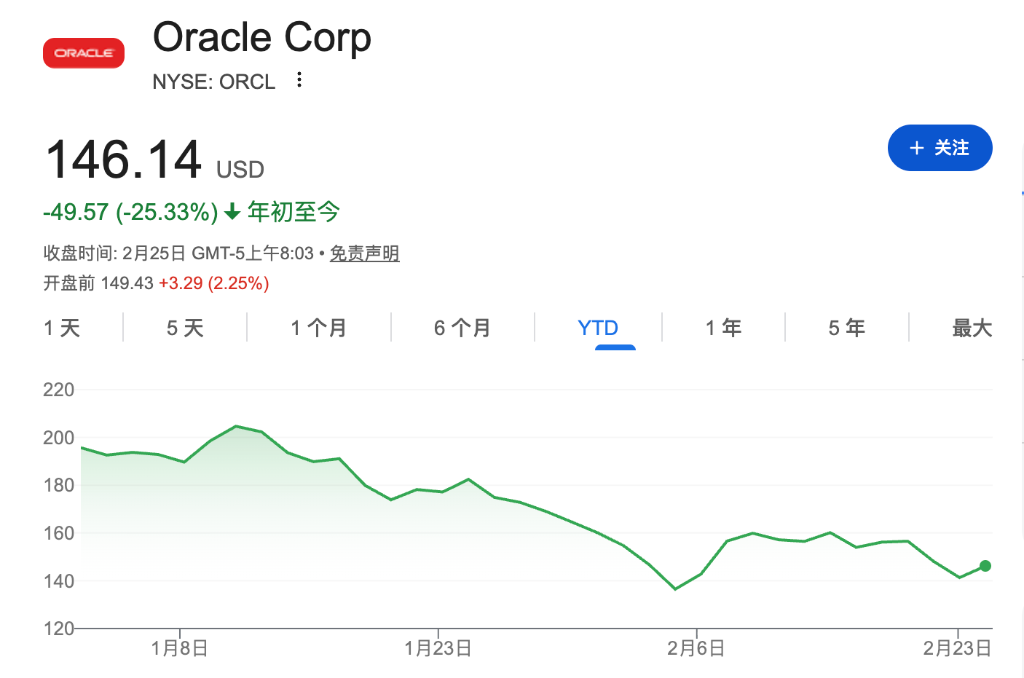
Core Viewpoint - Oracle's stock price has dropped over 25% year-to-date, presenting a buying opportunity according to Oppenheimer, which upgraded its rating from "market perform" to "outperform" with a target price of $185, indicating a potential upside of 27% [1] Group 1: Stock Performance and Valuation - Oppenheimer analyst Brian Schwartz noted that Oracle's price-to-earnings ratio has decreased by more than half since September last year, making the current risk-reward ratio highly favorable for investors [3] - The firm expects Oracle's earnings per share (EPS) to grow two to three times by fiscal year 2030, reinforcing its attractiveness as a buy [3] - Bernstein's extreme scenario stress test indicates that even if the AI business were to completely fail, Oracle's stock price downside would be limited to approximately 15% [4] Group 2: Lease Liabilities and Financial Health - Bernstein addressed concerns regarding Oracle's $248 billion lease liabilities, stating that the risk is significantly overstated. The actual annual maximum risk exposure is only $13 to $16.5 billion until fiscal year 2030 [4] - The long-term nature of these leases (15 to 19 years) allows Oracle to manage its capacity effectively, and demand for data centers is expected to remain high as long as the global market does not enter an "AI winter" [4] Group 3: Hardware and Capital Expenditure Risks - Bernstein highlighted that Oracle's exposure to hardware capital expenditure risks is limited, as the procurement cycle allows for flexibility in order cancellations without significant penalties [5] - Even if hardware has been delivered, most computing assets are highly versatile and can be repurposed for traditional SaaS and OCI businesses, mitigating risks associated with customer defaults [5] Group 4: Core Business Strength - Bernstein's analysis indicates that even without AI-related revenues, Oracle's core business (traditional databases, SaaS, and OCI) could generate total revenue of $101 billion by fiscal year 2030 [6] - After accounting for interest costs from debt incurred for AI infrastructure, Oracle's EPS is still projected to reach $9.0, suggesting a strong cash generation capability [7] Group 5: Revenue Projections - Oracle's total revenue is projected to grow from $50 billion in fiscal year 2023 to $221 billion by fiscal year 2030, with a year-over-year growth rate of 17% in the final year [8] - The revenue excluding AI is expected to reach $101 billion by fiscal year 2030, with a consistent growth trajectory [8] Group 6: Market Comparisons - Oracle's expected EPS compound annual growth rate (CAGR) is 18.2%, with a reasonable price-to-earnings ratio of 27.3x, suggesting that the current stock price is undervalued compared to peers like Microsoft and SAP [10]


甲骨文的最悲观假设:若AI数据中心合同全部终止
Hua Er Jie Jian Wen· 2026-02-12 11:20
Core Insights - Bernstein conducted an extreme scenario stress test on Oracle, estimating a valuation floor of $137 per share, indicating a 15% downside from the current level of approximately $160, providing a clear margin of safety for investors [1] - In an optimistic scenario, if execution goes smoothly, the target price could rise to $313, highlighting a strong asymmetric risk-reward profile [1] Customer Concentration and Capital Expenditure Concerns - Bernstein addressed market concerns regarding customer concentration and capital expenditure, particularly related to AI clients like OpenAI, suggesting that fears are overvalued [1] - The report indicates that even if all AI contracts fail to convert into revenue, Oracle's core database, SaaS, and non-AI OCI businesses would continue to grow normally [1] Lease Liabilities Analysis - Bernstein analyzed Oracle's $248 billion lease liabilities, arguing that the risk of clients defaulting is significantly overstated [2] - The long-term nature of these leases (15 to 19 years) means that the maximum annual risk exposure is only $13 to $16.5 billion, peaking in FY2030 [2] - The global demand for data centers is expected to remain high, allowing Oracle to utilize or sublease any idle space [2] Hardware Capital Expenditure Risks - Bernstein noted that the actual exposure to hardware capital expenditure risks is limited, as Oracle can cancel or delay orders without incurring significant penalties [3] - Most computing assets are highly versatile and can be repurposed for traditional SaaS and OCI businesses, mitigating risks associated with client cancellations [3] Core Business Fundamentals - The report highlights Oracle's core business value, projecting total revenue of $101 billion by FY2030, even without AI-related income [4] - After accounting for interest costs from debt incurred for AI infrastructure, the estimated earnings per share (EPS) could still reach $9.00, suggesting a valuation of $137 per share based on industry peers' price-to-earnings ratios [4] Financial Projections - Oracle's total revenue is projected to grow from $50 billion in FY23 to $221 billion by FY30, with a notable increase in revenue from AI expected to reach $120 billion by FY30 [5] - The operating income is expected to grow from $13.2 billion in FY23 to $39.8 billion by FY30, indicating a strong upward trend in profitability [5] Valuation Comparisons - Oracle's projected EPS growth rate of 18.2% positions it favorably against peers like Microsoft and SAP, with a reasonable price-to-earnings ratio of 27.3x suggesting a stock price of $137 excluding AI revenue [6] - Bernstein believes that Oracle's current stock price reflects overly pessimistic expectations, presenting an attractive risk-reward ratio for investors [6]
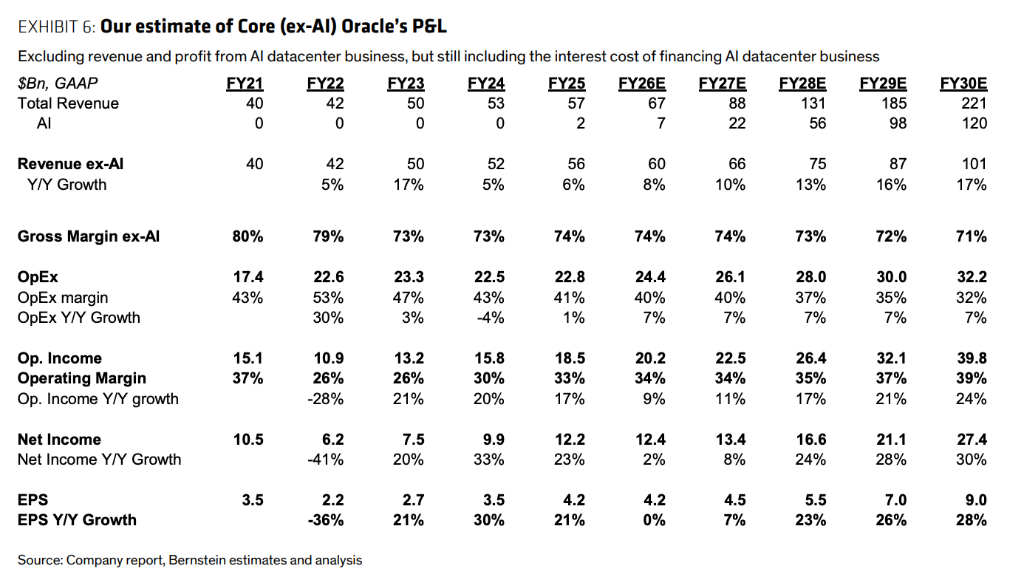
历史新高!集体大涨
券商中国· 2025-09-11 14:51
Core Viewpoint - The recent surge in Japan's stock market, particularly driven by SoftBank Group, is linked to renewed investor enthusiasm for AI and cloud computing, following Oracle's significant stock price increase [1][2][3]. Group 1: Market Performance - On September 11, the Nikkei 225 index rose over 1%, reaching a historical high, with SoftBank Group's stock price increasing nearly 10%, resulting in a market capitalization growth of over 2 trillion yen [1][2]. - SoftBank Group's total market value surpassed 26 trillion yen, while other tech stocks, such as Advantest and Fujikura, also saw notable gains [2]. - Oracle's stock surged nearly 36% on September 10, marking its largest single-day increase since 1992, which contributed to the positive sentiment in the tech sector [2][3]. Group 2: SoftBank and AI Investments - SoftBank's recent stock performance is not only influenced by Oracle but also by the soaring valuation of OpenAI, which raised $40 billion in a funding round led by SoftBank, bringing its valuation to $300 billion [3]. - OpenAI's valuation is projected to reach $500 billion following a proposed sale of shares by current and former employees, indicating a significant increase of nearly 70% in a few months [3]. Group 3: Economic Concerns - Despite the stock market's rise, there are concerns regarding the overall optimism for Japan's economic outlook, as evidenced by the underperformance of bank stocks, which fell nearly 1% [4]. - Analysts express uncertainty about the Bank of Japan's interest rate path, with expectations of a potential rate hike before January 2024, but caution remains due to global economic uncertainties [5].