Powerwall家用储能系统

Search documents
马斯克一句“愚蠢至极”,又得罪了整个硅谷
虎嗅APP· 2025-12-18 13:57
Core Viewpoint - Elon Musk criticized the pursuit of small nuclear fusion reactors on Earth, arguing that the sun serves as a free and efficient nuclear fusion reactor, and called for a halt to investments in such projects unless they are purely for scientific experimentation [5][7]. Group 1: Investment Landscape in Nuclear Fusion - In Silicon Valley, nuclear fusion is viewed as a long-term infrastructure investment rather than a fleeting trend, with nearly $10 billion in private capital expected to flow into the sector by July 2025 [9]. - Major tech figures, including Bill Gates and Jeff Bezos, have made significant investments in nuclear fusion, with Gates' Breakthrough Energy Ventures focusing on long-term clean energy strategies [9][10]. - Commonwealth Fusion Systems (CFS) has raised nearly $3 billion, emerging as a leading contender in the fusion startup space due to its high-temperature superconducting tokamak technology [10][11]. Group 2: The Narrative of Nuclear Fusion - Nuclear fusion is often framed as an "infinite energy" solution, promising abundant fuel sources and minimal carbon emissions, which is particularly appealing in the context of rising energy demands from AI [16]. - The International Energy Agency (IEA) projects that global data center electricity demand will approach 945 terawatt-hours (TWh) by 2030, with AI-specific loads increasing fourfold [16]. - 84% of fusion companies believe they can achieve grid connection by the 2030s, with over half targeting completion by 2035, driven by technological advancements like high-temperature superconductors [16]. Group 3: Challenges and Criticism of Nuclear Fusion - Musk highlighted significant engineering challenges facing terrestrial nuclear fusion, including the need for reactors to produce more energy than they consume, which remains unproven [18][19]. - The cost of building the first commercial fusion reactors is projected to be in the hundreds of billions, with construction timelines exceeding ten years, raising questions about economic viability [19]. - Musk argues that solar energy, which has seen a cost reduction of over 89% in the past decade, is a more practical and cost-effective solution compared to the uncertain future of nuclear fusion [19]. Group 4: Alternative Energy Strategies - Musk advocates for solar energy and storage technologies as the most viable and economically sound energy solutions, proposing that a solar panel area of 100 miles by 100 miles could power the entire United States [20]. - Tesla is actively working on solar products and energy storage systems to address the intermittency issues of traditional solar energy [20][21]. - Musk's vision includes deploying solar energy satellites in space, which would provide continuous power without atmospheric interference, further enhancing energy reliability for AI applications [21][22]. Group 5: Conclusion on Energy Transition - The debate between Musk and other tech leaders reflects differing philosophies on risk and return in energy technology, with fusion representing high-risk, high-reward potential, while solar energy offers more immediate and certain returns [25]. - The future of energy will require balancing the uncertainties of emerging technologies like nuclear fusion with the pressing need for reliable energy sources in the AI era [25].

马斯克一句“愚蠢至极”,又得罪了整个硅谷
3 6 Ke· 2025-12-17 04:17
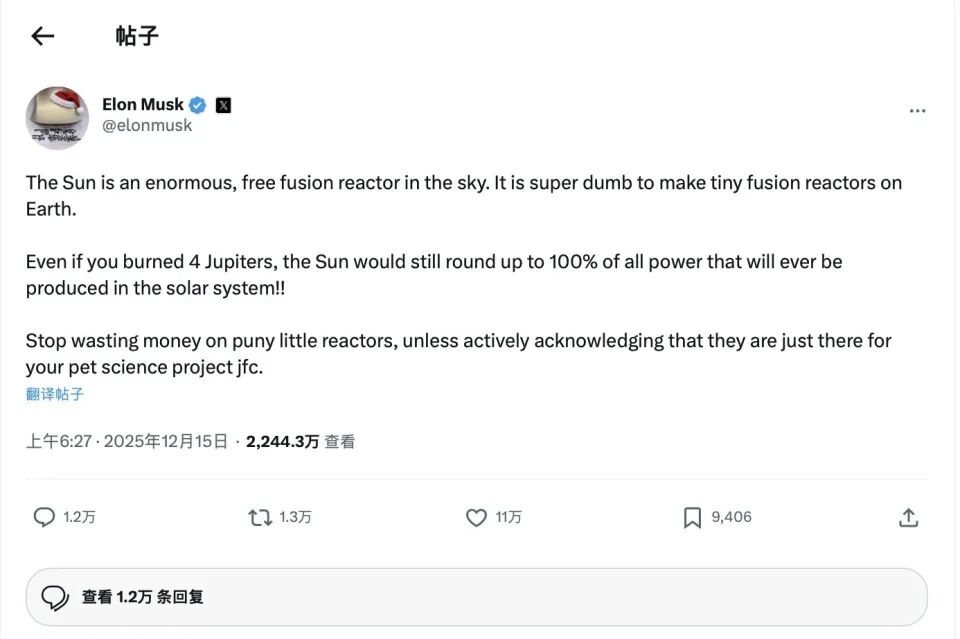
Core Viewpoint - Elon Musk criticized the investment in small nuclear fusion reactors, arguing that the sun serves as a free and efficient nuclear fusion reactor, making such investments "super dumb" [1][2]. Group 1: Investment Landscape in Nuclear Fusion - Significant investments in nuclear fusion have been made by prominent figures in Silicon Valley, including Bill Gates, Jeff Bezos, and Sam Altman, with nearly $10 billion in private capital expected to flow into the sector by July 2025 [5][6]. - The fusion industry is viewed as a long-term infrastructure investment rather than a typical "hot trend," with a focus on developing a "civilization-level infrastructure" that could reshape human technological capabilities [5][6]. - Commonwealth Fusion Systems (CFS) has raised nearly $3 billion, focusing on high-temperature superconducting tokamak technology, which is seen as a promising path toward practical fusion energy [6][7]. Group 2: Diverging Perspectives on Nuclear Fusion - Musk's skepticism towards nuclear fusion highlights the engineering challenges and economic impracticalities associated with terrestrial fusion reactors, which he believes cannot compete with solar energy [15][17]. - The narrative surrounding nuclear fusion as a source of "unlimited energy" continues to attract investment, despite repeated delays in its commercialization [13][14]. - Musk argues that the costs and complexities of developing nuclear fusion reactors are not justified when solar energy has become significantly cheaper and more efficient [16][18]. Group 3: Alternative Energy Strategies - Musk advocates for solar energy and energy storage technologies as the most viable and economically sound solutions for future energy needs, proposing a comprehensive approach that includes both terrestrial and space-based solar energy systems [18][19]. - The concept of deploying solar AI satellites in near-Earth orbit aims to leverage the advantages of space for energy collection, providing continuous power without the limitations faced by ground-based solar systems [19][20]. - The ongoing debate between nuclear fusion and solar energy reflects broader themes in energy transition, emphasizing the need for a balanced approach to risk and return in energy investments [21].
Stellantis整合特斯拉充电系统,有何深意?
Zhong Guo Qi Che Bao Wang· 2025-11-20 05:27
Core Viewpoint - The collaboration between Stellantis and Tesla marks a significant shift towards breaking barriers and accelerating development in the electric vehicle (EV) industry, allowing Stellantis users to access over 28,000 Tesla Supercharger stations starting in 2026 in North America and 2027 in Japan and South Korea [2][3]. Charging Infrastructure - Charging infrastructure has been a critical factor in the development of the EV industry, with many automakers historically building their own networks, leading to fragmentation and user inconvenience [3]. - The adoption of the North American Charging Standard (NACS) by Stellantis allows for hardware compatibility with Tesla's Supercharger stations, facilitating interconnectivity among different brands [3][4]. Market Dynamics - The focus in the EV market has shifted from vehicle performance and pricing to the overall service ecosystem, with charging infrastructure becoming a core consideration for consumers [5]. - Stellantis currently has about 5,000 charging stations in North America, significantly fewer than Tesla's approximately 20,000, which has impacted the market competitiveness of Stellantis vehicles [5][6]. Strategic Advantages - By partnering with Tesla, Stellantis can quickly enhance its charging network, increasing available charging resources for users by over five times, thus improving user experience and brand strength [6][9]. - This collaboration is seen as a "borrowed network" strategy, allowing Stellantis to save billions in infrastructure investments and focus on electric technology development [8]. Brand Image and Differentiation - The partnership with Tesla enhances Stellantis's brand image by associating it with Tesla's technological leadership in the EV sector, potentially increasing consumer recognition and acceptance [9]. - The collaboration provides Stellantis's upcoming electric models with a unique charging service advantage, crucial for differentiation in a crowded market [9]. Industry Evolution - The Stellantis-Tesla partnership reflects a broader trend in the EV industry towards ecosystem development, where electric vehicles evolve into energy storage and distribution nodes, contributing to sustainable transportation [10][11].


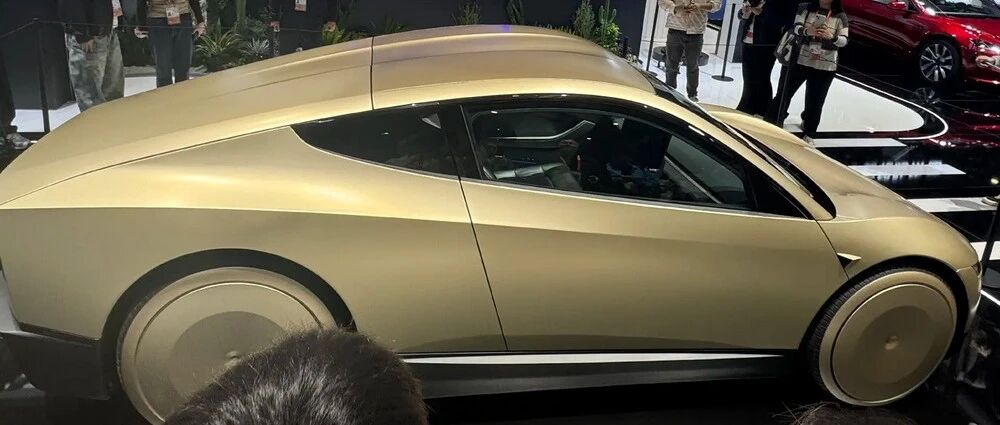
Cybercab亚太首秀,明年二季度计划量产
2 1 Shi Ji Jing Ji Bao Dao· 2025-11-07 13:15
Group 1 - Tesla's annual shareholder meeting approved Elon Musk's compensation plan, which could reach up to $1 trillion, involving the grant of up to 423.7 million restricted stock units, representing approximately 12% of the company's total shares [1] - Musk must achieve specific market capitalization and operational goals to unlock the stock awards, including increasing Tesla's market value from approximately $1 trillion to $8.5 trillion, delivering 20 million vehicles, and achieving significant milestones with FSD subscriptions and Optimus robots [1] - The Tesla Cybercab, a key product related to Musk's compensation performance, was showcased at the 8th China International Import Expo, featuring a design without a steering wheel or pedals and utilizing Tesla Vision for autonomous driving [2] Group 2 - The Cybercab is designed for 1-2 passengers and aims to meet 92% of ride-hailing scenarios, with plans to start mass production in Q2 2026 for Tesla's Robotaxi fleet [2] - Tesla is also developing humanoid robots, with production lines expected to start by the end of 2026 and a target of 1 million units annually by 2030 [2] - Tesla showcased its energy products, including Solar Roof, Powerwall, and Megapack, with record installations of Powerwall systems leading to a total energy product installation of 12.5 GWh by Q3 2025 [3]
Cybercab亚太首秀,明年二季度计划量产丨南财看进博
2 1 Shi Ji Jing Ji Bao Dao· 2025-11-07 12:33
Core Points - Tesla's annual shareholder meeting approved Elon Musk's compensation plan, potentially worth up to $1 trillion, involving the grant of up to 423.7 million restricted stock units, representing approximately 12% of the company's total equity [2] - Musk must achieve specific market capitalization and operational goals to unlock the stock awards, including increasing Tesla's market value from around $1 trillion to $8.5 trillion and delivering 20 million vehicles [2] Group 1 - The Tesla Cybercab, a driverless electric vehicle, was showcased at the expo, featuring no steering wheel or pedals and utilizing Tesla Vision for autonomous driving without expensive hardware [3] - The Cybercab is designed for 1-2 passengers and aims to meet the majority of ride-hailing scenarios while also serving as a small freight vehicle [3] - Production of the Cybercab is planned to start in Q2 2026, intended for Tesla's Robotaxi fleet [3] Group 2 - Tesla is also advancing its humanoid robot, Tesla Bot, which shares technology with its electric vehicles and will begin production by the end of 2026, targeting an annual output of 1 million units by 2030 [3] - The third-generation humanoid robot is set to be released in Q1 2026 [3] Group 3 - Tesla emphasized its identity as an energy company, showcasing products like Solar Roof, Powerwall, V4 Supercharger, and Megapack at the expo [4] - The installation of Tesla's energy products reached a record 12.5 GWh by Q3 2025, driven by the ramp-up of the Shanghai energy storage factory and Powerwall installations [4]
没有方向盘、脚踏板!特斯拉无人驾驶车亮相
财联社· 2025-11-04 14:40
Core Points - The 8th China International Import Expo (CIIE) will officially open on November 5, 2023, featuring participation from 155 countries and regions, with 4,108 foreign enterprises exhibiting, an increase of over 600 from last year [3][4] - The exhibition area exceeds 430,000 square meters, with over 367,000 square meters dedicated to enterprises, marking a new record in scale [3] - Tesla showcased its Cybercab autonomous electric vehicle, which is set to begin mass production in Q2 2026, and aims to significantly reduce transportation costs [5][7] - Tesla's Robotaxi service is expected to expand to 8-10 urban areas by the end of 2025, with operational costs projected to be lower than existing transportation options [8] - Westwell Technology, a participant in the expo, has expanded its logistics solutions globally, with nearly 1,000 autonomous vehicles in operation [11][13] - The expo will feature 461 new products, technologies, and services, highlighting innovations in low-altitude economy and humanoid robots [15][16] Group 1 - The 8th CIIE will have 155 participating countries and regions, with 4,108 foreign enterprises exhibiting, a significant increase from last year [3] - The exhibition area exceeds 430,000 square meters, with over 367,000 square meters for enterprises, setting a new record [3] - The event will host 43 trading groups and over 700 sub-groups for procurement discussions, with professional audience registration reaching 449,500 [3] Group 2 - Tesla's Cybercab, featuring no steering wheel or pedals, is designed for AI and aims for mass production in 2026, with a range of approximately 10 kilometers per kilowatt-hour [5][7] - The Robotaxi service has accumulated over 400,000 kilometers in Austin and over 1.6 million kilometers in the Bay Area, with plans to eliminate safety drivers in the coming months [8] - Tesla's humanoid robots are expected to start production by the end of 2026, with a target of 1 million units annually by 2030 [8][10] Group 3 - Westwell Technology has expanded its logistics services to 28 countries, with its autonomous vehicles operating in various logistics scenarios [11][13] - The company showcased its Q-Truck and Q-Tractor models at the expo, highlighting their applications in international logistics [13] - The expo will present innovations in low-altitude economy and humanoid robots, with 461 new products and technologies on display [15][16]
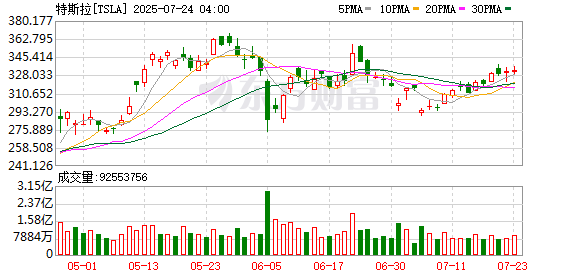
特斯拉暴跌8%,交出10年来最惨季报
21世纪经济报道· 2025-07-24 15:26
Core Viewpoint - Tesla's second-quarter performance has been disappointing, with significant declines in revenue and net profit, leading to a notable drop in stock price and raising concerns about its market position and future growth prospects [2][4][5]. Group 1: Financial Performance - In Q2 2025, Tesla reported revenue of $22.496 billion, a 12% year-over-year decline, marking the largest quarterly drop in over a decade [2]. - Net profit attributable to common shareholders was $1.172 billion, down 16% year-over-year, while the gross margin fell to 17.2% from 18% in the same period last year [2]. - Automotive sales revenue decreased by 16% year-over-year to $16.661 billion, with total revenue experiencing a 12% decline, the largest single-quarter revenue drop since 2012 [5]. Group 2: Sales and Market Dynamics - Tesla's global vehicle deliveries fell to 384,100 units in Q2, a decrease of nearly 60,000 units or 13.5% year-over-year, marking two consecutive quarters of double-digit declines [4]. - In contrast, Tesla's sales in China reached 129,000 units, accounting for 34% of global sales, with June sales hitting a record high of 61,484 units, a 59% month-over-month increase [4]. - The company faced a significant drop in the European market, with new car registrations in the EU plummeting by 40.5% year-over-year in May, resulting in a market share decline to 1.2% [4][10]. Group 3: Competitive Landscape - Tesla is experiencing intensified competition from domestic Chinese automakers, with BYD surpassing Tesla in pure electric vehicle sales in Europe for the first time in April, showing a staggering 359% year-over-year growth [9][10]. - Other Chinese brands like Geely and SAIC have also seen significant increases in new car registrations, further challenging Tesla's market position [10][11]. - Tesla's market share in China has shrunk from a peak of 15% in 2020 to 7.6% in the first half of 2025, indicating growing pressure from local competitors [10]. Group 4: Strategic Adjustments - In response to its challenges, Tesla is adjusting its product strategy, including plans to launch a more affordable model by the end of the year, which is expected to alleviate some market pressures [13]. - The company is also focusing on expanding its Robotaxi service, which has already logged over 7,000 miles since its launch, with plans for broader rollout pending regulatory approval [13][14]. - Tesla's energy storage business has shown growth, with a record 9.6 GWh of new installations in Q2, contributing to a historical high in energy business gross profit of $846 million [7][14].
特斯拉的“三重困境”
2 1 Shi Ji Jing Ji Bao Dao· 2025-07-24 13:28
Core Insights - Tesla reported its worst quarterly performance in a decade for Q2 2025, with revenue of $22.496 billion, a 12% year-over-year decline, and net profit of $1.172 billion, down 16% [2] - CEO Elon Musk indicated that the upcoming quarters may be "very difficult," while also presenting a vision for the future involving Robotaxi, humanoid robots, and fully autonomous driving technology [2] Financial Performance - Q2 revenue fell short of Wall Street expectations, marking the largest quarterly revenue drop in over a decade [2] - Automotive sales revenue decreased by 16% year-over-year to $16.661 billion, while total revenue saw a 12% decline, the largest since 2012 [5] Global Sales Dynamics - Tesla's global deliveries fell to 384,100 units, a 13.5% decrease year-over-year, marking the most significant decline since 2015 [4] - In contrast, the Shanghai Gigafactory achieved a record delivery of 191,720 units, accounting for 47% of global production [4] - In China, Tesla delivered 129,000 vehicles in Q2, contributing 34% to global sales, with June sales reaching a peak of 61,484 units, a 59% month-over-month increase [4] Market Challenges - Tesla faces significant challenges in North America due to the impending expiration of the $7,500 EV tax credit, which has been a key driver for the U.S. EV market [6] - Increased tariffs have added approximately $300 million in costs, with one-third impacting the battery division [7] - The company is also experiencing intense competition from domestic brands in Europe and China, with BYD surpassing Tesla in pure electric vehicle sales in Europe [8][9] Strategic Adjustments - Tesla is shifting its product strategy, planning to launch a more affordable model by the end of the year, which has already begun production [10] - The company is focusing on expanding its Robotaxi service, which has already logged over 7,000 miles in Austin, with plans for broader rollout pending regulatory approval [10] Growth Opportunities - Tesla's energy storage business has shown growth, with a record 9.6 GWh of new installations in Q2, contributing to a historical high in energy business gross profit of $846 million [5] - The company is also developing a third-generation humanoid robot, with plans for production to begin next year and a target of 10,000 units annually within five years [11]