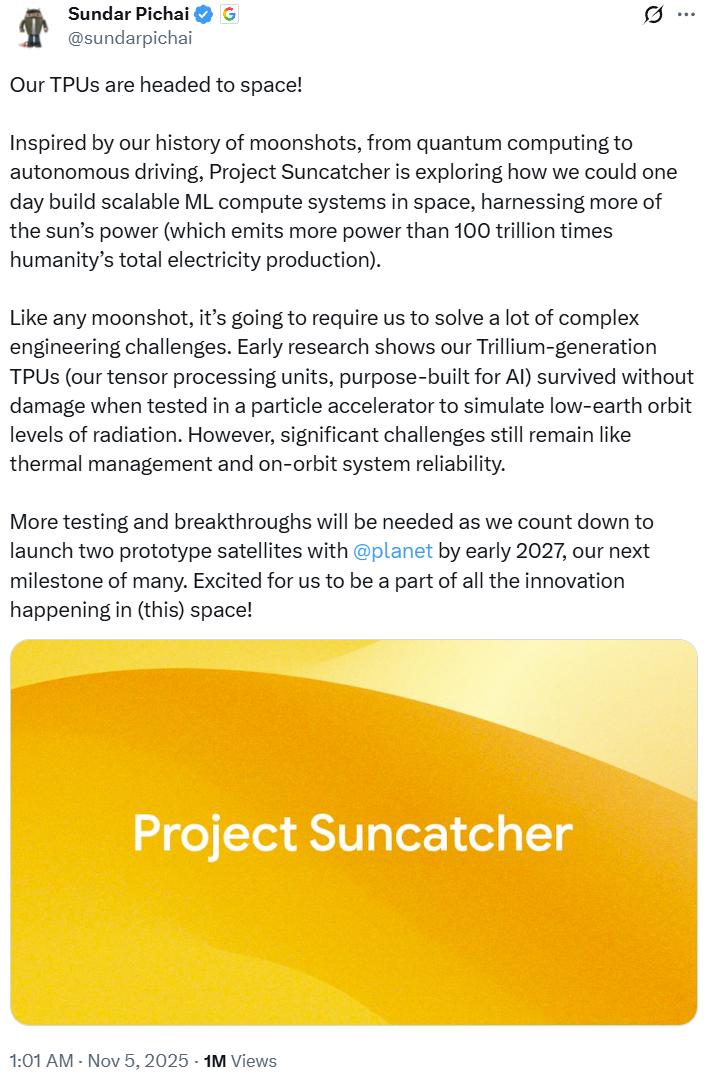
Project Suncatcher

Search documents
计算机行业周报:天河之力:大国运载与星辰棋局-20251221
HUAXI Securities· 2025-12-21 07:57
Investment Rating - Industry Rating: Recommended [4] Core Insights - SpaceX's target valuation is approximately $800 billion, with a fundraising scale of about $40 billion from the sale of 5% of its shares, reflecting strong market enthusiasm for the space sector [16][24] - ARK's valuation model suggests that SpaceX's enterprise value could reach around $2.5 trillion by 2030, with optimistic scenarios estimating up to $3.1 trillion and pessimistic scenarios around $1.7 trillion, heavily reliant on the rapid reusability of the Starship [16][25] - SpaceX achieved 144 launches in 2025, surpassing all other entities combined, indicating a recovery signal for the industry [16][36] Summary by Sections 1. SpaceX Valuation and Market Position - SpaceX's expected revenue for 2025 is projected to exceed $15.5 billion, supporting its high valuation [23] - The company has seen its valuation double from $400 billion in July to $800 billion in December 2025, showcasing the market's positive outlook on the space industry [24] - The Falcon 9 rocket has a recovery success rate exceeding 98%, with launch costs reduced to $27 million per mission [16][36] 2. Lunar Competition and International Developments - The U.S. government is accelerating its space capabilities, including plans to deploy nuclear reactors on the Moon by 2030 and return humans to the Moon by 2028 through the Artemis program [17][51] - South Korea's INNOSPACE successfully launched its "Hanlight-NANO" rocket, marking a significant milestone for private space ventures in the country [17][52] - China's Long March 10 rocket is expected to make its maiden flight in mid-2026, capable of supporting deep space missions [17][6] 3. Investment Recommendations - Beneficiary stocks in the rocket sector include Aerospace Power, Superjet, Western Materials, and others [20] - Satellite-related companies include West Measurement Testing, Tianyin Electromechanical, and others [20] - Companies involved in space computing include Shunhao Co., Puxian Technology, and others [20]
AI算力“逃离地球”?谷歌宣布“追日者”计划,2027年拟在太空部署AI数据中心
硬AI· 2025-12-17 13:58
Core Viewpoint - Google is attempting a groundbreaking infrastructure experiment with "Project Suncatcher," aiming to establish a space-based data center powered by solar energy to alleviate the energy and computational bottlenecks associated with AI [3][4]. Group 1: Project Overview - The project involves a cluster of 81 satellites equipped with AI chips, which will operate in a sun-synchronous orbit approximately 650 kilometers from Earth, providing near-constant solar energy for high-energy AI workloads [3][5]. - Google plans to collaborate with Planet to launch two prototype satellites into low Earth orbit by 2027 as the first step of this initiative [3][5]. - The project aims to circumvent the challenges faced by terrestrial data centers, such as complex planning approvals and local opposition, as well as the inability of existing power grids to meet the surging energy demands of AI [5] Group 2: Challenges and Risks - The ambitious plan faces significant technical and economic challenges, including high launch and maintenance costs, risks from space radiation, collision hazards, and the increasing congestion of orbital traffic [4][7]. - The proximity of satellites (100 to 200 meters apart) raises concerns about collision risks, which could lead to catastrophic chain reactions in the already crowded near-Earth orbit [7][8]. - The project also raises governance issues regarding space, as the increasing number of satellites could interfere with astronomical observations and contribute to light pollution and radio interference [11] Group 3: Industry Context - Microsoft's previous attempt with underwater data centers (Project Natick) ended without further plans, highlighting the increasing difficulty of establishing data centers in unconventional environments like space [9][10]. - The cost of space-based power remains comparable to terrestrial power, and despite decreasing launch costs due to companies like SpaceX, significant economic advantages have yet to be realized [9][10]. - The project reflects a broader trend in the tech industry, where companies are exploring unconventional solutions to address energy concerns while also showcasing the potential for AI scalability [3][11].



Gavin Baker On Why 'Crazy Idea' Of Space Data Centers Is Actually Logical, 'Superior' In Every Way - Alphabet (NASDAQ:GOOGL)
Benzinga· 2025-12-10 08:48
Core Insights - The concept of space-based data centers is gaining traction as a viable solution to the limitations of terrestrial data centers, particularly in the context of AI scaling [2][8] - Veteran technology investor Gavin Baker argues that data centers in space are economically superior due to the unique advantages offered by the space environment [3][4] Economic Advantages - The two most significant costs for AI data centers are power and cooling, which are mitigated in space due to the natural conditions [4] - Solar energy in space is 30% more intense without atmospheric interference, reducing the need for costly battery backups [5] - The vacuum of space allows for efficient cooling, as heat can be dissipated using radiators, making cooling effectively free [5] Speed and Latency - Data transmission in space can be faster than on Earth, as light travels quicker through a vacuum than through fiber optics [6] - A network of satellites using laser communication could provide lower latency compared to terrestrial systems [6] Industry Trends - Major tech companies are investing in space-based data centers, with Alphabet planning to deploy prototype servers by 2027 [7] - OpenAI is exploring partnerships to secure launch capabilities, indicating a competitive landscape in the space data center sector [7] Economic Necessity - As AI demands increase and strain existing utility grids, the shift to space-based computing is becoming a logical necessity rather than a mere concept [8]


Elon Musk Calls Google's Space Data Center Plan 'Interesting' As Pichai Targets 2027 Launch - Alphabet (NASDAQ:GOOGL)
Benzinga· 2025-12-09 09:06
Core Insights - Alphabet Inc. is advancing its "Suncatcher" plan to deploy data centers in space, with prototype servers expected to launch by 2027 to address terrestrial power limitations [1][5] - The initiative aims to utilize solar energy in orbit, which is more efficient than terrestrial solar energy harvesting [2] - The project is seen as a "moonshot" akin to Waymo and Google Quantum AI, with the potential to revolutionize data processing [2] Project Overview - The roadmap for Project Suncatcher begins in 2027, with plans to send small racks of machines to satellites for testing thermal management and reliability [3] - If successful, the project could lead to a significant shift of AI training operations off-planet within a decade [6] SpaceX Collaboration - The logistics of launching heavy server racks into orbit are expected to rely on SpaceX's capabilities, particularly the Starship, which is deemed critical for this initiative [4] - Elon Musk's interest in the project highlights the potential collaboration between Alphabet and SpaceX [4] Industry Context - The push for orbital computing is a response to a severe "power bottleneck" faced by tech companies due to increasing AI demands [5] - Google's Project Suncatcher aims to create a zero-carbon, always-on computing layer to alleviate these energy constraints [5] Financial Performance - Alphabet's stock has shown strong performance, with GOOG shares rising 65.12% year-to-date, outperforming the Nasdaq Composite and Nasdaq 100 indices [7] - Class C shares have increased by 78.17% over the year, indicating robust market confidence [7]

Elon Musk Touts Solar As 'Biggest Source of Power' As AI Industry Scrambles For Energy Solutions - CMS Energy (NYSE:CMS), Amazon.com (NASDAQ:AMZN)
Benzinga· 2025-11-14 06:25
Group 1 - Elon Musk predicts that solar electricity will become the primary power source for civilization, addressing the energy crisis driven by AI demands [1][2] - The global power demand is expected to increase by 30% by 2035, primarily due to the energy needs of AI, leading to concerns that electricity rates could double in five years [2][5] - Industry leaders are proposing innovative solutions to the energy crunch, including orbital data centers and floating data centers utilizing cold seawater for cooling [3][4] Group 2 - Musk's SpaceX Starship is identified as a critical technology for making orbital data centers economically viable, highlighting the connection between Musk's ventures and the AI industry's power challenges [5][6] - Notable companies in the solar and energy sectors have shown strong year-to-date and one-year performance, with Sunrun Inc. leading at 84.82% YTD [7]

AI太空竞赛?英伟达H100刚上天,谷歌Project Suncatcher也要将TPU送上天
3 6 Ke· 2025-11-05 02:20
Core Insights - Nvidia has launched its H100 GPU into space, marking a significant milestone in space-based AI infrastructure, while Google has announced its own initiative, Project Suncatcher, to utilize solar energy for AI processing in space [1][3] - Project Suncatcher aims to create a scalable AI infrastructure using a constellation of satellites equipped with TPUs and free-space optical communication links, leveraging the vast energy from the sun [6][8] Project Overview - Project Suncatcher is designed to explore the potential of solar-powered satellite constellations to enhance machine learning capabilities in space, with the sun's energy being 1 trillion times greater than human electricity production [6][8] - Google plans to launch two prototype satellites in early 2027 in collaboration with Planet, addressing engineering challenges such as thermal management and system reliability in orbit [3][18] Technical Challenges - The system will require high-bandwidth, low-latency inter-satellite links to distribute machine learning workloads effectively, aiming for performance comparable to ground data centers [8][10] - Google has developed models to analyze the orbital dynamics of tightly clustered satellites, ensuring they can maintain stable orbits with minimal propulsion [10][12] TPU Radiation Resistance - Google's Trillium TPU has undergone radiation testing, demonstrating resilience to total ionizing dose and single-event effects, making it suitable for space applications [14][13] Economic Viability - Historical data suggests that satellite launch costs could drop below $200 per kilogram by the mid-2030s, making space-based data centers economically feasible [15][18] - The analysis indicates that the operational costs of space-based data centers could become comparable to terrestrial counterparts in terms of energy costs [15] Future Directions - The next milestone for Google involves executing a "learning mission" to test TPU hardware and models in space, paving the way for potential gigawatt-scale satellite constellations [18][19]