
太空基建

Search documents
太空行业深度报告:SpaceX:构建全球太空基建与算力生态的“超级巨头”
Guolian Minsheng Securities· 2026-03-30 15:02
Investment Rating - The report maintains a "Buy" rating for the space industry, specifically for SpaceX [1]. Core Insights - SpaceX is transitioning from a launch service provider to a space infrastructure operator, driven by advancements in Starship and the emergence of space computing [8]. - The valuation of SpaceX has evolved to reflect a three-layer asset model: cash flow assets from launch services, global network assets from Starlink, and optionality from future space computing capabilities [20][22]. - The report highlights the industrialization of rocket capabilities, emphasizing the cost reduction and scalability achieved through innovations like 3D printing [7][43]. Summary by Sections 1. SpaceX: Valuation and Vision - SpaceX's valuation history shows significant growth through three phases: commercial launches, satellite services, and now space infrastructure [17][19]. - The current valuation of $1.5 trillion is attributed to the combination of cash flow from launch services, network assets from Starlink, and future growth potential from Starship [22]. 2. Rocket Technology and Advanced Manufacturing - SpaceX's rocket technology has evolved from Falcon to Starship, with a focus on reusability and cost efficiency [29][31]. - The integration of 3D printing technology has significantly reduced manufacturing costs and production times, enabling a shift from low-frequency custom production to industrial-scale manufacturing [43][46]. 3. Starlink: From Global Connectivity to Space Computing - Starlink is evolving from a broadband service to a space computing platform, with plans to deploy a million satellites to support AI computing needs [58][62]. - The report outlines three key challenges for Starlink's transition to a space computing center: building a scalable satellite platform, creating a low-latency network, and ensuring reliable operation in extreme space environments [61][69]. 4. Investment Recommendations - The report suggests focusing on high-performance satellite energy systems and advanced communication hardware suppliers as potential investment opportunities [11]. - It also recommends monitoring developments in next-generation aerospace manufacturing technologies and satellite applications that benefit from the diversification of satellite internet services [11].
正式進入全民「老富壯」世代!財富再洗牌!Ark Invest Big Ideas 2026 【邦妮區塊鏈】
邦妮區塊鏈 Bonnie Blockchain· 2026-02-23 11:00
🧑🏻🏫個人英語 AI 教練這裡找:https://tinyurl.com/elsa-bonnie-feb2026-yt 📍現在到3月2號新春限時特賣!最多人喜歡的終身版趁現在超划算, 結帳時使用優惠碼[BONNIE],享受超值折扣!優惠只適用於本專屬連結。 方舟投資木頭姐的年度報告《ARK Invest Big Ideas 2026》拆解5 大底層科技 × 13 項顛覆式創新!這集第三部曲我們談的是人類壽命跟太空科技帶來的生活圈延伸。看完這集記得點資訊欄連結收看前二部曲精彩內容! 讓我們一起拆解 ARK Invest Big Ideas 2026,聚焦長壽科技、太空基建與區塊鏈革命,人類壽命上看150歲能帶來哪些龐大的投資機會? #科技 #ai #長壽 #太空 #財富 #加密貨幣 #crypto #money #AI泡沫 #方舟科技 #BigIdeas #特斯拉 #馬斯克 #ElonMusk #長生不老 #科幻 ⭐2026科技趨勢首部曲!絕不能錯過的世紀致富機會! ►https://youtu.be/KnQ7auf93tY ⭐2026幣圈預言二部曲!比特幣最悲觀預測曝光! ►https://youtu.be ...


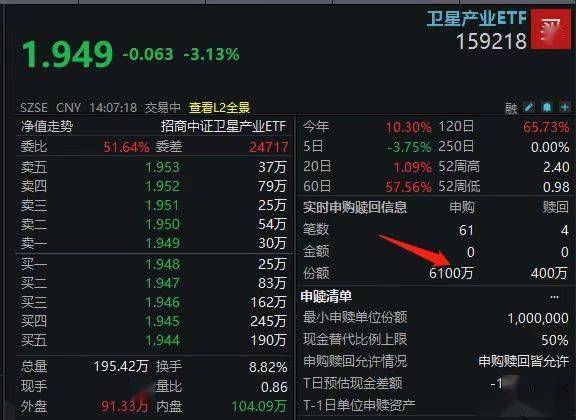
谁在抛,谁在买?暴跌3%的卫星产业ETF(159218)狂揽过亿,万亿"太空基建"逻辑生变?
Sou Hu Cai Jing· 2026-02-04 06:34
Core Viewpoint - The satellite industry ETF experienced a significant drop, but over 110 million yuan flowed into the ETF during the decline, indicating a "buy the dip" mentality among investors [1][4]. Group 1: Market Performance - As of February 4, the satellite industry ETF (159218) fell by 3.13%, with major component stocks like Xinwei Communication and Zhenlei Technology dropping over 9% [1]. - The ETF's net value showed a decline of 3.13%, with a 120-day increase of 10.30% and a 250-day decrease of 3.75% [2]. Group 2: Causes of the Decline - Internal factors include profit-taking by short-term investors, as the sector had seen a nearly 58% increase over the past three months, leading to a concentrated sell-off during market adjustments [2][3]. - External factors involve a sudden drop in risk appetite for global tech stocks, affecting sectors like AI and semiconductors, which amplified the volatility in the A-share satellite sector [3]. Group 3: Investor Sentiment and Strategic Insights - The lack of new catalysts and a divergence in market views on rapid short-term gains and valuations highlighted the need for a technical correction [4]. - The influx of over 110 million yuan into the ETF during the downturn reflects a strategic accumulation by long-term investors, viewing the drop as a "golden opportunity" [4]. - Three core values driving this sentiment include: 1. Strategic certainty: Low-orbit satellite internet has evolved from a tech concept to a national strategic infrastructure [4]. 2. Industry explosiveness: The year 2026 is pivotal for domestic commercial space, transitioning from storytelling to performance [4]. 3. Tool scarcity: As the first satellite-themed ETF in the market, it has become a primary tool for capital allocation in the space economy [4].
中国航天发布“十五五”蓝图,万亿级太空基建时代开启
Jin Rong Jie· 2026-02-02 12:04
Core Viewpoint - The China Aerospace Science and Technology Corporation (CASC) has unveiled a new blueprint for the "14th Five-Year Plan" period, focusing on the development of four key areas in commercial space: space tourism, space digital infrastructure, space resource development, and space traffic management, marking a significant shift towards industrialization and large-scale application in China's commercial space sector [1] Strategic Drivers - Establishing space as a new infrastructure hotspot is driven by the dual imperatives of national security and economic development. The increasing number of satellites in orbit (approximately 15,000, with the U.S. accounting for over half) necessitates an effective space traffic management system to ensure the safety of national space assets [2] - The global space economy is projected to grow from approximately $600 billion in 2024 to $1.8 trillion by 2035, highlighting the vast economic potential of space, including the mining of rare elements from celestial bodies [2] Four Key Tracks - The four identified tracks for future space economy development include: 1. **Space Tourism**: Aiming to develop mature suborbital and orbital flight products and establish a comprehensive operational system for suborbital tourism [3] 2. **Space Digital Infrastructure**: Plans to build gigawatt-level space computing facilities to enable "space intelligence" and liberate space-based productivity [3] 3. **Space Resource Development**: The "Tian Gong Kai Wu" initiative will focus on comprehensive experimental systems for space resource development, moving from conceptualization to systematic engineering [3] 4. **Space Traffic Management**: Emphasizing the need for monitoring, early warning, and removal technologies for space debris to ensure safety and gain a proactive stance in future international regulations [3] Solid Foundation - China's advancements in space technology include the establishment of a comprehensive infrastructure network and breakthroughs in metal 3D printing in microgravity, alongside the testing of reusable rockets to significantly reduce space access costs [4] - Policy support is also strengthening, with the establishment of a Commercial Space Bureau by the National Space Administration in 2025 and the release of a three-year action plan to facilitate industry development [4] Market Opportunities - The announcement of this national strategy has garnered significant attention in the capital markets, with expectations that 2026 will be a pivotal year for commercial space. Domestic policy support is unprecedented, and leading companies are likely to achieve breakthroughs in capital markets [6] - The potential successful listings of international commercial space leaders could lead to a revaluation of the global industry chain [6]
“基建狂魔”,要上太空了!
Jing Ji Ri Bao· 2026-02-02 08:01
Core Viewpoint - The China Aerospace Science and Technology Corporation has unveiled a new blueprint for the "14th Five-Year Plan," focusing on the development of space tourism, smart space infrastructure, space resource development, and space traffic management, marking a significant shift in infrastructure development towards space [1] Group 1: Security Perspective - Space is considered a "high frontier" for national security, with approximately 15,000 satellites in orbit globally, over half of which are owned by the United States [2] - The increasing congestion in low Earth orbit raises collision risks, necessitating the establishment of a space traffic management system to ensure safety [2] - Developing key technologies for space debris monitoring, early warning, and removal is crucial for securing China's position in international space traffic management rules [2] Group 2: Economic Perspective - The global space economy is projected to reach approximately $600 billion in 2024, with forecasts suggesting it could grow to $1.8 trillion by 2035 [2] - Space resource development, including mining on the Moon and asteroids, is expected to turn the concept of "space mining" into reality, driven by the rich resources available beyond Earth [2] - Building gigawatt-level smart space infrastructure is essential for unleashing space-based productivity and accelerating the development of the space economy [2] - Space tourism is anticipated to emerge as a new engine for consumer spending [2] Group 3: Current Capabilities - China has established a solid foundation for advancing space infrastructure, with significant technological advancements in satellite navigation and space computing [3] - Successful return of lunar soil samples and breakthroughs in 3D metal printing in microgravity demonstrate China's growing capabilities in space technology [3] - The development of reusable rockets is entering a verification phase, which is expected to significantly reduce launch costs [3] - Favorable policies, such as the establishment of a commercial space administration and initiatives to promote the utilization of commercial satellite data, are emerging [3] Group 4: Challenges Ahead - Technical challenges remain, particularly in the maturity of reusable rocket technology and the need for breakthroughs in key areas such as resource exploration and autonomous mining [4] - There is a significant regulatory gap in international space law, with existing treaties not adequately addressing current commercial space activities [4] - High capital risks associated with commercial space ventures necessitate a layered approach to investment, breaking down operations into independently profitable modules to lower entry barriers for private capital [4]
中经评论:下一个基建热点在太空
Jing Ji Ri Bao· 2026-02-02 00:05
Core Viewpoint - The China Aerospace Science and Technology Corporation has unveiled a new blueprint for the "14th Five-Year Plan," focusing on the development of space tourism, space digital infrastructure, space resource development, and space traffic management, marking a significant shift towards space as a new infrastructure hotspot in China [1] Group 1: Security Perspective - Space is considered a "high frontier," with approximately 15,000 satellites in orbit globally, over half of which are owned by the United States. The increasing congestion and collision risks in low Earth orbit necessitate the establishment of a space traffic management system [2] - The risks of satellite collisions, particularly between the U.S. Starlink satellites and the Chinese space station, highlight the urgent need for monitoring, early warning, and debris removal technologies to ensure safe operations in space [2] Group 2: Economic Perspective - The global space economy is projected to reach approximately $600 billion in 2024, with forecasts suggesting it could grow to $1.8 trillion by 2035. This growth is driven by the potential for resource extraction from celestial bodies, making "space mining" a feasible reality [2] - The construction of gigawatt-level space digital infrastructure is essential for deploying computing power in space, which will accelerate the development of the space economy. Additionally, space tourism is expected to emerge as a new engine for consumer spending [2] Group 3: Current Capabilities - China has established a solid foundation for advancing space infrastructure, with significant technological advancements such as the successful return of lunar soil samples and breakthroughs in 3D metal printing in microgravity environments [3] - The country is also in the process of developing reusable rocket technology, which is expected to significantly reduce launch costs [3] - Favorable policies are emerging, including the establishment of a Commercial Space Administration by the National Space Administration and initiatives to promote the development and utilization of commercial satellite remote sensing data [3] Group 4: Challenges Ahead - There are numerous technical challenges to overcome, including the maturity of reusable rocket technology and the need for breakthroughs in key technologies for space resource utilization [4] - Legal frameworks are lacking, with existing international space laws not adequately addressing the current commercial space landscape, necessitating the acceleration of space law legislation and active participation in international rule-making [4] - The high capital risk associated with commercial space ventures, characterized by long cycles and high uncertainty, calls for a layered approach to investment, allowing for independent profitability of different modules within the space industry [4]
下一个基建热点在太空
Jing Ji Ri Bao· 2026-02-01 21:56
Core Viewpoint - The China Aerospace Science and Technology Corporation has unveiled a new blueprint for the "14th Five-Year Plan," focusing on the development of space tourism, smart space infrastructure, space resource development, and space traffic management, marking a significant shift towards space as a new infrastructure hotspot in China [1] Group 1: Security Perspective - Space is considered a "high frontier" for national security, with approximately 15,000 satellites in orbit globally, over half of which are owned by the United States [2] - The increasing congestion in low Earth orbit raises collision risks, necessitating the establishment of a space traffic management system to ensure safety [2] - Developing key technologies for space debris monitoring, early warning, and removal will enhance China's position in international space traffic management rule-making [2] Group 2: Economic Perspective - The global space economy is projected to reach approximately $600 billion in 2024, with forecasts suggesting it could grow to $1.8 trillion by 2035 [2] - Space resource development, including mining on the Moon and asteroids, is expected to turn the concept of "space mining" into reality, driven by the rich resources available beyond Earth [2] - Building gigawatt-level smart space infrastructure is crucial for unleashing space-based productivity and accelerating the development of the space economy [2] Group 3: Current Capabilities - China has established a solid foundation for advancing space infrastructure, with significant technological advancements such as the successful return of lunar soil samples and breakthroughs in 3D metal printing in microgravity [3] - The country is in the process of developing a comprehensive infrastructure network that integrates terrestrial and space systems [3] - Favorable policies are emerging, including the establishment of a Commercial Space Administration and initiatives to promote the development and utilization of commercial satellite remote sensing data [3] Group 4: Challenges Ahead - There are significant technical challenges, particularly in reusable rocket technology and the development of key technologies for space resource utilization [4] - Legal frameworks are lacking, with existing international space laws not adequately addressing the current commercial space landscape, necessitating accelerated legislative efforts [4] - The high capital risk associated with commercial space ventures requires a layered approach to investment, breaking down operations into independently profitable modules to lower entry barriers for private capital [4]
太空基建不断加速-持续看好商业航天与卫星产业链
2026-01-29 02:43
Summary of Key Points from Conference Call Industry Overview - The conference call focuses on the commercial aerospace and satellite industry, highlighting rapid advancements and investment opportunities in this sector [1][2]. Core Insights and Arguments - **Rocket Reusability**: Breakthroughs in rocket reusability technology are expected by 2026, which will lower launch costs and enhance competitiveness in commercial aerospace [1][2]. - **Low Earth Orbit (LEO) Satellite Internet**: The development of LEO satellite internet is accelerating, with Starlink achieving near 5G speeds and increasing its user base from 2 million in 2022 to approximately 8-9 million currently [2][4]. - **Global Expansion of LEO Networks**: Companies like Blue Origin and OneWeb are expanding their LEO satellite networks, with OneWeb planning to deploy over 400 satellites [2][3]. - **China's Strategic Moves**: China has applied for frequency resources for 203,000 LEO and medium Earth orbit satellites, indicating a strategic push to secure limited resources in the satellite industry [3][4]. - **Technological Integration**: The integration of commercial aerospace with AI and other emerging technologies is expected to enhance data processing capabilities and improve applications in various sectors [5][6]. Investment Opportunities - **Space Infrastructure**: Investment opportunities include space computing, solar power, 3D printing, and satellite internet, particularly in the context of 6G technology [8][9]. - **LEO Satellites**: There is a significant demand for upgrading TR components and antenna sizes to improve signal quality and bandwidth [9][10]. - **Platform and Service Companies**: Companies providing production testing solutions and satellite asset management services are poised for growth as the industry expands [10][11]. Additional Important Insights - **Technological Innovations**: Key innovations include larger antenna arrays for better connectivity, advanced TR components to counteract Doppler frequency shifts, and upgrades in baseband payloads to meet higher bandwidth demands [12][13][14]. - **Market Dynamics**: The satellite industry is experiencing a shift from mere transmission capabilities to include space computing and solar power, driven by increasing demand and limited supply [7][8]. This summary encapsulates the essential points discussed in the conference call, providing a comprehensive overview of the commercial aerospace and satellite industry's current state and future prospects.
太空基建不断加速,持续看好商业航天和卫星产业链
Guotou Securities· 2026-01-26 08:53
Investment Rating - The industry investment rating is "Outperform the Market - A" [4] Core Insights - The importance of aerospace and satellite technology is increasingly recognized, with the acceleration of space infrastructure construction benefiting the related industry chain in the long term [2][12] - The report highlights significant recent developments in the commercial aerospace and satellite industry, including the launch of new satellite networks and rockets, which are expected to enhance the application potential of satellite infrastructure [1][11] - The report suggests focusing on incremental directions in space infrastructure, such as space computing power, 3D printing, terminal direct connection, and inter-satellite connectivity, as well as value-enhancing segments in low Earth orbit satellites [2][12] Summary by Sections Industry Performance - The report indicates that the industry has shown a relative return of 14.7% over the past month, 9.2% over three months, and 23.8% over twelve months, with absolute returns of 16.5%, 11.2%, and 47.4% respectively [6][13] Recent Developments - The report details various recent events, including the launch of the "TeraWave" satellite communication network by Blue Origin, which will consist of 5,408 low Earth orbit satellites, and the successful launch of multiple satellites by different companies [1][11] - It also mentions the approval of policies in Beijing to support the development of commercial satellite remote sensing data resources from 2026 to 2030, indicating a favorable regulatory environment for the industry [1][11] Investment Focus - The report recommends paying attention to companies involved in satellite and space asset management, safety, and applications, as well as those engaged in testing and simulation services [2][12]
中美太空竞赛日趋激烈:中国打出“南天门计划”,加速航天产业发展
Jin Rong Jie· 2026-01-13 00:28
Group 1 - The "Nantianmen Plan" features a 100,000-ton space mother ship "Luanniao," measuring 242 meters in length and 684 meters in wingspan, with a maximum takeoff weight of 120,000 tons, capable of carrying 88 "Xuannü" unmanned aerial vehicles [1] - The plan serves as a futuristic framework for China's aerospace defense system, enhancing market recognition of the strategic value of the aerospace industry [1] - The core technologies reflected in the plan, such as hypersonic flight, dual-mode propulsion, metamaterials for stealth, and intelligent swarm control, align closely with China's actual advancements in aerospace information technology [1] Group 2 - The U.S.-China space race is intensifying, with SpaceX deploying 15,000 Starlink satellites and aiming to significantly reduce launch costs through its Starship program [2] - In response, China has applied to the International Telecommunication Union (ITU) for 203,000 low-orbit satellites, indicating a potential market worth trillions of dollars and marking the beginning of a super cycle in space infrastructure [2] - The geopolitical climate has heightened the urgency of the space arms race, with major powers viewing space as a critical infrastructure for national survival [2] Group 3 - The "Nantianmen Plan" encompasses multiple sectors, including aerospace, artificial intelligence, new materials, and energy, likely driving upgrades in strategic emerging industries [2] - The development of space mother ships and unmanned aerial vehicles involves key areas such as high-temperature alloys, composite materials, advanced propulsion systems, and satellite communications [2] - Attention is drawn to leading companies in the aerospace industry chain as 2026 is projected to be a year of accelerated growth in the global aerospace sector [2]