SCRM系统

Search documents
私域管理的创新模式是什么?
Sou Hu Cai Jing· 2026-02-05 10:13
Core Insights - Private domain management is becoming a crucial part of modern enterprise marketing, focusing on enhancing interaction between brands and consumers to build long-term trust relationships [1][17] - The integration of SCRM systems allows for the consolidation and analysis of customer data, enabling personalized marketing strategies that improve customer satisfaction and conversion rates [1][10] Group 1: Private Domain Management - Private domain management transforms customers from mere buyers into active participants in brand communities, fostering a sense of belonging and encouraging them to share experiences [1][12] - Companies are increasingly investing in private domain traffic pools, reducing reliance on public traffic and focusing on deepening user relationships [1][17] - The importance of private domain management is amplified in the digital marketing wave, as it allows for better understanding of market demands and enhances customer loyalty [1][8] Group 2: SCRM Systems - SCRM systems are essential tools for implementing private domain management, enabling real-time tracking of customer dynamics and needs [2][14] - By analyzing customer behavior and preferences, SCRM systems help businesses create targeted marketing strategies, significantly improving customer engagement and retention [10][15] - The integration of SCRM systems facilitates the identification of high-value customers, allowing for personalized marketing efforts that enhance conversion rates [10][14] Group 3: Community Operations - Community operations are effective strategies for increasing customer stickiness, allowing customers to actively participate and share their thoughts within brand communities [4][18] - Regular online activities and discussions within communities help customers feel valued, enhancing their loyalty to the brand [5][12] - Brands can leverage community feedback to optimize products and services, creating a continuous loop of interaction and improvement [12][18] Group 4: Online and Offline Integration - The integration of online and offline channels is a significant trend in private domain management, allowing brands to connect better with consumers [7][19] - Brands can utilize social media to engage customers and drive participation in offline events, enhancing customer loyalty [7][19] - Real-time feedback collection through integrated channels helps brands adjust marketing strategies to better meet market demands [7][19] Group 5: Future Trends - The future of private domain management is expected to be more intelligent and personalized, with advanced SCRM systems enabling one-to-one marketing [15][17] - The incorporation of real-time interaction and feedback mechanisms in community operations will further enhance customer engagement [15][17] - Emerging technologies like VR and AR are anticipated to create more immersive interactions between brands and consumers, boosting conversion rates [15][17]


2026年热销榜单:TOP3高口碑SCRM系统推荐,赋能企业管理新方式
Sou Hu Cai Jing· 2026-01-10 11:07
Core Insights - SCRM systems are becoming essential for enterprise management by enhancing customer relationship management and providing new private domain marketing strategies [1][7] - The systems enable efficient data analysis, allowing businesses to gain insights into customer needs and optimize service processes across various industries [1][7] - Companies like 快鲸SCRM, 伟盛SCRM, and 企微助手 are leading the market with flexible functionalities and user-friendly interfaces, catering to diverse business needs [4][7] Group 1: SCRM System Features - 快鲸SCRM supports multiple business scenarios, optimizing customer relationship management through flexible ticket management and project libraries [2][6] - 伟盛SCRM offers customizable workflows and integrates various communication tools, enhancing timely information delivery [4][6] - 企微助手 provides intelligent marketing tools that analyze customer behavior for precise communication, improving overall operational efficiency [5][6] Group 2: Market Impact and Adoption - The adoption of SCRM systems is transforming traditional customer relationship management methods, emphasizing the need for efficient and intelligent tools [7] - SCRM systems are applicable across various industries, including retail, finance, education, and healthcare, helping businesses enhance service quality [7] - The implementation time for SCRM systems varies by company size, with smaller businesses typically requiring a few weeks and larger enterprises several months [8] Group 3: Choosing and Training - When selecting an appropriate SCRM system, companies should consider their specific business characteristics, system flexibility, user-friendliness, and ongoing support [7] - Many modern SCRM systems support mobile access, allowing users to access information anytime, thus improving work efficiency [9] - Employee training for new SCRM systems can be conducted through online courses, workshops, and manuals to ensure quick adaptation [9]

如何通过SCRM开发优化企业微信的客户管理流程?
Sou Hu Cai Jing· 2025-12-21 01:56
Core Insights - The development of SCRM (Social Customer Relationship Management) is crucial for companies to enhance customer management capabilities in the digital age [2][11] - SCRM enables businesses to integrate and analyze multidimensional customer data, leading to a deeper understanding of customer needs and preferences [2][5] - By utilizing SCRM, companies can improve communication efficiency, team collaboration, and ultimately customer satisfaction [3][12] Group 1: Importance of SCRM - SCRM is a key tool for improving customer management efficiency, particularly through the integration of customer data from various channels [5][11] - The system allows for centralized management of customer information, making it easier for teams to respond to market changes and maintain close contact with customers [2][5] - SCRM enhances the ability to create personalized marketing strategies based on comprehensive customer insights [6][10] Group 2: Communication and Collaboration - SCRM significantly boosts communication efficiency within teams by reducing repetitive tasks and allowing for more strategic focus [3][12] - The system provides various communication tools, such as instant messaging and group chats, facilitating quicker responses to customer inquiries [6][12] - By tracking communication history, SCRM helps identify feedback patterns, enabling companies to optimize their interaction strategies with customers [6][11] Group 3: Marketing and Customer Engagement - SCRM supports the creation of customized marketing plans that enhance customer loyalty and engagement [8][10] - The system allows for real-time monitoring of marketing activities, enabling quick adjustments based on market feedback [7][10] - By integrating private traffic management, SCRM helps businesses better understand customer needs and preferences, leading to more effective marketing campaigns [6][9] Group 4: Overall Business Efficiency - The implementation of SCRM leads to improved overall business efficiency by streamlining customer management processes [12][13] - Companies can leverage SCRM to quickly adapt to market changes and seize new opportunities, ensuring long-term growth [10][11] - SCRM's automation features, such as automatic messaging, enhance team collaboration and responsiveness during critical situations [10][12]

如何通过有效的私域管理实现客户忠诚度的提升?
Sou Hu Cai Jing· 2025-10-10 09:21
Core Viewpoint - Companies are increasingly focusing on private domain management to enhance customer loyalty and provide personalized customer experiences through data-driven strategies. Group 1: Importance of Private Domain Management - Effective private domain management is crucial in a competitive business environment, allowing companies to understand customer preferences and provide personalized services [1][12] - Systematic private domain management strategies can optimize relationships with customers, improving satisfaction and enhancing brand reputation [1][12] Group 2: Key Factors in Enhancing Customer Loyalty - Customer insights are essential for understanding customer needs, making marketing strategies more targeted [1][12] - Personalized services enhance customer experience and emotional connection [1][6] - Continuous interaction helps maintain brand relevance through regular communication with customers [1][8] - Trust building is vital, as it encourages customers to recommend the brand to others [1][8] Group 3: Role of Data Analysis - Data analysis enables companies to accurately understand customer needs and preferences, leading to effective relationship maintenance strategies [3][15] - Utilizing CRM systems allows for the collection and analysis of customer interaction data, identifying high-value customers and segmenting different customer groups [3][15] Group 4: Personalized Marketing Strategies - Personalized marketing techniques, such as product recommendations based on user behavior, improve customer satisfaction and strengthen brand connections [4][6] - Real-time feedback mechanisms allow companies to adjust services based on customer satisfaction, fostering ongoing positive interactions [4][6] Group 5: Building Trust and Engagement - Regular online and offline activities enhance customer participation and create a sense of belonging [8][17] - Transparency in operations, such as sharing real user reviews, helps build customer trust [8][17] Group 6: Innovative Private Domain Management - Implementing SCRM systems allows companies to better understand customer needs and preferences, facilitating personalized services [9][16] - Group activities and community engagement foster trust and deepen brand recognition [9][16] Group 7: Seamless Customer Experience - Designing a seamless experience across different touchpoints enhances customer satisfaction and brand loyalty [10][12] - Personalized interactions, such as birthday greetings or tailored recommendations, strengthen emotional connections with customers [10][12] Group 8: Long-term Relationship Focus - Companies should prioritize long-term relationships over short-term sales, enhancing customer recognition and trust through continuous communication and care [12][14]

私域管理是什么?主要包含哪些核心功能与应用场景?
Sou Hu Cai Jing· 2025-10-03 02:55
Core Insights - Private domain management is not only about digitalizing customer relationships but also about enhancing brand value through refined operations [2][10] - This management strategy emphasizes community operations to cultivate brand loyalty and user stickiness for sustainable growth [2][3] - Sales conversion is a core function of private domain management, utilizing SCRM systems to effectively follow up with potential customers and improve conversion rates [2][8] Group 1: Key Concepts - Customer retention involves continuously recording and updating customer information to enhance customer lifetime value [4] - Community operations focus on creating and maintaining communities to strengthen user interaction and loyalty [4][7] - Sales conversion through personalized recommendations and follow-up services aims to increase purchase conversion rates [4][8] - Data analysis includes monitoring user behavior and collecting feedback to optimize marketing strategies [4][9] Group 2: Application Effects - Private domain management helps businesses retain existing customers while attracting new ones, making it an indispensable part of modern marketing [4][12] - By analyzing customer data, companies can identify different customer groups' needs and develop targeted marketing strategies [6][12] - Engaging customers through community activities and personalized services fosters trust and enhances brand loyalty [6][11] Group 3: Implementation Tools - Implementing private domain management typically requires SCRM systems to manage customer data and interactions, supporting community operations and event planning [13] - Almost all industries can leverage private domain management to deepen customer relationships and enhance brand influence for long-term growth [13]
【投资视角】启示2025:中国呼叫中心行业投融资及兼并重组分析(附投融资事件、产业基金、兼并重组等)
Qian Zhan Wang· 2025-08-26 03:42
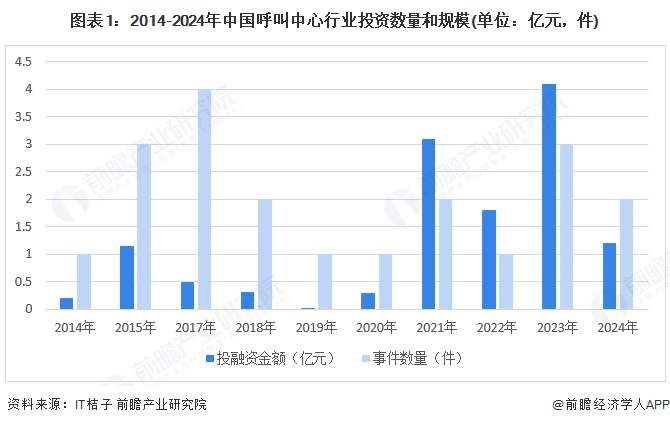
Core Insights - The call center industry has seen significant investment activity from 2014 to 2023, with a total of 20 financing events amounting to over 1.3 billion yuan, with notable peaks in 2021 and 2023 [1][14] - The focus of investments has shifted towards call center outsourcing and AI-driven solutions, indicating a trend towards automation and efficiency in customer service [4][12] Investment Trends - The years 2021 and 2023 recorded the highest investment amounts of 310 million yuan and 410 million yuan respectively, driven by significant investments in value-added services and AI technologies [1][2] - In 2024, only two investment events were recorded, indicating a potential slowdown in investment activity [1] Investment Amounts - Single investment amounts in the call center sector were generally in the millions from 2014 to 2020, with notable increases to 160 million yuan in 2021 and 140 million yuan in 2023, largely due to major investments in companies like StarNet Communication and Voice Technology [2][7] - The average single investment amount is expected to drop back to the million level in 2024, reflecting a cautious market sentiment [2] Geographic Focus - Investment is primarily concentrated in Beijing (45%) and Shanghai (22%), highlighting the urban concentration of call center operations and technology [9] - Other active provinces include Jiangsu, Hubei, Zhejiang, Guangdong, and Henan, benefiting from strong industrial foundations and supportive policies [9] Fund Activity - Several funds are actively investing in the call center industry, including the Double Hundred Fund, Shenzhen Investment Control Park Fund, and SoftBank Vision Fund, each with distinct investment strategies [12][13] - The Double Hundred Fund focuses on digital transformation projects for state-owned enterprises, while the SoftBank Vision Fund targets AI customer service solutions [12] Mergers and Acquisitions - The call center industry has seen limited M&A activity, with notable events including the acquisition of Huijie Technology by JD Technology Group in 2021, aimed at enhancing digital service capabilities [14] - A planned acquisition by Bangyan Technology of StarNet Communication was announced to be terminated in 2025 due to competitive pressures [14]
SCRM系统如何赋能企业精细化管理?四步实现精准营销与高效转化
Sou Hu Cai Jing· 2025-07-25 08:01
Core Insights - The introduction of SCRM systems has significantly improved operational efficiency for retail brands facing challenges such as customer dispersion and data silos, leading to a 40% increase in conversion rates, a 60% improvement in marketing attribution efficiency, and a 35% growth in repurchase rates [1] Group 1: Data Integration - SCRM systems integrate multi-dimensional data, including social interactions and online behaviors, to create a 360° customer profile, enhancing customer insights from vague assumptions to precise predictions [2] - The integration of enterprise data platforms allows for a fivefold increase in customer attribute tags through the use of UnionID, facilitating comprehensive customer views [2] - Real-time updates and compliance management are achieved through features like encrypted storage and blockchain technology, ensuring data security and regulatory adherence [2] Group 2: Customer Segmentation - The tagging system within SCRM software enables precise customer segmentation based on various dimensions, allowing for tailored marketing strategies [4] - Practical examples include a beauty brand that improved conversion rates by 28% through customized messaging based on customer source identification [4] - B2B companies have enhanced follow-up frequency for high-value clients by three times using opportunity dashboards to allocate sales resources effectively [4] Group 3: Process Automation - SCRM automates marketing and sales processes, reducing manual labor and enhancing productivity [6] - Automated welcome messages and targeted promotions have led to a 26% increase in new customer conversion rates [6] - The visualization of the sales process allows for real-time monitoring of sales quality, resulting in a 65% decrease in compliance complaints for an insurance company [6] Group 4: Performance Optimization - SCRM systems enable quantifiable measurement of marketing actions, allowing for continuous optimization based on key performance indicators [8] - A knowledge-based company improved its monthly performance by 130% after optimizing push notification timing based on SCRM analytics [8] - AI predictive models can identify high-risk customers seven days in advance, leading to a 22% increase in customer retention through targeted interventions [8] Group 5: Strategic Importance - SCRM systems have evolved into essential growth hubs for enterprises, with leading companies achieving a 90% online conversion rate for private car insurance and a 50% reduction in user conversion cycles [9] - The integration of AI into SCRM software is expected to further transform customer relationships in a competitive market, making the deployment of comprehensive SCRM systems a necessity for refined operations [9]

SCRM开发驱动电商私域双引擎增长
Sou Hu Cai Jing· 2025-06-14 10:10
Core Insights - SCRM development is emerging as a crucial tool for e-commerce companies to address "traffic anxiety" and enhance customer retention through personalized interactions and automated processes [2][4][19] Group 1: SCRM Functionality and Impact - SCRM systems enable e-commerce brands to convert casual customers into loyal ones by automating personalized marketing strategies, such as sending tailored discount coupons based on purchase history, resulting in a 35% increase in repurchase rates for a beauty brand [2] - The integration of SCRM with platforms like WeChat and public accounts allows for seamless data sharing and customer interaction, enhancing the customer experience and operational efficiency [4][16] - Brands utilizing SCRM have reported significant improvements in customer retention, with companies achieving a 2.6 times higher retention rate compared to those using single-channel operations [5] Group 2: Marketing Automation and Customer Engagement - SCRM systems facilitate targeted marketing campaigns by categorizing customers into segments based on behavior and preferences, leading to a 37% increase in marketing click-through rates and a 24% rise in coupon redemption rates [8] - The ability to automate customer interactions, such as sending reminders for uncompleted purchases or personalized offers, has proven effective in increasing customer engagement and sales [19][20] - Brands have successfully implemented dynamic marketing strategies, such as sending notifications for expiring coupons, which resulted in a 47% higher conversion rate compared to standard marketing efforts [17] Group 3: Operational Efficiency and Customer Service - SCRM systems streamline customer service operations by automating the assignment of service requests, significantly reducing response times from 48 hours to 6 hours for certain brands [6][20] - The integration of order data with customer service platforms allows for quick access to customer purchase history, enhancing the efficiency of handling inquiries and complaints [16][19] - Companies have reported a 50% increase in customer service efficiency due to the automation of routine tasks and the intelligent routing of customer inquiries [2][14] Group 4: Future Trends and Considerations - As e-commerce platforms like Tmall and Youzan open more APIs, the integration of SCRM systems is expected to deepen, providing brands with more opportunities to convert customer touchpoints into growth opportunities [19] - The implementation of SCRM is becoming essential for both large and small e-commerce businesses, as it allows for the identification and targeting of high-value customers through automated tagging and segmentation [20]
SCRM系统三强助力高效协作
Sou Hu Cai Jing· 2025-04-14 17:25
Core Insights - SCRM systems are becoming essential tools for companies to enhance collaboration efficiency through the integration of smart work order management, multi-end collaboration, and opportunity information linkage [2][10] - The ability to customize work order templates and process engines is crucial for adapting SCRM systems to various industry needs, such as compliance in medical devices or automatic work order distribution in educational institutions [2][4] Group 1: SCRM System Features - The main functionalities of SCRM systems include intelligent work order management, multi-end collaboration, and automatic opportunity linkage, which streamline processes and reduce response times [2][3] - Fast Whale SCRM, Enterprise WeChat Assistant, and Long Arm Ape systems differ in their capabilities, such as the number of multi-end collaboration entrances and the depth of integration with Enterprise WeChat [2][8] - Fast Whale SCRM supports private deployment, allowing companies to maintain data control and security, particularly important for industries with strict compliance requirements [4][11] Group 2: Industry Applications - SCRM systems are tailored to various industries, with medical device companies focusing on compliance processes and educational institutions prioritizing inter-campus work order distribution [2][4] - In retail, Fast Whale SCRM's private work order management is effective for handling cross-regional customer complaints, while the Enterprise WeChat Assistant excels in high-frequency communication scenarios [9][10] - Long Arm Ape's open API allows for integration with third-party platforms, making it suitable for technology companies that require extensive customization [6][10] Group 3: Efficiency and Collaboration - The integration of SCRM systems with Enterprise WeChat enhances service response times by allowing real-time updates and task assignments across departments [10][12] - Companies have reported significant improvements in response times, such as a 40% increase in response speed for a chain education institution using these systems [3][10] - The ability to automatically generate work orders from customer interactions reduces the need for repetitive communication and streamlines the workflow [5][10]