Stack Overflow

Search documents
AI“氛围编程”威胁开源,维护者面临危机
AI前线· 2026-03-08 05:49
Core Insights - Open source maintainers are increasingly closing doors to external contributors due to the overwhelming volume and low quality of AI-generated contributions, leading to a crisis in the open source community [2][3] - A recent study indicates that the reliance on AI for coding is creating a negative feedback loop, diminishing the quality and availability of software as fewer developers engage with documentation and report issues [3][4] Group 1: Impact of AI on Open Source Contributions - The phenomenon termed "AI Slopageddon" reflects the challenges faced by maintainers as they struggle to manage the influx of low-quality AI-generated code [2] - Stack Overflow activity dropped by 25% within six months of ChatGPT's launch, while Tailwind CSS saw a 40% decrease in documentation traffic and an 80% drop in revenue [3] - By 2025, it is projected that 20% of code submissions will be AI-generated, with overall effectiveness declining to 5% [3] Group 2: Responses from Maintainers - Some maintainers, like Hashimoto, have adopted zero-tolerance policies against unapproved AI contributions, emphasizing the need for high-quality submissions regardless of their origin [5] - Ruiz has taken drastic measures by closing external contributions after encountering poorly generated issues from AI tools, questioning the need for external input if coding becomes too easy [6] - The platforms that host open source projects, such as GitHub, are criticized for not providing tools to filter AI submissions, exacerbating the problem for maintainers [6] Group 3: Structural Challenges and Future Outlook - Researchers propose a model where AI platforms could redistribute subscription revenue based on package usage, but the required contribution from AI users is deemed unrealistic at 84% of current direct user revenue [7] - The Linux Foundation and Apache have focused on licensing rather than quality, failing to address the flood of low-quality contributions [7] - The impact of this crisis is expected to be uneven, with popular libraries likely to find sponsors while smaller projects may struggle, raising concerns about the future of foundational projects like Linux [8]


End of Stack Overflow
Matthew Berman· 2026-01-25 13:30
Poor one out for Stack Overflow. As a developer, I would always have a Stack Overflow tab open when I was working. That all changed when Chad GPT launched.But what makes this interesting is that Chad GPT used Stack Overflow's data to train their models. Stack Overflow essentially contributed to its own death. The founders of Stack Overflow sold Stack Overflow right before Chat GPT was announced.The founders got paid and then it basically went to zero. ...

这个手握全球代码精华的社区,自杀了
3 6 Ke· 2026-01-11 23:53
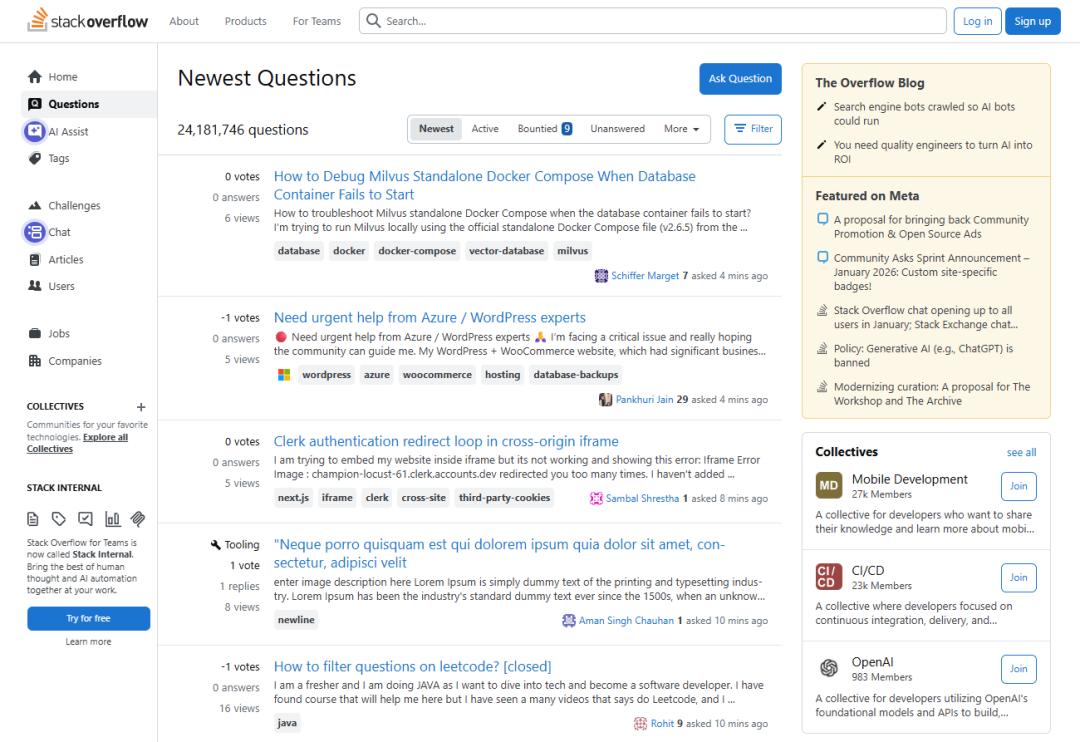
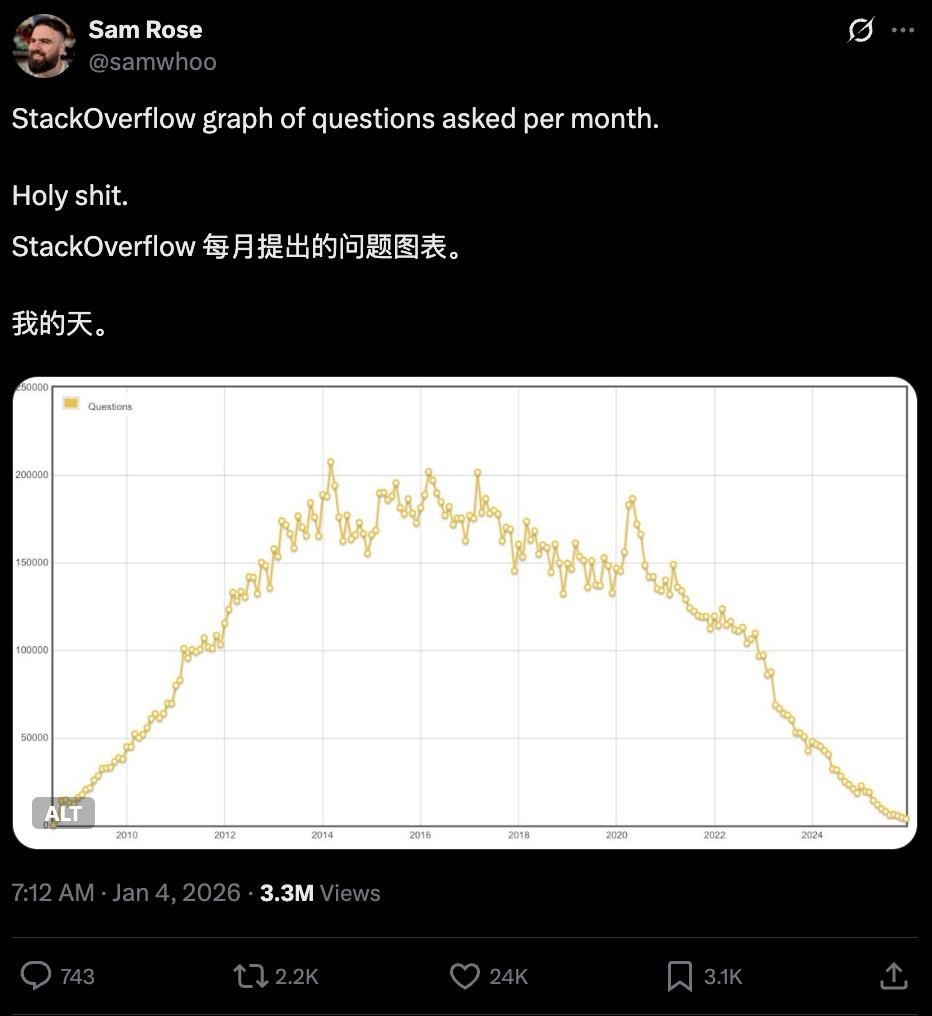
Core Insights - Stack Overflow, once a thriving community for programmers, is experiencing a significant decline in user activity, with active participation dropping from a peak of 200,000 in 2014 to just a few thousand recently, comparable to its early days in 2008 [4][5][17] - The decline is attributed not only to the rise of AI tools like ChatGPT but also to the deteriorating community environment, where experienced users prioritize shutting down questions over providing assistance, leading to a less welcoming atmosphere for newcomers [7][18][21] - Stack Overflow's initial rejection of AI-generated content followed by the launch of its own AI product, OverflowAI, reflects a shift in strategy that has not been well-received by the community, further contributing to its decline [25][28][29] Community Dynamics - The reputation system that once incentivized users to contribute by answering questions has led to a culture where experienced users derive satisfaction from closing questions rather than helping others, creating a hostile environment for new users [9][18][19] - The community's unwelcoming nature has been acknowledged by Stack Overflow itself, which admitted in a blog post that the platform was not friendly enough for newcomers, women, and minorities [21][24] - The experience of users who have faced negative interactions when asking questions highlights the community's shift from being a supportive resource to a more elitist environment [19][24] AI Impact - While AI tools have certainly influenced user behavior, the decline in Stack Overflow's activity began before the introduction of ChatGPT, indicating that other factors were at play [17][36] - The community's failure to adapt to the changing landscape, particularly in how it engages with AI, has left it vulnerable to competition from platforms that have embraced AI integration more effectively [32][36] - The concern remains that as users increasingly turn to AI for answers, the unique value of human interaction and shared experiences in knowledge communities may diminish [37][38]
悲报,Stack Overflow彻底凉了,比18年前上线首月问题数量还少
3 6 Ke· 2026-01-05 11:19
Core Insights - Stack Overflow, once a leading platform for developers, has seen a significant decline in question volume, now lower than its initial launch period 18 years ago [1][11] - The rise of AI coding tools like GitHub Copilot and ChatGPT has shifted developer behavior, reducing the need for public questions [11][12] - The platform's initial success was due to its structured Q&A format, which provided high-quality, reusable answers, but it has struggled to maintain this quality in recent years [5][7][14] Group 1: Historical Context - Stack Overflow was launched in 2008, quickly becoming a vital resource for programmers who previously relied on forums and blogs for solutions [5] - At its peak from 2013 to 2017, Stack Overflow had over 180 sub-sites covering various STEM fields, establishing itself as the largest developer knowledge infrastructure [8] Group 2: Decline Factors - The number of questions on Stack Overflow has been declining, exacerbated by the introduction of AI tools that allow developers to solve problems without public inquiries [11][12] - The platform's strict moderation policies led to a decrease in participation, as many new users faced their questions being removed for not meeting formatting or complexity standards [13] Group 3: Current Challenges - Despite integrating AI features to adapt to changing user needs, the quality of content on Stack Overflow has reportedly declined, leading to decreased trust among developers [14] - A 2025 report indicated that while AI tool usage among developers reached 84%, trust in these tools has diminished, reflecting a broader crisis for Stack Overflow [14][15] Group 4: Future Considerations - The future of Stack Overflow may hinge on whether it can refocus on niche technical areas or fully embrace AI to redefine its operational model [16]
悲报!Stack Overflow彻底凉了,比18年前上线首月问题数量还少
量子位· 2026-01-05 09:39
Core Viewpoint - Stack Overflow, once a thriving platform for developers, is experiencing a significant decline in user engagement, with the number of questions now lower than during its initial launch period 18 years ago [1][21]. Group 1: Historical Context - Stack Overflow was launched in 2008 to provide high-quality, reusable answers to programming questions, quickly becoming a vital resource for developers [7][9]. - The platform's unique voting and reputation system allowed for the creation of a structured knowledge base, making it the default destination for technical searches on Google for a long time [10][12]. Group 2: Decline in Engagement - Despite a significant increase in the global developer population and the emergence of numerous tools and languages, the act of asking questions on Stack Overflow has drastically decreased [4][21]. - The peak of Stack Overflow included over 180 sub-sites covering various STEM fields, but the platform is now facing challenges due to the rise of AI tools like GitHub Copilot and ChatGPT, which have changed developers' problem-solving habits [15][17][20]. Group 3: Impact of AI - The introduction of AI tools has led to a shift from public questioning to private inquiries, with developers now preferring to ask AI for solutions rather than posting on Stack Overflow [19][22]. - While AI tools rely on the quality content from Stack Overflow, they have diverted traffic away from the platform, leading to a decline in user engagement [23][24]. Group 4: Internal Challenges - Prior to the rise of AI, Stack Overflow was already facing issues due to its strict moderation policies, which discouraged new users from participating [26][27]. - The platform's attempt to integrate AI features resulted in a decline in content quality, further eroding user trust and engagement [28][29]. Group 5: Future Considerations - The future of Stack Overflow may hinge on whether it can refocus on niche technical areas to regain its unique value or fully embrace AI to restructure its operational model [32].

谁是2025年度最好的编程语言?
量子位· 2025-10-01 01:12
Core Viewpoint - Python continues to dominate as the most popular programming language, achieving a remarkable lead over its competitors, particularly Java, in the IEEE Spectrum 2025 programming language rankings [2][4][5]. Group 1: Python's Dominance - Python has secured its position as the top programming language for ten consecutive years, marking a significant achievement in the IEEE Spectrum rankings [6]. - This year, Python has not only topped the overall ranking but also led in growth rate and employment orientation, making it the first language to achieve this triple crown in the 12-year history of the IEEE rankings [7]. - The gap between Python and Java is substantial, indicating Python's strong growth trajectory [4][5]. Group 2: Python's Ecosystem and AI Influence - Python's rise can be attributed to its simplicity and the development of powerful libraries such as NumPy, SciPy, matplotlib, and pandas, which have made it a favorite in scientific, financial, and data analysis fields [10]. - The network effect has played a crucial role, with an increasing number of developers choosing Python and contributing to its ecosystem, creating a robust community around it [11]. - AI has further amplified Python's advantages, as it possesses richer training data compared to other languages, making it the preferred choice for AI applications [12][13]. Group 3: Other Languages' Challenges - JavaScript has experienced the most significant decline, dropping from the top three to sixth place in the rankings, indicating a shift in its relevance [15]. - SQL, traditionally a highly valued skill, has also faced challenges from Python, which has encroached on its territory, although SQL remains a critical skill for database access [18][21][23]. Group 4: Changes in Programming Culture - The community culture among programmers is declining, with a noticeable drop in activity on platforms like Stack Overflow, as many now prefer to consult AI for problem-solving [25][26]. - The way programmers work is evolving, with AI taking over many tedious tasks, allowing developers to focus less on programming details [30][31]. - The diversity of programming languages may decrease as AI supports only mainstream languages, leading to a stronger emphasis on a few dominant languages [37][39]. Group 5: Future of Programming - The programming landscape is undergoing a significant transformation, potentially leading to a future where traditional programming languages may become less relevant [41]. - While high-level languages like Python have simplified programming, the ultimate goal may shift towards direct interaction with compilers through natural language prompts [46]. - The role of programmers may evolve, focusing more on architecture design and algorithm selection rather than maintaining extensive source code [49][50].

喝点VC|a16z合伙人Chris:付费软件正在复兴,现如今对细分垂直领域初创而言是个令人激动的时刻
Z Potentials· 2025-09-19 02:43
Core Insights - The article discusses how entrepreneurs can leverage exponential forces and build network effects to create lasting value in the tech industry [3][4][5] Group 1: The Power of Networks and Network Effects - Many significant internet services are networks that become more valuable as more people use them, exemplified by email and social media platforms like Facebook and Instagram [5][6] - The tech industry benefits from powerful exponential forces, such as Moore's Law, which states that semiconductor performance doubles approximately every two years, leading to rapid advancements [6][7] - Entrepreneurs should focus on identifying these exponential forces, as they will dominate any tactical product work [6][10] Group 2: Strategies for Building Networks - Successful companies often start with a strong product that attracts users, then leverage existing networks to grow, as seen with Instagram and Substack [10][11] - The challenge lies in making networks useful from the beginning, as initial user bases can be small and unappealing [12] - The emergence of "narrow startups" that charge premium prices for specialized services indicates a shift towards more focused business models in the tech landscape [23] Group 3: The Role of Branding and Pricing - Brand power and consumer inertia are significant in the tech sector, as seen with ChatGPT's rapid rise to prominence despite lacking traditional network effects [15][21] - The increasing willingness of consumers to pay higher prices for software suggests a shift in spending priorities, with software potentially consuming a larger share of disposable income [14][21] Group 4: The Impact of AI and Open Source - The rise of AI tools has diminished the need for traditional web traffic, leading to a decline in SEO-driven traffic for many websites [20][21] - Open source software has played a crucial role in democratizing technology, allowing startups to thrive with minimal initial investment [35][36] - The future of open source AI remains uncertain, with potential for it to lag behind proprietary models, but it could provide affordable solutions for consumers [36][37]

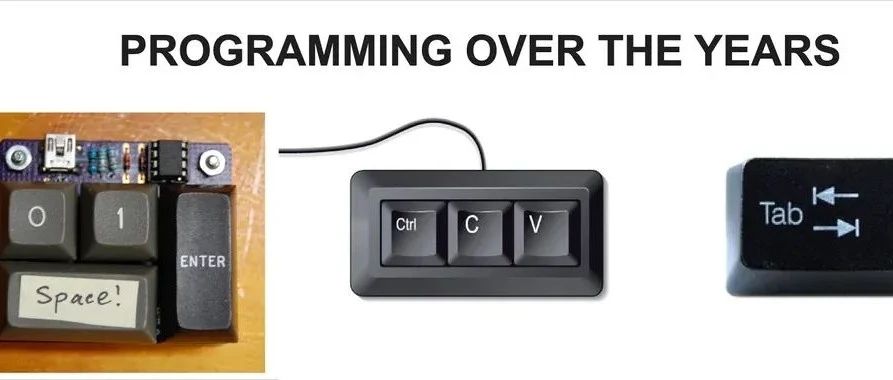
程序员这些年都发生了哪些改变~从 ENTER到 Tab,下一步是躺平?
菜鸟教程· 2025-06-25 01:42
Core Viewpoint - The evolution of programming has transitioned from manual coding to AI-assisted development, significantly changing the role of programmers and the tools they use [4][6][8]. Group 1: Stages of Programming Evolution - **First Stage: Manual Craftsmanship** Early programming involved basic languages like Basic, Pascal, and C, with no IDE support, leading to a high dependency on accuracy [4][5]. - **Second Stage: Copy and Paste Dominance** The rise of graphical IDEs and the internet allowed programmers to leverage search engines and online resources, shifting the focus from original coding to code assembly [6][7]. - **Third Stage: The Era of AI** The introduction of AI programming tools has transformed coding practices, allowing programmers to rely on AI for code generation and optimization, reducing the need for traditional coding skills [8][10]. Group 2: AI Programming Tools - **Cursor** An AI IDE optimized for VS Code, known for its strong code understanding and project-level analysis capabilities [13]. - **Windsurf** An AI tool with long-term memory, capable of understanding project context and suitable for complex tasks [14]. - **Trae** Developed by ByteDance, this AI IDE integrates deeply with AI to provide intelligent Q&A and code auto-completion features [15]. - **Lingma IDE** An Alibaba product that integrates cloud services, allowing AI to automatically call tools for end-to-end task completion [16]. - **VS Code + Copilot** This combination offers a rich plugin ecosystem, enhancing AI capabilities through the Copilot plugin [17].