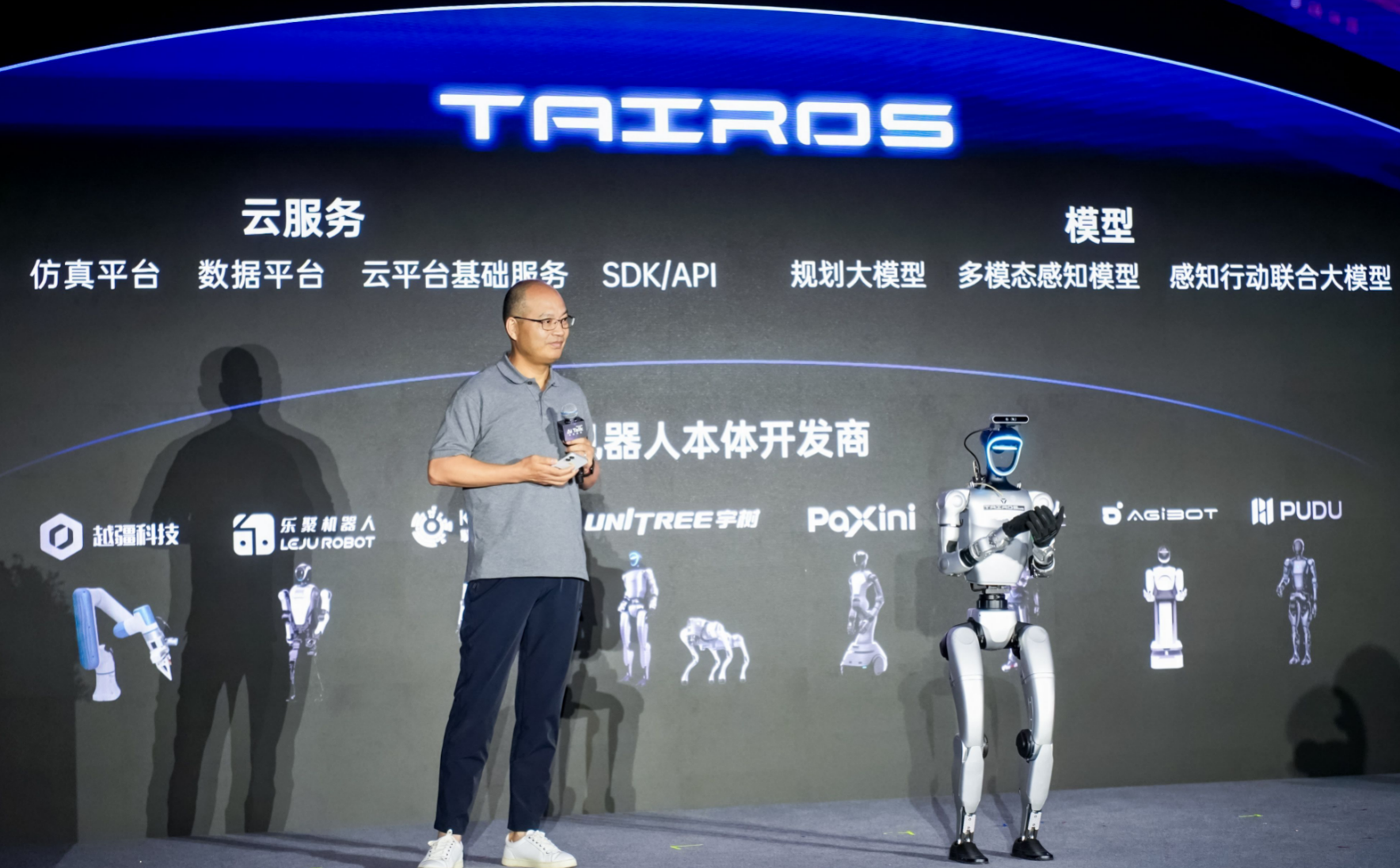
Tairos具身智能平台

Search documents
具身智能这一仗,大厂时刻在场
3 6 Ke· 2025-09-01 03:50
Core Insights - The field of embodied intelligence is experiencing a mix of excitement and anxiety, with concerns about whether it represents a long-term capability competition or merely a conceptual relay race [1] - Experts indicate that there is a structural "bubble" in the embodied intelligence sector, with some projects receiving high valuations despite immature products and limited application validation [1][3] - Major tech companies are focusing on building foundational capabilities and ecosystems in embodied intelligence, raising industry barriers and reducing speculative opportunities [1][4] Group 1: Industry Dynamics - Baidu, Tencent, and Alibaba are investing in the foundational infrastructure and core aspects of embodied intelligence, moving beyond mere model performance to focus on practical applications and closed-loop systems [4][10] - The global robotics market is projected to exceed $400 billion by 2029, with China accounting for nearly half of this market and leading with a compound annual growth rate of approximately 15% [8] - The development of embodied intelligence robots relies on the integration of multiple key technologies and complex systems to meet diverse application needs [8][10] Group 2: Company Strategies - Baidu's strategy involves enhancing its intelligent cloud services to support the development of key technologies and products in embodied intelligence [3][10] - Tencent's Robotics X lab has launched the Tairos platform, which provides modular software capabilities for the robotics industry, aiming to equip robots with essential "brains" [9][12] - Alibaba's Lingbo Technology focuses on creating industry-leading robotic products for service sectors, potentially leveraging Alibaba's large model capabilities for greater market impact [14] Group 3: Future Outlook - The competition in embodied intelligence is not just about individual robots but about defining the next generation of operating systems that integrate various technologies [10][14] - The ability to align brain, body, and real-world scenarios will determine which players succeed in the long term, emphasizing the importance of a comprehensive and stable delivery system [10][16] - The ongoing evolution in the industry suggests a shift towards a more sustainable and value-driven approach, where only those companies that invest patiently and continuously will thrive [16]



AI创业公司集体交阶段性答卷,热闹之下的底色是“活下去”
Nan Fang Du Shi Bao· 2025-07-29 15:57
Group 1: Event Overview - The World Artificial Intelligence Conference (WAIC) 2025 is expected to attract 350,000 attendees, with significant interest in AI technologies, particularly humanoid robots [1] - Over 150 humanoid robots were showcased, dominating the event and attracting large crowds [1][3] - Companies from various sectors, including robotics, AI models, and industrial applications, are eager to participate in the growing field of embodied intelligence [1][3] Group 2: Market Dynamics - Startups in embodied intelligence are facing challenges in commercialization, with a need to demonstrate tangible value to justify high valuations [3][6] - The current high valuations in the embodied intelligence sector are seen as a bubble that needs to be addressed through actual business implementations [6][12] - Companies are exploring various commercial applications, such as logistics, entertainment, and service industries, to support their business models [7][10] Group 3: Technological Developments - Different approaches to embodied intelligence are emerging, including hardware-first, model-first, and integrated hardware-software strategies [7][11] - Companies like Yushutech are focusing on showcasing their hardware capabilities through live demonstrations, while others are developing advanced algorithms to enhance robot functionality [8][10] - The integration of AI models with hardware is crucial, as many companies are finding it necessary to develop their own hardware to ensure compatibility and performance [10][11] Group 4: AI Chip Market - Domestic AI chip companies are leveraging the demand for model inference to catch up with industry leaders like NVIDIA, focusing on cost-effective solutions [20][21] - The shift in demand from training to inference presents opportunities for domestic chip manufacturers to innovate and capture market share [20][22] - Collaborations between AI model developers and chip manufacturers are being formed to enhance compatibility and efficiency in the AI ecosystem [22][25]


腾讯想做机器人的“大脑”供应商,现阶段不追求商业化
Nan Fang Du Shi Bao· 2025-07-28 15:51
Core Insights - Tencent has launched the Tairos embodied intelligence platform, which enhances the capabilities of humanoid robots like the G1 by providing them with advanced cognitive abilities and environmental awareness [2][3][4] - The platform consists of two main components: model algorithms and cloud services, enabling robots to perceive their surroundings and execute tasks effectively [2][3] - Tencent aims to collaborate with various robot hardware companies, offering modular services that allow customization based on specific needs [4][5] Group 1: Tairos Platform Features - The Tairos platform includes multi-modal perception models, planning models, and a perception-action joint model, allowing robots to understand their environment and execute tasks [2][3] - The G1 robot demonstrated its capabilities by autonomously navigating and identifying objects on stage, showcasing the effectiveness of the Tairos platform [3] - Tencent's Robotics X lab has been developing various robotic prototypes since its establishment in 2018, focusing on research rather than commercialization [5][6] Group 2: Strategic Partnerships and Market Position - Tencent is selectively partnering with a few seed companies for deep collaboration on the Tairos platform, avoiding a broad rollout initially [4] - The company emphasizes its role as a partner to robot manufacturers rather than competing with them in hardware production [6] - Tencent's approach is to transform research outcomes into stable products for the market, while not pursuing direct commercialization [5][6]

WAIC机器人告别“拘谨”,腾讯张正友称“iPhone时刻”未至
Di Yi Cai Jing· 2025-07-28 11:09
Core Insights - The 2025 World Artificial Intelligence Conference (WAIC) showcased advancements in humanoid robots, which are evolving from data collection and research tools to more interactive and capable machines [2][6] - The Robotics X lab, led by Zhang Zhengyou, has developed the Tairos embodied intelligence platform, which allows robots to operate without remote control and interact based on algorithms [2][7] - The industry is at a critical juncture, with expectations for large-scale deployment of humanoid robots in industrial settings within the next couple of years, particularly in roles like material handling [9][10] Industry Developments - Humanoid robots demonstrated new capabilities at WAIC, including boxing, drumming, and performing tasks in various environments, indicating a shift towards more practical applications [2][3] - The Robotics X lab has not yet commercialized its research but remains influential in the field, focusing on collaboration with hardware manufacturers to enhance embodied intelligence technology [6][7] - The industry is seeing a rise in companies developing humanoid robots, with a notable emphasis on addressing labor shortages in industrial applications [9][10] Technological Challenges - Current humanoid robots primarily utilize visual language action (VLA) models, which are still in the early stages and lack comprehensive 3D world understanding [10][11] - There is a need for advancements in tactile and force perception to improve the robots' operational capabilities in real-world environments [11] - The supply chain for humanoid robots is not yet standardized, leading to variations in product parameters and design requirements across different applications [11]
腾讯的机器人战略越来越清晰了
Hua Er Jie Jian Wen· 2025-07-28 08:14
Core Insights - The 2025 World Artificial Intelligence Conference (WAIC) showcased over 150 robots, highlighting the rapid evolution of robotics from static displays to dynamic performances in real-world scenarios [2] - Tencent launched the Tairos "Titanium Screw" embodied intelligence open platform, aiming to become a partner for all robot manufacturers rather than competing in hardware [2][4] - Tairos is the first modular platform in China that offers large models, development tools, and data services for the robotics industry, allowing manufacturers to select necessary modules based on their needs [2][3] Summary by Sections Platform Features - Tairos consists of two main components: model algorithms and cloud services, including multimodal perception models, planning large models, and perception-action joint large models [3][4] - The multimodal perception model enables robots to understand their environment through sensory inputs, creating a 3D hierarchical map and facilitating interaction and task planning [3] - The planning large model allows robots to comprehend their roles and tasks, breaking them down into executable strategies, enhancing reasoning, cognition, and reflection capabilities [3] Technological Advancements - The perception-action joint large model connects environmental understanding to actionable commands, improving robots' decision-making abilities in complex scenarios through advanced technologies [4] - The Tairos platform aims to equip robots with essential software capabilities, transforming them from passive executors to proactive intelligent entities [4][6] Strategic Positioning - Tencent's strategic positioning in the robotics field was reiterated by its CEO, who emphasized the goal of being a partner to robot manufacturers rather than replacing them [4][6] - The launch of Tairos reflects Tencent's long-term commitment to advancing robotics and AI technologies, with a focus on collaboration with hardware and application developers [6][7] Industry Context - The robotics industry has seen significant changes since the establishment of Tencent Robotics X in 2018, with a growing number of startups and increased commercialization efforts [5][6] - Despite advancements, the industry is still in its early stages, facing challenges in meeting high standards and requirements for diverse applications [6][9] - The commercial viability of humanoid robots is still developing, with expectations that the "big brother era" will emerge first in elder care or industrial sectors [8][9]