
英伟达CPU

Search documents
算力博弈升级 英伟达抛出“万亿预期”
Bei Jing Shang Bao· 2026-03-18 14:35
Core Insights - Nvidia remains at the center of the global AI competition, with its annual GTC conference highlighting its significant role in the industry amidst increasing competition and market scrutiny regarding its $5 trillion valuation [1] Group 1: Nvidia's Innovations and Predictions - Nvidia's CEO Jensen Huang introduced OpenClaw, an open-source project that he claims is set to revolutionize AI, likening its impact to that of Linux [4] - The Vera Rubin platform, a massive supercomputer consisting of seven chips and five racks, was unveiled, marking a pivotal moment for Agentic AI and signaling a major infrastructure build-out [5] - Nvidia forecasts that its chip revenue will reach $1 trillion by 2027, doubling its previous estimate of $500 billion for 2026, emphasizing the need for improved cost-effectiveness in its offerings [5] Group 2: Market Reactions and Stock Performance - Following Huang's optimistic predictions, Nvidia's stock initially rose by 4% but closed with a modest gain of 1.2%, reflecting ongoing market concerns about its growth prospects and the potential "AI bubble" [6] Group 3: Strategic Shifts and Collaborations - Nvidia is transitioning from a chip manufacturer to an AI infrastructure company, with plans to collaborate with Uber on deploying AI-driven autonomous taxi fleets in major cities by 2028 [7] - The company is focusing on selling standards and ecosystems rather than just raw computing power, leveraging generative models and 3D graphics engines to enhance its product offerings [8] Group 4: Competitive Landscape and Challenges - Despite holding a 90% market share, Nvidia faces increasing competition as companies like Meta develop their own chips, and new entrants focus on creating cost-effective alternatives for AI inference [9] - The AI hardware landscape is evolving, with a growing emphasis on inference capabilities, prompting cloud giants and startups to invest heavily in developing competitive AI chips [9][10] Group 5: China Market Dynamics - Nvidia's importance in the Chinese market remains significant, with potential annual demand for AI processors estimated in the hundreds of billions [10] - Recent policy changes have allowed Nvidia to restart production of the H200 processor for the Chinese market, with Huang noting an increase in demand and the resumption of supply chain operations [11]



AI发展驶入“回归商业本质”阶段 国产芯片迎“推理机遇”
Shang Hai Zheng Quan Bao· 2026-02-26 17:59
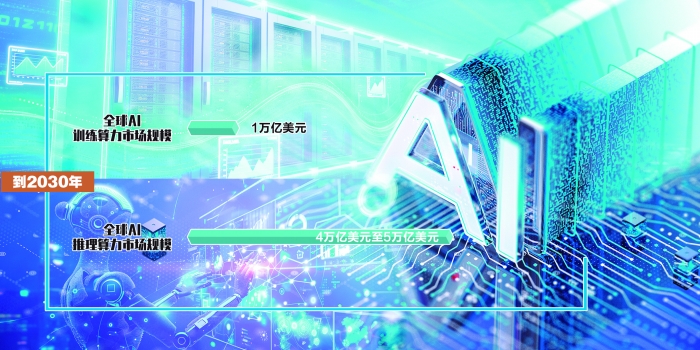
Core Insights - OpenAI has significantly reduced its AI infrastructure spending target from $1.4 trillion to $600 billion by 2030, focusing on pure computing power expenditures, which has sparked widespread discussion in the industry [3] - The reduction in budget is viewed positively by the industry, indicating a shift towards a more pragmatic approach in AI development, emphasizing revenue and profit [3][4] - North American cloud providers continue to invest heavily in data center construction, with Meta and NVIDIA entering a multi-billion dollar chip procurement agreement [5] Investment Opportunities - The AI industry is transitioning from a "computing arms race" to a "commercial validation phase," with companies that can efficiently utilize computing power and demonstrate profitability likely to benefit first [6] - There is a growing focus on AI applications in various sectors, including healthcare, marketing, enterprise services, programming, and entertainment, suggesting potential investment opportunities in these niches [6] - The demand for AI inference is becoming a new focal point, with predictions that the global AI inference market could reach $4 trillion to $5 trillion by 2030, significantly outpacing the AI training market [7] Technological Advancements - The introduction of specialized AI chips, such as the Taalas HC1, which utilizes ASIC technology, is gaining attention for its efficiency and cost-effectiveness in AI inference tasks [7][8] - Domestic AI chip manufacturers are establishing competitive advantages through ASIC and full-stack optimization technologies, with significant order growth reported by companies like Chipone [8] - The landscape for AI chips is evolving, with several companies, including Cambrian and Moore Threads, making strides in the domestic market and preparing for public listings [8]
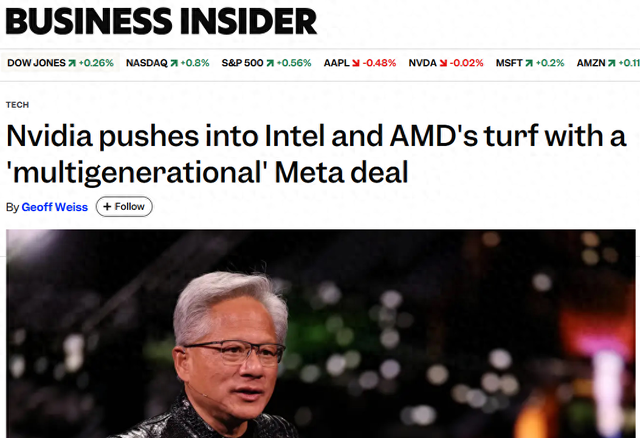
英伟达与Meta达成长期合作,进军英特尔AMD核心腹地
Xin Lang Cai Jing· 2026-02-19 02:30
Group 1 - Nvidia announced a "multi-generational" partnership with Meta to deploy millions of Nvidia's current and next-generation chips for AI training and inference data centers [1][4] - This collaboration marks Nvidia's entry into the CPU market, traditionally dominated by Intel and AMD, as Meta will utilize both Nvidia's GPUs and CPUs [1][4] - The partnership highlights Meta's increasing reliance on Nvidia, despite its own chip development and collaborations with competitors like AMD and Google [4] Group 2 - The collaboration includes Nvidia's networking equipment and confidential computing technology for WhatsApp's AI features, as well as the deployment of the next-generation Vera CPU to replace the current Grace CPU [4] - By choosing a single supplier for a full-stack chip solution, Meta aims to reduce operational complexity, while Nvidia's move indicates its ambitions in the CPU space [4] - The current demand for AI infrastructure is strong, suggesting that competitors like Intel and AMD may not experience significant declines in the short term despite increased competition [4]

SEMICON TAIWAN现场调研反馈
2025-09-15 01:49
Summary of Key Points from the Conference Call Industry Overview - The conference focused on the AI computing industry, highlighting the significant role of system vendors like NVIDIA and Google in shaping market trends, while TSMC and ASML are pivotal in providing technological platforms [1][2] - Silicon photonics technology emerged as a key topic, aimed at reducing energy consumption unrelated to computation, with large-scale commercialization expected by 2027 [1][2] Company Insights TSMC - TSMC is advancing steadily in its technology, with 2nm process expected to achieve mass production by 2025 and ongoing development of 3nm technology, enhancing its pricing power and customer profitability [1][3] - Under the Foundry 2.0 concept, TSMC's advanced packaging revenue is accelerating, with six operational factories and plans for four new ones, including expansions of CoWoS, SoIC, and CoPoS platforms [1][15] - TSMC's average selling price (ASP) has nearly doubled from $3,000 in 2019 to over $7,000 currently, driven by its technological advantages [13] - Future revenue growth for TSMC is heavily reliant on high-performance computing (HPC) clients, with a 70%-80% growth rate among these customers [16] - TSMC's capital expenditures have increased, with a peak in 2021 at 50% of revenue, but the pressure is expected to ease moving forward [21] Oracle - Oracle's capital expenditures have significantly increased, potentially linked to securing a large order from OpenAI, which could drive additional computing demand [3][19] - If Oracle executes on its projected orders, it could benefit not only itself but also related companies like SoftBank and Industrial Fulian [19] Industrial Fulian - Industrial Fulian is positioned to benefit from the AI-related capital expenditure cycle, particularly in its cloud service equipment segment, which is expected to see rapid growth in 2025 and 2026 [23][24] Market Dynamics - The energy consumption associated with AI development is rising sharply, with cabinet energy consumption projected to increase from 60 kW in 2022 to 120 kW in 2025, and potentially reaching 500 kW by 2027 [10] - New AI chip architectures are emerging, such as 3D stacking and RISC-V based designs, which could significantly impact the market landscape [11] Competitive Landscape - Google and NVIDIA have different approaches in the semiconductor solutions space, with Google utilizing over 9,000 TPUs, while NVIDIA focuses on GPUs [7] - TSMC and ASML are leading the global semiconductor technology landscape, with TSMC introducing GAA technology and ASML advancing EUV lithography [8] Investment Outlook - TSMC is expected to see annual profit growth of 25%-30% in the coming years, with an attractive valuation compared to its peers [4][22] - The semiconductor industry is anticipated to continue evolving, with significant opportunities for companies like TSMC and Industrial Fulian in the AI computing supply chain [25]

美国对等关税政策第一时间联合专家解读
2025-04-03 06:35
Summary of Key Points from the Conference Call Industry or Company Involved - The discussion primarily revolves around the **U.S. tariff policy** and its implications on **global trade**, particularly focusing on the **U.S.-China trade relationship** and the impact on various industries. Core Points and Arguments - The U.S. government has announced a **10% baseline tariff** effective from **April 5, 2025**, projected to generate **$1.9 trillion** in revenue from **2025 to 2034** [2][4] - The tariff policy is based on a **reciprocal principle**, with varying rates for different countries, notably a **34% additional tariff** on Chinese goods, despite claims of a **67% tariff** by the Trump administration [2][3] - The new tariffs are expected to significantly impact **domestic supply chains** and **export trade**, particularly affecting **labor-intensive industries** and companies reliant on **supply chains in Southeast Asia** [2][5] - **Chinese electrical products** face a **66% weighted average tariff**, undermining their cost advantage, while the **textile and apparel sector** may pass costs onto U.S. consumers due to low profit margins [2][7][8] - The Trump administration plans to impose a **25% tariff on automobile imports** and has eliminated the **de minimis exemption** for small packages, introducing a **30% import value-added tax** [9][10] - The high tariffs are likely to increase **global supply chain costs**, affecting U.S. buyers and consumers, and may lead to a reconsideration of production bases, potentially encouraging **reshoring** [12][20] - China may respond with **targeted countermeasures** rather than broad retaliation, focusing on specific sectors to mitigate negative impacts [15][17] - The agricultural sector's tariffs are expected to contribute to rising **U.S. inflation**, with projections of a **1% increase in CPI**, potentially leading to **stagflation** risks [16][20] - The Trump administration's policies are politically motivated, with tariffs potentially serving as leverage in **midterm elections** [22][23] - Future negotiations may allow for **product exemptions** or tariff delays, particularly in sectors like **pharmaceuticals and semiconductors** [13][14] Other Important but Possibly Overlooked Content - The **dynamic adjustment** of tariffs based on China's export levels to the U.S. indicates a flexible approach to trade policy [23] - The potential for **non-tariff barriers** as a response to U.S. pressures, with China possibly increasing scrutiny on U.S. imports [19] - The **long-term implications** of the U.S. tariff strategy on global trade relations and the potential for a **shift in supply chains** away from traditional partners [12][24] - The **most-favored-nation status** for China could be at risk, with strategic goods facing **100% tariffs** and non-strategic goods potentially facing high tariffs as well [25]