Vera Rubin系列芯片

Search documents
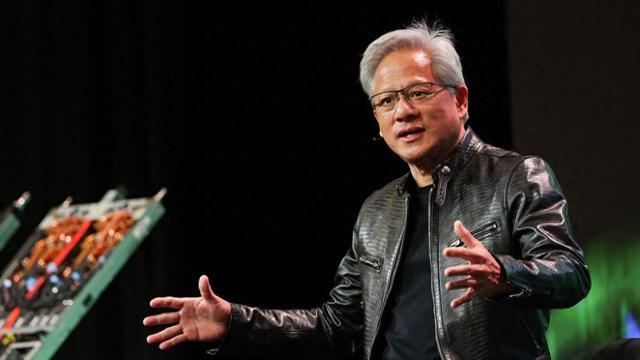
黄仁勋:将在GTC 2026发布“世界前所未见”芯片
Xin Lang Cai Jing· 2026-02-19 05:36
Group 1 - Nvidia's CEO Jensen Huang announced a new chip that will be unveiled at the upcoming GTC 2026 conference, generating significant industry interest [2] - The GTC 2026 conference will take place on March 15 in San Jose, California, focusing on a new era of AI infrastructure competition [2] - The new chips are expected to come from two main series: the Rubin series and the next-generation Feynman series, with the latter being described as a "revolutionary" product [2] Group 2 - Nvidia is adapting to quarterly changes in AI computing demands, with products targeting pre-training and inference scenarios to address latency and memory bandwidth bottlenecks [3] - The company emphasizes that broad collaboration and investment are key to maintaining its leadership in the AI industry, covering sectors such as energy, semiconductors, and data centers [3]


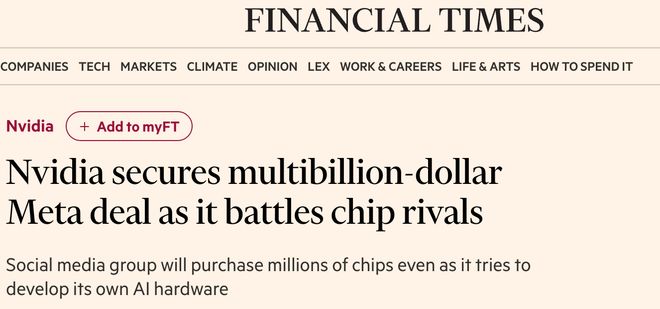
Meta与英伟达签署数十亿美元多年期协议,承诺采购数百万枚下一代AI芯片及独立CPU
Huan Qiu Wang Zi Xun· 2026-02-18 04:03
Group 1 - Nvidia and Meta have announced a multi-year, multi-billion dollar chip procurement agreement, where Meta will purchase millions of Nvidia's latest AI acceleration chips, including the upcoming "Vera Rubin" series [1][3] - Meta's CEO Mark Zuckerberg stated that the company plans to invest up to $135 billion in AI infrastructure by 2026, nearly double its spending in 2025 [3] - Despite challenges in its own AI chip development, Meta continues to rely on Nvidia's established solutions due to technical challenges and deployment delays in its self-developed AI chip projects [3] Group 2 - The transaction highlights a shift in AI computing focus from "model training" to the "inference" phase, with Nvidia's CEO Jensen Huang adjusting the product strategy to sell CPUs as standalone products rather than integrated with GPUs [3] - The growing demand for efficient, low-latency inference capabilities is driving this change in hardware architecture, as noted by industry analysts [3]

马斯克对英伟达挑战特斯拉的企图不以为然
Xin Lang Cai Jing· 2026-01-06 16:16
Core Viewpoint - Nvidia is attempting to challenge Tesla and a few other companies in the autonomous vehicle sector, while Tesla's CEO Elon Musk expresses no concern about this competition [1][4]. Group 1: Nvidia's Developments - Nvidia launched a series of open-source autonomous driving models named Alpamayo, which are designed to make "human-like" decisions and handle rare or tricky scenarios through reasoning rather than traditional rule-based methods [5][6]. - The new model series is expected to enhance Nvidia's influence in the growing autonomous vehicle industry, which the company views as a significant opportunity [6]. - Nvidia's CEO Jensen Huang stated that the company has been developing autonomous vehicle technology for eight years and has thousands of employees dedicated to this sector [6]. Group 2: Industry Reactions and Competitors - Companies like Uber, Jaguar Land Rover, and Lucid Group are interested in using Alpamayo to develop fully autonomous vehicles, and they have previously collaborated with Nvidia on autonomous technology [6]. - Mercedes-Benz announced plans to launch a CLA model equipped with advanced driver assistance features similar to those offered by Tesla later this year [6]. - Lucid and Uber also unveiled a near-production vehicle designed for autonomous taxi services this week [6]. Group 3: Market Impact - Following Nvidia's announcements, its stock rose by 1.6%, while Tesla's stock faced selling pressure, dropping approximately 3% [7]. - Nvidia introduced its next-generation AI, the Vera Rubin series of chips, which is expected to significantly improve performance and cost-effectiveness compared to the current Blackwell platform [7]. - Tesla plans to reduce its reliance on Nvidia chips in its data centers, while xAI is collaborating with Nvidia to build a large data center in Saudi Arabia, expected to utilize the Rubin platform [7][3].

【电子】英伟达GTC2025发布新一代GPU,推动全球AI基础设施建设——光大证券科技行业跟踪报告之五(刘凯/王之含)
光大证券研究· 2025-03-22 14:46
Core Viewpoint - NVIDIA's GTC 2025 conference highlighted advancements in AI technologies, particularly focusing on Agentic AI and its implications for global data center investments, which are projected to reach $1 trillion by 2028 [3]. Group 1: AI Development and Investment - Huang Renxun introduced a three-stage evolution of AI: Generative AI, Agentic AI, and Physical AI, positioning Agentic AI as a pivotal phase in AI technology development [3]. - The scaling law indicates that larger datasets and computational resources are essential for training more intelligent models, leading to significant investments in data centers [3]. Group 2: Product Launches and Innovations - The Blackwell Ultra chip, designed for AI inference, is set to be delivered in the second half of 2025, with a performance increase of 1.5 times compared to its predecessor [4]. - NVIDIA's Quantum-x CPO switch, featuring 115.2T capacity, is expected to launch in the second half of 2025, showcasing advanced optical switching technology [5]. - The introduction of the AI inference service software Dynamo aims to enhance the performance of Blackwell chips, alongside new services for enterprises to build AI agents [6].