
Hopper系列芯片

Search documents
黄仁勋:将在GTC 2026发布“世界前所未见”芯片
Xin Lang Cai Jing· 2026-02-19 05:36
Group 1 - Nvidia's CEO Jensen Huang announced a new chip that will be unveiled at the upcoming GTC 2026 conference, generating significant industry interest [2] - The GTC 2026 conference will take place on March 15 in San Jose, California, focusing on a new era of AI infrastructure competition [2] - The new chips are expected to come from two main series: the Rubin series and the next-generation Feynman series, with the latter being described as a "revolutionary" product [2] Group 2 - Nvidia is adapting to quarterly changes in AI computing demands, with products targeting pre-training and inference scenarios to address latency and memory bandwidth bottlenecks [3] - The company emphasizes that broad collaboration and investment are key to maintaining its leadership in the AI industry, covering sectors such as energy, semiconductors, and data centers [3]


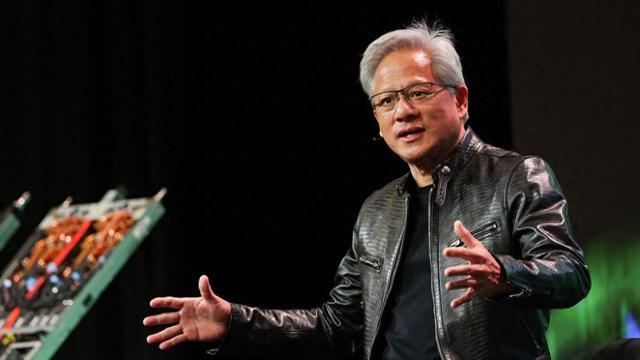
H200春节前重返中国,黄仁勋有多少胜算?
Tai Mei Ti A P P· 2025-12-23 02:35
Core Viewpoint - Nvidia aims to export H200 chips to China before February 17, 2024, with an expected initial shipment of 40,000 to 80,000 units, primarily from inventory capacity [2][3] Group 1: Export Plans and Market Dynamics - Nvidia plans to increase production of H200 chips to supply the Chinese market in Q2 2024 [2] - The export of H200 chips to China is subject to significant uncertainty, as there is currently no approval from Chinese authorities for any related procurement [3] - Following the announcement by Trump allowing Nvidia to export H200 chips to China, the company must pay 25% of sales proceeds to the U.S. government [3][4] Group 2: Regulatory Environment and Challenges - The U.S. government has initiated a review process for the export of H200 chips, which may take up to 30 days, with Trump holding the final decision-making power [4] - There is opposition within the U.S. Congress regarding the export, with calls for more transparency on whether the chips could be used for military purposes [6] - Concerns about "backdoor" security risks have been raised, with previous incidents involving Nvidia's H20 chip [6][9] Group 3: Market Demand and Competition - Major Chinese tech companies like Alibaba, ByteDance, and Tencent are expected to be the first buyers of H200 chips, indicating strong demand in the AI infrastructure sector [7] - Despite the potential for Nvidia's return to the Chinese market, domestic chip manufacturers are rapidly improving their capabilities, posing a competitive threat [9] - AMD and Intel are also targeting the Chinese market, with AMD having already secured export licenses for its AI chips [10][11] Group 4: Financial Implications - The estimated sales revenue from the initial shipment of H200 chips could range from $1 billion to $4 billion, considering the market price and the required tax [8] - Nvidia's previous quarterly revenue from the Chinese market was significantly lower, indicating challenges in regaining market share [8]
英伟达回应H200芯片可向中国出售,称“值得肯定”
3 6 Ke· 2025-12-09 04:11
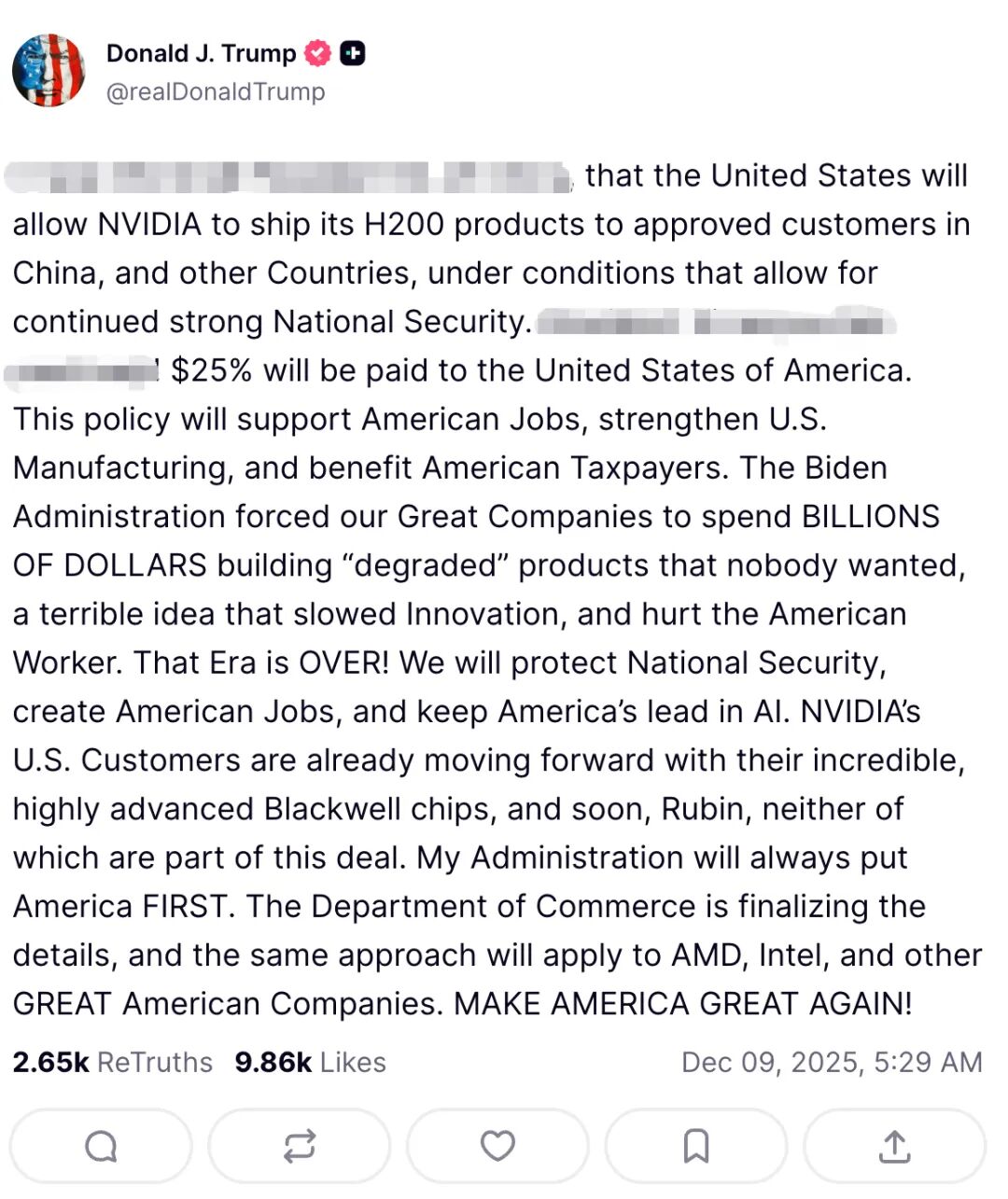
Core Viewpoint - The U.S. government will allow NVIDIA to deliver H200 products to qualified customers in China and other countries, ensuring national security is protected. This policy aims to support U.S. jobs and manufacturing while benefiting taxpayers [1]. Group 1: NVIDIA's H200 Chip - The H200 chip, released in November 2023, offers over 13 times the theoretical AI computing power compared to the previously approved H20 chip, with a bandwidth increase of over 45% [2]. - The H200 chip is expected to significantly enhance performance in intensive computing tasks, such as large model training [2]. Group 2: Market Dynamics and Sales - In 2024, the estimated shipment volume of NVIDIA's H20 series chips in the Chinese market is projected to be around 600,000 to 800,000 units, indicating a market share exceeding 60% [4]. - NVIDIA's revenue from mainland China reached $17.1 billion, a 66% year-over-year increase, accounting for 13.1% of its total revenue, despite a declining share due to U.S. export controls [4]. Group 3: Impact of U.S. Export Controls - U.S. export controls have led to NVIDIA's complete exit from the Chinese market, reducing its market share from 95% to 0% [3]. - The ongoing restrictions have resulted in a significant decline in NVIDIA's revenue share from China over the past three years [4]. Group 4: Competitive Landscape - Chinese companies are developing their own AI chips, such as Huawei's Ascend, Baidu's Kunlun, and Alibaba's Pingtouge, as a strategic move to reduce reliance on foreign technology [5]. - The U.S. government is concerned that strict export controls may inadvertently accelerate the growth of China's domestic AI chip industry [5].
6100亿美元AI骗局,假的?
Ge Long Hui· 2025-11-22 09:03
Core Viewpoint - The article discusses the contrasting perspectives on the AI sector, particularly focusing on Nvidia's recent Q3 earnings report, which shows strong financial performance despite concerns about potential bubbles in the AI market [1][2][4][30]. Financial Performance - Nvidia reported a record total revenue of $57.006 billion for Q3, a year-on-year increase of 62%, significantly surpassing market expectations of $54.92 billion [4]. - The net profit reached $31.91 billion, up 65% year-on-year, translating to a daily profit of $350 million [4]. - For Q4, Nvidia expects revenue to reach $65 billion, exceeding analyst expectations of $61.66 billion [5]. Business Segments - The data center business, contributing 89.5% of total revenue, generated $43 billion, primarily driven by the performance of the Blackwell series chips [20]. - The gaming and AI PC segment achieved $4.3 billion in revenue, with a 30% year-on-year growth, supported by strong sales of the RTX 50 series graphics cards [23]. - The professional visualization segment saw a revenue increase of 62% year-on-year, driven by demand in design tools and medical imaging [25]. - The automotive and robotics segment, while only 1% of total revenue, showed significant growth potential, with a 55% increase in shipments of the DRIVE AGX Orin chips [27]. Market Dynamics - Nvidia's CEO, Jensen Huang, emphasized the exponential growth in demand for GPUs, stating that every GPU is being utilized, indicating a healthy cycle for AI [7]. - Despite concerns raised by a controversial article alleging financial discrepancies within Nvidia's reporting, the company’s actual data appears robust upon closer examination [10][14][18]. - The article highlights the interconnected nature of funding within the AI sector, suggesting potential risks if the funding cycle were to break [12]. Future Outlook - Nvidia has committed to a revenue target of $500 billion, with clear visibility into data center revenue for the next two years [32]. - Key growth drivers include the anticipated shift from training to inference demand, the emergence of embodied AI, and the ongoing expansion of sovereign and enterprise AI projects [32]. - The success of the upcoming Rubin platform is seen as critical for sustaining growth, with expectations for advanced technology and increased production capacity [34]. Conclusion - Nvidia's Q3 results indicate a strong foundation for continued growth in the AI sector, despite the presence of speculative bubbles [30][31]. - The ongoing transformation of data centers into "AI factories" is expected to drive demand for several years, marking a significant shift in the industry [35].
市值首次站上4万亿美元后,英伟达将来华参加链博会
Di Yi Cai Jing· 2025-07-11 09:36
Group 1: Company Overview - Nvidia's supply chain is global, with production bases and markets in Taiwan, Mexico, Vietnam, and other regions, and CEO Jensen Huang has visited China multiple times this year to maintain close ties with the Chinese market [1][3] - Nvidia's market capitalization surpassed $4 trillion for the first time on July 10, 2023, despite facing an estimated loss of $8 billion due to U.S. chip export restrictions to China [1][3] - Nvidia's sales in China reached $17 billion last year, highlighting the significant impact of U.S. government export controls on its business [3] Group 2: Product Development and Market Challenges - The next-generation Blackwell Ultra chip, which can generate over 50 times more AI content than its predecessor, is set to enter mass production globally, raising questions about its availability in China [3][7] - Huang acknowledged the challenges posed by the DeepSeek model in China, which may affect the sustainability of demand for AI chips, but emphasized that Nvidia is launching faster and more powerful chips to address these concerns [7] - Nvidia is expanding its cloud ecosystem by partnering with smaller cloud service providers, including some in China, to enhance its competitive position in the cloud business [8] Group 3: Supply Chain and Geopolitical Challenges - Nvidia faces increasing supply chain management challenges due to complex global geopolitical dynamics, despite its significant market valuation [4] - TSMC, a key supplier for Nvidia, is under threat of high tariffs from former President Trump if it does not establish manufacturing in the U.S. [5][6] - Huang stressed the importance of flexibility for companies in adapting to changing policies, as the semiconductor industry relies on global collaboration [6]
机构:AI投资减速已触底 英伟达市值首破4万亿
news flash· 2025-07-09 19:26
Group 1 - Nvidia's market value has surpassed $4 trillion, making it the first company to reach this milestone [1] - Dan Morgan, a senior portfolio manager at Synovus Trust, indicates that Nvidia's stock performance suggests that the slowdown in AI investment has bottomed out [1] - The four major cloud computing giants—Amazon, Microsoft, Meta, and Alphabet—are expected to collectively invest over $330 billion in AI infrastructure by 2025, a significant increase of 38% from the estimated $240 billion in 2024 [1] Group 2 - The primary concern affecting Nvidia's stock is the uncertainty regarding the sales growth during the transition from the Hopper series chips to the new Blackwell chips in the second half of this year [1]
隔夜美股全复盘(5.20) | 诺瓦瓦克斯大涨15%,FDA批准其新冠病毒疫苗上市
Ge Long Hui· 2025-05-19 23:27
Market Overview - US stock indices closed higher with the Dow Jones up 0.32%, Nasdaq up 0.02%, and S&P 500 up 0.09% [1] - The VIX index increased by 5.22% to 18.14, indicating rising market volatility [1] - The US dollar index fell by 0.6% to 100.37, while the yield on the 10-year Treasury rose by 0.18% to 4.451% [1] - Spot gold increased by 0.91% to $3230.07 per ounce, and Brent crude oil rose by 0.21% to $65.53 [1] Industry & Stocks - Most sectors in the S&P 500 saw gains, with healthcare up 0.96%, utilities up 0.43%, and industrials up 0.34%, while energy, semiconductors, and technology sectors declined by 1.3%, 0.6%, and 0.14% respectively [2] - Chinese concept stocks mostly fell, with Alibaba down 0.4% and Pinduoduo up 0.71% [2] - Major tech stocks had mixed results, with Microsoft up 1.01% and Apple down 1.17% [2] - NVAX surged 15.01% after FDA approval for its COVID-19 vaccine for older adults and those over 12 [2] Daily Focus - Putin expressed readiness to cooperate with Ukraine on peace negotiations, indicating potential for a ceasefire [3] - Trump's tax reform bill advanced in the House, facing opposition from conservative Republicans [4] - Nvidia's CEO announced the company will not release further Hopper series chips for the Chinese market due to US government restrictions [5] - Nvidia introduced the "Grace Blackwell" system aimed at enhancing AI capabilities, with significant performance improvements [6] - Apple reportedly earns $20 billion annually from the App Store, with developers facing a 15% to 30% commission [7] - Apple plans to allow EU users to set default voice assistants other than Siri, adapting to new regulations [8] - The valuation of the "Tech Seven" has dropped to a seven-year low, with a forward P/E ratio of 28 times [9] - Microsoft is integrating Elon Musk's xAI models into its cloud services, expanding its AI offerings [9] - TSMC plans to raise prices for advanced manufacturing nodes, with a 10% increase for 2nm wafers [9] - The US government is reviewing Apple's AI collaboration with Alibaba due to concerns over data sharing and regulatory risks [10][11]

AI日报丨黄仁勋最新表态!英伟达正重新审视其中国市场战略,未来不会再对华推出Hopper系列芯片
美股研究社· 2025-05-19 10:51
Core Insights - The article discusses the rapid development of artificial intelligence (AI) technology and its potential opportunities in the market, emphasizing the importance of analyzing AI-related stocks and market trends for deeper industry insights [1]. Group 1: Company Updates - Nvidia (NVDA.US) shares fell over 3% to $131.06 after CEO Jensen Huang announced a reevaluation of its China market strategy due to U.S. government restrictions on the export of the H20 chip, indicating that no further Hopper series products will be launched for the Chinese market [3]. - Google CEO Sundar Pichai stated that AI will not eliminate search engines but will drive their advancement, highlighting the potential for AI to enhance search capabilities [3]. - Nvidia launched the Lepton cloud platform at COMPUTEX 2025, connecting global developers with thousands of GPUs for building AI applications [3]. Group 2: Market Analysis - CITIC Securities reported that Tencent and Alibaba's investments in AI are beginning to yield results, with AI capabilities contributing significantly to Tencent's advertising and gaming businesses, while Alibaba's AI-related product revenues are experiencing high growth across various sectors [6][7]. Group 3: Major Transactions - Nvidia's stock saw a nearly 15% increase last week, with a year-to-date rise of 0.4%, driven by the announcement of supplying over 18,000 top-tier AI chips to Saudi Arabia, which has helped restore its market value above $3 trillion [9][10]. Group 4: Regulatory Developments - The European Commission is seeking feedback on Microsoft's proposed commitments to address antitrust issues related to its Office-Teams acquisition, which includes offering a suite version without Teams and improving interoperability for competitors [11][12].

英伟达Hopper告别中国市场,国产替代加速,半导体设备ETF(159516)、芯片ETF(512760)午后拉升
Mei Ri Jing Ji Xin Wen· 2025-05-19 06:11
Core Viewpoint - The recent restrictions imposed by the U.S. government on NVIDIA's H20 chip exports to China are prompting the company to reassess its market strategy in China, leading to the discontinuation of the Hopper series chips, which were the only high-performance AI chips previously allowed for export to China [1] Group 1: Market Impact - Over the past five days, the chip ETF (512760) has seen a net inflow exceeding 200 million yuan [1] - The termination of the Hopper series is expected to create a supply gap in the Chinese AI chip market, which local manufacturers are likely to fill [1] Group 2: Local Manufacturers - Huawei's Ascend 910 series is projected to ship over 700,000 units by 2025, with a peak performance of 800 TFLOP/s in FP16, comparable to NVIDIA's H100, marking a significant moment for China's AI development [1] - TrendForce forecasts that the proportion of NVIDIA/AMD chips used in Chinese AI servers will decrease from 63% in 2024 to 42% by 2025, while local chip supply is expected to rise to 40% due to policy support [1] Group 3: Long-term Outlook - According to CITIC Securities, the U.S. government's stringent regulatory measures are likely to accelerate the domestic substitution in China's AI industry in the medium to long term [1] - Key areas for investment focus include wafer foundry, computing chip design, domestic equipment and components, and advanced packaging [1]
英伟达称正重新审视中国市场战略;梁文锋等发表署名论文;OpenAI发布AI编程智能体
Guan Cha Zhe Wang· 2025-05-19 00:59
Group 1 - Nvidia's CEO Jensen Huang announced that the company will not release any more Hopper series chips due to U.S. government restrictions on the export of the Hopper H20 chip to China, indicating a reassessment of the strategy in the Chinese market [1] - OpenAI launched Codex, a cloud-based AI programming agent capable of handling multiple development tasks simultaneously, which assists developers in coding, understanding code structure, and fixing bugs [1] - Ant Group's CTO He Zhengyu stated that the lack of data is the source of "hallucinations" in large models, emphasizing that the boundaries of data determine the capabilities of these models, and that the cost of data acquisition is increasing as cheap internet data is running out [4] Group 2 - The DeepSeek V3/R1 model architecture was analyzed in a recent paper, highlighting innovations such as multi-head latent attention for memory efficiency, expert mixture architecture for optimizing computation and communication, and FP8 mixed precision training to maximize hardware potential [2] - The establishment of China's first clinical and translational ward for brain-computer interface technology at Beijing Tiantan Hospital aims to provide innovative treatments for patients with neurological diseases [6] - China has built the world's largest and most advanced information and communication network, with 5G applications integrated into 86 of 97 national economic categories, promoting deep integration of the real economy and digital economy [8]



