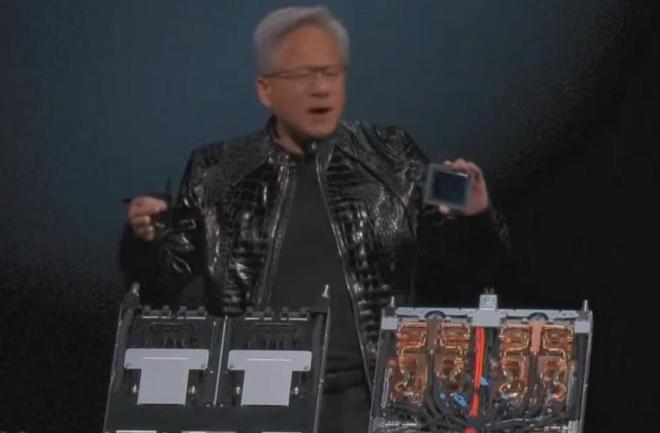
Vera Rubin芯片架构

Search documents
黄仁勋塑造“Token经济学” 英伟达拥抱智能体时代
2 1 Shi Ji Jing Ji Bao Dao· 2026-03-17 22:29
Core Insights - NVIDIA's GTC event showcased the launch of the Vera Rubin architecture, marking a significant leap in AI technology with seven new chips and the establishment of the largest AI factory globally [1][2] - The introduction of Vera Rubin is expected to double the revenue forecast for AI chips, reaching $1 trillion by the end of 2027, compared to the previous estimate of $500 billion [2] - The event emphasized a shift from individual chip competition to a comprehensive system-level competition among tech giants, highlighting the importance of integrated solutions [2] Chip Innovations - The Vera Rubin platform includes a diverse range of chips: NVIDIA Vera CPU, NVIDIA Rubin GPU, NVIDIA NVLink 6, NVIDIA ConnectX-9 SuperNIC, NVIDIA BlueField-4 DPU, and NVIDIA Spectrum-6, which together form a robust data center infrastructure [1] - The architecture utilizes TSMC's 3nm process and features a tightly coupled design that enhances performance, achieving 50 PFlops for inference and 35 PFlops for training [3][4] AI Infrastructure - The Vera CPU rack, built on NVIDIA MGX, integrates 256 Vera CPUs, providing scalable and energy-efficient capacity, with performance improvements over traditional CPUs [4] - The introduction of the Groq LPU architecture aims to enhance real-time interaction capabilities, with the LPX rack containing 256 LPU processors and a bandwidth of 640 TB/s [5][6] AI Agent Development - NVIDIA launched the NemoClaw software stack for AI agents, which allows for continuous operation and complex task execution, positioning it as a foundational tool for the next generation of AI applications [8][10] - The company is also forming the Nemotron Coalition to advance open model development, supporting various applications across industries [10][11] Real-World Applications - New models for robotics and autonomous driving, such as NVIDIA Isaac GR00T and NVIDIA Alpamayo, are designed to enhance decision-making capabilities in real-world environments [11]

王炸!英伟达连发7款芯片,黄仁勋演讲刷屏
2 1 Shi Ji Jing Ji Bao Dao· 2026-03-17 01:53
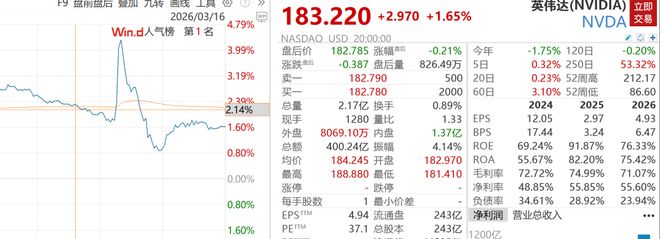
Core Insights - NVIDIA's CEO Jensen Huang announced significant technological breakthroughs and a bold prediction of generating at least $1 trillion in revenue from the new AI chip architecture during the annual GTC conference [1][6][8] - Following Huang's speech, NVIDIA's stock price surged, reaching a peak increase of 4.31% during trading [2] Group 1: Technological Advancements - The newly introduced Vera Rubin architecture includes seven new chips that are now in production, marking a generational leap in AI capabilities [6][11] - The Vera Rubin platform integrates various chip types, including CPUs, GPUs, and storage chips, to create a powerful AI supercomputer capable of supporting large-scale training and real-time intelligent inference [6][12] - Huang emphasized that the introduction of Vera Rubin signifies the onset of a new era in AI infrastructure, with a projected revenue increase from $500 billion to $1 trillion by the end of 2027 [6][8] Group 2: Market Impact - Nearly 60 stocks in the A-share market are linked to NVIDIA, with a combined market capitalization exceeding 2.7 trillion yuan, indicating a strong market interest in AI-related investments [3][4] - The performance of NVIDIA-related stocks has been mixed this year, with around 60% of these stocks recording gains, highlighting the growing influence of NVIDIA's advancements on the broader market [4] Group 3: AI Infrastructure and Ecosystem - NVIDIA is transitioning into an AI infrastructure company, aiming to become a foundational platform for the AI ecosystem, akin to water and electricity in the AI era [8][15] - The company introduced the DSX platform to optimize energy usage in AI infrastructure, addressing energy supply challenges and enhancing grid stability [14][15] - NVIDIA's new AI factory reference design aims to guide the construction and operation of AI infrastructure, promoting efficiency and scalability [15][27] Group 4: AI Agent and Open Model Development - NVIDIA launched the NemoClaw software stack to support AI agents, enabling them to autonomously plan tasks and execute complex workflows [23][24] - The establishment of the Nemotron Coalition aims to advance open model development, with collaborations from leading AI labs to enhance the AI model ecosystem [25][26] - New models targeting robotics and autonomous driving were introduced, showcasing NVIDIA's commitment to integrating AI into real-world applications [26][27]

王炸!英伟达连发7款芯片,黄仁勋演讲刷屏
21世纪经济报道· 2026-03-17 01:44
Core Viewpoint - NVIDIA's GTC conference showcased significant advancements in AI technology, with CEO Jensen Huang predicting that the new AI chip architecture could generate at least $1 trillion in revenue, doubling previous forecasts [1][4][6]. Group 1: AI Chip Innovations - The newly announced Vera Rubin architecture includes seven new chips, marking a generational leap in AI capabilities, with products such as NVIDIA Vera CPU and Rubin GPU now in production [4][5]. - The Vera Rubin platform integrates various chips to create a powerful AI supercomputer, capable of supporting large-scale pre-training and real-time intelligent inference [5][10]. - Huang emphasized that the introduction of Vera Rubin signifies the beginning of a new era in AI infrastructure, with a projected revenue of $1 trillion from AI chips by the end of 2027, up from a previous estimate of $500 billion [4][6]. Group 2: System-Level Evolution - The focus has shifted from individual chip performance to the systematic construction of AI infrastructure, indicating a new era of system-level evolution in AI [6][14]. - NVIDIA's new DSX platform aims to optimize energy usage in AI infrastructure, addressing the energy bottleneck in AI development [13][14]. - The introduction of the Vera Rubin DSX AI factory reference design provides a blueprint for building efficient AI infrastructure, enhancing productivity and energy efficiency [14]. Group 3: AI Agent and Open Models - NVIDIA is advancing AI agents capable of autonomous task planning and execution, with the launch of the NemoClaw software stack aimed at enhancing AI agent capabilities [22][23]. - The establishment of the Nemotron Coalition aims to foster collaboration among leading AI labs to develop open frontier models, enhancing the AI ecosystem [25]. - New models introduced, such as NVIDIA Isaac GR00T and Alpamayo, are designed for robotics and autonomous driving, expanding AI applications into the physical world [26].

黄仁勋:中企那么强,我们不拿出“真家伙”不行
Guan Cha Zhe Wang· 2026-01-07 00:31
Core Insights - Nvidia's CEO Jensen Huang emphasized the importance of the Chinese market during his appearance at CES 2026, highlighting the launch of the new Rubin platform with a performance increase of 5 times and full production set for the second half of the year [1][4] - Huang expressed optimism about demand for the H200 AI chip from Chinese buyers, despite facing increasing competition from local companies like Huawei [1][2] - The U.S. government has approved the export of the H200 chip to China, but with a 25% fee, and the latest chips are not included in this agreement [1][4] Group 1 - The new Rubin platform's training performance is 3.5 times that of the previous Blackwell generation, with AI software performance also improved by 5 times [4] - Huang stated that to maintain competitiveness in China, Nvidia must timely release more advanced products, including Blackwell and Rubin chips [1][2] - Huang acknowledged the strong demand for the H200 chip in the Chinese market and mentioned that the supply chain is already in motion [4] Group 2 - Huang noted that many Chinese startups are emerging and performing well, reflecting the vitality of the Chinese tech industry [2] - There is uncertainty regarding whether Chinese buyers will purchase the H200 chip, as some are reportedly reluctant to buy a "special version" designed for the Chinese market [5] - The Chinese government has expressed a desire for semiconductor independence, which may affect the demand for Nvidia's chips [5]