Metamate

Search documents
Meta is making 'AI core to how we work' with the help of tools from Google and OpenAI
Business Insider· 2025-12-16 12:31
Core Insights - Meta is transitioning to an "AI-first" workplace by expanding employee access to AI tools from competitors like Google and OpenAI [1][5] - The company aims to integrate AI into its core operations, utilizing both its own models and those from other firms [2][6] AI Tool Access - All employees now have access to advanced AI tools including Google's Gemini 3 Pro and OpenAI's ChatGPT-5, along with a list of various AI tools and their use cases [3][4] - The tools available include Agentic Auto, Advanced Auto, iLlama, and others, designed for different tasks ranging from coding assistance to complex problem-solving [4] Internal AI Development - Meta has invested tens of billions into developing its own AI models, including an internal assistant called Metamate based on Llama models [6] - The company has also integrated Midjourney's AI-image generator into its products, available to employees for design and prototyping [7] Productivity Enhancements - Meta migrated its internal productivity suite to Google Workspace to leverage AI-driven capabilities [8] - The engineering team is expanding access to coding systems and exploring new integrations with tools like OpenAI's Codex CLI [9] Employee Engagement - To promote AI adoption, Meta has gamified the use of AI through an internal game called "Level Up," rewarding employees for utilizing AI [10] - Performance reviews will include metrics related to AI-driven impact starting in 2026, incentivizing employees to demonstrate results achieved through AI [10]




腾讯研究院AI速递 20251118
腾讯研究院· 2025-11-17 16:18
Group 1: Meta's AI Integration - Meta will officially incorporate "AI-driven impact" into employee performance metrics starting in 2026, assessing how employees utilize AI to enhance work outcomes and team productivity [1] - The company has launched the "Level Up" game project and AI performance assistant tools this year to encourage employees to use the internal AI chatbot Metamate as much as possible [1] - Meta has begun allowing some job candidates to use AI assistants during coding interviews, believing this better represents a real development environment [1] Group 2: Google NotebookLM Features - Google NotebookLM introduced image data source functionality on November 15, enabling automatic OCR and semantic parsing, allowing users to retrieve content from images using natural language [2] - The underlying multimodal model can distinguish between handwritten and printed areas, extract table structures, and automatically link with existing text, audio, and video notes [2] - Within 48 hours of the feature launch, educational accounts uploaded over 500,000 pages of images, a 340% increase, with plans to integrate AR glasses for real-time "see and ask" capabilities next year [2] Group 3: Alibaba's Qianwen App Launch - Alibaba's Qianwen app public beta has launched, built on the Qwen3 model, providing an all-in-one entry point for users to experience a full suite of AI capabilities for free [3] - The application will gradually cover various life scenarios including office work, maps, health, and shopping, aiming to make AI a daily companion [3] - Qianwen will continue to evolve and integrate the latest Qwen models, currently available for search and download in major app stores in China [3] Group 4: Zhiyu GLM Coding Plan - Zhiyu has launched the "GLM Coding Plan·Special Edition" subscription package, offering a 50% discount for first-time buyers, with a minimum monthly cost of only 16 yuan [4] - Powered by the flagship model GLM-4.6, it ranked first globally in the LMArena evaluation alongside Claude Sonnet 4.5 and GPT-5, supporting 200K long context [4] - The model is officially compatible with over 10 mainstream AI programming tools, with several US tech companies like Cerebras and Vercel adopting GLM-4.6 [4] Group 5: Xiaomi's Miloco Solution - Xiaomi has launched its first "large model + smart home" solution, Miloco, using the Mijia camera as a visual information source, with the self-developed large language model MiMo-VL-Miloco-7B at its core, and the framework is open-sourced [5] - Users can communicate with the smart home system through natural language, allowing the system to automatically fulfill various smart needs and rules while ensuring privacy through visual data understanding [5] - Xiaomi's AIoT platform has connected nearly 1 billion IoT devices, and Miloco achieves interoperability between the Mijia ecosystem and Home Assistant ecosystem through standardized MCP protocols, supporting third-party IoT platform integration [5] Group 6: MiroMind's MiroThinker v1.0 - MiroMind has officially launched the open-source intelligent agent base model MiroThinker v1.0, introducing a new dimension of "deep interaction scaling," supporting 256K context and 600 tool calls [6] - In the BrowseComp test, it achieved an accuracy rate of 47.1%, nearing OpenAI DeepResearch's 51.5%, while surpassing DeepSeek-v3.2 by 7.7 percentage points in Chinese tasks [6] - The model adopts a fully open-source architecture, providing all model weights, toolchains, and interaction frameworks, with the 72B version approaching or even surpassing OpenAI DeepResearch, promoting intelligent agents from passive execution to active learning evolution [6] Group 7: MedGPT's Clinical Success - The core model of Future Doctor AI Studio, MedGPT, has outperformed GPT-5 and other leading international models in a multi-model practical evaluation conducted by 32 top domestic clinical experts, achieving the global first in clinical safety and effectiveness assessment [7] - It has launched two products: a clinical decision AI assistant and a patient follow-up AI assistant, providing safe and effective decision support during diagnosis and supporting patient follow-up for chronic disease management [7] - MedGPT has been adopted by dozens of national discipline leaders for daily use and is recognized by experts as the "best practice" for AI empowering grassroots healthcare, aligning with the National Health Commission's guidelines for promoting and regulating AI in healthcare [7] Group 8: Li Feifei on AGI - Li Feifei stated in an interview that AGI is "more of a marketing term than a scientific term," emphasizing that the current AI's biggest shortcoming is the lack of spatial intelligence, which allows humans to navigate and manipulate in a three-dimensional world [8] - She outlined three core capabilities of world models: generative, multimodal, and interactive, arguing that relying solely on data and computing power will not lead to the maturity of robots, which are physical systems needing bodies and application scenarios [8] - The first large-scale world model product, Marble, released by World Labs, has been widely applied in film production, game development, scientific research, and robot training, reducing creation time by 40 times [8]

小扎再出奇招:Meta员工绩效,AI来评判
量子位· 2025-11-17 13:23
Core Viewpoint - Meta is integrating AI into employee performance evaluations, marking a significant shift in how employee productivity and contributions are assessed [3][8][12]. Group 1: AI Integration in Performance Metrics - Starting in 2026, Meta will link employee performance metrics to their use of AI tools, assessing how effectively employees utilize AI to enhance productivity [8][9]. - Employees will be encouraged to report their achievements through AI in self-evaluations, with a focus on how AI has improved their output and work quality [12][16]. - A new internal AI performance tool, Metamate, will assist employees in drafting performance evaluations and feedback, although its reliability has been questioned by some users [16][18]. Group 2: Broader Industry Trends - Other major tech companies, including Microsoft and Google, are also adopting similar strategies to incorporate AI into employee performance assessments, making AI usage a requirement rather than an option [23][24]. - The trend of linking AI performance to employee evaluations is becoming increasingly prevalent in Silicon Valley, with mixed reactions from employees regarding the added pressure this may create [25][26].

硅谷 10 万大裁员真相:AI 根本没想取代你,是老板想干掉你
程序员的那些事· 2025-11-11 01:27
Core Viewpoint - The article discusses the significant impact of AI on the U.S. economy, highlighting a paradox where substantial investments in AI lead to massive layoffs in the tech sector, suggesting a future where either widespread unemployment or economic collapse may occur [3][8][9]. Group 1: Economic Impact of AI - Investment in information processing and software accounts for 4% of U.S. GDP but contributed 92% of GDP growth in the first half of the year [6]. - The U.S. economy is heavily betting on AI, with the potential for transformative changes that could lead to either mass automation of jobs or economic stagnation [9][10]. - The tech industry is experiencing a wave of layoffs, with October 2025 seeing 33,281 layoffs, a significant increase from 5,639 in September [37][38]. Group 2: Industry Reactions and Strategies - Keith Riegert, CEO of Ulysses Publishing, expressed concerns about AI's dual potential to either create a dystopian future of mass unemployment or lead to economic collapse, preferring the latter [13][31]. - Riegert emphasized the need for the publishing industry to embrace AI or risk being left behind, showcasing a strategic partnership with OpenAI that mandates employees to use ChatGPT for at least one hour daily [20][17]. - Meta is integrating AI into employee performance management, using an internal tool called Metamate to assist in generating performance reviews [48][50]. Group 3: Layoffs and Financial Pressures - The tech sector's layoffs are attributed to a combination of factors, including over-hiring during the pandemic, economic downturns, and the rising costs associated with AI infrastructure [55][66]. - Companies like Amazon and Meta are facing financial pressures due to high AI-related expenditures, leading to significant layoffs as a cost-cutting measure [67][75]. - The article notes that AI investments are not generating sufficient revenue to justify the scale of layoffs, with projections indicating that global AI infrastructure spending could approach $1 trillion by 2025, while revenues from generative AI may not exceed $30 billion [75][76]. Group 4: Future Employment Landscape - The article raises concerns about the long-term employment prospects for recent graduates, noting that a significant portion of the long-term unemployed are college graduates [85]. - While AI has not yet fully displaced young workers, the narrative suggests that future job opportunities may diminish as the economy recovers [86][87].
扎克伯格急了,Meta内部文件曝光:宁用竞品,也要废掉祖传系统
3 6 Ke· 2025-10-21 02:26
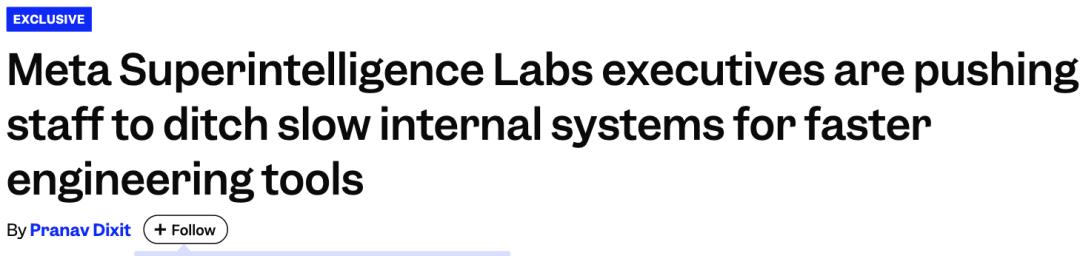
Core Insights - Meta's CEO Mark Zuckerberg views time as the only enemy in the AI race, investing hundreds of billions and offering nine-figure salaries to attract top talent, while accelerating internal engineering processes from hours to minutes to close the gap with competitors like OpenAI and Google [1][3][6] Group 1: Investment and Talent Acquisition - Meta has made significant investments in AI, including restructuring its AI team and offering salaries as high as $250 million to attract top talent [5][3] - The company has established the Meta Superintelligence Lab (MSL) to centralize all AI operations and expedite development [3][1] Group 2: Internal Revolution and Infrastructure Changes - MSL is pushing for a deep internal revolution to adopt faster engineering tools and accelerate AI development [1][9] - Meta is transitioning from its slow legacy systems to more agile platforms like Vercel and GitHub to enhance productivity and reduce deployment times from 99 minutes to under 2 minutes [12][14] Group 3: AI Usage and Employee Engagement - Meta has implemented various measures to enforce AI usage among employees, including tracking AI usage rates and setting specific targets for different departments [2][17] - The company has gamified AI adoption through a project called "Level Up," rewarding employees for completing tasks that involve AI tools [21][23] Group 4: Leadership and Strategic Direction - Nat Friedman, former CEO of GitHub, is leading the product and application research team at Meta, emphasizing the urgency to adopt faster development practices [7][9] - Zuckerberg has expressed a willingness to incur losses in the short term to avoid missing out on the potential of AI, highlighting the critical nature of rapid action in this technological race [6][1]